Written by: Doug Camplejohn, CEO & Co-Founder, Coffee
Key Takeaways for Mid-Market RevOps Teams
- Autonomous AI CRM agents capture, enrich, and write customer data across email, calendar, and call channels without manual input, which removes the data-entry burden that limits legacy CRMs.
- Mid-market teams often feel forced to either replace Salesforce or HubSpot or layer agents on top; Coffee uniquely supports both a standalone system-of-record model and a companion-agent model on existing CRMs.
- Effective evaluation criteria focus on data quality and automation depth, implementation effort, user adoption, pipeline intelligence, total cost of ownership, and scalability across MCP gateways and data-warehouse-backed agents.
- Coffee cuts manual CRM admin time from hours per day to minutes, raises pipeline data accuracy from about 58% to 91%, and folds CRM, enrichment, recording, and forecasting tools into one seat-based price.
- See how Coffee’s dual-model pricing consolidates your RevOps stack into a single predictable cost.
Executive Summary: Choosing Between Replacement and Agent Layer
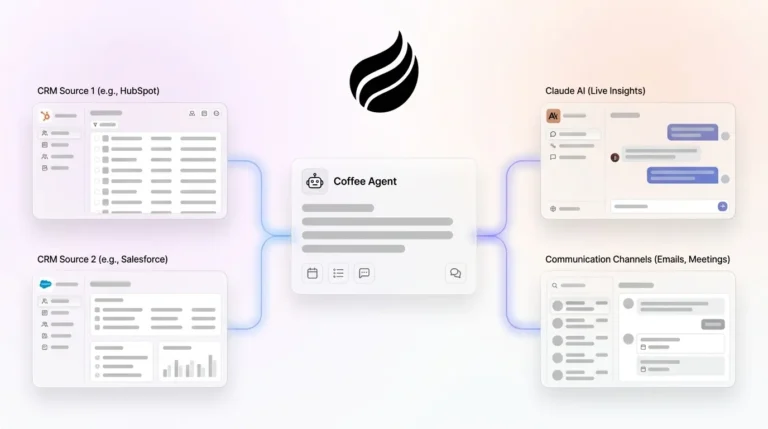
Mid-market RevOps and sales leaders face a choice in 2026: replace Salesforce or HubSpot with an AI-native system of record, or layer autonomous agents on top of the existing stack. The replace path offers a clean slate but introduces migration risk and potential downtime. The layer path preserves current data and workflows but can add another fragmented tool if the agent does not write back reliably. Replacing a mature Salesforce deployment containing three or more years of account history can typically be completed in 8-20 weeks, while fragmented point-tool layers lose context across handoffs and collapse ROI without reliable two-way CRM write-back. Coffee resolves this dilemma by operating as either the standalone system of record or a companion agent layer on existing Salesforce and HubSpot instances, a dual model no competitor currently offers.
This flexibility lets teams start with a low-risk companion deployment, capture autonomous data immediately, and later shift to standalone mode if their needs change.
Explore Coffee’s dual-model approach to avoid a forced rip-and-replace decision.
Evaluation Criteria for Autonomous AI CRM Automation
RevOps leaders can separate truly autonomous systems from augmented legacy platforms by using six criteria that also anchor the comparison table below. These dimensions shape data quality, rollout speed, adoption, and long-term cost, so they form the basis for the side-by-side architecture comparison that follows.
- Data quality and automation depth: The platform should capture structured and unstructured data, such as emails and transcripts, autonomously instead of relying on human input.
- Implementation effort and timeline: A 20–100 person team should reach production quickly without dedicated engineering resources.
- User adoption: The interface should serve the rep so that the rep does not spend time serving the interface.
- Pipeline intelligence: Forecasts should rely on agent-captured ground-truth data rather than manually entered fields.
- Total cost of ownership (TCO): The solution should consolidate the stack instead of adding another point tool.
- Scalability and integration: The architecture should extend to MCP gateways, data-warehouse-backed agents, and new channels without a full rebuild.
The next section applies these six criteria across four CRM architecture categories.
Side-by-Side Comparison: Legacy CRMs, All-in-One AI CRMs, Headless Agent Stacks, and Coffee’s Dual Model
The table below uses the six criteria to compare legacy CRMs, all-in-one AI CRMs, headless agent stacks, and Coffee’s dual model. The comparison shows how Coffee removes the forced choice between rip-and-replace risk and fragmented agent layers.
| Criterion | Legacy CRMs (Salesforce, HubSpot) | All-in-One AI CRMs (e.g., HubSpot Breeze, Agentforce) | Headless Agent Stacks (custom MCP / orchestration layers) | Coffee (Dual Model) |
|---|---|---|---|---|
| Data quality & automation depth | Average seller spends only 35% of time selling. B2B CRM contact data decays at 22.5–30% annually due to job changes, company updates, and email invalidation rather than manual entry, with no documented 37% fabrication rate. Structured data only. | 40% fewer repetitive tasks and 25% faster lead response within 90 days when all four Breeze agents are deployed. AI features remain largely stateless and human-triggered. | Automates a substantial portion of manual CRM tasks, improving data accuracy. Requires clean API surface, context layer, and orchestration build. | Agent captures structured and unstructured data such as emails, transcripts, and calendar events autonomously after connection to Google Workspace or Microsoft 365. Saves reps 8–12 hours per week. Operates on a built-in data warehouse for persistent history. |
| Implementation effort | Weeks to months for initial setup, with high ongoing admin burden. 51% of sales leaders with AI say tech silos delay or limit AI initiatives. | Typical 90-day phased roadmap for all-in-one AI CRMs. | Several weeks for a well-bounded build of headless agent stacks. Complex multi-system pipelines extend timelines significantly and require engineering resources. | Simple authentication connects the Coffee Agent to existing Salesforce or HubSpot. Standalone CRM onboards quickly without migration for teams under 20 seats. No engineering resources required. |
| User adoption | Reps spend 25–28% of their workweek on data handling, so shadow CRMs such as spreadsheets and Notion often become the real workspace. | Adoption improves when agents handle bounded tasks. Augmentation-mode tools often see higher adoption than replacement-mode tools. | Adoption depends on rep-facing surface quality. Headless stacks require custom front-end investment to avoid low adoption. | Reps work from a “Today” page briefing and review AI-drafted follow-ups instead of entering data. The agent handles chores, and reps focus on relationships. |
| Pipeline intelligence | Forecast accuracy is limited by manual entry quality. VP-level quarterly forecast miss rates are common before AI automation. | AI forecasting tools improve forecast accuracy on average. | High-quality pipeline intelligence is achievable with a data-warehouse-backed agent layer and clean write-back. Pipeline velocity improves with AI agent integration. | Pipeline Compare feature visualizes week-over-week deal changes from agent-captured data warehouse history. Replaces manual CSV exports and expensive add-ons. |
| TCO | High: CRM license plus ZoomInfo, Gong, SalesLoft, Fathom, and forecasting add-ons. Admin cost per rep remains significant before AI automation. | Moderate: consolidated within one vendor, but add-on modules increase cost. Creatio’s no-code CRM capabilities reduce TCO by 37 percent according to Nucleus Research. | Variable: build cost is the primary expense. Inference costs are modest relative to the integration build and ongoing maintenance. | Simple seat-based pricing. Agent labor for enrichment, recording, forecasting, and visitor identification is included. Consolidates CRM, enrichment, recording, and pipeline tools into one seat cost. |
| Scalability | Scalability is constrained by the vendor roadmap, and 25 years of legacy architecture limit unstructured data handling. | All-in-one CRMs scale with the vendor roadmap, while Headless 360 and Agentforce extend the API surface for agentic workloads. | Headless CRMs scale with the organization’s tech stack via decoupled, API-first architecture and support Bring Your Own LLM. | Data-warehouse-backed architecture supports structured and unstructured data. API access enables custom agent prompts, and an MCP-compatible roadmap supports future agents. Scales from a single-seat standalone deployment to mid-market companion rollouts. |
Setup and Onboarding Timelines Across Architectures
Timeline often becomes the deciding factor for mid-market teams. A minimum viable CRM agent covering three to five core workflows can be deployed in two to four weeks when the CRM data layer is reasonably clean. More complex builds that include custom enrichment pipelines or multi-system integrations extend that window considerably.
For teams that replace their CRM entirely, data migration quality is the leading cause of CRM project failure at every company size. Series A–B companies with minimal legacy data face lower migration risk, but mid-market teams with three or more years of Salesforce history can typically complete the project in 8-20 weeks. As noted earlier, this 8–20 week range assumes reasonably clean data and clear project ownership. The Coffee Companion App bypasses migration entirely, because a single authentication connects the agent to the existing Salesforce or HubSpot instance and the agent begins capturing data immediately.
Automatic Data Capture and Enrichment Performance
32% of sales reps spend more than one hour daily on manual CRM data entry, which equates to over 250 hours per year per rep. Autonomous capture removes this manual work. A 12-rep SaaS sales team reduced daily CRM admin time from 2.5 hours to 24 minutes per rep after deploying an AI automation layer on HubSpot, improving pipeline data accuracy from 58% to 91%.
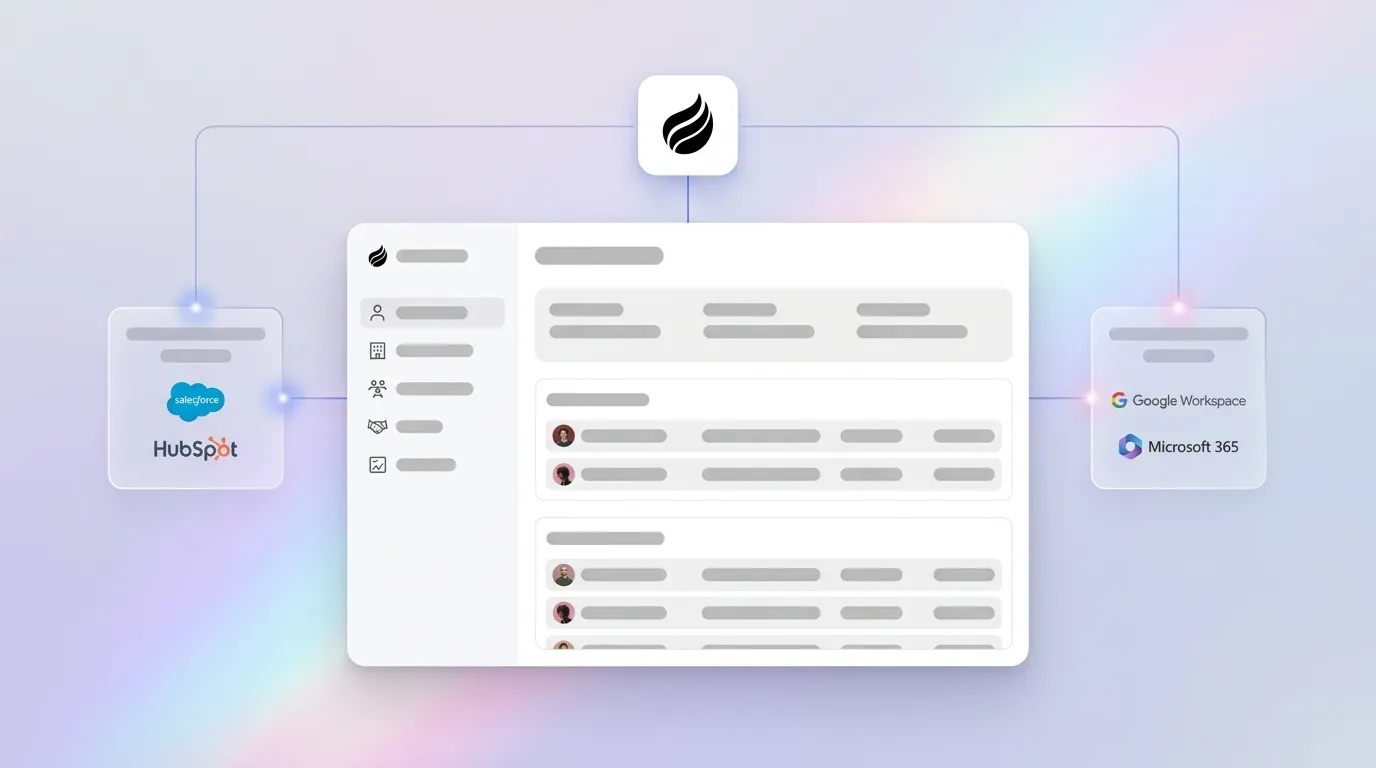
Coffee’s agent connects to Google Workspace or Microsoft 365 and auto-creates contacts, companies, and activity logs from emails and calendar events. Because the agent captures this data at the source, it can immediately enrich records with job titles, funding data, and LinkedIn profiles via licensed data partners, which removes the need for Apollo or ZoomInfo. This end-to-end automation, from initial capture through enrichment, produces large reductions in data entry time and recovers several hours per rep per week.

Meeting Orchestration and Follow-Up Automation Benchmarks
Meeting preparation and post-call administration represent two of the largest recoverable time categories for sales reps. Account Executives can reclaim substantial time each week when AI handles CRM logging, meeting notes, and follow-up automation.

Coffee’s agent joins Zoom, Teams, and Meet calls to record and transcribe, then generates summaries, next steps, and follow-up email drafts in Gmail for rep review. It structures notes according to BANT, MEDDIC, or SPICED, which keeps qualification data consistent. A meeting-prep dossier system reduced preparation time from 45 minutes to 10 minutes per meeting while improving signal detection on prospect company changes and competitive positioning shifts.

Pipeline Intelligence Outputs and Reporting Visibility
No McKinsey publication estimates that 35% of lost deals result from forgetting and late follow-ups rather than value or competition. AI CRMs that automatically detect cooling signals can still improve follow-through rates. Accurate pipeline intelligence becomes possible only when the underlying data is captured by agents instead of keyed in manually.
Coffee’s Pipeline Compare feature visualizes week-over-week changes, including progressed deals, stalled opportunities, and new additions, directly from the data warehouse. VP-level quarterly forecast accuracy can improve significantly once AI automation raises pipeline data accuracy. Pipeline reviews shift from interrogation sessions to strategic discussions, and teams can retire spreadsheets and manual CSV exports.
See how Coffee’s Pipeline Compare replaces manual CSV exports with autonomous pipeline intelligence.
Integration Complexity with Existing Tools and MCP Gateways
RevOps AI agents require sub-minute latency for CRM data reads, bidirectional read/write support, per-tenant field mapping, and managed authentication to function reliably at production scale. Headless agent stacks built on custom orchestration layers can satisfy these requirements but demand engineering investment that most mid-market teams cannot sustain.
Coffee currently integrates via Zapier, with deeper roadmap integrations in development. The Companion App authenticates directly with Salesforce and HubSpot and inherits existing integrations with marketing automation, CS platforms, and billing systems without reconfiguration, which mirrors the documented advantage of agent-layer deployments generally.
Ongoing Maintenance and Administrative Burden
Agentic CRM integrations reduce manual sales admin workloads by 60–80%, cut operational expenses by 30% or more at the workflow level, and save individual reps 2–5 hours per week on record-keeping. These gains depend on governance, including field standardization, defined write permissions, and named business owners for each automated field, which teams should establish before orchestration work begins.
Legacy CRMs impose the highest ongoing maintenance burden because every data-quality problem traces back to human entry. 74% of sales professionals spend time on manual data cleansing, described as a symptom of bad orchestration. Coffee’s agent reduces this cycle by ensuring that accurate interaction data enters the system from the start.
Best-Fit Coffee Deployments by Company Stage and CRM Commitment
The replace-versus-layer decision aligns closely with company stage and current CRM investment.
- 1–20 employees, no CRM or spreadsheet-based: Coffee Standalone CRM fits best. Teams avoid migration risk and legacy baggage, and the agent manages the system of record from day one.
- 20–100 employees, committed to Salesforce or HubSpot: Coffee Companion App works as the primary choice. The agent layers on top of the existing instance and handles data-in so the system of record stays accurate without human effort.
- Series A–B, Salesforce trial or HubSpot Starter: Migration cost to an AI-native replace model is low because there is little legacy data to move, so Coffee Standalone is viable.
- Mid-market with 3+ years of Salesforce history: Coffee Companion App preserves institutional data while removing the manual entry burden immediately.
Operational and Long-Term Scalability Considerations
By the end of 2026, 40% of enterprise applications will include task-specific AI agents, up from less than 5% in 2025, representing an eightfold increase according to Gartner. Platforms that cannot expose their data layer to external agents through APIs or MCP will become architectural dead ends.
Coffee’s data-warehouse-backed architecture stores full interaction history, including emails, transcripts, and deal state changes, which the agent can query and external systems can access via API for custom prompt engineering. Many enterprises may struggle to deploy the latest AI technology for sales because their processes and system designs are outdated, and Coffee’s architecture is designed to avoid that trap.
Risks, Limitations, and Common Misconceptions
Four recurring misconceptions shape how teams evaluate autonomous AI CRM automation in 2026, and each one can distort architecture decisions if left unchallenged.
- Misconception: Full autonomy always outperforms hybrid models. Human-generated meetings convert to revenue at 2.3x the rate of AI-generated meetings, while hybrid teams outperform pure AI or pure human setups by 40-60%. The strongest results come from pairing agents with humans, not replacing humans outright.
- Misconception: Layering agents on a dirty CRM is safe. Dirty CRM data does not block an AI agent integration build but poisons the output. A data quality audit should always precede any agent deployment.
- Misconception: All-in-one AI CRMs eliminate the need for a data strategy. Simply adding AI features to legacy architectures is insufficient; enterprises must transform their CRM architectures first to measurably improve sales productivity, forecast reliability, and customer retention. AI features still depend on a coherent data model.
- Misconception: Newer AI CRM alternatives handle Salesforce integrations as well as established players. Newer alternatives such as Day.ai and Clarify lack the depth required for sophisticated Salesforce and HubSpot integrations involving quotas, forecasting, required fields, and custom validation rules. Coffee treats this integration depth as a core competency.
Replace-Versus-Layer Decision Framework and Summary Matrix
Teams can use the following five-step framework to reach a defensible architecture decision.
- Audit CRM data age and quality. If the instance has fewer than 12 months of consistently maintained data, replace risk stays low. If it has three or more years of account history and active integrations, layer first.
- Assess RevOps bandwidth. A full replace can typically be completed in 8-20 weeks. If the team cannot absorb that effort, a companion agent layer delivers faster ROI.
- Evaluate unstructured data handling. If the current CRM cannot ingest call transcripts or email threads into the data model, a companion agent that writes structured outputs back to the CRM offers the fastest path to reliable reporting.
- Check MCP and API readiness. AI-native architecture maintains context across multiple interactions with the same deal and works toward multi-step goals without per-step human approval, so teams should confirm that the chosen platform supports this behavior natively.
- Apply the dual-model test. If answers to steps one through four remain ambiguous, choose a platform that can operate in both modes. Coffee functions as the system of record or as the agent feeding Salesforce and HubSpot, which removes the need to commit irrevocably to either path during evaluation.
Apply Coffee’s dual-model architecture to your replace-versus-layer decision today.
Frequently Asked Questions
How long does implementation typically take?
For the Coffee Companion App, implementation begins with a single authentication step that connects the agent to an existing Salesforce or HubSpot instance. The agent starts capturing contacts, logging activities, and enriching records immediately, with no data migration, no parallel-run period, and no engineering work required. For the Coffee Standalone CRM, teams without an existing CRM can be fully operational within days. More complex configurations that involve custom API workflows or bespoke agent prompts through Coffee’s API access can be scoped and deployed within a few weeks, depending on workflow complexity.
What technical expertise is required?
Coffee is designed for sales and RevOps leaders rather than engineers. The Companion App requires only OAuth authentication with Salesforce or HubSpot, with no code, no custom field mapping, and no IT security review beyond standard OAuth permissions. The Standalone CRM requires no prior CRM configuration. Teams that want to extend Coffee’s capabilities through API access for custom prompt engineering can do so, but this remains optional and is not required to capture the core value of automated data entry, meeting orchestration, and pipeline intelligence.
How much migration effort is involved when layering versus replacing?
Layering Coffee as a Companion App on an existing Salesforce or HubSpot instance involves zero data migration. The agent reads from and writes back to the existing system of record and inherits all current integrations, historical records, and custom fields. Replacing an existing CRM with Coffee Standalone involves migrating contact and deal records, which stays straightforward for teams with limited legacy data, such as under 12 months of history, but requires more planning for teams with years of accumulated account data. For mid-market teams committed to Salesforce or HubSpot, the Companion App is the recommended path because it removes migration risk entirely.
How do these solutions affect data quality and security at scale?
Coffee’s agent treats direct interaction capture as the foundation of data quality. By capturing interactions from email, calendar, and call transcripts instead of relying on human entry, the agent reduces fabrication, decay, and incompleteness that affect manually maintained CRMs. On security, Coffee is SOC 2 Type 2 and GDPR compliant, and customer data is not used to train public models. Teams in regulated industries or those with specific data residency requirements should still review Coffee’s security posture against internal compliance standards before deployment, because Coffee is not currently positioned for heavily regulated sectors such as healthcare or finance that require multi-year security reviews.
Conclusion: Moving Toward Autonomous CRM Automation
CRM platforms in 2026 are evolving from passive systems of record into active systems of action that use agentic workflows to automatically fulfill customer requests. Mid-market RevOps and sales leaders now need an architecture that delivers reliable data and automation without forcing a premature, high-risk rip-and-replace decision.
Legacy CRMs rely on humans as data-entry clerks. All-in-one AI CRMs improve this pattern but remain constrained by vendor roadmaps and stateless AI features. Headless agent stacks offer architectural flexibility at a level of engineering investment that most mid-market teams cannot sustain. Coffee resolves this tradeoff by operating as either the standalone system of record or the companion agent layer on existing Salesforce and HubSpot instances, which makes it the only dual-model solution in the market. The agent handles enrichment, meeting orchestration, pipeline intelligence, visitor identification, and list building, consolidating a fragmented stack into a single seat-based cost and giving reps a co-pilot they trust instead of a database they resent.
Start your Coffee evaluation to experience autonomous CRM automation without migration risk.