Written by: Doug Camplejohn, CEO & Co-Founder, Coffee
Key Takeaways for Claude Forecasting with Coffee
- Claude AI forecasts only stay accurate when the CRM data is complete and current, so fragmented or stale records create unreliable predictions.
- Legacy CRMs hide activity gaps, stalled deals, and missing fields, which drive forecast errors of 25–40% on average.
- A seven-step workflow connects Coffee to email, calendar, and CRM sources to automate data capture and keep pipeline data continuously accurate.
- Success is measured by achieving ±10% forecast accuracy, cutting manual data entry by 8+ hours per rep weekly, and logging every activity on closed-won deals.
- See Coffee’s pricing and start measuring these outcomes from week one with Coffee.
The Business Problem: Dirty CRM Data Derails Claude Forecasts
RevOps managers and sales leaders at small-to-mid-market companies face the same pattern. The weekly forecast consumes hours of manual effort and still misses by a wide margin. A SiriusDecisions study found that 79% of sales organizations miss their forecast by more than 10%, and fewer than 25% of sales leaders say their forecasts are accurate within 10%, with the average B2B forecast missing by 25–40%.
The root cause is structural. In representative CRM datasets, a significant portion of open pipeline value sits in deals with at least one reliability-affecting condition, such as a lapsed close date, an extended activity gap, or incomplete attribution fields. These conditions often stay invisible in standard forecast views. Salesso research indicates that 79% of opportunity data that sales reps collect never makes it into the CRM, so the system never reflects the real state of the pipeline. As a result, few sales teams feel fully confident in their CRM data and know they are forecasting from an incomplete foundation.
Claude inherits every one of these errors when it forecasts from this data. A deal marked “Negotiation” that stalled three weeks ago inflates the quarterly number. A closed-won deal with no logged activities teaches the model nothing about what winning looks like. The outcome is faster wrong answers, not better predictions.
Why Legacy CRMs Break Claude Predictions
The problem runs deeper than missing data, because the way most teams feed CRM data to Claude amplifies accuracy issues. LLM accuracy tests on B2B sales datasets show that direct CSV uploads without contextual prompting can produce calculation hallucinations, and that providing an explicit data dictionary can reduce them. Manual CSV exports make this worse because the data is already stale by the time it reaches Claude.
B2B CRM contact data decays at rates between 22.5% and 30% annually on average, so a substantial share of pipeline records can contain inaccurate information at any given point. Four specific failure modes explain how this decay misleads Claude’s predictions, and each one reflects a different way stale data distorts the model’s view of reality:
- Invisible activity, where deals appear healthy because no one has updated them, is one of the biggest sources of forecast inaccuracy in CRM data.
- Deals stalled beyond 28 days show 67% lower conversion rates (14.3% vs. 43.2%), yet many sales teams still include these phantom opportunities in their forecasts.
- The average B2B CRM has 30–40% of records missing at least one critical field for sales or marketing use, which removes key context from Claude’s analysis.
- Automated activity capture tools raise activity completeness in CRM compared to rates achieved with manual entry, which directly improves the data Claude receives.
An agent that captures data continuously from emails, calendar events, and call transcripts solves this problem at the source. Without continuous capture, Claude reasons over a snapshot of a pipeline that no longer exists.
See how Coffee’s automated data capture solves the activity gap problem.
Readiness Checklist for the Coffee–Claude Workflow
Confirm these items before you begin the workflow so setup runs smoothly:
- Google Workspace or Microsoft 365 account with admin access to authorize OAuth connections
- An active Salesforce or HubSpot instance with at least one pipeline configured
- A Claude account (Anthropic API access recommended for structured prompt workflows)
- RevOps or sales operations ownership of the setup process
- At least 60 days of historical closed-won and closed-lost deal data in the CRM
Seven-Step Workflow to Feed Claude Clean Pipeline Data
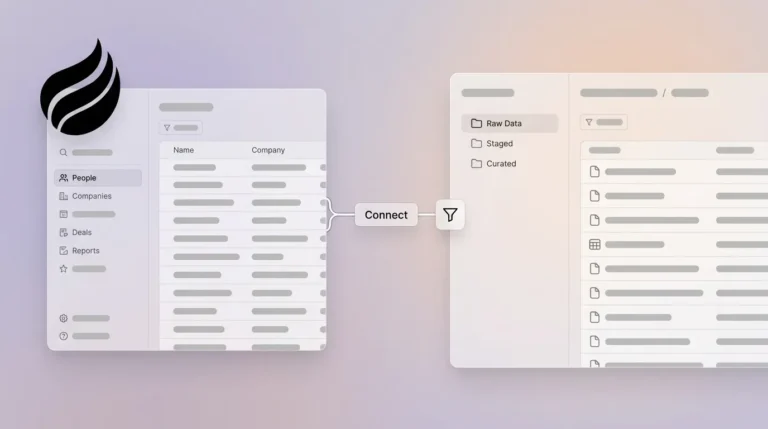
- Connect Coffee to email and calendar sources. Ownership: RevOps. Authorize Coffee to read Google Workspace or Microsoft 365 via OAuth. Once connected, Coffee’s agent scans emails and calendar events and begins populating contact, company, and activity records. Outcome: all meetings and emails are logged automatically without rep involvement.
- Troubleshooting: If OAuth authorization fails, confirm that the Google Workspace or Microsoft 365 admin has not restricted third-party app access at the domain level. Request the specific scopes Coffee requires from your IT administrator.
- Authenticate Coffee to Salesforce or HubSpot. Ownership: RevOps. Use Coffee’s Companion App integration to grant OAuth access to your existing CRM instance. Coffee’s integration layer handles field mapping, SOQL or HubSpot filterGroups syntax, and idempotency to prevent duplicate record creation. Outcome: OAuth scopes granted, no duplicate-record errors, and Coffee writing enriched data back to the correct CRM objects.
- Troubleshooting: HubSpot documentation warns that newly created or updated CRM objects may take a few moments to appear in search results, which can cause AI agents performing immediate follow-up searches to create duplicate contacts unless idempotency keys and upsert operations are used. Coffee handles this natively.
- Enable automatic contact, company, and activity creation. Ownership: Coffee agent. Configure Coffee to auto-create and enrich contacts and companies from email and calendar signals. The agent augments records with job titles, funding data, and LinkedIn profiles via licensed data partners. Outcome: every interaction appears in the correct CRM record within minutes, and activity logs reflect the current deal state without manual entry.
- Troubleshooting: If contacts are created under incorrect account records, review the domain-matching rules in Coffee’s settings and confirm that company domains are populated in your CRM.
- Configure Coffee to join and transcribe meetings. Ownership: Reps. Enable Coffee’s AI meeting bot to join Zoom, Teams, or Google Meet calls. The agent records, transcribes, and structures notes according to BANT, MEDDIC, or SPICED frameworks, then writes summaries, next steps, and follow-up drafts back to the CRM record. Outcome: 100% of calls have structured notes and next steps logged without rep data entry.
- Troubleshooting: Timezone mismatches between calendar invites and CRM activity timestamps can cause meeting logs to appear on the wrong date. Confirm that Coffee, your calendar, and your CRM all use the same timezone in their respective settings.
- Set up the Pipeline Compare view for week-over-week changes. Ownership: RevOps. Activate Coffee’s Pipeline Compare feature, which uses its built-in data warehouse to visualize progressed deals, stalled opportunities, and new pipeline additions between any two time periods. Outcome: pipeline reviews move from manual spreadsheet reconciliation to structured exception management, with visible progression and stalls surfaced automatically.
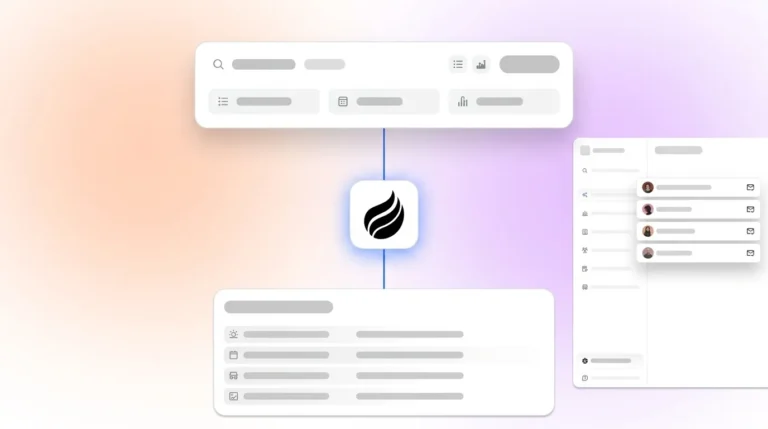
- Link Claude to Coffee’s data via API or structured export. Ownership: RevOps. Connect Claude to Coffee’s data warehouse using the API access Coffee provides, or configure a structured CSV export with a prepended data dictionary. Including explicit field definitions and semantic context in the system prompt can reduce LLM calculation hallucination rates. Outcome: Claude receives live, structured pipeline data with field-level context rather than a raw, ambiguous spreadsheet.
- Run the first forecast prompt and calibrate outputs. Ownership: RevOps and sales leaders. Structure the Claude prompt with four elements. Define the role, such as “You are a revenue analyst reviewing this week’s pipeline for a B2B SaaS company.” Provide the pipeline data from Coffee. Specify the output format, including deal stage, probability change from last week, next action, main risk, and close date assessment. Add a constraint that instructs Claude to flag any deal with no logged activity in 30 or more days. Compare Claude’s output against the prior week’s actuals to establish the initial accuracy baseline. Outcome: first forecast produced, ±10% accuracy target defined, and calibration notes documented for prompt refinement.
Validation: Three Measurable Success Criteria
The workflow is performing correctly when three conditions occur at the same time and stay stable over multiple weeks.
- Forecast accuracy within ±10% of actuals for two consecutive weeks. The workflow is on track when forecast accuracy reaches the ±10% threshold outlined in the key takeaways and sustains that level for at least two weeks. With Coffee ensuring continuous data quality from day one, teams reach this threshold significantly faster than with manual cleanup.
- Reduction of manual data-entry time by at least 8 hours per rep per week. Coffee’s agent handles contact creation, activity logging, meeting transcription, and follow-up drafting, which are the tasks that consume a significant portion of a sales rep’s time.
- Zero missing activities on closed-won deals. Every closed-won deal should have a complete activity log traceable through Coffee’s data warehouse. This completeness gives Claude the historical patterns it needs to improve future probability scoring and reflects the impact of the automated activity capture described earlier.
Review Coffee’s pricing and start tracking these three metrics from week one.
Scaling Notes for Growing Sales Teams
Coffee’s pricing and architecture are designed to scale with team size without surprise costs. Coffee uses seat-based pricing with no per-process metering on LLM usage or automation runs. This pricing model means scaling from 5 to 25 reps simply adds seats without changing the underlying workflow or introducing per-activity costs, and the agent’s work scales automatically with team size. Because Salesforce or HubSpot remains the system of record throughout, teams can scale Coffee’s data-quality layer without migrating away from existing CRM investments, custom objects, or quota configurations. This distinction matters for teams that rely on mature CRM setups that newer alternatives cannot easily replicate.
Organizations that implement integrated predictive analytical systems achieve higher forecasting accuracy than those that rely on conventional forecasting. Data quality and continuity of capture explain most of that gap, and Coffee’s agent layer focuses on exactly those two levers.
Frequently Asked Questions
How long does initial setup take?
Most RevOps teams complete the core setup in a single working session. That session covers connecting Coffee to Google Workspace or Microsoft 365, authenticating to Salesforce or HubSpot, and enabling automatic activity logging. The Coffee agent begins populating records immediately after OAuth authorization. Teams usually run the first Claude forecast prompt within the first week, once a baseline of automatically captured activities has accumulated in the CRM.
What security certifications does Coffee hold?
Coffee is SOC 2 Type 2 certified and GDPR compliant. Data ingested by the Coffee agent is not used to train public AI models. Teams in regulated industries should review Coffee’s security documentation directly, because Coffee is best suited for small-to-mid-market companies rather than organizations that require multi-year enterprise security reviews.
What is the pricing model?
Coffee uses seat-based pricing. You pay for the human seats on your team, and the agent’s labor, including data capture, enrichment, meeting transcription, pipeline intelligence, and API access, is included without additional per-process or per-API-call metering. This structure keeps costs predictable as teams grow from early-stage to mid-market.
How does the workflow change with multi-currency or custom objects?
When Salesforce or HubSpot instances include custom objects, required fields, or multi-currency configurations, Coffee’s Companion App integration respects the existing CRM schema and writes data back to the correct objects and fields. Custom field mappings can be configured during setup. For Claude prompts, custom fields should appear in the data dictionary prepended to the system prompt so the model interprets them correctly instead of treating them as ambiguous text. Multi-currency pipelines should standardize on a single reporting currency in the Claude prompt context to prevent the model from conflating deal values across currencies.
Conclusion: Turn Claude into a Reliable Sales Forecaster
The seven-step workflow connects Coffee, Salesforce or HubSpot, and Claude into a system where data quality stays high continuously instead of being cleaned manually before each forecast cycle. The data-quality prerequisite is non-negotiable. No Gartner report states that improving CRM data hygiene increases forecast accuracy by up to 30%; one Gartner-cited study instead notes organizations believe 32% of their CRM data is inaccurate, which reinforces how far most teams are from a trustworthy baseline. Predictive models in mature deployments achieve variance from actual revenue in the ±5–12% or ±8–15% range, while traditional rep-submitted forecasts often miss by 25–40%, as discussed earlier. Coffee’s agent captures the emails, calendar events, and call transcripts that legacy CRMs miss, structures them against the correct records, and gives Claude the complete, current pipeline data required to produce forecasts that sales leaders can act on. This continuous data capture is what enables the ±10% forecast accuracy target outlined in the validation criteria and brings teams closer to the performance of mature predictive systems.
Connect Coffee to your CRM and run your first reliable Claude AI sales forecast this week.