Written by: Doug Camplejohn, CEO & Co-Founder, Coffee | Last updated: June 20, 2026
Key Takeaways
- AI sales agents in 2026 now run full revenue workflows like prospecting, outreach, and CRM logging. Assistant tools still only suggest actions.
- Buyers should weigh five criteria: autonomous execution depth, native CRM integration quality, automated data entry, real-time pipeline intelligence, and total cost including stack consolidation.
- Platforms vary widely in integration depth. Coffee offers bidirectional native sync with Salesforce and HubSpot, while many competitors store data externally or need extra add-ons.
- Strong data quality automation matters. Coffee auto-creates contacts, enriches records, and logs activities from email and calendar without manual input, which removes a major AI adoption barrier.
- Teams ready to streamline sales operations can review Coffee’s flexible pricing and deployment options at Coffee.
Five Practical Evaluation Criteria for 2026 Buyers
1. Autonomous Execution Depth. Decide whether the platform replaces manual SDR workflows end to end or simply assists reps who still drive execution. Fully autonomous agents handle prospecting, enrichment, outreach, and CRM updates without per-step human approval.

2. Salesforce/HubSpot Integration Quality. Native bidirectional sync means activity data lands as native CRM records, which keeps it available to reports, APIs, and automations. Bolt-on integrations store data in vendor systems with lag and delete it upon contract cancellation, which creates long-term data risk.
3. Data-Entry Automation Proof. Poor data quality is a significant barrier to agentic AI adoption. Platforms must show automatic contact creation, activity logging, and enrichment, not just field suggestions.
4. Pipeline Intelligence Freshness. Accurate forecasting depends on continuously updated deal state. Platforms that rely on rep-entered stage changes create stale pipeline views. Look for automated week-over-week pipeline comparison and visitor identification that converts anonymous intent into named leads.
5. Total Cost of Ownership and Stack Consolidation. Autonomous AI SDR platforms usually cost more than companion-layer tools. Include displaced tools in your math, since enrichment, recording, and forecasting add-ons each carry their own seat costs.
The following comparison applies these criteria to leading platforms and highlights how each handles execution, CRM integration, data quality, and pricing.
2026 AI Sales Agent Platform Comparison
| Platform | Autonomous Execution Depth | Salesforce/HubSpot Integration | Data-Entry Automation | Pipeline Intelligence | Pricing Model | Deployment Type |
|---|---|---|---|---|---|---|
| Coffee | Full agent: auto-logs contacts, activities, enrichment, meeting summaries, and follow-ups without rep input | Bidirectional write-back to Salesforce and HubSpot, with awareness of quotas, forecasting, and required fields | Auto-creates contacts from email and calendar, enriches with job titles, funding, LinkedIn, and Stripe and QuickBooks sync | Week-over-week Pipeline Compare, visitor ID with named individual plus Suggested Leads, and natural-language deal search launched Jan 2026 | Seat-based, agent labor unlimited | Standalone CRM or Companion layer |
| 11x.ai (Alice) | Fully autonomous outbound SDR, with independent testing showing 1 meeting from 200 leads over two weeks | CRM sync available, without native Salesforce object model access | Outreach logging with limited enrichment depth | Outbound sequence tracking, no pipeline compare feature documented | Usage and seat hybrid | Standalone SDR agent |
| Artisan (Ava) | Fully autonomous, with reviewer complaints about generic AI-generated emails by Jan 2026 | CRM integrations available, companion depth unverified | Outreach and contact creation, enrichment via internal database | Sequence analytics, no pipeline compare documented | Fixed monthly | Standalone SDR agent |
| Salesforce Agentforce | Autonomous multi-step workflows native to Salesforce org | Native, with Data Cloud required for external data unification | Native CRM object updates, while external unstructured data requires a Data Cloud add-on | Native Salesforce reporting | Bundled with Einstein 1, requires Sales Cloud Enterprise+ | Salesforce-native only |
| Apollo | Assisted prospecting and sequencing, with human approval required for most outreach steps | Bidirectional sync with Salesforce and HubSpot that pushes activity logs and updated fields | Contact enrichment from a large database and activity logging on outreach actions | Intent signals and contact database freshness, without a pipeline compare feature | Seat-based with usage tiers | Companion layer and prospecting tool |
Get started with Coffee. Review standalone and companion pricing.
Why Hybrid Execution Beats Pure AI or Human-Only SDRs
The market now splits into human-only, AI-only, and hybrid pods, and hybrid pods usually win on efficiency. Hybrid pods generate more qualified opportunities per seat per month than human-only or AI-only configurations. Cost per qualified opportunity fell 54% in hybrid configurations versus human-only, dropping from $487 to $224.
This shift toward hybrid models reflects hard lessons from the market. Between 50% and 70% of managed “autonomous” AI SDR contracts signed in 2025–2026 were canceled as buyers moved to human-in-the-loop setups after hallucinations and low reply rates. Pure AI SDR configurations produce meetings at roughly 5.1 times lower cost than human SDRs. Meeting-to-opportunity conversion then falls from 25% to 15%, which makes AI-only setups about 1.5 times more expensive per closed-won deal.
Assistant-style tools such as email drafters and basic enrichment widgets add only marginal lift and leave the core data problem untouched. B2B sales reps spend about 35% of their time selling, based on market data shared by Coffee. Manual prospecting, data entry, and CRM hygiene consume the remaining 65%. Teams reduce that 65% only when an agent executes work instead of merely suggesting next steps.
Salesforce and HubSpot Companion Integration in Practice
Native integrations vary widely in quality and long-term value. Salesforce-native storage keeps captured activity data as native records that remain accessible to standard reports, APIs, Process Builder, and Flow even after the vendor relationship ends. Bidirectional sync that stores data in the vendor’s system introduces lag and removes data when the contract ends.
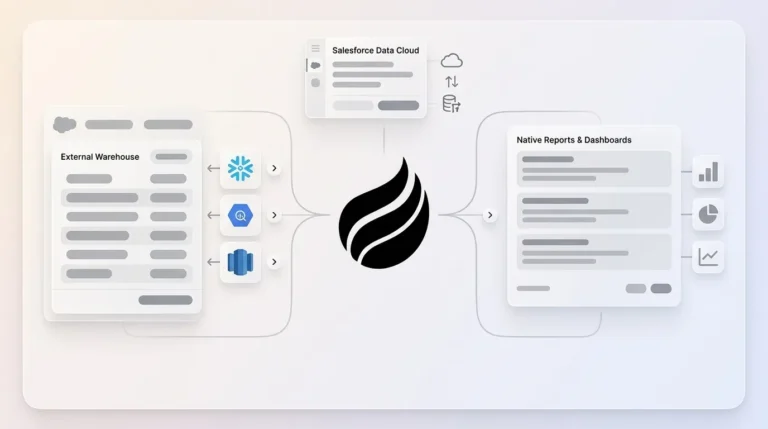
Agentforce operates inside the Salesforce object model without custom API connections, while external data unification still requires Data Cloud as an additional cost layer. HubSpot Breeze comes with Sales Hub Professional and Enterprise plans and remains limited to HubSpot-native workflows.
Coffee’s companion layer authenticates once and then writes enriched contacts, activity logs, meeting summaries, and deal updates back to Salesforce or HubSpot as native records. Summary templates released in November 2025 are customizable and writable back to Coffee, HubSpot, or Salesforce, which keeps formatting consistent across the system of record. Coffee’s integration also respects Salesforce-specific complexity such as required fields, quota structures, and forecasting hierarchies that newer companion tools often ignore.

Data Capture, Enrichment, and “Good Data In” Proof
Most AI CRM disappointments come from data quality issues rather than weak algorithms. One B2B company that implemented AI lead scoring saw poor performance because 40% of lead records lacked industry classification, which was a key predictive variable.
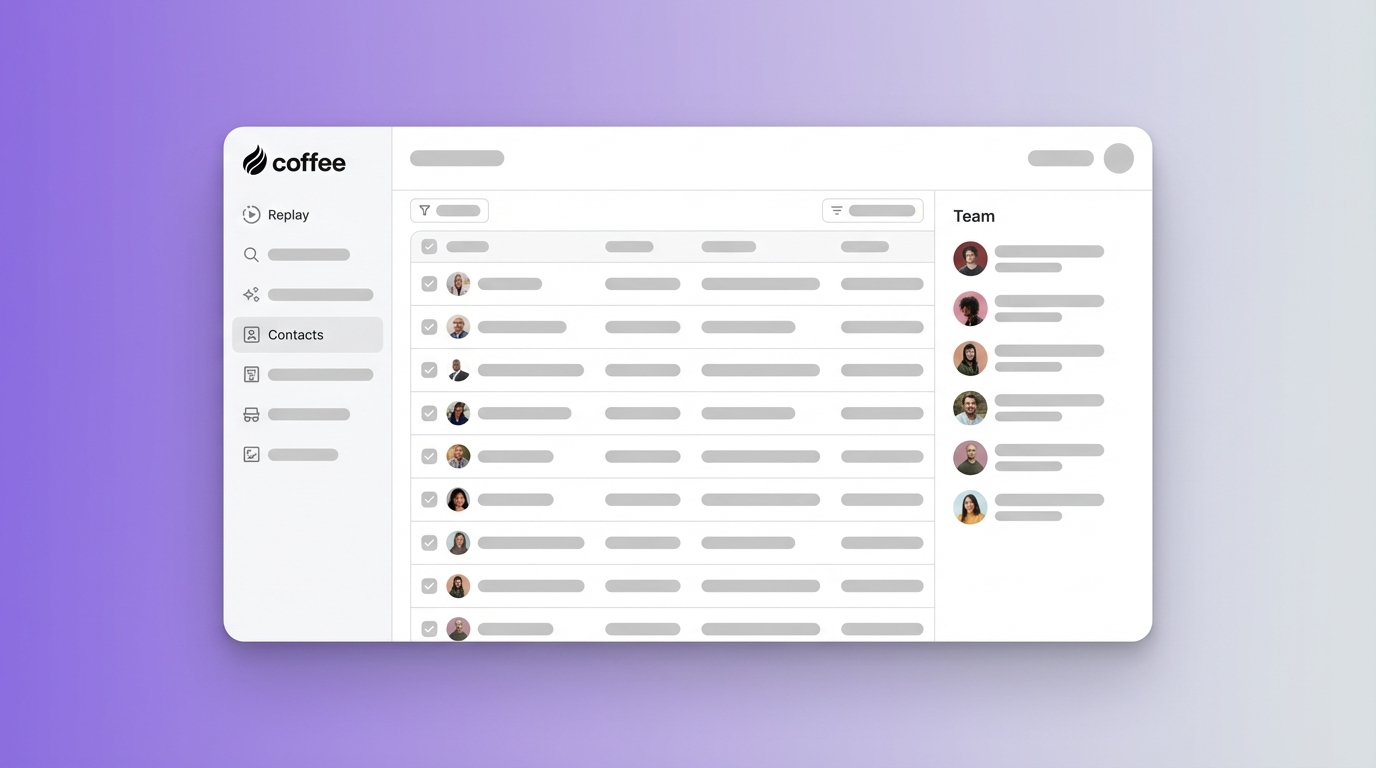
Coffee’s agent-led approach fixes this problem at the source. After connecting Google Workspace or Microsoft 365, the agent scans emails and calendars to auto-create contacts and companies, enriches records with job titles, funding data, and LinkedIn profiles, and logs last and next activity without manual work. The Stripe integration launched in January 2026 automatically imports customers, enriches them, and marks paid invoices as Closed Won. This removes an entire category of manual deal updates.

Apollo enriches from a large proprietary database but still relies on rep-initiated actions to trigger most logging, so data quality depends on human discipline. By contrast, Agentforce updates native Salesforce objects autonomously but depends on structured data already present in the org, while unstructured inputs such as call transcripts need extra configuration. 11x and Artisan log outreach activity yet leave the broader CRM data quality problem unsolved for teams with existing systems.
Pipeline Intelligence Freshness and Visitor Identification
Sales leaders need live pipeline views, not static snapshots. Coffee’s Pipeline Compare feature visualizes week-over-week changes such as progressed deals, stalled opportunities, and new additions without manual CSV exports. AI search on deals, released January 2026, answers natural-language queries such as “Which deals are stuck in negotiation?” or “What is closing this month?”
Visitor identification also separates platforms. Coffee’s pixel identifies named individuals, including name, title, email, and LinkedIn, along with company, pages visited, and session depth. Many competitors surface only company-level data or undifferentiated people lists. Coffee’s Suggested Leads feature instead uses the buyer persona to highlight the two or three specific contacts inside a visiting company that deserve outreach first, with LinkedIn profiles ready for immediate contact.

Pricing and Stack Consolidation Trade-offs
Coffee uses seat-based pricing with unlimited agent labor and no metering on LLM usage or automated processes. A realistic AI sales technology budget for a 10–20 person B2B team ranges from $2,500 to $8,000 per month in licensing, with Year 1 implementation adding $15,000 to $40,000. Stack consolidation changes that equation because Coffee replaces enrichment tools, meeting recorders, and pipeline reporting add-ons with a single seat fee.
Embedded AI inside CRM platforms usually costs $50 to $150 per user per month, while standalone AI platforms range from $100 to $500 per user per month. Agentforce and Breeze come bundled into enterprise CRM plans but still require those base licenses. Autonomous SDR platforms such as Artisan at $999 per month and 11x at $750 to $1,500 per month carry high fixed costs, while their conversion rates trail hybrid configurations.
How AI Fits into Real-World Revenue Stacks
Real revenue stacks vary by stage, tooling, and process maturity. A 15-person B2B team committed to HubSpot with Salesloft for sequencing and Gong for recording faces a different decision than a 30-person team on spreadsheets choosing its first CRM. About 60% of RevOps leaders say data silos block accurate forecasting, and adding another point solution on top of a fragmented stack usually makes that problem worse. The practical question becomes which platform fixes the data problem that keeps every other tool from performing.
Best-Fit Use Cases for Early-Stage and Mid-Market Teams
Teams needing a new system of record (1–20 employees). Companies that have outgrown spreadsheets but find HubSpot or Pipedrive to be expensive manual chores fit naturally with Coffee’s Standalone CRM. The agent handles all data entry from day one, without legacy CRM migration and without a separate seat cost for the agent’s labor.
Teams committed to Salesforce or HubSpot (20–50 employees). RevOps leaders with existing CRM investments, low adoption, and missing data from calls and emails deploy Coffee as a Companion App. A single authentication lets the agent sync, enrich, and write insights back to the primary CRM without disrupting current workflows, quota structures, or forecasting hierarchies.
Teams evaluating pure AI SDR replacement. As noted earlier, the hybrid model’s roughly three times pipeline advantage over AI-only setups means full SDR replacement suits only high-volume, low-complexity outbound. In those environments, conversion quality matters less than raw volume, so autonomous SDR platforms can still make sense.
Risks and Limitations to Consider in 2026
Integration gaps. Only about 5% of enterprise AI agent prototypes reach production, and most fail because they cannot integrate with real CRM data. Teams should confirm that activity data lands as native CRM records rather than in a vendor-side data store.
Even when integration succeeds, operational challenges appear. Hidden maintenance. About 47% of attempted AI SDR deployments hit a domain-reputation wall inside the first 90 days due to high outbound volume. Autonomous outreach platforms require ongoing deliverability management that base pricing rarely includes.
Beyond maintenance, capacity planning becomes a risk. Overbuying autonomous SDR capacity. Teams with monthly outbound budgets under $500 should avoid autonomous AI SDRs because they often deliver weaker results than lower-cost platforms with manual review.
The data challenge also scales with usage. Data-quality barriers. The data quality concern raised in the evaluation criteria becomes even more important at higher volumes. Companies that embed formal data governance before deploying AI agents achieve 40% higher sales efficiency than those that layer AI on top of poor CRM data. Platforms that do not solve data entry at the source amplify existing data quality problems as they scale.
Decision Framework Matrix for Common Constraints
| Constraint | Best-Fit Option | Rationale |
|---|---|---|
| No existing CRM, 1–20 employees | Coffee Standalone CRM | Agent handles all data entry, no migration required, and seat-based pricing scales with headcount |
| Committed to Salesforce or HubSpot, with data quality problems | Coffee Companion App | Single authentication, enriched data written back natively, and awareness of Salesforce quota and forecasting complexity |
| Committed to Salesforce, want native agent with no new vendor | Salesforce Agentforce | Native object model access, with Sales Cloud Enterprise+ and Data Cloud required for full capability |
| High-volume outbound, willing to accept lower conversion quality | 11x.ai or Artisan | Autonomous outreach at scale, with close monitoring of domain reputation and conversion rates |
| Need prospecting database plus basic CRM sync, limited budget | Apollo | Large contact database with bidirectional CRM sync, without solving CRM data quality at the record level |
Get started with Coffee and compare standalone and companion plans.
Frequently Asked Questions
How long does it take to implement Coffee and see value?
Standalone CRM value arrives quickly. Connecting Google Workspace or Microsoft 365 prompts the agent to start auto-creating contacts, logging activities, and enriching records within hours. Teams starting fresh avoid data migration. For the Companion App on Salesforce or HubSpot, a single authentication deploys the agent against the existing system of record. Most teams see clean activity logging and meeting summaries within the first week. This contrasts with standalone AI platforms that need API integration and often take six to twelve weeks for full implementation.
How difficult is migrating from an existing CRM to Coffee’s Standalone product?
Coffee targets teams that have outgrown spreadsheets or view legacy CRMs as manual chores, not large enterprises with heavily customized Salesforce orgs. For small teams migrating from HubSpot, Pipedrive, or spreadsheets, the agent begins populating records from email and calendar history immediately after connection, which reduces manual data import. Teams with complex custom objects, multi-year historical data needs, or strict regulatory demands should consider whether the Companion App on their existing CRM fits better than a full migration.
Is Coffee’s data secure, and how is it handled?
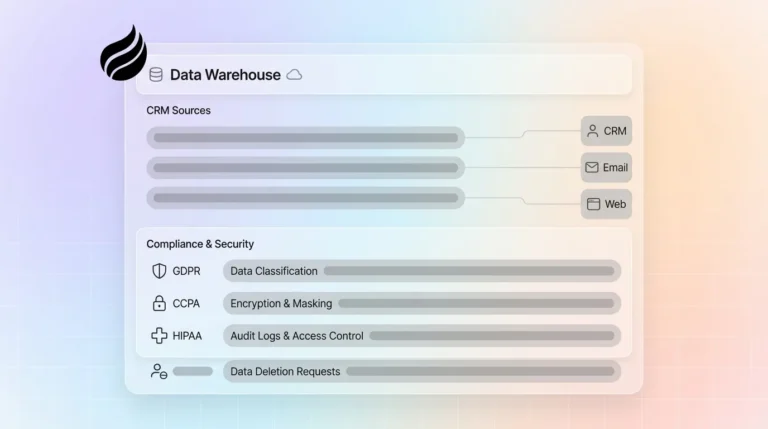
Coffee holds SOC 2 Type 2 and GDPR compliance. Data ingested by the agent, including emails, calendar events, and call transcripts, never trains public AI models. Teams in highly regulated industries such as healthcare or finance that require multi-year security reviews may not find Coffee suitable. B2B SaaS, professional services, and technology companies usually find that Coffee’s compliance posture meets standard enterprise procurement requirements.
How does Coffee’s enrichment quality compare to dedicated tools like ZoomInfo?
Coffee’s agent enriches records with job titles, funding data, and LinkedIn profiles through licensed data partners at quality roughly on par with ZoomInfo for most B2B use cases. The main difference lies in workflow. Enrichment occurs automatically at contact creation instead of requiring a separate tool, export, and re-import cycle. Teams with very specific data needs, such as niche technographic signals or narrow industry coverage, should test Coffee’s enrichment against their target accounts during evaluation.
What happens to CRM data if we stop using Coffee as a Companion App?
Data that Coffee writes back to Salesforce or HubSpot remains as native records in those systems. Activity logs, enriched contact fields, and meeting summaries written to Salesforce stay as standard Salesforce records that reports, APIs, and automations can access without Coffee. This approach differs from the vendor-side storage model discussed earlier.
Conclusion: Choosing AI Agents That Protect Data Quality
AI sales agent evaluations in 2026 ultimately revolve around one core issue: bad data breaks autonomous agents before they deliver value. Platforms that automate outreach without fixing CRM data quality simply scale the garbage-in, garbage-out cycle. The five criteria that predict long-term platform value, including autonomous execution depth, integration quality, data-entry automation proof, pipeline intelligence freshness, and total cost of ownership, all depend on solving data quality first.
Coffee addresses this problem from both directions. It operates as a standalone CRM where the agent becomes the system of record and as a companion layer that writes clean, enriched, structured data back to Salesforce or HubSpot. Continuous product development through early 2026, including natural-language deal search, custom meeting briefings, QuickBooks and Stripe sync, and an Intelligence layer for context-aware AI suggestions, reflects a platform built around an agent-first principle rather than retrofitted onto a passive database.
Heads of Sales and RevOps at 10–50 person B2B companies now face a clear choice. They can chase tools that send more emails or select a platform that keeps the data feeding every downstream AI output accurate, complete, and current. That “good data in, good data out” standard remains the only standard that matters in 2026.
Get started with Coffee and see how the agent handles your data from day one.