Written by: Doug Camplejohn, CEO & Co-Founder, Coffee
Key Takeaways
- CRM data warehouse compliance means enforcing privacy controls, access rules, and deletion protocols at every pipeline stage, from ingestion through backups and derived datasets.
- Core obligations cover data subject rights (erasure, access, correction), data minimization, consent mapping, RBAC, encryption, retention policies, audit logging, and vendor accountability under GDPR, CCPA/CPRA, HIPAA, and related regulations.
- Deletion propagation is technically complex because GDPR and CCPA erasure requests must reach raw tables, marts, BI extracts, and backups, with audit trails and crypto-shredding or “beyond use” handling for immutable copies.
- Consent and suppression flags must travel as first-class columns through ETL and be enforced at every layer, while non-production environments require masking or tokenization to avoid regulatory exposure.
- Coffee’s agent-led architecture applies classification, minimization, and lineage tracking at the point of capture, so compliance controls are built into the pipeline rather than added later.
See How Coffee Enforces Compliance At The Source
Core Compliance Requirements For CRM Data Warehouse Pipelines
Syncing CRM data into a data warehouse requires matching privacy controls, access rules, and deletion protocols across both environments. These obligations attach at collection and follow the data through every downstream system, including backups and derived datasets.
The foundational requirements are:
- Data Subject Rights: GDPR Article 17 grants the right to erasure, and that right extends to analytics systems and derived datasets. For backups that cannot be edited record by record, regulators accept placing the data “beyond use” until it ages out on the next backup cycle. CCPA/CPRA grants parallel rights to know, delete, correct, and opt out, with a 45-day response window.
- Data Minimization: The NIST Privacy Framework Control-P function treats minimization as a baseline requirement. CPRA Section 3(B)(3) restricts collection to what is strictly necessary for a defined purpose.
- Consent Mapping: Timestamped consent and opt-out flags must travel with records through ETL and be enforced in marts and BI layers per GDPR and CCPA/CPRA consent requirements.
- Role-Based Access Control (RBAC): NIST SP 800-53 AC-6 requires least-privilege access for every identity, human or automated, with quarterly access reviews.
- Encryption In Transit And At Rest: HIPAA does not name a specific algorithm, but HHS guidance points to NIST standards. AES-256 at rest and TLS 1.2+ in transit form the practical minimum, and customer-managed keys keep plaintext access under customer control.
- Retention Policies: Retention periods must be defined per data category, documented in a Record of Processing Activities, and enforced by automated deletion triggers across all systems, including backups.
- Audit Logging: HIPAA requires audit logs of ePHI access to be retained for a minimum of six years per 45 CFR 164.316(b)(2). Logs must be append-only or cryptographically signed and aligned with NIST SP 800-53 audit control families.
- Vendor And Processor Accountability: Every vendor in the stack, including ETL tools, warehouses, BI layers, and backup services, must be covered by a DPA, CCPA service provider contract, or HIPAA BAA before any personal data flows.
Review Coffee’s Compliance-Ready Architecture
The CRM-To-Warehouse Pipeline And Where Controls Apply
Those obligations do not stay in the CRM. They follow the data as soon as it is copied into an analytics environment, so each pipeline stage needs specific controls.
A CRM functions as a system of record for customer interactions: structured fields, activity logs, and contact data maintained for operational use. A data warehouse is an analytics environment optimized for historical queries, aggregations, and BI. When CRM data moves into a warehouse, it crosses a boundary from operational to analytical processing. Every regulation that governed it in the CRM continues to govern it in the warehouse. GDPR Article 4(2) defines “processing” broadly to include storage, retrieval, and use in analytics systems, so the warehouse remains in scope.
The pipeline stages and their associated compliance risks are:
- CRM (Source): System of record where consent flags, suppression lists, and data subject identifiers originate.
- Ingestion/ETL: Transformation layer where minimization rules must run before data lands downstream. PHI masking should occur as early as possible.
- Raw/Staging: Unprocessed data lands here, so access should be limited to engineering roles and retention kept short.
- Governed Warehouse: Curated, access-controlled layer where RBAC, encryption, and audit logging apply at the table and column level.
- Curated Marts: Aggregated datasets for specific teams, where deletion propagation and suppression flags must remain effective.
- BI/Reporting Layer: Analyst-facing layer where PII should be masked or tokenized and row-level security must enforce least privilege.
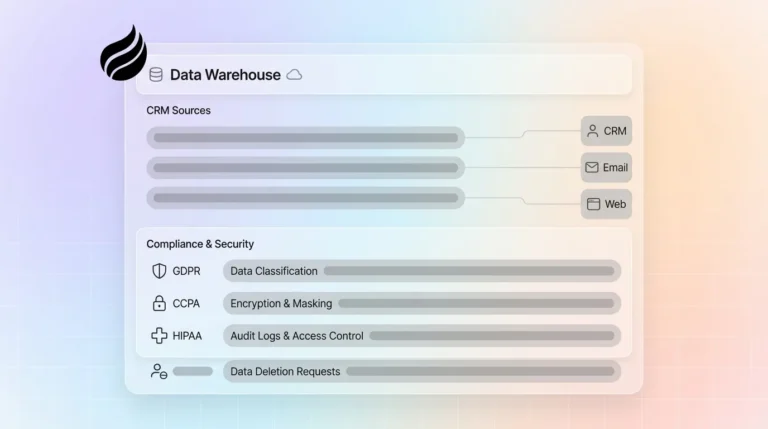
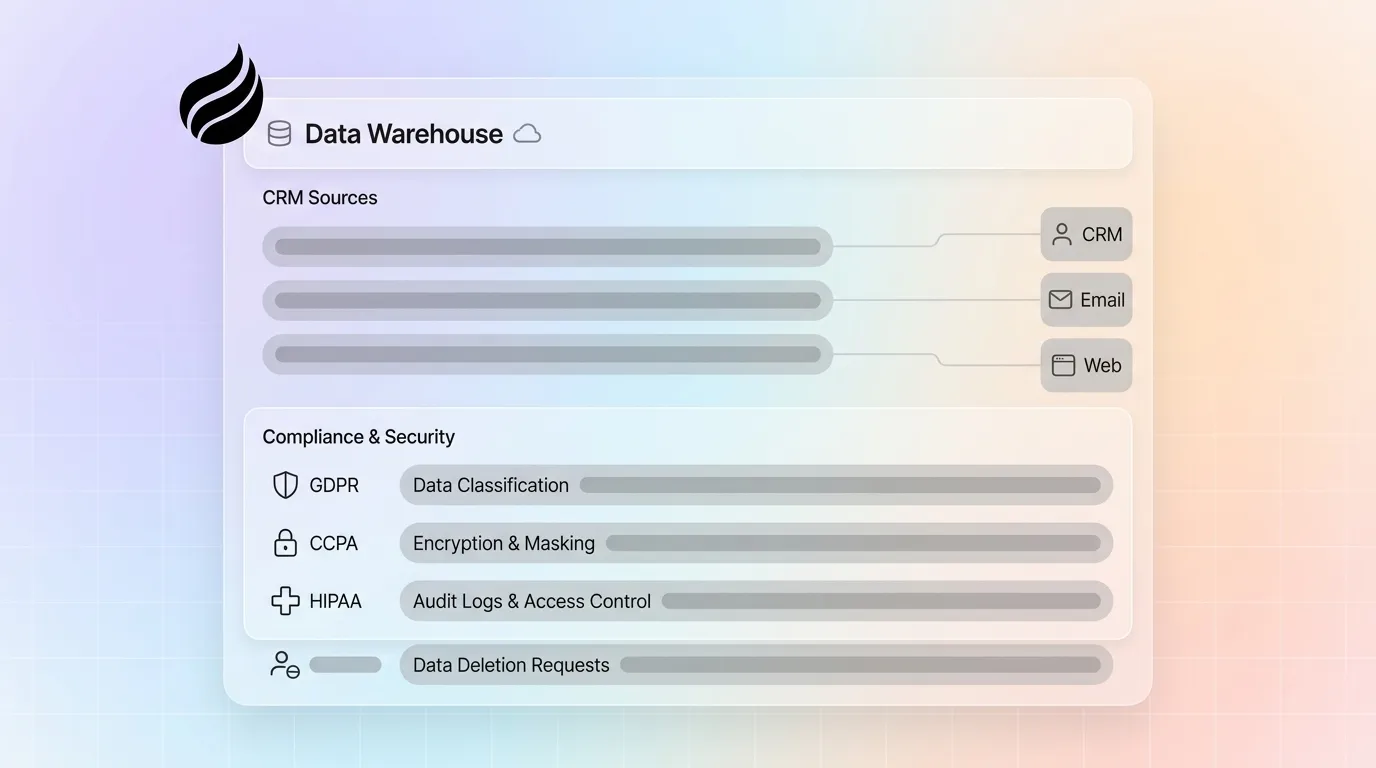
Coffee’s agent-led architecture captures data at the source from emails, calendars, and call transcripts and stores it in a built-in data warehouse. Because the agent maintains lineage from CRM to warehouse, compliance controls apply from the point of capture instead of after data spreads across stages.
Data Classification And Minimization Before Ingestion
The strongest compliance posture keeps non-compliant data out of the warehouse entirely. Certain field types should be excluded from ingestion or transformed before landing:
- Unhashed email addresses in raw form
- Social Security Numbers (SSNs) and government-issued identifiers
- Protected Health Information (PHI) including diagnosis codes, treatment records, and health plan identifiers
- Full payment card numbers and CVVs
- Authentication credentials and API keys
- Precise geolocation data beyond what is necessary for the stated purpose
NIST minimization guidance treats data minimization as a baseline requirement. Organizations must limit processing, enforce defined retention periods, and destroy data once its purpose has been fulfilled. Storing excessive data compounds risk across four dimensions: increased attack surface, harder audit trails, financial exposure, and legal liability. GDPR permits fines of up to €20 million or 4% of global annual revenue for failing to delete data once it is no longer needed.
Before ingestion, each CRM field should be classified against a sensitivity schema such as Public, Internal, Confidential, or Restricted. It should also be mapped to its legal basis for processing. ETL jobs then apply field-level masking, tokenization, or exclusion rules based on that classification before writing to raw or staging tables.
Coffee’s agent enriches and structures data at the point of entry and applies classification and minimization so only compliant data enters the warehouse. Fields that should not be synced are excluded before they spread downstream.
How A GDPR Deletion Request Reaches Warehouse Tables And Backups
Minimization keeps regulated data out of the warehouse, but it cannot remove data that already exists there. When a data subject exercises their right to erasure, the request must reach every copy, including those minimization never touched. Deletion propagation is the most technically complex compliance obligation in a CRM-to-warehouse pipeline.
A soft-delete flag does not satisfy GDPR Article 17 or CCPA/CPRA erasure requirements. True erasure requires hard deletion across every copy of the data. The workflow below outlines the required steps:
- Request Received: A deletion or DSAR request is received and logged in the CRM with a timestamp, identity verification record, and response deadline. The deadline is one month under GDPR, extendable by two further months for complex requests, and 45 days under CCPA/CPRA.
- CRM Record Flagged: The CRM flags the record for deletion and checks for statutory exceptions such as legal holds, fraud prevention, or tax retention. Any exception code and justification should be logged if deletion is declined.
- Downstream Inventory: The ETL lineage map is queried to identify every downstream table, mart, BI extract, and backup containing the subject’s identifiers. Column-level lineage is required because table-level lineage does not provide enough precision.
- Propagation To Active Systems: Hard deletes run in raw and staging tables, governed warehouse tables, curated marts, and BI extracts in the correct referential order. Search indexes, caches, and message queues are invalidated or purged.
- Backup Handling: Where backups cannot be edited record by record, regulators accept placing the data “beyond use” until the next backup rotation cycle, provided the backup is access-controlled, the subject’s identifiers are flagged to prevent reintroduction on restore, and the retention window is documented and proportionate. Crypto-shredding, where each person’s data is encrypted with a unique key and that key is destroyed on erasure, often provides the most reliable way to make every copy unreadable at once, but it depends on a robust key store.
- Third-Party Propagation: Deletion instructions are sent to every downstream processor, including analytics vendors, BI tools, and email platforms, and confirmations are retained as evidence.
- Audit Trail: A deletion record documents the request date, verification method, systems searched, actions taken, backup files affected, expected expiry dates, and the identity of the person responsible.
Coffee’s built-in data warehouse captures history and maintains agent-generated lineage from CRM to warehouse, which enables precise deletion propagation. Because the agent tracks every record it creates or enriches, the inventory step becomes automated instead of manual.
Automate Deletion Propagation With Coffee
Consent, Suppression, And Preference Mapping During ETL
Consent and suppression flags are operational data that teams must enforce like any other column. These flags need to travel with records through every ETL transformation and must be enforced at every layer that supports outreach, segmentation, or analysis. Under CCPA/CPRA, opt-out signals, including browser-level Global Privacy Control (GPC) signals, must be honored and propagated to every system involved in data sharing or sale, such as advertising platforms, data brokers, and analytics vendors.
ETL jobs should follow this sequence:
- Start by carrying the consent timestamp, consent version, and opt-out status as columns alongside every contact record in the warehouse so downstream layers can enforce rules.
- At the mart layer, join suppression lists before any record is made available to marketing or outreach tools.
- Then enforce purpose-limitation rules so that a record consented for transactional email cannot be queried by a campaign mart without a matching consent flag.
- Finally, log every consent state change with a before-and-after snapshot and the source of the change so enforcement remains auditable.
Coffee’s agent logs consent and suppression flags automatically from emails and calendars, so they are captured at the source and carried through to the warehouse without manual work. When a contact opts out, the agent updates the record and the suppression state propagates to downstream systems.
Access Control, Encryption, And Audit Logging In The Warehouse
NIST SP 800-53 AC-3 (Access Enforcement) requires systems to enforce approved authorizations at the system, application, and service level in real time. Policy documents and implicit trust do not satisfy this control. The 2014 Anthem breach, where attackers used stolen credentials to issue bulk SQL queries against an unencrypted enterprise data warehouse and exfiltrate 78.8 million records, shows the cost of missing enforcement. The stolen administrator credentials carried no restriction limiting queries to required resources, and no anomaly detection flagged the query volume. The resulting HHS OCR settlement reached $16 million.
Warehouse access controls must include:
- RBAC With Least Privilege: Define roles by job function rather than by individual. Each role then receives only the schemas and columns its current duties require, per NIST SP 800-53 AC-6.
- SSO And MFA: Enforce multi-factor authentication on all privileged sessions and any account that can reach PII or PHI data stores.
- TLS In Transit: Under HIPAA, ePHI in transit must be protected with TLS 1.2 or higher, including east-west traffic between microservices within a VPC.
- Encryption At Rest: Use AES-256 with customer-managed keys via a Key Management Service so the customer governs access to plaintext.
- Immutable Audit Logs: Maintain append-only or cryptographically signed logs that capture every access event, query, and modification, retained for the six-year HIPAA minimum noted earlier and aligned with GDPR accountability requirements. Logs must be accessible to the compliance team independently of engineering.
- Quarterly Access Reviews: Confirm every permission assigned to a role as still required for current duties, and review privileged accounts monthly.
Coffee enforces RBAC and encryption across its built-in data warehouse, and its agent-generated audit logs provide a verifiable, time-stamped trail of every data access and modification event.
Masking And Tokenization In Non-Production Environments
Development, test, and sandbox environments often create a compliance blind spot. PHI or PII that flows into a non-production environment without masking creates the same regulatory exposure as unprotected production data and is frequently overlooked in BAA reviews because non-production systems are treated as infrastructure.
ISO 27001:2022 Control A.8.11 (Data Masking) requires masking techniques that align with access control policy and business requirements, especially for personal data in development, testing, or analytics environments. ISO 27001:2022 Control A.8.31 requires development, test, and production environments to be separated and secured, and Control A.8.33 requires test information to be appropriately selected, protected, and managed.
Teams can choose among several masking techniques for non-production CRM data:
- Static Data Masking: Replace PII fields with realistic but synthetic values before copying data to non-production environments. This approach works well for functional testing.
- Tokenization: Replace identifiers with opaque tokens and keep the mapping in a secured token vault that non-production systems cannot access. This pattern supports limited re-identification in tightly controlled workflows.
- Synthetic Data Generation: Generate statistically representative datasets that do not reference real individuals, which suits load testing and ML feature development.
All 18 HIPAA identifiers must be stripped before data enters development, staging, or analytics pipelines. Coffee’s agent can generate masked datasets for testing, which reduces compliance risk in non-production environments without disrupting engineering workflows.
Regulation-To-Control Matrix And Vendor Accountability
No single vendor certification covers the entire CRM-to-warehouse pipeline. Accountability must be split across the CRM, ETL tool, warehouse, BI layer, and backup vendor, and each relationship needs the right legal instrument such as a DPA, CCPA service provider contract, or HIPAA BAA before any personal data flows. SOC 2 CC9.2 requires assessment and management of risks associated with vendors and business partners across the full vendor lifecycle. ISO 27001:2022 Controls 5.19 and 5.20 require security requirements to appear in supplier agreements and to be managed throughout the supplier relationship lifecycle.
The matrix below maps each regulation to the controls it expects across data subject rights, minimization and consent, and access and audit. Use it as a checklist when preparing for security reviews or DPA and BAA conversations.
| Regulation | Data Subject Rights & Deletion | Minimization & Consent | RBAC, Encryption & Audit Logging |
|---|---|---|---|
| GDPR | Right to erasure (Art. 17) across all copies including backups, with a one-month response window that can extend by two months for complex requests, and required propagation to processors. | Purpose limitation and minimization (Art. 5), timestamped consent, and opt-outs that must propagate to all systems. | Least privilege (Art. 32), encryption in transit and at rest, immutable audit logs, and 72-hour breach notification to the supervisory authority. |
| CCPA/CPRA | Right to delete across all systems including backups, a 45-day response window, and deletion that must be propagated to service providers and contractors. | Data minimization (CPRA Sec. 3(B)(3)), GPC opt-out signals that must be honored and propagated, and sensitive personal information use-limitation rules. | RBAC for systems holding personal information, expected encryption, audit logs to demonstrate compliance, and CPPA enforcement authority. |
| HIPAA | No general right of erasure, but individual rights to access and amend PHI, and a BAA requirement with every vendor touching ePHI before data flows. | Minimum necessary standard (45 CFR 164.502(b)), PHI masking in non-production environments, and de-identification via Safe Harbor or Expert Determination to remove PHI status. | Unique user IDs, MFA, automatic logoff per 45 CFR 164.312, audit controls, TLS in transit, AES-256 at rest with customer-managed keys, six-year log retention, and 60-day breach notification. |
| PCI DSS | No statutory data subject rights, but Requirement 3.2.1 limits stored account data to what is necessary for legal, regulatory, or business purposes. | Strict minimization of cardholder data, full PANs kept out of the warehouse, and tokenization for downstream systems. | RBAC and least privilege, encryption at rest and in transit, audit logs, quarterly access reviews, and penetration testing. |
| SOC 2 | Privacy TSC requires data subject rights processes including access, correction, and deletion within 30 days, along with retention schedules and automated secure deletion. | Privacy TSC requirements for data minimization, purpose limitation, consent management, and de-identification or masking in non-production environments. | CC6 requires MFA, RBAC, and quarterly access reviews. CC7 requires a SIEM or log management solution with alerts for anomalous activity, and CC9.2 requires vendor risk management with DPAs and SOC report reviews. |
| ISO 27001:2022 | Control A.8.10 (Information Deletion) requires deletion when data is no longer required, and Control 5.34 requires compliance with applicable privacy laws including data subject rights. | Control A.8.11 (Data Masking) for non-production environments, Control 5.12 for data classification, and Controls 5.19–5.23 for supplier and cloud security. | Controls 5.15, 8.2, and 8.18 cover access control and least privilege. Control 8.15 requires audit logging, Control 8.16 requires anomaly monitoring, and Control 8.12 requires DLP. |
Coffee is SOC 2 Type 2 and GDPR compliant. Its agent-led architecture simplifies vendor accountability by consolidating CRM, enrichment, and warehouse functions into a single system, which reduces the number of vendor relationships that must each be governed.
Reduce Vendor Risk With Coffee’s Unified Stack
Frequently Asked Questions
What Is The Difference Between CRM Data Governance And CRM Data Warehouse Compliance?
CRM data governance covers the policies, ownership structures, and quality standards that determine how data is defined, entered, and maintained within the CRM itself. It includes field naming conventions, duplicate management, required fields, and data stewardship roles. CRM data warehouse compliance is a narrower, legally specific discipline that addresses the obligations that attach when CRM data is copied into an analytics environment. Compliance requires enforcing data subject rights, applying minimization rules before ingestion, propagating consent and suppression flags through ETL, enforcing RBAC and encryption at every pipeline stage, and maintaining audit logs that satisfy GDPR, CCPA/CPRA, HIPAA, or other regulations. Governance supports compliance by improving data quality, but governance alone does not meet warehouse regulatory obligations.
Which Fields Should Never Be Synced From CRM To A Data Warehouse?
The exclusion list in the classification section above covers the field types that should never land in the warehouse. The practical test for anything not on that list is whether the field, combined with any other field in the warehouse, could identify a natural person or create a regulated data category under GDPR, CCPA/CPRA, HIPAA, or PCI DSS. If it can, the field requires masking, tokenization, or exclusion before it crosses the ETL boundary. Coffee’s agent applies classification and minimization at the point of entry so only compliant data enters the warehouse.
How Do You Map Consent And Suppression Flags During ETL?
Consent and suppression flags must be treated as first-class columns that travel with every contact record through each ETL transformation. The implementation pattern carries the consent timestamp, consent version, opt-out status, and suppression list membership as dedicated columns in the warehouse contact table. It then enforces a join against the suppression table at the mart layer before any record is exposed to marketing, outreach, or segmentation queries and logs every consent state change with a before-and-after snapshot and the source of the change. Under CCPA/CPRA, Global Privacy Control browser signals must be detected and treated as opt-out requests, with opt-outs honored within 15 business days and propagated to systems involved in data sharing. Under GDPR, consent withdrawal must trigger deletion or suppression without undue delay.
What Does HIPAA Require For CRM Data In A Cloud Warehouse (BAA)?
If a CRM contains Protected Health Information, such as health plan membership, treatment history, or any of HIPAA’s 18 specified identifiers combined with health information, then any cloud warehouse that stores, processes, or transmits that data is a Business Associate under HHS guidance, regardless of whether the provider can read the data. A Business Associate Agreement must be signed before any ePHI flows to the warehouse. The BAA must specify permitted and required uses and disclosures, require safeguards aligned with the HIPAA Security Rule (45 CFR 164.312), mandate breach notification to the covered entity within 60 days of discovery, flow down equivalent obligations to subcontractors, and require return or destruction of PHI at termination. The warehouse must enforce unique user IDs, MFA, least-privilege IAM policies, TLS in transit, AES-256 encryption at rest with customer-managed keys, and immutable audit logs retained for at least six years. AWS, Azure, and Google Cloud offer HIPAA-eligible services and will sign a BAA, but the customer remains responsible for configuring those services correctly, and a signed BAA does not replace correct configuration.
Conclusion
CRM data warehouse compliance is a property of the entire pipeline, from the CRM source through ingestion, raw staging, governed warehouse, curated marts, and BI, and every stage requires its own controls. The pipeline-stage control map in this guide shows where each obligation attaches. The deletion-propagation workflow addresses the most technically complex gap by ensuring that a GDPR or CCPA/CPRA erasure request reaches raw tables, marts, backups, and third-party processors, with a documented audit trail at every step. The regulation-to-control matrix provides a defensible reference for security reviews, DPA and BAA conversations, and audit preparation across GDPR, CCPA/CPRA, HIPAA, PCI DSS, SOC 2, and ISO 27001.
Retrofitting controls after data has already spread across pipeline stages creates an expensive and weak compliance posture. Coffee’s agent-led architecture addresses this at the source. The agent captures data from emails, calendars, and transcripts, applies classification and minimization at the point of entry, maintains lineage from CRM to the built-in data warehouse, and enforces RBAC, encryption, and audit logging from capture to insight. This approach produces good data in and good data out, with compliance built into the architecture and enforced continuously.
Talk To Coffee About End-To-End Pipeline Compliance