Written by: Doug Camplejohn, CEO & Co-Founder, Coffee
Key Takeaways For Salesforce Teams
- Fix Salesforce data quality before choosing an engagement platform, because stale records derail sequences and distort pipeline reporting.
- Native Salesforce Sales Engagement costs $50 per user per month as an add-on and fits teams already on Sales Cloud Unlimited.
- Third-party platforms like Outreach and Salesloft add sync maintenance, API quota management, and can create data silos that weaken reporting and automation.
- An agent layer improves data at the source by auto-creating contacts, enriching records, and logging activity autonomously before sequences start.
- Coffee acts as that agent layer, so any engagement tool you select runs on accurate Salesforce data.
How Salesforce Functions As A Sales Engagement Platform
Salesforce offers a native Sales Engagement platform, formerly High Velocity Sales, built directly into Sales Cloud. It automates multi-channel outreach with emails, calls, and tasks using structured cadences and a prioritized Work Queue that lives inside the CRM. Reps work their day inside Salesforce instead of jumping between tools.
Salesforce renamed High Velocity Sales to Sales Engagement in the Winter ’22 release. The product now sits under the Agentforce Sales branding, while still running the cadence engine underneath Agentforce. Core components include the Work Queue, Sales Cadences, Einstein Activity Capture, Einstein Lead Scoring, and Salesforce Inbox.
Salesforce Sales Engagement Pricing In Context
The $50 figure is the starting point, not the full picture. For a 200-rep organization on Sales Cloud Enterprise, the add-on alone amounts to $120,000 per year at list price. That figure is a floor, not a ceiling. Sales Dialer is a separate add-on, Einstein Conversation Insights requires higher-tier licensing, and admin labor and training stack on top. The real cost of ownership ends up materially higher than the headline rate.
The gap between list price and real cost is what makes the native-versus-third-party decision worth examining side by side.
Native Salesforce Sales Engagement Vs. Third-Party Tools
The comparison below highlights how each path handles cost, integration, admin effort, and data quality. Read it for one pattern: native and third-party tools keep data-quality work on the admin, while an agent layer absorbs that work before outreach.
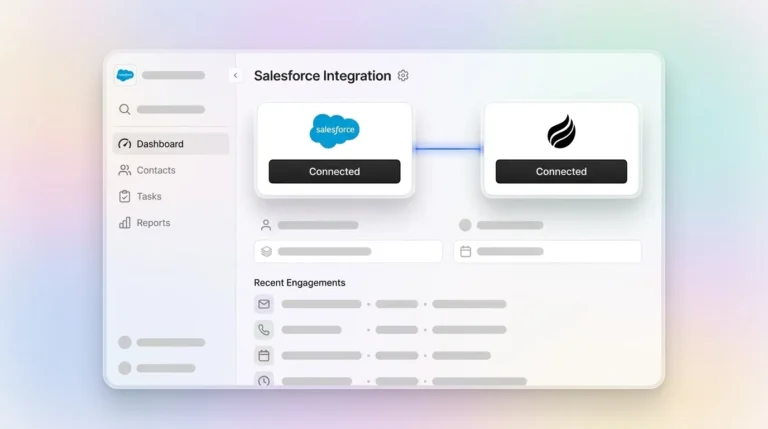
How Deep Bidirectional Sync Actually Works
Every vendor claims deep Salesforce integration, yet admins experience something more specific day to day.
Salesloft’s Salesforce integration uses a native OAuth CRM Sync configurable at 1, 5, or 10-minute pull intervals. From Salesforce into Salesloft, the sync imports leads, contacts, accounts, and opportunities. From Salesloft into Salesforce, each call, email, and completed cadence step writes back as a task with over 30 activity properties. That setup represents a best-case scenario.
The failure modes consume most admin time. The sync silently breaks when a Salesforce admin renames an API field, removes a picklist value, or adds a validation rule. Data then stops flowing for that field, and no alert fires. Salesforce also caps API calls per 24-hour period across every integration connected to the org. A 50-rep team running high-volume sequences can exhaust the budget quickly, especially when enrichment and reporting tools share the same API limit.
Outreach batches updates and waits 60 seconds before pushing them to Salesforce in a single API call. Tasks created in Salesforce do not sync back into Outreach, so teams that manage task workflows in both systems must design around that gap.
On the native side, Einstein Activity Capture stores captured email and calendar data on AWS by default rather than as standard Salesforce objects. Captured emails do not appear in standard Salesforce reports, are not queryable via SOQL, cannot trigger Flows, and stay invisible to the API. The Summer ’25 release introduced a setting to write new emails as native EmailMessage records. The migration is irreversible and historical backfill is capped at 180 days, so every email captured before that window remains on AWS outside native reporting.
Field mapping conflicts, required-field validation errors, forecasting object mismatches, and historical context loss when fields are overwritten appear constantly. They form the normal operating condition of any sync-based architecture at scale, and they directly affect data quality.
The Data-Quality Bottleneck
Every engagement platform inherits the data quality of your Salesforce instance. That inheritance is the central fact of the decision.
Market data shared by Coffee shows that 71% of sales reps say they spend too much time on data entry, leaving only 35% of their time for selling. Only 9% of businesses trust their CRM data, and 37% of CRM users report direct revenue loss from poor data quality. CRM data decays at approximately 30–34% per year without active enrichment, so a 50,000-contact database loses between 15,000 and 17,000 accurate records in a single year.
Sequences that run on stale contacts misfire and waste rep time. Incomplete activity logs distort pipeline reports and weaken leadership decisions. Missing call notes turn forecast confidence intervals into guesswork. AI-powered outreach amplifies these problems because an AI agent runs outbound sequences at scale on whatever data it receives. A human rep might skip an obviously dead contact, while an agent keeps going.
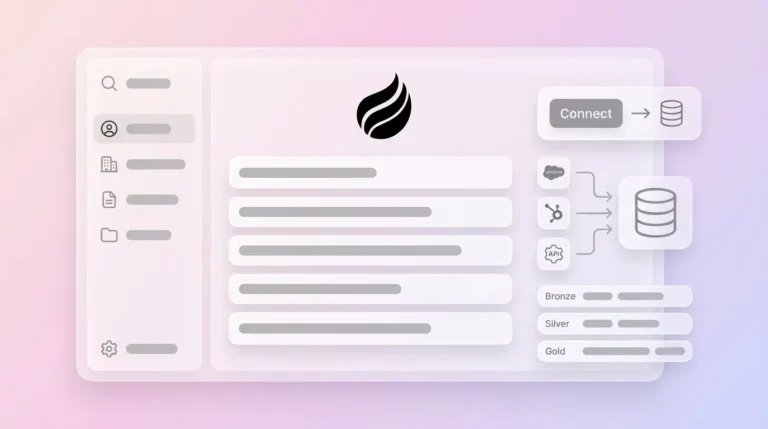
The Coffee Agent focuses on this bottleneck. The Coffee Companion App for Salesforce connects to your existing Salesforce instance and handles the data-in process autonomously. It auto-creates and enriches contacts and companies from email and calendar, logs activity without rep input, and writes insights back to Salesforce so the engagement tool has accurate data to work with. Coffee is SOC 2 Type 2 and GDPR compliant and does not use customer data to train public models.

Fix Your Salesforce Data First
Admin Overhead And Total Cost Of Ownership
License fees represent only one slice of the cost. Setup effort, ongoing maintenance, internal ownership, and the impact of another data silo all shape total cost of ownership.
Revenue Grid’s 50-seat Outreach TCO model estimates Salesforce admin overhead at 5 hours per month. That workload translates to $6,000–$12,000 per year in internal cost and appears as a non-negotiable line item. Total cost of ownership for a 50-seat Outreach deployment runs $105,000–$161,000 in Year 1. That figure covers base licenses, implementation, tier upgrades, voice usage, data providers, and Salesforce admin overhead.
Only 3 of 11 sales engagement vendors publish actual per-seat pricing. Outreach, Salesloft, Groove By Clari, Gong Engage, and ZoomInfo Engage all use quote-only pricing, which makes pre-call cost modeling difficult.
Coffee uses simple seat-based pricing. You pay for the human seats, and the agent’s unlimited labor is included. The model avoids complex metering on LLM usage or processes and removes the need for a separate enrichment subscription alongside the engagement tool.
What Admins Actually Complain About
Admin feedback across tools points to a consistent pattern: cadence builders feel clunky, syncs fail quietly, and fragmented logging breaks reporting and automation.
- TrustRadius reviewers describe “loads of room for improvement” across the Salesforce Sales Engagement cadence builder UI, especially around editing cadences after activation and adding prospects.
- A verified Capterra reviewer of Outreach wrote that it “doesn’t always sync well to Salesforce” and that this becomes troublesome when leaders rely on activity to prove rep value.
- The three most common causes of Salesloft activities not appearing in Salesforce are disabled activity logging, missing Task write permissions for the integration user, or hitting the daily API call limit.
- Salesforce Sales Engagement cadences allow only one active cadence per record at a time and require explicit admin configuration to exit targets upon reply.
- Sync-based architectures store email and call data in the engagement tool’s database, which prevents that activity from feeding Salesforce collaborative forecasting or triggering Change Data Capture events. RevOps automation rules built on CDC then break.
- If Einstein Activity Capture, a Gmail or Outlook extension, and a conversation intelligence tool all log the same meeting, activity counts inflate, duplicates appear, and automations based on last activity date or meeting volume misfire.
How To Choose By Team Size And Motion
Team size, sales motion, and admin capacity should guide your engagement stack decisions.
Small Teams (Under 20 Reps), Inbound-Heavy, Limited Admin Capacity: Native Salesforce Sales Engagement works for teams already on Sales Cloud Unlimited. Small teams with low lead volume may perform well using standard Salesforce tasks and templates instead of paying for Sales Engagement. For free Salesforce-friendly options, the native Work Queue and quick cadences on Unlimited provide a reasonable starting point before adding a third-party subscription.
Mid-Market Teams (20–200 Reps), Outbound-Heavy, Dedicated RevOps: Third-party platforms like Outreach, Salesloft, or Apollo provide deeper sequencing logic and stronger multichannel support. Apollo offers strong value for SMB and mid-market teams with its combined database-plus-engagement model and published pricing tiers starting at $49/user/month. Budget for sync maintenance overhead regardless of which platform you choose.
Any Team Committed To Salesforce That Wants Reliable Engagement: An agent layer acts as the prerequisite for effective engagement. The Coffee Companion App for Salesforce fixes data-in first by auto-creating contacts, enriching records, and logging activity autonomously, so whichever engagement tool sits on top inherits clean, current data. Coffee’s Campaigns feature also runs multi-step, AI-generated email sequences from the rep’s own connected mailbox with stop-on-reply enabled by default, which closes the loop from data enrichment to outreach inside one agent.

Frequently Asked Questions
Is Salesforce A Sales Engagement Platform?
Salesforce provides native Sales Engagement, formerly High Velocity Sales, built into Sales Cloud. It includes sales cadences, a prioritized Work Queue, Einstein Activity Capture, and Einstein Lead Scoring. Pricing and edition details appear in the sections above.
How Much Does Salesforce Sales Engagement Cost?
As covered above, Salesforce Sales Engagement runs $50 per user per month as an add-on for Professional and Enterprise and is included with Unlimited and Agentforce 1 Sales Edition. Sales Dialer and full AI-tier features require separate add-on purchases.
What Is The Best Sales Engagement Platform For Salesforce?
No single platform fits every team. Native Salesforce Sales Engagement suits teams already on Unlimited. Outreach and Salesloft fit high-volume outbound teams with dedicated RevOps. Apollo fits mid-market teams that want a combined database and engagement tool. Across all of these, the data-quality layer underneath the engagement tool determines whether any platform delivers on its promise, which is where Coffee’s Companion App for Salesforce fits.
Does Coffee Integrate With Salesforce?
Coffee connects to Salesforce as a Companion App through simple authentication. The Coffee Agent auto-creates and enriches contacts and companies from email and calendar data, logs activity autonomously, and writes insights back to Salesforce. Coffee is SOC 2 Type 2 and GDPR compliant and does not use customer data to train public models.

Conclusion: Fix Data Before You Pick A Platform
The sales engagement platform decision matters, yet the primary decision concerns whether the Salesforce data feeding your engagement tool is accurate enough to trust. 62% of organizations have suffered direct revenue loss due to poor CRM data quality, and every engagement platform on your shortlist inherits that problem on day one.
Coffee acts as the agent layer that solves data-in before sequences run. The Coffee Companion App for Salesforce auto-creates contacts, enriches records, logs activity without rep input, and writes clean data back to Salesforce so the engagement tool on top has something worth engaging. Coffee is SOC 2 Type 2 and GDPR compliant, uses simple seat-based pricing with no metering on agent labor, and deploys without a months-long implementation project.
Pick your engagement platform, but fix your data first, because every platform on your shortlist will inherit whatever data quality you hand it.