Written by: Doug Camplejohn, CEO & Co-Founder, Coffee
Key Takeaways for MEDDIC-Focused Enterprise Teams
- MEDDIC methodology improves forecast accuracy for leading revenue teams by qualifying deals across Metrics, Economic Buyer, Decision Criteria, Decision Process, Identify Pain, and Champion.
- Traditional CRMs fail enterprise teams because manual entry consumes 71% of reps’ time and creates 30-50% forecast errors when automation is missing.
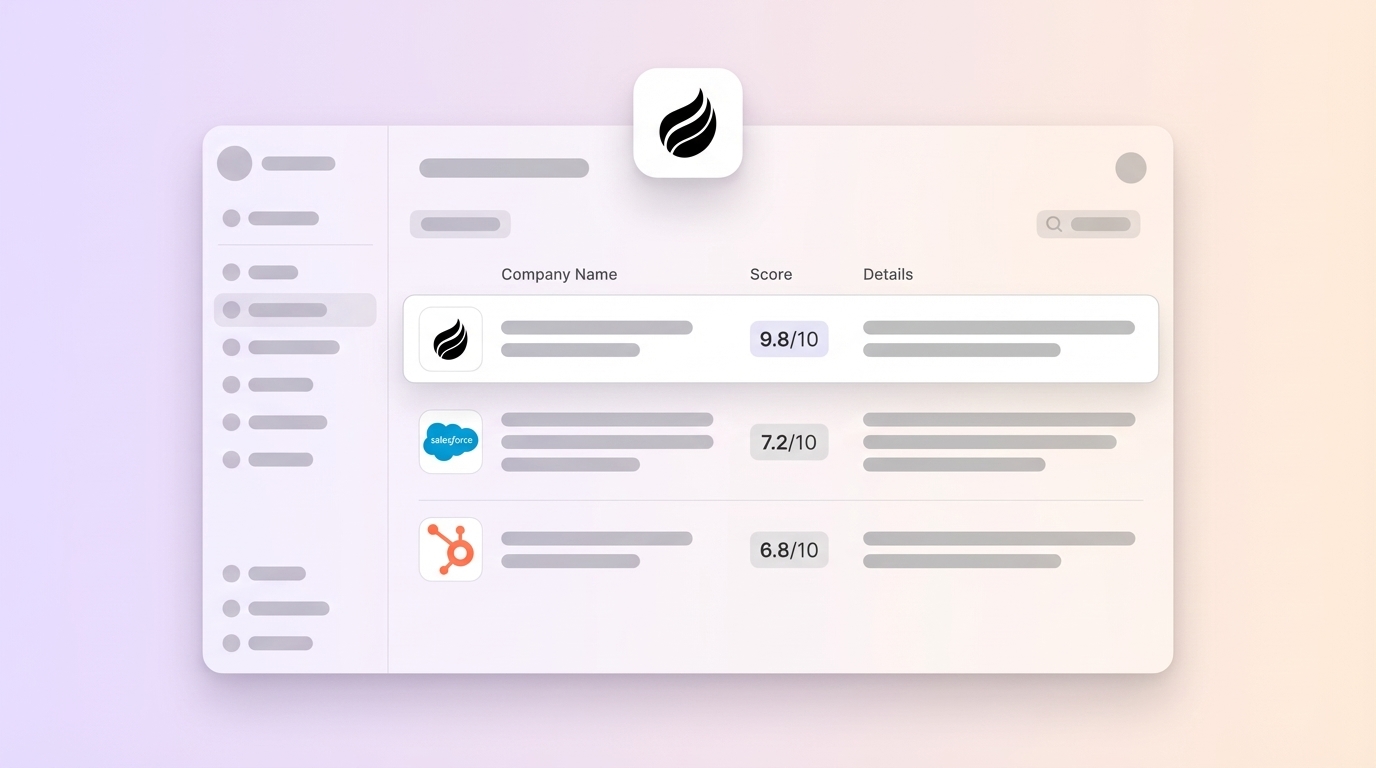
- Coffee holds a 9.2/10 score by using AI agents that capture and structure MEDDIC data from emails, calls, and meetings, then sync it to Salesforce and HubSpot.
- Salesforce (7.8/10) and HubSpot (7.5/10) offer deep customization but still rely heavily on manual work, while tools like Gong specialize in conversation analysis.
- Teams that prioritize AI automation see stronger MEDDIC outcomes; explore Coffee’s zero-training qualification that scales enterprise sales.
Why Enterprise B2B Teams Need MEDDIC-Friendly CRMs in 2026
MEDDIC sales methodology covers six qualification areas: Metrics (quantifiable business impact), Economic Buyer (budget authority), Decision Criteria (evaluation requirements), Decision Process (approval workflow), Identify Pain (specific problems), and Champion (internal advocate). Organizations using MEDDIC benefit from more accurate forecasting and higher close rates compared to basic qualification frameworks like BANT.
Enterprise teams need CRMs that support custom MEDDIC fields, automated data population, and scalable reporting. Parametric Technology Corporation (PTC) boosted its sales from $300 million to $1 billion after implementing the MEDDIC sales methodology, showing the methodology’s enterprise impact when technology supports consistent execution.
However, PTC’s success story does not guarantee similar results for every organization. The challenge lies in execution. MEDDIC training adherence drops 40-50% within six months without technology support, even when companies invest $100,000 to $500,000 per year in training specialists. Modern CRM solutions must close this gap with intelligent automation that keeps qualification data complete and current.
How We Ranked the Best MEDDIC CRMs for 2026
Our evaluation framework focuses on the real needs of enterprise B2B sales teams running MEDDIC at scale. The table below shows how we weighted each criterion, with MEDDIC automation receiving the highest weight because it directly reduces the manual entry burden that causes most implementations to fail.
|
Criteria |
Weight |
Why It Matters |
Benchmark |
|
MEDDIC Automation |
30% |
Reduces manual entry burden |
75%+ field completion |
|
Enterprise Scalability |
25% |
Supports large sales teams |
1000+ users |
|
Integration Depth |
20% |
Works with existing stack |
Native SF/HubSpot sync |
|
Data Quality |
15% |
Ensures forecast accuracy |
Sub-10% variance |
|
User Adoption |
10% |
Drives consistent usage |
80%+ daily active users |
We analyzed 2026 market data from leading revenue intelligence platforms and enterprise implementation case studies. These sources helped us rank solutions based on real-world MEDDIC performance instead of feature lists alone.
9 Best MEDDIC-Friendly CRMs for Enterprise B2B Sales Teams (2026)
1. Coffee – Agentic CRM for Automated MEDDIC Data Capture
Coffee transforms sales processes with autonomous AI agents that capture and structure data from emails, calls, and interactions. Traditional CRMs rely on manual entry. Coffee’s agent handles data unification and syncs structured information to existing Salesforce or HubSpot instances.

MEDDIC Strengths:
- AI-powered meeting notes structured according to MEDDIC methodology, extracting the six qualification elements from every customer conversation.
- This structured data flows into automatic contact and company creation with enrichment from emails, so your CRM reflects the full stakeholder map.
- Before each meeting, Coffee provides briefings and automated summaries that surface relevant MEDDIC context from previous interactions.
- All captured data feeds pipeline intelligence with week-over-week tracking that highlights qualification completeness across deals.

Enterprise Fit: Coffee works as a companion app for existing Salesforce and HubSpot teams or as a standalone CRM for small to mid-sized organizations. Coffee.ai introduced an Intelligence layer that allows users to define and store deep context on business model, product specifics, ICP, and competitors for tailored AI suggestions. This capability supports sophisticated sales customization for complex enterprises.

Score: 9.2/10. Coffee leads in automation capabilities while still scaling with growing teams. Experience Coffee’s agentic sales automation and reduce manual MEDDIC work for your reps.

2. Salesforce Sales Cloud
While Coffee leads in automation, many enterprise teams already rely on Salesforce infrastructure. Salesforce Sales Cloud offers extensive MEDDIC customization through custom objects, fields, and Lightning App Builder. Implementation complexity and manual entry requirements limit effectiveness when teams do not pair Salesforce with an automation layer.
MEDDIC Strengths:
- Unlimited custom fields for all MEDDIC elements
- Advanced reporting and dashboard capabilities
- Workflow automation through Flow and Process Builder
- Enterprise-grade security and compliance
Limitations: Salesforce often requires dedicated administrators and heavy manual data entry. Total cost of ownership often reaches tens or hundreds of thousands of dollars due to implementation and maintenance.
Score: 7.8/10. Salesforce remains powerful but feels complex without an AI automation layer.
3. HubSpot CRM
HubSpot CRM serves mid-market teams with intuitive MEDDIC field customization and built-in automation. HubSpot CRM supports custom pipelines, property fields for contacts and companies, a visual automation designer, and dynamic dashboards.
MEDDIC Strengths:
- Drag-and-drop custom property creation
- MEDDIC-specific deal templates and workflows
- Integrated email and meeting scheduling
- Built-in reporting for qualification completeness
Limitations: Advanced MEDDIC features sit behind the Enterprise tier at $75 per user each month. Reps still complete most qualification data manually.
Score: 7.5/10. HubSpot offers a strong mid-market solution with expanding enterprise capabilities.
4. Microsoft Dynamics 365
Microsoft Dynamics 365 targets enterprises that standardize on the Microsoft ecosystem. Microsoft Dynamics 365 supports low-code customization of forms, workflows, and business rules via Power Platform.
MEDDIC Strengths:
- Native Teams and Outlook integration for data capture
- Power Platform automation capabilities
- Advanced AI insights through Viva Sales
- Enterprise security and compliance features
Score: 7.2/10. Dynamics 365 works well for Microsoft-centric enterprises but has complex licensing.
5. Gong Revenue Intelligence
Gong focuses on conversation intelligence and MEDDIC signal extraction from calls. The platform maps call signals such as budget, decision makers, and challenges into corresponding MEDDIC methodology fields.
MEDDIC Strengths:
- Automatic extraction of MEDDIC elements from sales calls
- Deal risk identification based on qualification gaps
- Competitive intelligence and objection handling
- Pipeline forecasting based on conversation data
Score: 7.0/10. Gong excels at call analysis but still requires a separate CRM.
6. Chorus.ai (ZoomInfo)
Chorus.ai provides revenue intelligence with a focus on conversation analysis and MEDDIC qualification extraction from customer interactions.
MEDDIC Strengths:
- AI-powered qualification scoring from calls
- Automatic Champion and Economic Buyer identification
- Decision Process timeline mapping
- Integration with major CRM platforms
Score: 6.8/10. Chorus.ai delivers strong conversation intelligence but limited standalone CRM features.
7. Clari Revenue Operations
Clari focuses on revenue operations with MEDDIC-based forecasting and pipeline management.
MEDDIC Strengths:
- MEDDIC-based deal inspection and coaching
- Automated forecast accuracy tracking
- Pipeline change analysis and alerts
- Integration with existing CRM systems
Score: 6.5/10. Clari centers on forecasting and still depends on an underlying CRM.
8. Gainsight Customer Success
Gainsight supports customer success teams with MEDDIC tracking for expansion and renewal opportunities.
MEDDIC Strengths:
- Post-sale MEDDIC qualification for expansions
- Customer health scoring based on qualification data
- Renewal risk identification through MEDDIC gaps
- Integration with sales CRM systems
Score: 6.2/10. Gainsight specializes in customer success more than new business sales.
9. Pipedrive
Pipedrive serves SMB teams with basic MEDDIC field customization and visual pipeline management.
MEDDIC Strengths:
- Simple custom field creation for MEDDIC elements
- Visual pipeline management
- Basic automation and workflow capabilities
- Affordable pricing for smaller teams
Score: 5.8/10. Pipedrive offers limited enterprise scalability and automation depth.
MEDDIC CRM Comparison Table for Fast Shortlisting
The table below summarizes how each platform performs across our three most critical dimensions. Use it to quickly see which solution matches your automation needs, scale requirements, and integration preferences before you dive into detailed evaluations.
|
CRM Platform |
MEDDIC Automation |
Enterprise Scale |
Integration Depth |
Overall Score |
|
Coffee |
AI Agent Data Capture |
Small-Mid Market |
Native SF/HubSpot |
9.2/10 |
|
Salesforce |
Manual + Flows |
Enterprise-grade |
Extensive AppExchange |
7.8/10 |
|
HubSpot |
Basic Workflows |
Mid-market focus |
Marketplace apps |
7.5/10 |
|
Dynamics 365 |
Power Platform |
Enterprise-ready |
Microsoft ecosystem |
7.2/10 |
|
Gong |
Call intelligence |
Scalable |
CRM overlays |
7.0/10 |
Coffee leads in automation capabilities, delivering deals closing up to 23% faster than those relying on manual entry through its agentic approach to data population.
Buyer Guide: Selecting and Rolling Out a MEDDIC CRM
Enterprise teams should choose CRMs that cut manual entry while protecting data quality. For existing Salesforce users, Coffee’s companion app adds immediate MEDDIC automation without migration risk. Coffee.ai released improved summary templates customizable to match workflows and writable back to Coffee, HubSpot, or Salesforce, which helps teams align automation with their current processes.
Implementation Steps:
- Trial automation capabilities with sample MEDDIC data to confirm the platform can extract the six core elements from your real sales conversations.
- After you validate extraction accuracy, pilot with 5-10 reps to check that automated field population matches your team’s qualification standards.
- Once you confirm accuracy and rep acceptance, scale gradually while monitoring adoption and data quality so you can catch edge cases before full deployment.
Common Pitfalls: Avoid CRMs that depend on extensive manual MEDDIC entry, because the adherence challenges mentioned earlier become inevitable without automation support. Experience Coffee’s zero-training MEDDIC automation that maintains adherence without extra manual effort.
MEDDIC CRM FAQs
What is the best CRM for enterprise MEDDIC implementation?
Coffee stands out for MEDDIC implementation in small to mid-market teams because its autonomous AI agent captures sales data from emails, calls, and interactions. The platform structures notes according to MEDDIC methodology and keeps data consistent without extra effort from reps.
As discussed in the rankings above, Coffee can run as a standalone CRM or as a companion app for existing Salesforce and HubSpot instances, which supports teams that want automation without a risky migration.
How do I set up MEDDIC tracking in Salesforce?
Salesforce MEDDIC setup starts with custom fields for Metrics, Economic Buyer, Decision Criteria, Decision Process, Identify Pain, and Champion. You then use Lightning App Builder to design page layouts and create workflow rules for data validation.
Manual entry still creates friction for reps. As covered earlier, Coffee’s companion app can automatically populate Salesforce MEDDIC fields through AI analysis of sales interactions, which improves accuracy while reducing rep workload.
What is the difference between MEDDIC and MEDDPICC?
MEDDPICC extends the original MEDDIC framework by adding Paper Process, which covers contract and legal requirements, and Competition, which covers competitive landscape analysis. MEDDIC focuses on six core qualification elements.
MEDDPICC expands that list to eight elements for more detailed deal analysis. Both approaches require consistent CRM tracking, and MEDDPICC adds even more fields and data points, which increases the value of automation for enterprise teams.
Can AI CRMs effectively automate MEDDIC qualification?
Modern AI CRMs such as Coffee can extract and populate MEDDIC elements from sales conversations, emails, and meeting transcripts.
AI agents identify Champions through communication patterns, pull Metrics from customer discussions, and map Decision Processes based on stakeholder interactions. This automation solves the primary MEDDIC adoption challenge, which is consistent data entry that previously depended on manual effort from sales reps.
What does enterprise CRM pricing look like for MEDDIC-focused teams?
Enterprise CRM pricing varies based on automation depth and required customization. Traditional platforms like Salesforce often start around $100 or more per user each month and then add implementation and maintenance costs.
HubSpot Enterprise begins at $75 per user each month for advanced MEDDIC features. Coffee uses transparent seat-based pricing that includes unlimited AI agent labor for MEDDIC automation, which often delivers stronger ROI through time savings and improved forecast accuracy compared to manual-entry platforms.
Next Steps for MEDDIC Success in 2026
Enterprise B2B sales will increasingly depend on intelligent automation that preserves MEDDIC data quality without overloading sales reps. Coffee’s agentic approach shifts teams from passive CRM databases to active AI agents that keep data accurate for forecasting and pipeline intelligence.
Whether your team uses Salesforce, HubSpot, or a standalone solution, you should choose technology that automates MEDDIC qualification instead of adding administrative work.
Transform your MEDDIC implementation with Coffee from a manual process into automated intelligence that scales with your enterprise growth.