Key Takeaways for 2026 Visitor Identification
- Person-level website visitor identification resolves anonymous sessions to named individuals using pixels, IP matching, cookies, and identity graphs, with realistic 2026 match rates of 5–40%.
- Warmly relies on a multi-provider waterfall for company- and person-level matches but delivers raw lists that still require manual prioritization and outreach by sales reps.
- Structural 2026 factors such as remote work, VPNs, cookie deprecation, and the California Delete Act constrain Warmly’s person-level accuracy and data quality.
- Coffee combines a single pixel with agent-driven enrichment to surface persona-matched Suggested Leads, create CRM records, and trigger outbound actions without manual data entry.
- Teams ready to remove manual enrichment and turn anonymous traffic into actionable leads should get started with Coffee.
How Warmly Performs Person-Level Identification in 2026
Warmly installs a JavaScript pixel that captures each visitor’s IP address, browser signals, and behavioral data. It then routes that signal through a waterfall of identification methods to maximize coverage.
Warmly’s identification process follows a sequential waterfall. First, IP-to-company matching maps the visitor’s IP against commercial databases of corporate IP ranges to return company name, industry, and size. IP-to-company matching typically achieves 30–50% identification rates for B2B traffic and performs better on office networks than home networks.
When IP matching fails or returns incomplete data, the multi-provider waterfall routes each visitor through additional data providers to compensate for gaps in any single source and improve both company- and person-level match rates. Once a match is established, cookie and identity graph enrichment use first-party cookies to stitch sessions into a behavioral timeline, then attempt to link that timeline to a verified individual profile.
The resulting identifications trigger two main outputs. Real-time Slack alerts notify sales reps immediately with company and, where available, person-level data. CRM sync pushes identified records to connected CRMs, although the completeness of those records depends on whether person-level identification succeeded for that visitor.
The output is a list of company accounts and, at lower frequency, named individuals. A sales rep must still manually evaluate, prioritize, enrich, and act on those records.
Warmly Match Rates and 2026 Structural Limitations
Warmly claims 65% company-level and 15–25% person-level identification rates by combining multiple data providers, while independent benchmarks report more conservative performance.
Several structural factors constrain those numbers in 2026.
- Remote and hybrid work: A large share of knowledge workers now operate remotely or in hybrid models, which causes IP-based identification to fail for traffic originating from residential ISPs.
- VPNs and privacy tools: Privacy-focused browsers, ad blockers, and VPNs reduce the quality and quantity of identifying signals available.
- Mobile and cross-device fragmentation: Cookies do not persist across devices, so a visitor browsing on mobile and then on a laptop appears as two separate people.
- Cookie deprecation: Chrome has not eliminated third-party cookie support, which preserves traditional identification methods in that browser while Safari, Firefox, and privacy regulations have reduced their effectiveness elsewhere.
- California Delete Act: The California Delete Act allows consumers to submit a single deletion request across all registered data brokers, directly degrading the third-party identity graphs that waterfall tools depend on.
- Bot traffic inflation: Bots accounted for more than 53% of all global web traffic in 2025, so a significant portion of “visitors” Warmly processes are non-human sessions that inflate raw visitor counts without producing actionable leads.
The practical result is a raw list that still demands human effort. Sales reps must decide which person to contact, locate their LinkedIn profile, create a CRM record, and initiate outreach manually.
Coffee Visitor Identification: Agent-Led Workflow From a Single Pixel
These manual steps represent the core workflow gap that Coffee addresses differently. Coffee’s visitor identification is built into the same agent that runs its CRM, which changes the post-identification workflow entirely.
- Single pixel installation: Add one script into the
<head>tag. Coffee verifies installation and begins identifying visitors immediately. - Person-level inference: Coffee infers name, title, email, and LinkedIn profile alongside company, pages visited, time on site, and visit frequency.
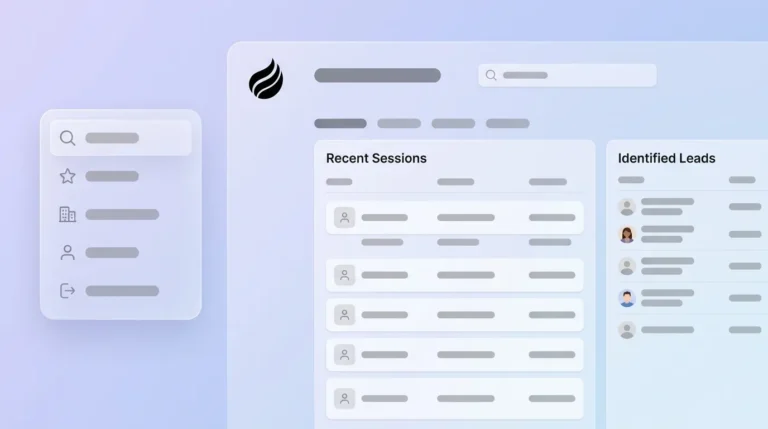
- Suggested Leads: Coffee’s agent applies your defined buyer persona to the visiting company and surfaces two or three specific individuals inside that company who match your ICP, with LinkedIn profiles ready for outreach. This approach differs from tools like Warmly and RB2B that return undifferentiated people lists or company-only data.
- Automatic CRM record creation: With one click, the prospect is added to Coffee with contact, company, enrichment data, and visit history all pre-filled. Manual data entry disappears from the workflow.
- Immediate outbound actions: Real-time Slack notifications surface high-fit visitors, and the agent enables direct LinkedIn connection requests, outbound email drafting, or auto-enrollment into a drip campaign without leaving the platform.
For teams already on Salesforce or HubSpot, Coffee Companion writes these enriched records back to the existing system of record automatically. See how Coffee Companion integrates with your existing CRM.

Warmly vs Coffee: Head-to-Head on Five Evaluation Criteria
| Criteria | Warmly | Coffee Standalone | Coffee Companion |
|---|---|---|---|
| Data quality (person-level match rate) | 15–25% person-level match rates per vendor and reviews | Person-level inference with Suggested Leads matched to buyer persona; no published third-party benchmark | Same identification engine; enriched records written to Salesforce/HubSpot automatically |
| Implementation effort | Multi-provider waterfall setup, with CRM integration configuration required per provider | Single pixel in <head>, Google Workspace or Microsoft 365 auth, no additional configuration |
Single pixel plus CRM OAuth authentication, with the agent handling sync |
| Workflow automation depth | Slack alerts and CRM push, with manual rep action required to prioritize, enrich, and initiate outreach | Agent creates contact and company records, surfaces Suggested Leads, and enables one-click LinkedIn or email outreach | Same automation, with outputs written back to the existing Salesforce or HubSpot instance |
| Privacy/compliance posture | Person-level identification raises GDPR and CCPA concerns, with US-focused person-level data | SOC 2 Type 2 and GDPR compliant, with data not used to train public models | SOC 2 Type 2 and GDPR compliant, with data not used to train public models |
| Post-identification actionability | Raw company list or undifferentiated people list, so reps select and act manually | Persona-matched Suggested Leads with pre-filled enrichment and immediate outbound from within the agent | Persona-matched Suggested Leads, with outbound triggered from within Salesforce or HubSpot workflows |
Implementation Steps for Warmly and Coffee
Warmly requires creating an account, installing the pixel, connecting and configuring each data provider in the waterfall, mapping fields to the target CRM, and setting up Slack alert routing. Each provider connection may require separate authentication and field-mapping work.
Coffee compresses setup to two steps. Teams paste the auto-generated pixel script into the site’s <head> tag, then authenticate Google Workspace or Microsoft 365. The agent verifies pixel installation and begins identifying visitors. For Coffee Companion users, a CRM OAuth connection routes enriched records directly into Salesforce or HubSpot without additional configuration.

2026 Privacy and Compliance Considerations
Under GDPR, person-level visitor identification processes personal data and requires a lawful basis such as consent (which need not be explicit) or another basis under Article 6, while company-level identification can typically proceed under legitimate interest. A compliant implementation uses a consent management platform so the identification pixel fires only when functional or analytics consent is granted for EU visitors.
Under CCPA/CPRA, businesses must disclose data collection in a privacy policy, provide a “Do Not Sell or Share My Personal Information” link, honor opt-out requests within 15 business days, and allow consumers to request deletion. The California Delete Act mentioned earlier allows consumers to submit a single deletion request across all registered data brokers, so businesses must confirm how vendors handle these requests and how that affects identity graph coverage.
GDPR regulators have classified browser fingerprinting as a tracking technology requiring consent, and UK ICO guidance treats fingerprinting as requiring explicit consent. Coffee holds SOC 2 Type 2 and GDPR compliance certifications and does not use customer data to train public models, which reduces vendor-side compliance risk for buyers.
Review Coffee’s security and compliance posture before deploying visitor identification at scale.
Best-Fit Scenarios and Practical Decision Checklist
Warmly suits mid-market teams that already have a dedicated SDR function to manually work raw visitor lists. These teams want real-time Slack alerts as a signal layer on top of an existing sales stack and have RevOps bandwidth to configure and maintain a multi-provider waterfall.
Coffee Standalone suits early-stage or small teams with 1–20 employees where the agent needs to function as the entire CRM. These teams want anonymous traffic converted into enriched records and Suggested Leads without manual data entry or separate enrichment tooling.
Coffee Companion suits small-to-mid-market teams committed to Salesforce or HubSpot that want visitor identification, persona-matched lead suggestions, and automatic CRM record creation while keeping their existing system of record.
Decision checklist:
- Teams with fewer than 20 employees and no existing CRM should choose Coffee Standalone.
- Teams on Salesforce or HubSpot with low CRM adoption and poor data quality should consider Coffee Companion.
- Teams with a dedicated SDR group to manually work raw visitor lists may use Warmly as a signal layer.
- Teams that need Suggested Leads matched to a buyer persona without manual enrichment should select Coffee.
- Teams that treat eliminating manual data entry as a primary requirement should select Coffee.
- Teams that require GDPR-compliant person-level identification with SOC 2 Type 2 certification should select Coffee.
See Suggested Leads from your own website traffic with a Coffee trial.
Frequently Asked Questions
What realistic match rates can I expect from person-level tools in 2026?
Person-level match rates vary significantly by tool, traffic source, and geography. The 5–40% person-level and 30–65% company-level ranges mentioned earlier reflect real-world performance across the industry. These rates shift based on traffic mix, with corporate office traffic identifying at higher rates than mobile or home traffic.
Tools using deterministic identity graph matching tend toward the higher end of the person-level range for US traffic, while probabilistic methods and waterfall approaches produce more variable results. Mobile traffic, visitors on VPNs, and remote workers on residential ISPs all identify at lower rates than visitors on corporate networks. Identity graphs also face ongoing erosion from privacy regulation, so match rates reported before 2026 may overstate current performance.
How do VPNs and remote work affect Warmly identification accuracy?
VPNs and remote work act as primary structural constraints on IP-based identification accuracy in 2026. When an employee connects from a home network, their traffic resolves to a residential ISP like Comcast or AT&T rather than their employer’s corporate IP range, which makes IP-to-company matching fail for that session.
A significant portion of knowledge workers now operate remotely or in hybrid models, so much of B2B website traffic may originate from addresses that IP-based tools cannot match to a company. VPNs compound this pattern by routing traffic through third-party servers that have no relationship to the visitor’s employer.
Warmly’s multi-provider waterfall partially compensates by layering cookie and identity graph signals on top of IP matching, yet those signals are also degraded by cookie deprecation, privacy browsers, and ad blockers. Warmly’s person-level identification is therefore most reliable for visitors arriving from corporate office networks, which represent a shrinking share of total B2B traffic.
Does Coffee visitor identification require extra data-entry work?
Coffee’s agent removes manual data entry from the visitor identification workflow. When a visitor is identified, the agent infers name, title, email, LinkedIn profile, company details, pages visited, and visit history, then stores that information automatically.
The agent applies your buyer persona to surface Suggested Leads inside the visiting company, with LinkedIn profiles ready for outreach. With one click, the prospect becomes a fully enriched contact and company record inside Coffee. For teams using Coffee Companion on top of Salesforce or HubSpot, those enriched records sync back to the existing CRM automatically, so reps avoid copy-pasting and separate enrichment steps.
Which solution is GDPR-compliant for person-level data?
Both Warmly and Coffee operate primarily on US traffic for person-level identification, where GDPR does not apply directly. For EU visitors, person-level identification processes personal data and requires a lawful basis such as consent or another basis under Article 6, while company-level identification can typically proceed under legitimate interest.
Coffee holds SOC 2 Type 2 and GDPR compliance certifications and does not use customer data to train public models. When evaluating any person-level identification vendor for EU traffic, buyers should confirm the presence of a consent management platform that gates the identification pixel on consent, EU-hosted data processing, a published opt-out mechanism, and certifications such as SOC 2 Type 2 or ISO 27001.
Buyers should also review vendor data processing agreements and confirm how the tool handles deletion requests under both CCPA and the California Delete Act before deployment.