Written by: Doug Camplejohn, CEO & Co-Founder, Coffee | Last updated: July 22, 2026
Key Takeaways for 2026 BANT Success
- BANT still works in 2026 when you treat it as a scored diagnostic conversation instead of a recited checklist, driving up to 59% higher conversion rates.
- Modern BANT discovery flows start with Need, then move to Authority and Timeline, with Budget last to keep conversations natural and reduce defensiveness.
- Open-ended, ROI-framed questions and a 0–2 scoring rubric per element create consistent qualification data that sales and revenue teams can use immediately.
- High-performing teams use BANT for rapid inbound triage and layer MEDDIC for complex, multi-stakeholder deals above $25K ACV.
- AI agents like Coffee remove manual CRM entry by automatically capturing, scoring, and writing BANT results back to Salesforce or HubSpot after every call.
The Four-Step Conversational Discovery Flow
Modern BANT in 2026 starts with Need instead of Budget to keep prospects relaxed and open. Classic BANT that opens on Budget often triggers defensiveness and short answers. The sequence below reflects a Need-first approach and shows why each transition feels natural for the buyer.
Need first. Start with the prospect’s problem so the conversation centers on their situation, not your quota. This focus surfaces the pain that will later justify budget creation and support a faster timeline.
Authority second. Once pain is clear, ask who else is affected or who else needs to weigh in so the discussion flows naturally from the problem. Gartner research indicates the typical B2B buying group now includes six to ten stakeholders, so Authority should map the committee instead of chasing a single name.
Timeline third. After the prospect has described the pain and you understand who cares about it, urgency emerges more organically. Ask what is driving the timing or what happens if nothing changes to reveal whether a real deadline exists.
Budget last. Treat budget as a confirmation step instead of a screening question to reduce defensiveness. By this point, the prospect has already described the cost of inaction, so the investment conversation feels proportionate rather than premature.
Practical BANT Discovery Questions That Reveal Real Deals
The table below lists open-ended, ROI-framed questions for each BANT element, based on conversational discovery best practices. Use these questions as prompts that you adapt to your style, not as rigid scripts.
| Element | Sample Question | Strong Answer Sounds Like | Weak Answer Sounds Like |
|---|---|---|---|
| Need | “What does this problem cost you today, in hours, dollars, or missed revenue?” | “We lose about 10 hours per rep per week to manual entry. That’s roughly $400K annually in lost selling time.” | “It’s a bit of a pain, but we manage.” |
| Authority | “Who else should be in this conversation so we can move forward?” | “It’ll be me, our CFO for budget sign-off, and our IT lead for security review.” | “I’ll just run it by my manager at some point.” |
| Timeline | “Is there an event or deadline tied to this, such as a renewal, audit, launch, or board meeting?” | “Our fiscal year starts July 1st and we need this live before then.” | “We’re just exploring our options right now.” |
| Budget | “What would a successful ROI look like for you six months from now?” | “If we reclaim 8 hours per rep per week, that pays for itself in the first month. We have budget set aside.” | “We don’t really have a budget for this right now.” |
BANT Sales Scorecard for Consistent 2026 Qualification
Verbal BANT without scoring stays at the level of casual conversation and rarely produces consistent data. Teams that apply BANT with a clear scorecard discipline see significantly higher conversion rates than teams that rely on unstructured talk tracks. The rubric below uses a 0–2 scale per element for a maximum of 8 points, with explicit definitions at each level.
| Element | 0 — Disqualifying | 1 — Partial | 2 — Confirmed |
|---|---|---|---|
| Need | No specific pain identified, vague interest only | Pain acknowledged but not quantified or prioritized | Pain quantified in dollars, hours, or missed targets, and solving it is a stated priority |
| Authority | Contact has no buying influence and the decision-maker is unknown | Contact is an influencer or champion, but the economic buyer is not yet engaged | Economic buyer identified by name and role, and the decision process is mapped |
| Timeline | No timeline and the prospect is purely exploratory | General intent this year with no specific event driving urgency | Specific event or deadline confirmed, such as a renewal, launch, fiscal year, or board review |
| Budget | No budget and price is a dealbreaker | Budget exists or can be created, but the approval process is unclear | Budget allocated or ROI case strong enough to create it, and the approval path is known |
Qualification thresholds:
- 0–3: Nurture or disqualify, then return to marketing or an SDR sequence.
- 4–5: Schedule one more discovery touch and address the specific gap before advancing.
- 6–7: Advance to demo because the deal is real and ready for the next stage.
- 8: Fast-track to proposal because all criteria are confirmed and the opportunity deserves priority.
BANT vs MEDDIC: Matching Frameworks to Deal Complexity
Once you have scored a deal using BANT, you need to decide whether that framework alone fits the deal size and complexity. BANT and MEDDIC are not competitors because they serve different stages and deal profiles. High-performing teams commonly use BANT as a first-pass filter on all inbound leads, then move deals above a revenue threshold into full MEDDIC qualification. The table below compares the two frameworks across four practical dimensions.
| Dimension | BANT | MEDDIC | Best For |
|---|---|---|---|
| Depth | Four criteria that you can complete in a single discovery call | Six or more criteria that usually require two or three conversations to complete | BANT for triage and MEDDIC for active opportunity management |
| Speed | Completable in 15–20 minutes of discovery | Requires 6–12 months of rigorous implementation for organizations to reach MEDDPICC proficiency | BANT for high-volume inbound and MEDDIC for strategic accounts |
| Ideal deal size | Best suited for deals under $25K with cycles under 30 days | MEDDIC fits $25K–$100K ACV deals with 30–90 day cycles, while MEDDPICC suits $100K+ ACV deals with 90+ day cycles | Match the framework to ACV and cycle length |
| Buying-committee size | Designed for 1–3 decision-makers, and a single Authority question is insufficient for enterprise buying groups | Maps Economic Buyer, Champion, and Decision Process across committees of 6 or more stakeholders | MEDDIC for multi-stakeholder enterprise deals |
Common BANT Mistakes and How to Fix Them Fast
Three execution errors cause most failed BANT qualification attempts in 2026.
- Treating BANT as a rigid checklist. Treating BANT as a yes or no checklist instead of a layered diagnostic conversation often leads to unproductive discovery meetings because prospects feel interrogated and share less context. Using a Need-first approach and asking at least two follow-up questions per element before scoring turns BANT into a diagnostic conversation that surfaces the nuance you need for accurate scores.
- Skipping Need and jumping to Budget. Need acts as the anchor that justifies every other element, and without quantified pain, budget conversations stall while timeline claims lose meaning. Open every discovery call with a pain-quantification question and stay with Need until the cost of inaction is clear before you move to Budget.
- Accepting a vague timeline at face value. “Sometime this year” does not qualify as a real timeline and usually signals a desire to avoid commitment. Ask “What would need to be true internally for you to move by [their stated date]?” to test whether the date reflects real approval mechanics or only an optimistic preference.
How an AI Agent Automates BANT Capture and Scoring
Even reps who run a strong conversational BANT flow face a second challenge, which is getting accurate data into the CRM right after the call. Salesforce research shows reps spend only 28% of their time selling, and CRM data entry for qualification fields is a major productivity drain. Manual note-taking after a call introduces delays, missing details, and inconsistent scoring across the team.
The Coffee Companion App solves this by acting as an AI note-taker and BANT scorer. Coffee’s agent joins calls on Zoom, Teams, or Google Meet, listens to the full conversation, and structures the output into BANT fields automatically. It reads emails and calendar context to fill gaps the call did not cover, assigns a score per element using the 0–2 rubric, and writes the composite score and field-level notes back to the rep’s existing Salesforce or HubSpot instance, all without manual entry.
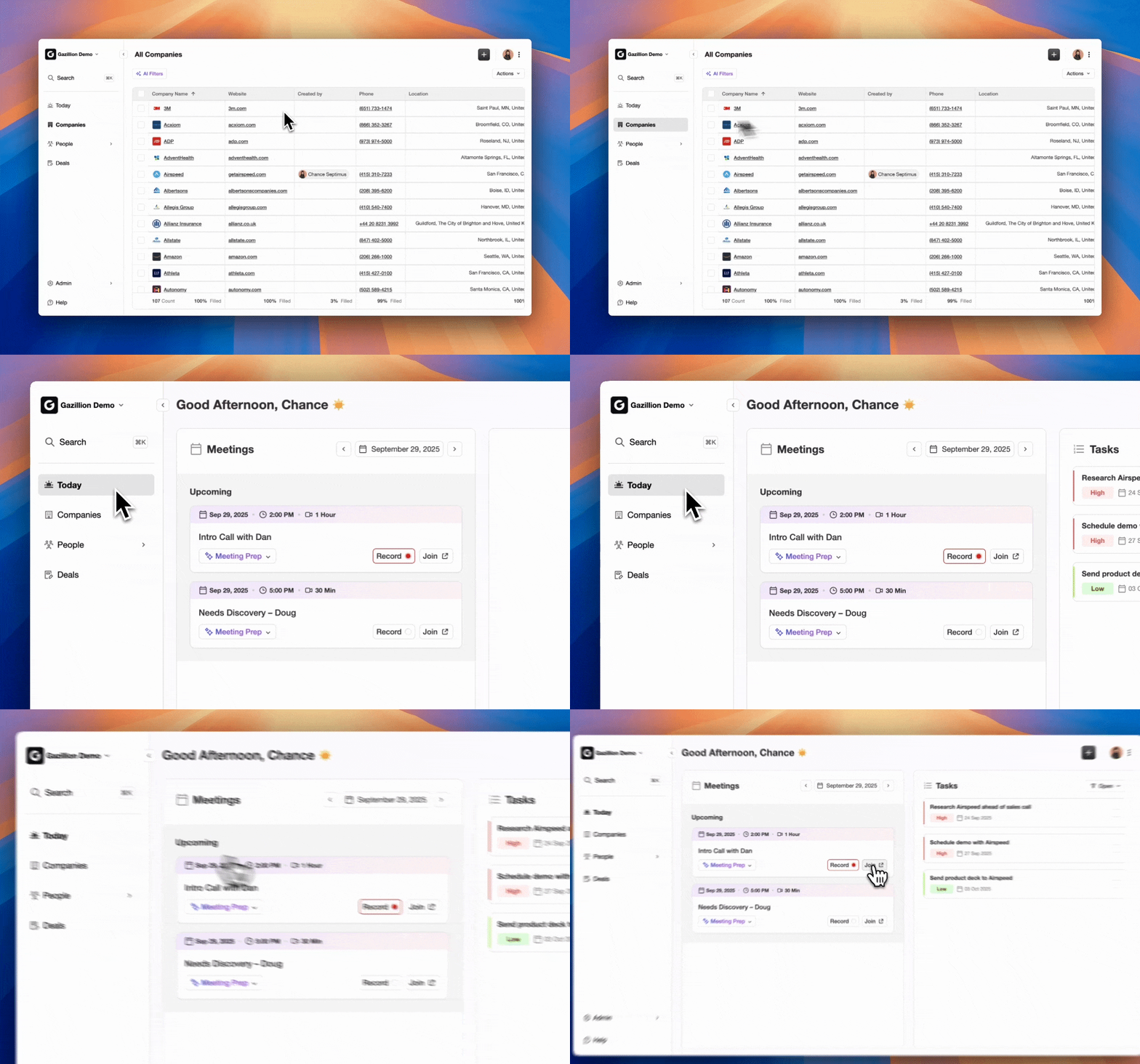
Pipeline reviews then focus on strategy instead of data-quality audits because the CRM reflects what was actually said. Coffee is SOC 2 Type 2 and GDPR compliant, and call data is not used to train public models. For teams already committed to Salesforce or HubSpot, Coffee connects through a simple authentication and begins capturing structured qualification data from the first call.

Frequently Asked Questions
How do I integrate an AI agent with my existing CRM?
Coffee connects to Salesforce and HubSpot through a simple authentication flow that does not require custom development. After authentication, the agent reads emails, calendar events, and call transcripts to populate and update BANT fields automatically. For teams that need connections to other tools, Coffee currently supports integrations via Zapier, with deeper native integrations on the product roadmap.
Is my call data secure when an agent processes it?
Coffee is SOC 2 Type 2 certified and GDPR compliant. Call recordings and transcripts processed by the agent are not used to train public AI models. Data handling follows enterprise-grade security standards, which makes Coffee suitable for small-to-mid-market tech and services companies that handle sensitive commercial conversations.
When is BANT alone not enough?
BANT works for sub-$25K deals with one or two stakeholders and a sub-30-day cycle. When deal size climbs above $50K, buying committees expand to five or more stakeholders, or procurement reviews introduce multiple approval layers, BANT’s single Authority question and surface-level pain assessment leave too many gaps. In those scenarios, layering MEDDIC elements, especially Economic Buyer access, Decision Process mapping, and Champion identification, on top of an initial BANT triage produces better forecast accuracy and win rates.
Can I still use BANT if my deals involve six or more stakeholders?
You can still use BANT for larger buying groups if you adjust how you treat Authority. Treat Authority as a buying-committee map rather than confirmation of a single decision-maker. Instead of asking “are you the decision-maker?”, ask who else needs to weigh in, how similar decisions have been made in the past, and who would push back on a change. Use BANT to qualify the opportunity at the top of the funnel, then layer MEDDIC’s Champion and Decision Process elements as the deal progresses. This hybrid approach, with BANT for initial triage and MEDDIC for active opportunity management, is the model many high-performing mid-market teams rely on in 2026.
Conclusion: Turn Every Discovery Call into a Scored, Actionable Record
The BANT framework still works in 2026 when you modernize how you run it. Scripted delivery, inconsistent scoring, and manual CRM entry create most of the problems that reps blame on BANT. This guide gives you a practical playbook: reorder to Need–Authority–Timeline–Budget, ask open-ended ROI-framed questions, score each element on a 0–2 rubric, apply the advance or nurture thresholds, and use the BANT versus MEDDIC comparison to match framework depth to deal complexity.
The final step is getting that scored data into Salesforce or HubSpot without burning 30 minutes after every call. An AI agent like Coffee removes that last point of friction so every discovery call becomes a structured, scored, searchable record the moment it ends.