Written by: Doug Camplejohn, CEO & Co-Founder, Coffee | Last updated: September 4, 2026
Key Takeaways
- Stale CRM data causes bounced emails and lost deals. Real-time prospect data updates prevent this by syncing job changes, funding events, and engagement signals instantly.
- Manual updates and batch enrichment tools leave multi-week gaps where data decays. Those gaps cost teams hundreds of hours and tens of thousands of dollars per rep annually.
- API and webhook approaches deliver true real-time sync but require engineering resources most mid-market teams lack to handle rate limits, deduplication, and conflict resolution.
- AI agents like Coffee automate the entire data-in process, capturing, enriching, and writing accurate records back to Salesforce or HubSpot without manual effort or engineering overhead.
- Eliminate stale CRM data for good by letting Coffee keep your pipeline current.
What Real-Time Prospect Data Updates Do
Real-time prospect data updates provide automatic, continuous synchronization of prospect information such as job title changes, company funding, or engagement signals directly into your CRM as events occur. This automation removes manual data entry and keeps your sales team working with the most current intelligence.

The key distinction from batch enrichment is architectural. Batch enrichment runs on a schedule, typically nightly or weekly, with latency measured in hours to days, while real-time enrichment is event-driven with latency of seconds to minutes. Batch systems create windows where data is stale by definition. Real-time systems keep data current continuously.
Common types of real-time updates include:
- Job title or employer change detected from LinkedIn or email signals
- Company funding announcement such as a Series A, B, or later round
- Website engagement event, such as a prospect visiting a pricing page
- Email open, click, or hard bounce that triggers re-verification
- Intent signal spike from third-party review sites like G2 or TrustRadius
- Inbound form submission that triggers instant firmographic enrichment
Why Real-Time Data Matters for Sales Teams
Sales reps lose approximately 500 hours per year chasing bad prospect data, the equivalent of 62 working days, according to DealSignal research cited by Apollo.io. That time does not go toward selling, building pipeline, or closing deals.
The downstream effects extend well beyond wasted hours. An estimated 67–70% of revenue leaders do not fully trust the forecast their own CRM produces, because forecast accuracy depends on data that is often outdated or inaccurate. When the system of record is unreliable, every decision built on top of it, including territory planning, quota setting, and pipeline reviews, inherits that unreliability.
The impact on outreach performance is equally concrete. Campaigns targeting contacts verified within the last 0–3 months achieve a 25% open rate and a 3% reply rate, while contacts verified 12–24 months ago see only a 12% open rate and a 1% reply rate, according to Cleanlist data cited by Seamless.AI. That difference in reply rate comes directly from data freshness.
Personalization also depends on current data. A rep who knows a prospect just closed a Series B round can reference it in their opening line. A rep working from a six-month-old record cannot. UserGems’ analysis of 40,000 prospects found that outreach in the first 30 days of a champion’s new job converts at three times the rate of later outreach. Timing, enabled by real-time data, drives that lift.
The 4 Approaches to Real-Time Prospect Data Updates
Approach 1: Manual Updates for CRM Maintenance
Manual updates represent the default state for many sales teams. Reps research prospects individually, verify contact details before outreach, and update CRM records when they notice something is wrong. The problem is structural. Sales teams spend only 28–34% of their time actually selling, with the remainder consumed by administrative tasks and data issues, according to TryKondo data cited by Apollo.io.
Manual processes fall behind the rate at which B2B data decays. B2B contact data loses roughly 2.1% of its accuracy every month, meaning a fully accurate list degrades by more than 12% by the end of Q2 if left untouched, according to Cleanlist data cited by Seamless.AI. A rep who updates records only after a bounce or out-of-office reply always trails the decay curve. The cost of this approach goes beyond inefficiency. Poor data quality costs businesses $32,000 per sales representative annually, meaning a 10-person sales team faces $320,000 in yearly productivity losses from bad data alone, according to industryselect.com data cited by DataPartners.
Approach 2: Batch Enrichment Tools for Periodic Refresh
Standalone enrichment databases like ZoomInfo and Apollo.io provide a significant improvement over purely manual processes. They offer access to large contact databases, firmographic data, and some intent signals. The limitation appears in the refresh architecture. Independent testing estimates that some contact databases achieve practical refresh cycles of 90–180 days despite claims of “real-time” signals, and ZoomInfo’s “updated daily” claim is contradicted by “outdated contacts” appearing in nearly 200 G2 reviews as a top complaint theme, according to Salesmotion’s 2026 analysis.
Batch tools also introduce operational friction. They require separate subscriptions and manual export-import workflows. They add another silo to an already fragmented tech stack. A team using a standalone CRM, a separate enrichment tool, a sequencing platform, and a recording tool manages four systems, four contracts, and four integration points. Each integration can break and create more work.
Approach 3: Real-Time Data APIs and Webhooks for Custom Syncs
For engineering-resourced teams, APIs and webhooks provide a technically precise approach to real-time data synchronization. Data providers push updates directly into the CRM as events occur, with latency measured in seconds rather than days. The tradeoff comes from complexity and cost in engineering time.
Salesforce Enterprise Edition enforces a 100,000 daily API request limit per org, and HubSpot uses a burst-based rate limit of 190 requests per 10 seconds, according to Truto’s technical guide. Building a production-grade real-time sync pipeline requires handling rate limiting, deduplication, conflict resolution, webhook ordering guarantees, and nightly reconciliation jobs to catch missed events. Webhook-based CRM sync does not guarantee exactly-once delivery or event ordering, so integrations need idempotency, deduplication, and sequencing logic. Most SMB and mid-market teams lack the engineering capacity to build and maintain this infrastructure reliably.
Approach 4: AI Agents with Coffee for Autonomous Data-In
Coffee functions as an autonomous agent that handles the entire “data in” process. It automatically captures and enriches contacts, companies, and activities from emails, calendars, call transcripts, and licensed data partners. Coffee operates continuously in the background and writes accurate, enriched data back to the CRM without human effort.

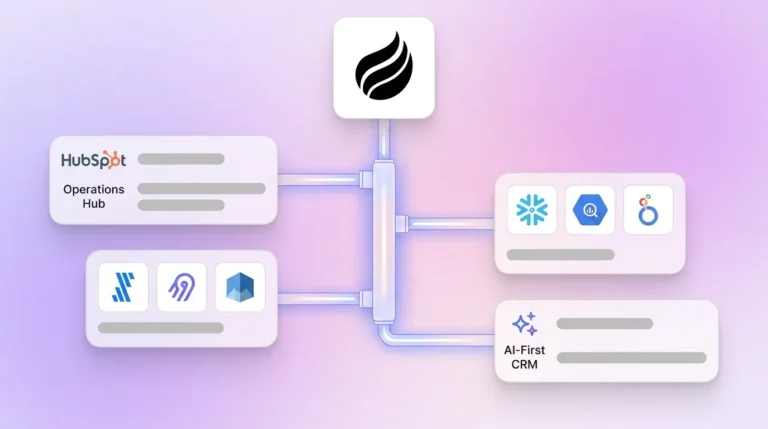
Coffee works in two deployment models: as a standalone AI-first CRM for small and mid-sized teams, or as a companion layer on top of existing Salesforce or HubSpot installations. In both cases, the agent handles enrichment, activity logging, meeting summaries, and pipeline tracking. That consolidation removes the fragmented stack problem that makes batch enrichment tools expensive and operationally complex to maintain.
After deployment, teams gain real-time enrichment without managing APIs, rate limits, or multiple vendors. Get started with Coffee and let the agent handle your data automatically.
How to Set Up Real-Time Updates in 5 Steps
Whichever of the four approaches you choose, the same five implementation steps apply, and Coffee automates most of them. Here is how to build a real-time update workflow that fits manual, batch, API, or AI-agent setups.
- Audit Your Current Data: Identify which fields are most often stale, since job titles, company size, and phone numbers decay fastest. Establish a baseline data accuracy rate. Seventy-six percent of organizations believe less than half their CRM data is accurate, according to the Validity State of CRM Data Management in 2025 report cited by DataPartners. This baseline gives you a clear starting point for measuring improvement across all four approaches.
- Choose Your Data Sources: Evaluate options including ZoomInfo, Apollo.io, or an AI agent like Coffee that automatically enriches from emails, calendars, and licensed data partners. Consider coverage, refresh cadence, and integration depth, rather than focusing only on database size. These choices determine how often each approach can refresh your core fields.
- Integrate with Your CRM: Confirm that the tool connects natively with Salesforce, HubSpot, or your chosen system of record. For Coffee, this step involves a simple authentication against Google Workspace or Microsoft 365. For API-based approaches, plan rate limit handling and conflict resolution from the start so your real-time sync remains stable.
- Set Up Automation Rules: Define triggers for updates that match your chosen approach. Apollo recommends event-based triggers for job changes, hard bounces, and intent signal spikes. Automation ensures that records update consistently instead of waiting for a rep to notice and act.
- Monitor Data Quality: Track email bounce rate with a target below 2 percent. Track field completion rate for verified email and job title with a target above 85 percent. Then monitor post-enrichment conversion rates to confirm that fresher data improves replies and opportunities, according to Crustdata’s ROI guide. These metrics reveal whether your chosen approach delivers durable gains.
Measuring the ROI of Real-Time Data Updates
ROI measurement for data enrichment starts with a pre-enrichment baseline and a consistent set of downstream KPIs. The core metrics include data accuracy rate, email bounce rate, field completion rate, time saved per rep per week, response rate improvement, and pipeline forecast accuracy.
A straightforward ROI calculation estimates hours saved per rep per week, multiplies by hourly cost, multiplies by number of reps, then adds the revenue value of improved win rates from timely outreach. The cost of inaction compounds quickly. As noted earlier, the $32,000-per-rep cost of poor data scales to $320,000 in annual losses for a 10-person team before accounting for missed pipeline, according to industryselect.com data cited by DataPartners.
A well-implemented enrichment tool should return three to five times its cost within the first six months. If results fall below that threshold after three months, common causes include a low match rate on the ICP, enriching fields not used in outreach, or enriched data that does not trigger downstream workflows. Coffee’s Pipeline Compare feature simplifies this analysis for AI-agent deployments by tracking pipeline changes automatically.
Coffee’s Pipeline Compare feature automates the tracking side of this equation. Because the agent captures all pipeline changes in a built-in data warehouse, week-over-week comparisons such as progressed deals, stalled opportunities, and new additions appear automatically without CSV exports or manual reporting.
Common Pitfalls and How to Avoid Them
Three failure modes appear consistently across real-time data implementations, regardless of the approach chosen.
The first is data overload. When every field updates at the same frequency, reps receive a flood of notifications with no clear priority. Apollo recommends a tiered freshness model where critical fields like job title and email update in real time, while contextual fields like industry update monthly. Coffee applies this logic automatically and surfaces high-fit signals through Visitor Identification and Suggested Leads instead of routing every update to the rep.
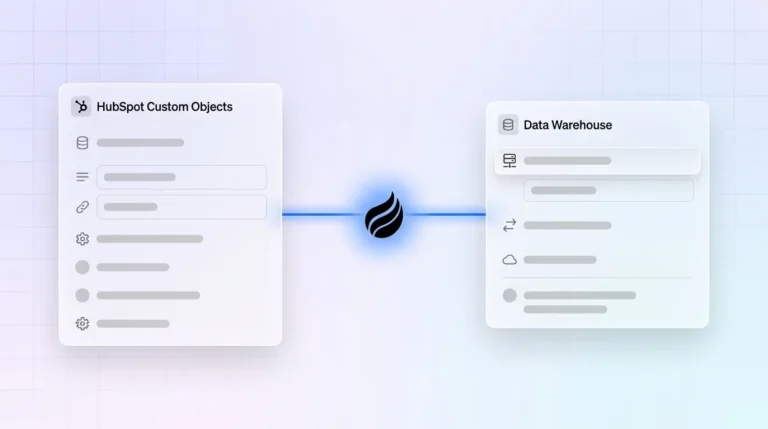
The second is integration failure. Tools that do not sync reliably with complex CRM configurations, including custom objects, required fields, and multi-currency setups, create data gaps that undermine the entire enrichment investment. Coffee’s deep integration expertise with Salesforce and HubSpot, including quotas, forecasting, and required field logic, addresses this risk directly.
The third is over-reliance on automation without governance. Without governance rules, automated enrichment can overwrite good data with worse data, break lead scoring models, or trigger incorrect routing, according to Apollo’s governance guide. To prevent that, every automated enrichment system needs a field ownership map, per-field overwrite policies, and audit trails that log every automated change with its source and previous value.
Frequently Asked Questions
What does prospect data mean?
Prospect data refers to information about potential customers who fit an organization’s ideal customer profile. It includes firmographics such as company size, industry, and revenue range. It also covers technographics such as the tools and platforms a company uses, contact data such as verified email addresses, direct phone numbers, and job titles, and behavioral data such as engagement with content, website visits, and intent signals from third-party review platforms. Because this data reflects the real-world state of people and organizations, it degrades continuously as people change jobs, companies restructure, and contact details become invalid. Treating prospect data as a living record rather than a static asset prevents many CRM data quality problems.
How often should prospect data be updated?
Refresh cadence depends on the field type and its rate of decay. Work email addresses should be re-verified every 30–60 days, job titles every 60–90 days, and direct phone numbers every 90 days. Intent signals such as website visits, content downloads, and third-party review activity have a very short shelf life and should refresh in real time or weekly, because a buying signal that is 90 days old provides no actionable intelligence. Company-level firmographics like headcount and revenue range can tolerate quarterly refreshes. A single refresh cadence applied uniformly across all fields either over-refreshes slow-moving data or under-refreshes fast-decaying contact fields. A tiered model, where field type determines refresh frequency, provides an operationally sound approach.
What are the 5 P’s of prospecting?
The 5 P’s of prospecting are Purpose, Preparation, Personalization, Perseverance, and Practice. Purpose refers to defining a clear reason for prospecting and aligning it with business goals. Preparation involves researching prospects and tailoring outreach strategies. Personalization means customizing communication to each prospect’s needs and context. Perseverance emphasizes consistent follow-up and resilience in the face of rejection. Practice highlights the importance of refining skills through repetition and feedback. Real-time prospect data updates directly support the Personalization and Preparation dimensions, which in turn improve Perseverance and Practice outcomes.
How do real-time updates differ from batch enrichment?
Real-time updates are event-driven. A specific event such as a job change, form submission, or pricing page visit triggers an immediate enrichment action, with latency measured in seconds to minutes. Batch enrichment runs on a fixed schedule, typically nightly or weekly, with latency measured in hours to days. The architectural difference matters because batch enrichment creates predictable windows during which data is known to be stale. A contact who changed jobs on a Tuesday will not appear updated in a batch system until the next scheduled run, which may be days away. Real-time systems remove this window by responding to the event as it occurs. For high-velocity outbound teams, the difference between a same-day job-change alert and a three-week-delayed one often determines whether a conversation feels warm or lands in a dead inbox.
Conclusion
Real-time prospect data updates form the operational foundation that determines whether a sales team’s outreach reaches the right people at the right time. Manual processes fall behind data decay. Batch enrichment tools create refresh lag and stack complexity. DIY API integrations demand engineering resources that many mid-market teams cannot sustain. An AI agent like Coffee automates the entire data-in process, keeps the CRM accurate without human effort, and consolidates the stack in the process.
Give your sales team a CRM that works for them and get started with Coffee today.