Key Takeaways
- Monday.com AI pipeline forecasting uses machine learning for deal scoring and revenue projections but depends on manual data entry that weakens accuracy.
- Setup requires seven detailed steps across data connections, automations, and dashboards, with ongoing maintenance to keep forecasts reliable.
- Data quality issues such as incomplete records and delayed updates contribute to 44% deal slippage and 85% of B2B firms missing forecasts by over 5%.
- Coffee’s agent captures data automatically from emails and calendars, saving 8–12 hours per week and delivering 2x forecast accuracy through ground-truth data.
- Teams that want instant setup and deeper automation should choose Coffee over Monday, and get started with Coffee for agent-powered pipeline management.
How Monday.com AI Pipeline Forecasting Works
Monday.com AI pipeline forecasting uses machine learning models such as ARIMA and LSTM to analyze historical deal data, velocity patterns, and sales activities. These models process structured data from deal records, stage progressions, and logged activities to generate probability scores and revenue projections.
The platform’s AI capabilities center on five interconnected features that work together as a forecasting system. At the base, Activity Logging tracks engagement patterns across emails, meetings, and tasks to inform deal health. This activity data feeds Predictive Deal Scoring, which analyzes data for close likelihood using historical patterns and deal characteristics.
These probability scores then drive AI Automations, which trigger actions when deals hit specific stages or thresholds. The system aggregates this information into Proactive Forecasting, generating revenue predictions based on pipeline velocity and conversion rates. Finally, the AI Email Composer uses deal context and stage information to create personalized outreach that keeps opportunities moving.
Monday.com AI Capabilities in Practice
Monday.com integrates AI throughout its CRM, with a strong focus on pipeline forecasting. The system analyzes historical deal data, sales velocity, and activity patterns to predict deal outcomes and revenue.
These AI models rely on structured inputs from deal records and sales activities to produce probability scores and forecast ranges. Sales teams gain automated deal risk identification, stage-specific recommendations, and predictive insights that support resource allocation and quota planning.
Step-by-Step Monday AI Pipeline Forecasting Setup
Teams must configure several components before Monday’s AI pipeline forecasting delivers consistent value. Follow this seven-step process for a complete setup:
1. Enable AI in the Monday CRM board by opening board settings and activating AI features in the automation section.
2. Connect data sources by integrating email, calendar, and existing CRM data through Monday’s native connectors.
3. Configure predictive scoring by defining deal stages, probability percentages, and scoring criteria that match your sales methodology.
4. Set automations for stages so the system triggers deal progression, follow-up reminders, and risk alerts at the right time.
5. Build dashboards that present forecast views, pipeline metrics, conversion rates, and revenue projections for leaders and reps.
6. Test forecasts by running historical data through the system, checking accuracy, and adjusting parameters where needed.
7. Monitor accuracy through recurring reviews that track forecast performance and refine models as your pipeline evolves.
The platform connects to ChatGPT for enhanced AI features and integrates with Zapier for workflow automation. Teams can customize dashboards to highlight forecast views, pipeline health indicators, and performance metrics that match their sales process.
Let Coffee’s agent handle setup automatically and avoid complex manual configuration.
How Monday AI Deal Scoring Evaluates Opportunities
Monday’s AI deal scoring system evaluates multiple data points to assign probability percentages and health ratings to each opportunity. The scoring algorithm reviews stage duration, activity frequency, stakeholder engagement, and historical patterns from similar deals.
The system flags at-risk deals based on sentiment in communications, engagement drop-offs, and extended time in a single stage. Health analysis also considers response times, meeting attendance, and decision-maker involvement to create a more complete deal assessment.
The accuracy of these scores depends entirely on the quality of the underlying data. Bad data means bad insights, and bad insights kill trust in the whole system, which shows how manual data entry weakens even advanced AI analysis.
Data Quality Pitfalls in Monday AI Forecasting
Sophisticated AI built on a weak data foundation produces sophisticated garbage predictions because models amplify existing data problems. Monday’s forecasting accuracy suffers when data quality breaks down.
Manual entry often creates incomplete records, inconsistent formatting, and delayed updates that distort AI predictions. Sales teams that juggle tools like ZoomInfo for enrichment and Gong for intelligence struggle to keep data clean across multiple platforms.
The impact is measurable. 44% of deals slipped in 2023, with poor qualification and data management as contributing factors. At the same time, 85% of B2B firms regularly miss their monthly sales forecast by more than 5%. These numbers highlight how human data entry introduces systematic errors that undermine forecast accuracy.
Why Coffee’s Agent Improves Pipeline Forecasting
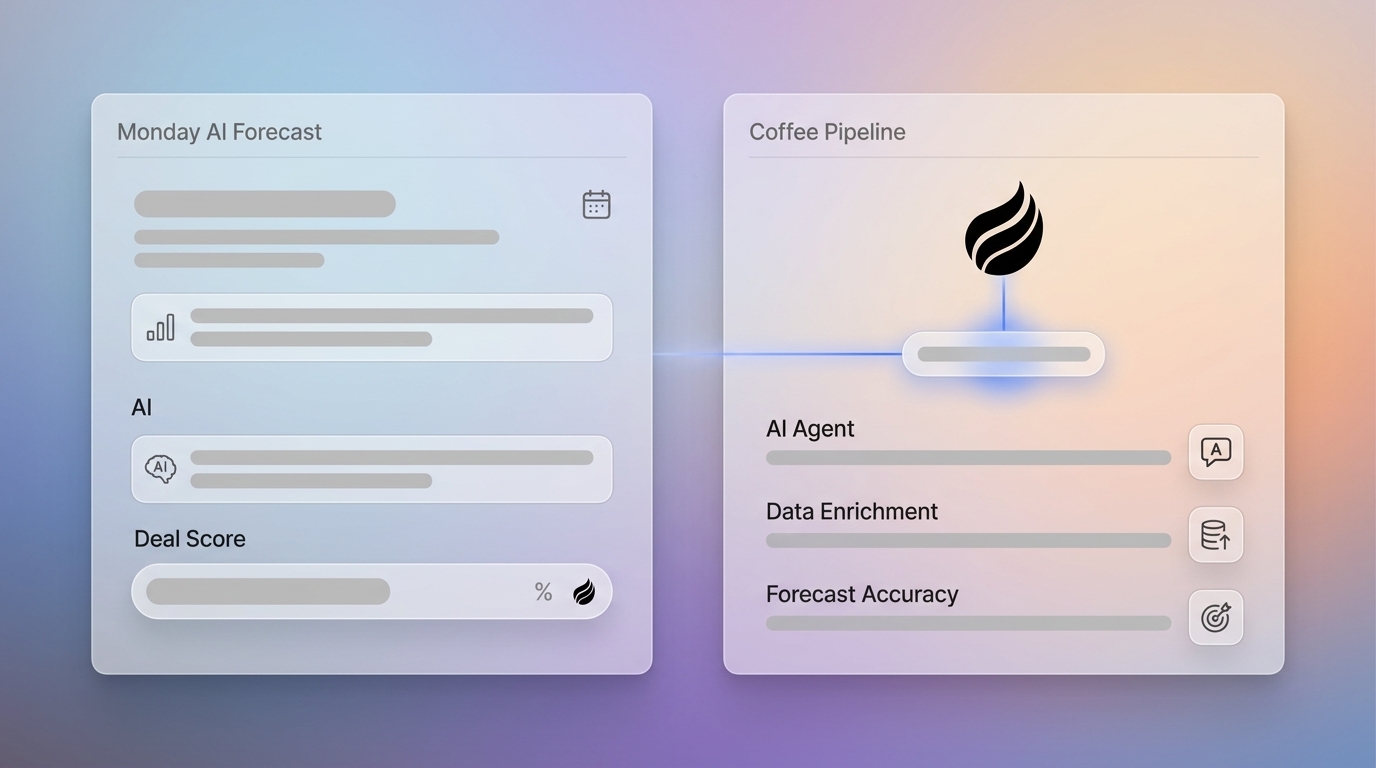
Coffee’s agent-based architecture addresses Monday’s core weakness by automating data entry and maintaining ground-truth accuracy. The Coffee Agent acts as an autonomous worker that captures, enriches, and updates CRM data without relying on reps.

Key advantages include automatic contact and company creation from Google Workspace and Microsoft 365, along with real-time activity logging from emails and calendars. Intelligent briefings prepare sales reps with contextual information before meetings, and the Pipeline Compare feature shows week-over-week changes without manual spreadsheets.

Coffee’s List Builder supports natural language prospecting commands such as “Find VPs of Sales in North America at $10M+ funding companies using Salesforce.” The agent then runs complex queries through integrated enrichment tools and returns ready-to-work lists.

The platform can run as a standalone CRM for growing teams or as a Companion App that enhances existing Salesforce and HubSpot instances. SOC2 Type 2 and GDPR compliance provide enterprise-grade security while keeping the experience simple for users.
See how Coffee’s agent upgrades your forecasting accuracy with clean, automatic data.
Head-to-Head Comparison: Monday vs. Coffee
The following comparison highlights the core differences in data automation, accuracy, setup effort, and user experience between Monday.com and Coffee.
| Feature | Monday.com | Coffee (Agent-Based) |
|---|---|---|
| Data Automation | Manual entry, with 71% of reps saying they spend too much time on data entry, leaving only 35% for selling | Agent automation from emails and calendars, saving 8–12 hours per week |
| Forecasting Accuracy | Prone to errors when data hygiene slips | Ground-truth forecasts supported by continuous data hygiene |
| Setup Effort | Complex setup with seven steps plus ongoing maintenance | Fast activation with simple connection and immediate agent activity |
| User Adoption | Feels like a chore because reps must enter data manually | Feels like a co-pilot that handles admin work for reps |
| Cost | Feature-based add-ons that increase total spend | Straightforward seat pricing that includes core agent capabilities |
Best-Fit Use Cases and 2026 Benchmarks
Given these differences in automation, accuracy, and setup complexity, the right platform depends on your team’s stage and resources. Early-stage teams gain the most from Coffee’s Standalone CRM, while established HubSpot users often prefer the Companion App model.
A $10M ARR technology firm improved forecast accuracy significantly after rolling out Coffee’s agent automation, showing clear ROI from better data quality. Coffee also saves 8–12 hours per week in manual data entry, which frees reps to focus on selling instead of updating records.
These improvements support stronger resource planning and more predictable revenue, which matter for both growth-stage and mature organizations.
Risks, Limitations, and How to Decide
Monday’s main risks include low user adoption caused by manual entry requirements and the complexity of ongoing maintenance. Coffee’s limitations appear in highly customized enterprise environments that demand deep, bespoke workflows and integrations.
Teams should weigh data automation needs, team size, and forecast accuracy requirements when choosing a platform. Coffee works best for SMB and mid-market teams that want agent-driven accuracy without adding headcount, while Monday can fit organizations with dedicated data operations resources.
Eliminate manual forecasting challenges with Coffee and shift your team’s time back to selling.
FAQ
What is Monday AI deal scoring?
Monday AI deal scoring analyzes historical data, deal characteristics, and sales activities to assign probability percentages and health ratings to opportunities. The system evaluates stage duration, stakeholder engagement, activity frequency, and communication sentiment to predict deal outcomes. These scores help sales teams prioritize efforts and identify at-risk opportunities that need attention.
How does Coffee compare to Monday for forecasting?
Coffee’s agent automates data entry and enrichment, which keeps inputs clean and consistent for accurate forecasting. Monday relies on manual data entry that often introduces gaps and errors, while Coffee captures information automatically from emails, calendars, and meetings. This automation improves data hygiene and removes the weekly hours that reps usually spend on CRM updates.
What is the implementation time for each platform?
Coffee offers near-instant setup through simple authentication with Google Workspace or Microsoft 365, and the agent starts capturing and enriching data right away. Monday usually requires several days to weeks for full configuration, including the seven-step setup process, data migration, automation rules, and user training. Coffee’s agent-driven approach removes much of this complexity.
Which platform offers better integrations?
Coffee integrates natively with Google Workspace, Microsoft 365, and Zapier for workflow automation, and the agent automatically captures data from these sources. Monday connects to ChatGPT and Zapier as well but often needs manual configuration for each integration. Coffee’s agent model provides deeper, more automated integration behavior with less ongoing admin work.
How do both platforms handle data security?
Coffee maintains SOC2 Type 2 and GDPR compliance with enterprise-grade security controls. Customer data does not train public AI models, which protects privacy. Monday also offers strong security and compliance but requires careful configuration to keep protections consistent across integrations and automations. Both platforms can meet enterprise standards, while Coffee’s agent architecture supports built-in data governance.
Conclusion
Monday AI pipeline forecasting delivers advanced machine learning capabilities but still struggles with the core challenge of manual data entry. AI models amplify existing data problems, which makes data quality the deciding factor for any forecasting system.
Coffee’s agent-based approach addresses this issue by automating data capture, enrichment, and maintenance. The result is the time savings and accuracy improvements described above, supported by ground-truth data that sales reps do not need to babysit.
Teams that care about forecast accuracy and sales productivity gain a clear advantage with agent-powered automation. Experience agent-powered pipeline management with Coffee and give your reps a CRM they actually want to use.