Key Takeaways
-
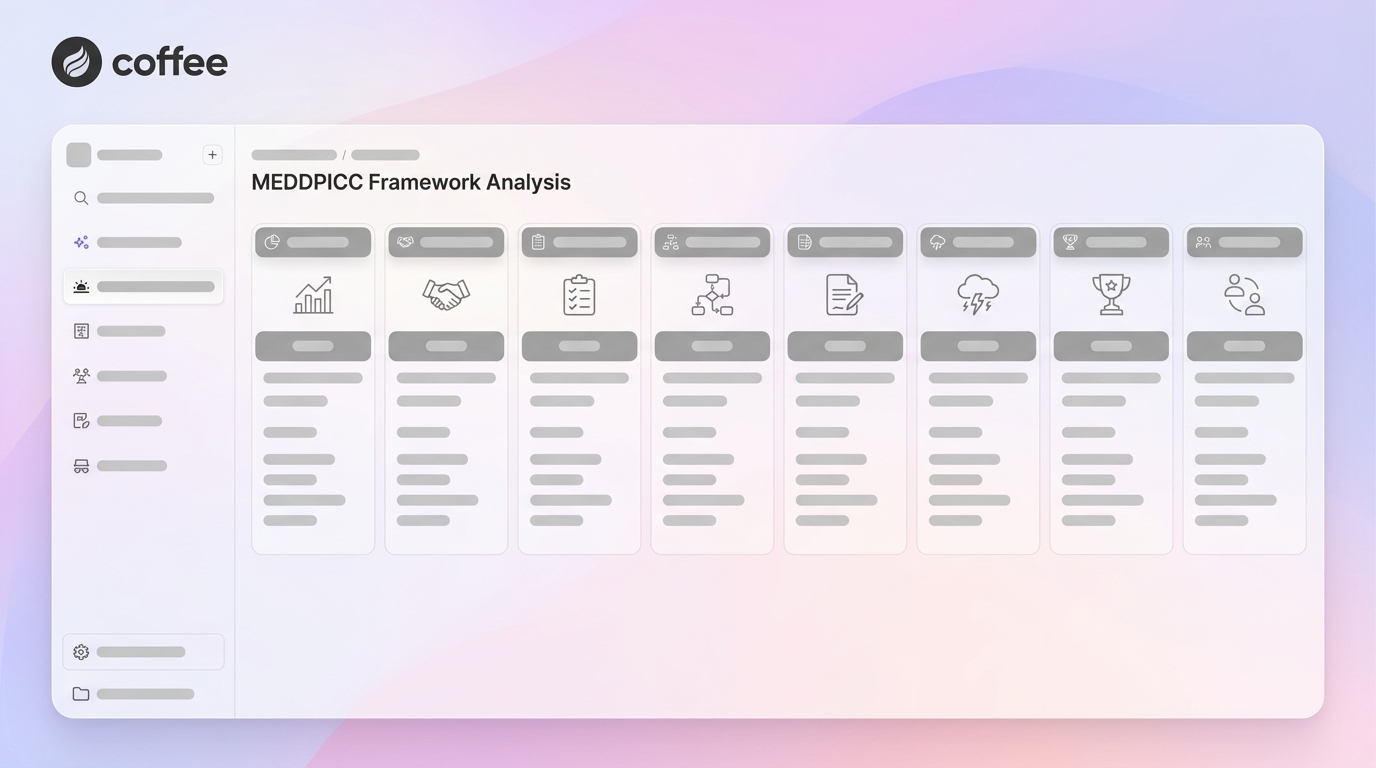
MEDDPICC qualifies complex enterprise B2B deals through eight components: Metrics, Economic Buyer, Decision Criteria, Decision Process, Paper Process, Identify Pain, Champion, and Competition.
-
Each component uses targeted qualification questions that reveal KPIs, stakeholders, timelines, pains, and the competitive landscape, which supports higher win rates.
-
MEDDPICC improves on MEDDIC by adding Paper Process and Competition, which reduces delays and blindsides in multi-stakeholder enterprise sales.
-
Teams adopting MEDDPICC achieve 18% higher win rates, 24% larger deals, and 40% better forecasting accuracy.
-
Automate MEDDPICC qualification with Coffee’s AI agent for MEDDPICC automation to remove manual data entry and increase sales efficiency.
How the MEDDPICC Framework Works in Enterprise Sales
The MEDDPICC sales qualification framework for enterprise B2B sales consists of eight essential components. Together, these components create a consistent way to judge deal quality and improve forecasting in complex sales environments.
1. Metrics (M)
Metrics define how the prospect measures the success of a solution, such as cost savings, faster cycle times, or revenue growth. These metrics establish the prospect’s key performance indicators and let sales reps connect their solution to clear business outcomes.
Key Qualification Questions:
-
What specific KPIs will this solution impact?
-
How do you currently measure success in this area?
-
What is the quantifiable impact of not solving this problem?
Enterprise Example: A Fortune 500 technology client identified a $2 million revenue leak through MEDDPICC qualification. That insight supported a $400,000 deal that closed 60% faster than typical sales cycles.
2. Economic Buyer (E)
The Economic Buyer is the person who approves the budget, overrides objections, and signs off on the deal without needing additional approval. This person holds final purchasing authority and can unblock stalled decisions.
Key Qualification Questions:
-
Who has final budget authority for this purchase?
-
What is the approval process for investments of this size?
-
Who can override objections from other stakeholders?
Enterprise Example: beehiiv’s sales team discovered a back-end developer as an unexpected influencer in integration decisions. That insight improved technical alignment and saved more than 10 hours on post-sale support.
3. Decision Criteria (D)
Decision Criteria are the formal and informal factors a buying organization uses to evaluate solutions. These criteria usually fall into technical factors such as features, integrations, and security, and business factors such as ROI, risk, and time to value.
Key Qualification Questions:
-
What factors will you use to evaluate potential solutions?
-
How will you score different vendors?
-
What are your must-have versus nice-to-have requirements?
4. Decision Process (D)
The Decision Process maps the prospect’s steps from initial evaluation to purchase. It covers who is involved, what approvals are required, and how decisions move forward so reps can plan and avoid surprises.
Key Qualification Questions:
-
What steps are involved in your buying process?
-
Who needs to approve this decision?
-
What is your timeline for making a decision?
5. Paper Process (P)
Paper Process covers procurement, legal terms, redlines, data protection, InfoSec, and vendor onboarding steps. These steps often cause 30 to 90 day delays when teams ignore them early in the cycle.
Key Qualification Questions:
-
What legal and procurement steps are required?
-
Who handles contract negotiations and security reviews?
-
What compliance requirements must be met?
Twenty eight percent of deals fail when buyers cannot secure internal approval. Early Paper Process qualification helps prevent those failures.
6. Identify Pain (I)
Implicate the Pain deepens the identified problem by quantifying its business impact. For example, a vague issue like slow ramp times becomes a concrete statement such as costing $2 million in burned leads each year and blocking growth targets.
Key Qualification Questions:
-
What is the business impact of this problem?
-
What happens if you do not solve this issue?
-
How urgent is addressing this pain point?
7. Champion (C)
The Champion is an internal advocate who sells the solution inside the organization when the sales rep is not in the room. A strong champion opens doors to key stakeholders, shares critical deal intelligence, and argues for your solution over alternatives.
Key Qualification Questions:
-
Who internally benefits most from this solution?
-
Who has influence with the buying committee?
-
Who would advocate for this solution in internal meetings?
8. Competition (C)
Competition maps alternatives including incumbent tools, other vendors, and the do nothing status quo. Clear visibility into these options helps you avoid late surprises and position your solution effectively.
Key Qualification Questions:
-
What other solutions are you evaluating?
-
What is your current approach to this problem?
-
What would happen if you did nothing?
The table below highlights how four core MEDDPICC components directly affect enterprise deal outcomes. It shows where teams often see the strongest ROI improvements.
|
Component |
Key Question |
Enterprise Focus |
ROI Impact |
|---|---|---|---|
|
Metrics |
What KPIs will this impact? |
Quantifiable outcomes |
20-30% higher win rates |
|
Economic Buyer |
Who has budget authority? |
C-level engagement |
55% win rate boost |
|
Decision Criteria |
How will you evaluate solutions? |
Technical and business factors |
Competitive positioning |
|
Paper Process |
What legal steps are required? |
Procurement navigation |
Prevents 30-90 day delays |
MEDDPICC vs MEDDIC in Complex Enterprise Deals
MEDDPICC extends the MEDDIC framework by adding Paper Process and Competition. Paper Process explicitly qualifies legal, procurement, and administrative steps such as MSA redlines, security questionnaires, DPAs, vendor onboarding forms, and compliance reviews, which often slow deals when ignored. Competition adds a structured view of every alternative in play.
The MEDDPICC framework performs especially well in complex, multi-stakeholder enterprise sales. Typical use cases include enterprise software, industrial solutions, medtech, and services that involve formal procurement and security reviews.
To capture these benefits in your organization, use a clear rollout plan that builds skills, creates consistency, and reinforces MEDDPICC in every deal review.
Implementation Steps for MEDDPICC Rollout
-
Train reps on qualification questions for each MEDDPICC component so they know what to ask during discovery and follow up conversations.
-
Score deals weekly using 1 to 5 ratings per component so you can quantify qualification strength and spot weak areas.
-
Review pipelines monthly using these scores to focus on qualification gaps and coach reps on specific components.
-
Build multi-stakeholder champions across buying committees for deals with weak Champion scores to strengthen internal advocacy.
These improvements align with the win rate and deal size gains mentioned earlier, with full adoption delivering the strongest impact.
While MEDDPICC delivers strong results, tracking eight components across many deals by hand creates heavy admin work for sales teams. Automation reduces that burden and keeps qualification data accurate and current.
Automate MEDDPICC with Coffee’s AI CRM Agent
Unlike passive Salesforce and HubSpot systems, Coffee works as an autonomous agent that captures key sales data from your existing workflows. The agent identifies contacts and activities from email signatures and calendar invitations, extracts insights from meeting transcripts, and supports pipeline tracking.

Coffee’s Intelligence layer introduced in February 2026 lets users define and store deep context on business model, product specifics, ICP, and competitors. This context powers tailored AI suggestions and insights. The agent’s AI search on deals answers natural language questions such as “Which deals are stuck in negotiation?” and “What is closing this month?”
Key automation features work together to support MEDDPICC qualification and reduce manual effort:

-
Auto-data entry that saves reps 8 to 12 hours each week while keeping CRM fields complete.
-
Meeting summaries that capture action items, MEDDPICC signals, and follow ups from every call.
-
Pipeline Compare that tracks deal progression and highlights stalled stages tied to weak components.
-
Briefings that surface context on attendees, past interactions, and open MEDDPICC gaps before each meeting.
Example: A mid-market SaaS team using Coffee reduced data entry time while improving data quality and forecast accuracy. See how Coffee can automate your MEDDPICC tracking.
MEDDPICC Tools and Templates for Enterprise Teams
Use a MEDDPICC scorecard template to evaluate deal quality in a consistent way. Score each component from 1 to 5 and flag qualification gaps that need attention. The template includes enterprise-specific questions and ROI benchmarks tailored to complex B2B sales cycles.
After you put automation in place, additional resources help your team keep MEDDPICC front and center in every opportunity review.
Conclusion
Strong MEDDPICC execution helps enterprise B2B sales teams qualify complex deals with confidence and improve forecast accuracy. Coffee’s AI agent automates the qualification process, removes manual tracking work, and still captures complete data. Start automating your MEDDPICC qualification today.
FAQ
What is Paper Process in MEDDPICC and why is it critical for enterprise sales?
Paper Process, detailed in the framework components above, addresses the administrative requirements that often catch sales teams off guard.
Beyond the basic legal and procurement steps, enterprise deals usually require coordination across multiple departments such as legal for contract terms, IT security for compliance reviews, and procurement for vendor onboarding workflows. Clear visibility into these steps helps sales teams set realistic timelines and avoid last minute surprises that can stall or kill deals.
How does Coffee automate sales processes compared to traditional CRMs?
Coffee operates as an autonomous AI agent that captures sales data from your existing workflows, while traditional CRMs rely on manual data entry. The agent scans emails to create contacts, analyzes meeting transcripts for summaries and action items, logs activities, and monitors calendars. This automation saves reps 8 to 12 hours each week and keeps CRM data accurate without extra effort from the team.

What are the key differences between MEDDIC and MEDDPICC for enterprise B2B sales?
MEDDPICC extends the original MEDDIC framework by adding two critical components, Paper Process and Competition. Paper Process addresses the legal, procurement, and administrative steps that frequently cause delays in enterprise deals.
Competition systematically maps alternative solutions, including the status quo and do nothing options. These additions make MEDDPICC especially useful for complex enterprise sales with formal procurement processes, multiple stakeholders, and structured competitive evaluations.
When should enterprise sales teams use MEDDPICC versus simpler qualification frameworks?
MEDDPICC works best for enterprise deals with annual contract values above $50K, sales cycles longer than 90 days, six or more stakeholders, and involvement from legal, procurement, or security teams. Use MEDDPICC when deals include formal procurement processes, competitive evaluations, or complex approval chains.
For transactional sales under $25K with simple buying processes and few stakeholders, lighter frameworks such as BANT may fit better and avoid extra qualification overhead.
What ROI can enterprise sales teams expect from implementing MEDDPICC?
Enterprise sales teams that implement MEDDPICC typically see 18 to 30 percent higher win rates, 24 percent larger deal sizes, and 40 percent more accurate forecasting. Teams also report shorter deal cycles through stronger qualification and fewer late stage surprises.
The framework helps prevent the 28 percent of deals that fail due to procurement issues and the 72 percent that fail because buyers do not see clear value. When combined with AI automation such as Coffee’s agent, teams gain further efficiency, including a 71 percent reduction in manual data entry time.