Key Takeaways
- 71% of sales reps lose hours to data entry, and AI tools like Coffee redirect that time to selling and booking more meetings.
- Use the 3-3-3, 95-5, and 3/2/1 rules to run disciplined, value-first LinkedIn outreach that avoids spam filters.
- Coffee’s List Builder and Visitor ID help you target your ICP precisely and turn website visitors into warm LinkedIn leads.
- Automate data entry, tracking, and human-like messaging with Coffee Agent to save 8-12 hours weekly.
- Scale LinkedIn prospecting efficiently by getting started with Coffee today.
Why LinkedIn Prospecting Breaks Down in 2026
LinkedIn prospecting in 2026 punishes generic, high-volume tactics. What worked in 2022, such as mass templates and basic automation, now triggers advanced spam detection. Generic template-based LinkedIn automation connection acceptance rates have declined significantly in recent years.
At the same time, automated LinkedIn direct messages achieve a 10.3% response rate, nearly double cold email performance when executed well. The gap comes from deeper personalization and AI-powered precision, not from sending more messages.
Sales teams also lose a large share of selling time to manual data entry, while connection acceptance rates average 26-30%. AI agents like Coffee connect LinkedIn outreach, email sequences, and visitor identification into one system that legacy CRMs such as Salesforce and HubSpot cannot match on their own.
11 Proven Steps to LinkedIn Sales Prospecting Mastery
1. Turn Your Profile into a Trust-Building Asset
Your LinkedIn profile acts as your digital storefront and shapes first impressions. LinkedIn profiles with a professional headshot receive up to 21 times more views and 9 times more connection requests. Focus on four elements that build trust quickly.
Use a high-quality professional photo, a headline that clearly states your value proposition, a banner image that reinforces your niche, and featured content that highlights client results. Fully optimized LinkedIn profiles receive 40 times more opportunities than incomplete ones, so treat this as core sales infrastructure.
2. Build Precise ICP Lists with Coffee’s List Builder
Accurate targeting drives every successful LinkedIn prospecting program. Coffee’s List Builder uses natural language processing to create prospect lists such as “VPs of Sales at $10M+ funding companies using Salesforce.” You describe the audience, and the system builds the list.
The AI enriches profiles with job titles, funding data, and LinkedIn information, which removes hours of manual research. This precise targeting keeps your outreach focused on decision-makers who match your ideal customer profile and lifts response rates across campaigns.

3. Apply the 3-3-3 Rule to LinkedIn Outreach
The 3-3-3 rule focuses on three prospects at a time, contacting each via three channels, and making three attempts per prospect. This structure narrows your attention and encourages thoughtful outreach. When applied to LinkedIn, the rule turns into a simple daily plan.
Limit yourself to 3 connection requests per day, 3 personalized messages, and 3 content engagements. This constraint pushes you toward quality over volume. Space the second phone call attempt 3-5 days after the first and the third attempt after 1-2 weeks to keep momentum while giving prospects time to respond.
This disciplined cadence reduces spam risk, protects your account, and still delivers consistent follow-through on every prospect.
4. Use the 95-5 Rule to Lead with Value
The 95-5 rule keeps 95% of your messaging focused on value and only 5% on direct asks. Instead of opening with a pitch, reference a recent post, share a relevant insight, or offer a helpful resource that fits their role.
For example, say, “Saw your post on sales automation challenges. We helped a similar company reduce manual data entry by 70%. Worth a quick conversation?” This style builds trust first, then introduces your solution as a logical next step.
5. Run the 3/2/1 Rule for LinkedIn Sequences
The 3/2/1 cadence creates simple, repeatable outreach flows. It includes 3 touchpoints, 2 value-driven messages, and 1 soft close. Well-structured sequences achieve 15-25% reply rates compared to single-touch outreach.
Touch 1 is a personalized connection request. Touch 2 is a value-add message that shares an industry insight or relevant resource. Touch 3 is a soft close that offers a helpful asset and invites a brief meeting without pressure.
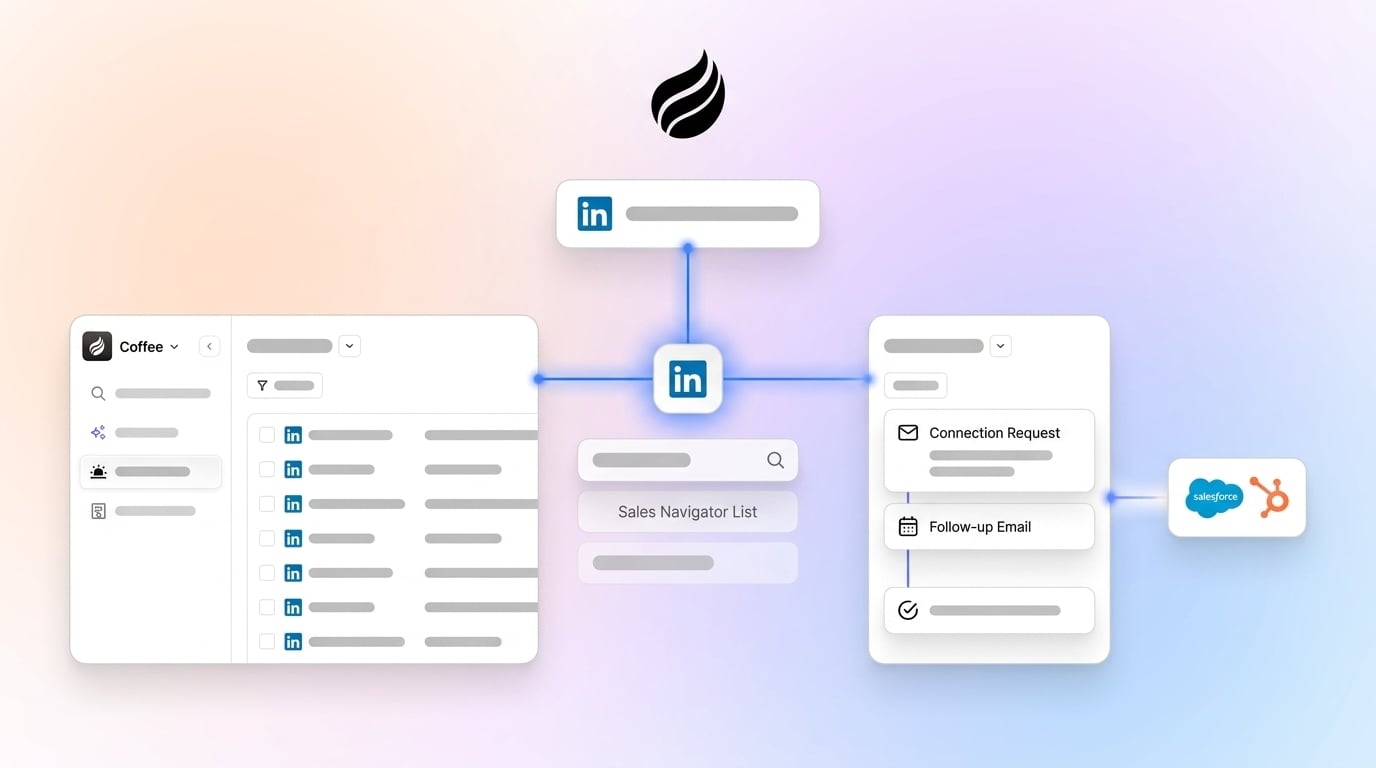
6. Combine Sales Navigator with Coffee’s Visitor ID
Sales Navigator helps you find prospects inside LinkedIn with advanced filters and saved searches. These tools surface people who match your ICP but may not know your brand yet. Your highest-intent prospects, however, often come from another source.
Many of those high-intent prospects already visit your website and never appear in a LinkedIn search. Coffee’s Visitor ID bridges this gap by identifying anonymous website visitors and connecting them to LinkedIn profiles. When someone visits your site, Coffee’s pixel reveals their name, title, company, and LinkedIn profile.
This insight enables immediate, contextual outreach to visitors who have already shown interest. As a result, you turn cold traffic into warm prospects and lift connection acceptance rates.
7. Write Message Sequences That Do Not Feel Salesy
Prospects respond more often to messages that reference their own content than to generic templates. Build sequences that start with something specific they posted or commented on. This shows you did your homework and respect their time.
Use frameworks such as, “Saw your recent post about [specific topic]. Your point about [detail] resonated because we are seeing similar challenges with [peer companies]. Mind if I share what is working for them?” Trigger-based templates like this can drive strong reply rates across B2B campaigns.
8. Automate Data Entry and Admin with Coffee Agent
Coffee’s AI Agent removes most of the manual work from LinkedIn prospecting. It logs interactions automatically, creates contact records, and syncs data between LinkedIn and your CRM without extra clicks. You stay focused on conversations instead of forms.
The Agent also prepares meeting briefings, writes post-call summaries, and drafts follow-up messages, reclaiming time that usually disappears into administrative tasks. This automation keeps your pipeline clean and ensures no prospect slips through the cracks.

9. Track LinkedIn Metrics Directly in Coffee’s CRM
Consistent measurement turns LinkedIn prospecting into a repeatable system. Coffee tracks connection acceptance rates, message response rates, and meeting booking rates automatically. You see performance without building manual reports.
The platform highlights which messages perform best, which send times work, and how prospects engage over time. Teams using Coffee avoid spreadsheet tracking and gain clear visibility into what actually drives pipeline.
10. Bypass AI Detection with Human-Like Messaging
LinkedIn’s algorithms now flag robotic messaging patterns quickly. AI systems that analyze each prospect’s profile in real time achieve higher acceptance rates than generic templates because they sound more natural. Coffee’s AI focuses on this kind of real-time personalization.
The system drafts human-sounding messages by reviewing prospect activity, recent posts, and company context. This level of relevance reduces spam signals while keeping your outreach authentic and conversational.
11. Use Pipeline Intelligence to Refine Your Strategy
Coffee’s Compare feature shows pipeline changes week over week in a clear visual view. You see progressed deals, stalled opportunities, and new additions at a glance. This makes it easier to coach teams and adjust tactics.
Pipeline intelligence reveals which LinkedIn prospecting strategies create the most qualified pipeline. The system tracks the full journey from first LinkedIn connection to closed deal, which supports data-driven improvements to your outreach approach.
Choosing Between Manual Prospecting and Coffee
Your LinkedIn prospecting results depend on how you match your approach to your team size and tech stack. Coffee offers two deployment models that fit different setups: a Standalone CRM for growing teams and a Companion App for Salesforce or HubSpot users. The table below compares manual prospecting with Coffee’s automated options so you can see the tradeoffs in time, data quality, and reporting.

| Feature | Manual Process | Coffee Standalone | Coffee Companion |
|---|---|---|---|
| List Building | For many teams, manual prospecting takes 8–12 hours per rep every week | Auto-generation via natural language | Auto-sync with Salesforce/HubSpot |
| Visitor Identification | None | Pixel → LinkedIn leads | HubSpot/Salesforce integration |
| Pipeline Tracking | Manual spreadsheets | Compare visual dashboards | Enhanced CRM reporting |
Get started with Coffee to remove manual prospecting bottlenecks and scale your LinkedIn outreach with less effort.
Common LinkedIn Prospecting Pitfalls
Several recurring mistakes quietly undermine LinkedIn prospecting performance. Poor data quality leads to irrelevant outreach and low trust. Generic messaging triggers spam filters and blends into every other pitch in a prospect’s inbox.
- Poor data quality leading to irrelevant outreach
- Generic messaging that triggers spam filters
- 10-15% reply rates from templated approaches
- Lack of systematic follow-up and tracking
- Disconnected tools creating data silos
Coffee’s auto-enrichment and intelligent logging address these issues by keeping data clean and synced from LinkedIn into your CRM. Prospect context stays intact throughout the sales cycle, which supports more relevant conversations at every stage.
Frequently Asked Questions
What is the 3-3-3 rule in sales?
The 3-3-3 rule is a focused prospecting method that limits salespeople to three active prospects at a time. It also requires contact through three different channels, typically LinkedIn, email, and phone. Each prospect receives three contact attempts before you move on.
This structure promotes quality over quantity, reduces burnout, and improves follow-through. It also prevents scattered efforts across bloated pipelines while keeping outreach disciplined and predictable.
How does Coffee integrate with existing Salesforce or HubSpot systems?
Coffee operates as a Companion App that layers intelligent automation on top of your current CRM. After a simple authentication step, Coffee’s AI Agent syncs prospect data, enriches contact records, and writes insights back to Salesforce or HubSpot.
The integration preserves your existing workflows while removing manual data entry. You gain accurate pipeline tracking and richer context without disrupting established processes.
What security measures does Coffee implement for LinkedIn prospecting data?
Coffee maintains SOC 2 Type 2 compliance and adheres to GDPR for all prospect data handling. The platform uses role-based access controls so only the right people see sensitive information. Customer data never trains public AI models.
All LinkedIn prospecting activities follow platform guidelines and respect user privacy standards, which protects both your brand and your prospects.
Can you provide examples of the 95-5 rule in LinkedIn messaging?
The 95-5 rule keeps 95% of your message focused on value and only 5% on direct asks. You might share relevant industry insights, reference a specific post the prospect created, or offer a useful resource with no strings attached.
The small ask can be a line such as “worth a brief conversation?” or “open to a quick resource share?” instead of an immediate meeting request or product demo pitch.
What integrations does Coffee support beyond LinkedIn?
Coffee connects with major email platforms such as Gmail and Outlook, calendar systems such as Google Calendar and Outlook Calendar, and video tools such as Zoom, Teams, and Meet. These integrations support a full sales workflow from first touch to meeting.

Current CRM integrations include Salesforce and HubSpot, with additional connections available through Zapier. The roadmap includes more native integrations based on customer demand and usage patterns.
How accurate is Coffee’s visitor identification for LinkedIn prospecting?
Coffee’s visitor identification system converts anonymous website traffic into named prospects with high accuracy. The platform identifies visitors by name, title, company, and LinkedIn profile, then compares them to your ideal customer profile criteria.
This matching process enables immediate, contextual LinkedIn outreach to people who already showed interest by visiting your site. As a result, connection acceptance and response rates rise compared to cold outreach alone.
Conclusion: Turn LinkedIn into a Predictable Pipeline Channel
LinkedIn sales prospecting in 2026 works best when you blend proven frameworks with targeted AI automation. The 11 steps above, from profile optimization through pipeline intelligence, create a system that scales without losing personalization.
Coffee’s AI Agent handles list building, data entry, and prospect tracking so your team can focus on high-value conversations and relationships. Get started with Coffee today and shift LinkedIn prospecting from manual busywork to a reliable pipeline engine.