Written by: Doug Camplejohn, CEO & Co-Founder, Coffee | Last updated: August 29, 2026
Key Takeaways
- Most B2B visitors never fill out a form, so an autonomous agent must convert anonymous traffic into clean, pipeline-ready CRM records without duplicates or low-confidence noise.
- The three-layer data model (Visitor → Account → Contact) with confidence thresholds prevents duplicate rates of 20–45% and ensures only high-confidence matches are written to HubSpot or Salesforce.
- Structured activity events replace raw visit logs, turning behavioral signals into CRM-ready fields that support accurate pipeline attribution and workflow enrollment.
- ICP qualification and suppression rules must run before any record reaches a rep queue, routing Tier 1 fits immediately while suppressing unqualified or already-active contacts.
- Coffee’s autonomous agent enforces every layer of this architecture automatically, so teams convert anonymous traffic into clean, pipeline-ready CRM records without manual entry or duplicate noise.
Why Clean Visitor-to-CRM Integration Protects Revenue
Skipping data-quality enforcement creates direct, measurable revenue loss. An analysis of 12 billion Salesforce records found that 45% were duplicates across organizations, with the rate climbing to 80% for records created via API integrations. Poor data quality costs B2B companies an estimated 15–25% of annual revenue through wasted outreach, missed opportunities, and deals built on inaccurate records. Gartner estimates that poor data quality costs the average organization $12.9 million per year.
The compounding effect on RevOps teams is severe. An estimated 66–68% of CROs and sales leaders do not fully trust their team's submitted pipeline forecasts or find them inaccurate or unreliable, per Gartner and Salesforce research. Duplicate and other stale CRM records (such as dead deals and renewal clones) inflate reported pipeline by 15–30% on average. B2B contact data decays at 22-25% annually on average, rising to 28-38% for technology and startup contacts and around 30-40% for email addresses. Without enrichment and deduplication at the point of capture, today's visitor records become tomorrow's liabilities.
These data quality challenges are particularly acute for visitor identification tools. Unlike form submissions that capture verified contact information, visitor identification tools that push records directly into a CRM without a quality layer accelerate these problems. Visitor identification tools create new CRM records in real time on a per-session basis rather than in controlled batches, leading to duplication rates of 20–45% for companies without an active data quality program. The three-layer model and autonomous agent logic described below exist specifically to prevent that outcome.
Prerequisites That Support a Clean Data Foundation
Confirm the following before implementing any step in this workflow. These three prerequisites form the foundation of the data quality architecture: you need visitor data to resolve (tracking pixel), a place to write it (CRM access), and rules to determine what qualifies for writing (documented ICP).
- A tracking pixel or visitor-identification script is installed in the
<head>tag of every page on the site and verified as firing correctly. - CRM admin access is available to create custom properties, configure duplicate rules, and build enrollment workflows in HubSpot or Salesforce.
- The ICP is documented with explicit criteria: firmographic thresholds (industry, employee count, revenue range), behavioral signals (high-intent pages, minimum session depth), and any suppression rules (existing customers, active deals, competitors).
Step 1: Map Visitors to the Three-Layer Data Model
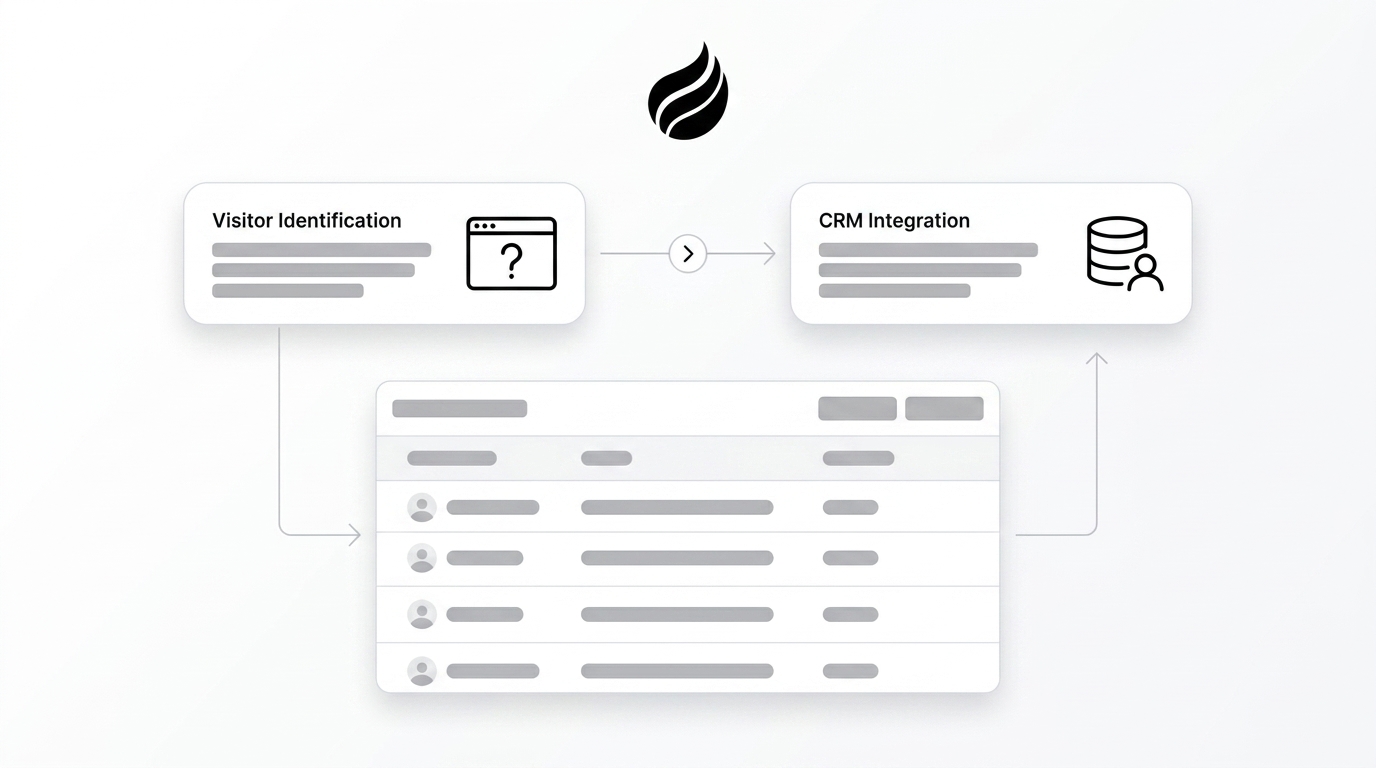
The three-layer model maps every visitor session to a hierarchy of CRM objects before any record is created or updated.
- Visitor layer: The raw session includes IP address, device fingerprint, behavioral events, and any deterministic identifiers such as cookies, UTM parameters, or tracked email clicks.
- Account layer: The company is resolved from the visitor session via reverse-IP lookup, domain inference, or identity graph match. Company-level matches should update the Company or Account record only, and no Contact should be created from a company-level match alone.
- Contact layer: The named individual is resolved via deterministic or probabilistic matching against a verified identity graph. Contact creation is gated by ICP fit score and confidence threshold.
Confidence thresholds govern which matches trigger automated action and which route to human review.
| Confidence Band | Score Range | Automated Action | Human Step Required |
|---|---|---|---|
| High | ≥ 90 | Auto-merge or upsert record | None |
| Medium | 60–89 | Stage record for review | RevOps or rep confirms match |
| Low | < 60 | No CRM write | Discard or re-queue for enrichment |
A visitor record payload entering the resolution pipeline looks like this:
{ "session_id": "vs_8a3f2c", "ip": "203.0.113.42", "domain_inferred": "acme-corp.com", "email_deterministic": "j.smith@acme-corp.com", "pages_viewed": ["/pricing", "/case-studies"], "session_depth": 4, "duration_seconds": 187, "confidence_score": 94, "resolution_method": "deterministic_email" }Step 2: Run Identity-Resolution Rules Before Record Creation
Identity resolution runs a hierarchy of match keys from strongest to weakest and stops at the first confident match. A reliable matching stack layers signals in this order: verified email (normalized by lowercasing and stripping plus-tags), company domain for account-level deduplication, fuzzy name plus company using Levenshtein or token-based similarity, normalized phone number in E.164 format, and finally a composite 0–100 confidence score.
The resolution sequence follows this order.
- Normalize the email address by lowercasing and stripping display names and plus-tags.
- Query the CRM for an exact email match. If found at ≥ 90 confidence, upsert the existing record.
- If no email match exists, query by normalized company domain plus fuzzy name. Apply Levenshtein distance only within records sharing the same domain, never across the full database.
- If domain plus name match scores 60–89, stage for human review. Below 60, discard.
- Log every match decision with method, score, matched fields, and timestamp for audit.
Pitfall: Missing confidence thresholds. Skipping threshold enforcement and auto-merging on any positive signal, including name-only matches, destroys data quality. Auto-merging at 95%+ similarity is reasonable, while thresholds as low as 80% are too risky and can destroy data quality in clean pipelines.
Step 3: Store Structured Activity Events Instead of Raw Visits
Raw visit logs with only a timestamp and a URL give sales reps almost no context. Structured activity events normalize behavioral signals into a schema that CRM workflows can act on directly.
A structured activity event schema looks like this:
{ "event_type": "high_intent_page_view", "contact_id": "hs_contact_00291", "account_id": "hs_company_00847", "pages_viewed": ["/pricing", "/case-studies/acme"], "session_depth": 4, "duration_seconds": 187, "intent_signals": ["pricing_page", "case_study_download"], "first_visit": false, "visit_count": 3, "timestamp": "2026-08-29T14:22:11Z", "source": "coffee_visitor_id", "confidence_score": 94 }| Required Input | Required Output Field | CRM Object | Notes |
|---|---|---|---|
| Resolved contact ID | Associated Contact ID | Contact / Lead | Must exist before event write |
| Pages viewed array | Custom: pages_viewed | Contact / Activity | Write to dedicated custom property |
| Intent signals array | Custom: intent_signals | Contact / Activity | Used for workflow enrollment |
| Timestamp (ISO 8601) | Last visit timestamp | Contact / Activity | Always update and never overwrite with an older value |
Step 4: Enforce ICP Qualification and Routing Rules
Qualification runs after identity resolution and before any record reaches a rep queue. The agent evaluates each resolved contact against ICP criteria and assigns a tier.
- Tier 1 (ICP fit + high intent): Create the Contact, route to the rep queue the same day, and fire an SLA-timed Slack alert.
- Tier 2 (ICP fit + low intent): Create the Contact and enroll in a nurture sequence, with no immediate rep alert.
- Tier 3 (Outside ICP): Suppress from CRM write and log the suppression reason for attribution reporting.
Suppression rules must also check for active pipeline and current engagement. Routing should suppress people already in an active deal or sequence and should write SLA properties for sales follow-up. Routing a visitor already in an open opportunity into a cold outbound sequence wastes rep time and creates a poor buyer experience.
Pitfall: Over-syncing unqualified visitors. Pushing every identified visitor into the CRM regardless of ICP fit recreates the duplicate and noise problem this architecture is designed to prevent. New Leads should be created only for identified visitors who hit high-intent pages such as pricing, comparison, or demo pages, while existing records are enriched for all other identified visitors.
Get started with Coffee to automate ICP qualification and routing without manual scoring or rep intervention.
Step 5: Adjust Sync Logic for HubSpot and Salesforce
Once you have defined your qualification and routing logic, the next challenge is implementing it correctly in your specific CRM platform. The two platforms handle visitor data differently at the object, field, and workflow levels.
| Dimension | HubSpot | Salesforce |
|---|---|---|
| Primary deduplication key | Email (contact), Domain (company) | Email (Lead/Contact), Domain (Account) |
| New record object | Contact or custom object | Lead (pre-conversion) or Contact (post-conversion) |
| Behavioral data storage | Dedicated custom lp_ properties |
Custom Lead/Contact fields and Task objects |
| Workflow trigger | Property-change enrollment and native workflow engine | Flow or Process Builder and Agentforce for agent-driven steps |
In HubSpot, lifecycle stage should start at an intermediate state such as "Identified Visitor" rather than skipping directly to MQL. Never allow the visitor sync to overwrite Lifecycle Stage or Lead Status, because those properties must remain under workflow control. In Salesforce, set Lead Source to a dedicated "Visitor Identification" value on every synced record to preserve attribution in reports and flows.
Step 6: Track Data-Quality Metrics and Run Audits
Three metrics define a healthy visitor-to-CRM integration.
- Duplicate rate < 2%: Target duplicate rates in B2B CRMs should be kept below 2% to maintain data quality and reduce wasted outreach.
- Activity-event completeness > 95%: Every resolved Contact should have at least one structured activity event with a timestamp, pages-viewed array, and intent signals populated.
- Pipeline attribution accuracy: Every opportunity sourced from visitor identification should carry a traceable attribution chain from session ID through match decision to Contact creation.
Run a monthly audit covering match rates by resolution method, field completeness on visitor-sourced records, duplicate rate trend, and suppression log review. Rule changes do not retroactively apply to existing records, so audits after any scoring rule or field mapping change are mandatory.
Scaling the Three-Layer Visitor Architecture
The three-layer model scales from single-product SMB motions to multi-product mid-market volumes without architectural changes, as long as confidence thresholds and suppression rules stay current as record volume grows. Data orchestration pipelines that enforce entity resolution at ingestion can significantly reduce duplicate creation rates compared to reactive merge campaigns. The quality investment then compounds rather than degrades at scale.
As CRM maturity increases through added product lines, expanded territories, or buying-committee signals, extend the qualification tier logic and add object associations such as linking identified visitors to Opportunities or custom objects. The identity-resolution and deduplication layers remain stable while the routing and association logic evolves.
Frequently Asked Questions
What are the setup prerequisites for the three-layer data model?
Three prerequisites must be in place before the workflow can enforce data quality. First, a tracking pixel or visitor-identification script must be installed on every page of the site and confirmed as firing correctly, because partial installation creates coverage gaps that produce incomplete session data. Second, CRM admin access is required to create custom properties for confidence scores, intent signals, and visit metadata, and to configure duplicate rules and enrollment workflows. Third, the ICP must be documented with explicit, machine-readable criteria such as specific industries, employee count ranges, revenue thresholds, and behavioral signals like minimum session depth or high-intent page visits. Without a documented ICP, the qualification gate in Step 4 cannot function and the architecture defaults to syncing all identified visitors, which recreates the noise problem it is designed to prevent.
How often should identity-resolution rules be reviewed and updated?
A monthly audit cadence is the minimum for teams running visitor identification at meaningful volume. Each audit should cover match rates by resolution method, field completeness on visitor-sourced records, duplicate rate trend, and suppression log review. Identity-resolution rules should be recalibrated whenever ICP criteria change, when a new product line or market segment is added, or after any field mapping change in the CRM, because configuration changes only affect new records going forward, not the existing database. Confidence thresholds should also be reviewed quarterly against closed-won data to confirm that the high-confidence band is producing qualified pipeline rather than false positives.
What security and compliance considerations apply when writing visitor events to a CRM?
Company-level identification via reverse-IP lookup is generally treated as low-risk under GDPR and CCPA because it identifies organizations rather than individuals. Person-level identification that writes a named individual's email, title, and behavioral history to a CRM record requires a lawful basis such as consent or legitimate interest, plus transparency in the site's privacy policy. Every structured activity event written to the CRM should carry a source field identifying the identification method and a timestamp, which enables audit and deletion on data-subject requests. Coffee is SOC 2 Type 2 and GDPR compliant, and visitor data processed through the Coffee Agent is not used to train public models.
How does this process evolve as CRM maturity increases?
At early CRM maturity, the three-layer model operates as described, resolving visitors to accounts and contacts, applying confidence thresholds, writing structured events, and routing ICP-qualified records. As maturity increases, the architecture extends in three directions. First, buying-committee signals, such as multiple contacts from the same account visiting high-intent pages, can trigger multi-contact alerts and fast-track SQL review without changing the underlying identity-resolution logic. Second, the qualification tier can incorporate product-usage data, intent signals from third-party sources, or historical deal-velocity data to produce more precise scoring. Third, the audit cadence can shift from monthly to continuous, with the autonomous agent flagging anomalies in match rates or field completeness in real time rather than waiting for a scheduled review.
Conclusion: Turn Anonymous Traffic into Reliable Pipeline
Anonymous traffic becomes usable CRM pipeline only when identity resolution, deduplication, structured event logging, and ICP qualification are enforced before any record is created. The three-layer data model provides the architecture, confidence thresholds provide the decision logic, and structured activity events provide the behavioral context that makes pipeline attribution accurate. No manual process can apply these rules consistently at the volume and speed that modern visitor identification generates.
Coffee's autonomous agent enforces every layer of this workflow by resolving identities, deduplicating before insert, writing normalized activity events, and routing only ICP-qualified records. RevOps and sales teams then get good data out because the agent guarantees good data in.
Get started with Coffee and convert your anonymous traffic into clean, pipeline-ready CRM records without manual entry or duplicate noise.