Key Takeaways for Choosing Conversation Intelligence
- Enterprise conversation intelligence platforms deliver deep analytics but come with high costs and complex IT setup. SMB tools deploy quickly at lower prices yet struggle to scale.
- Mid-market teams benefit from platforms like Coffee that combine enterprise-grade security, custom AI coaching, and CRM integrations without heavy overhead.
- Strong evaluation criteria include 85% or higher transcription accuracy, meaningful automation, simple setup, clear time-based ROI, and room to grow.
- Coffee’s agent-led approach saves users 8–12 hours per week on data entry, supports HubSpot and Salesforce companion modes, and maintains SOC 2 Type 2 compliance.
- RevOps teams ready to scale can explore Coffee’s pricing for agent-led intelligence tailored to SMB and mid-market needs.
How SMB, Mid-Market, and Enterprise Teams Differ
Clear segment definitions help you match conversation intelligence tools to your company’s stage. Small businesses with 10–100 employees prioritize agility and fast setup, so they often choose tools like Fireflies, whose Pro plan starts at $10 per seat per month, billed annually. Enterprise organizations with more than 500 employees focus on compliance, advanced analytics, and deep integrations, which leads many to select platforms like Gong with custom pricing for mid-market and enterprise teams.
Mid-market companies with 100–500 employees face a specific challenge. They have outgrown basic SMB tools yet cannot justify enterprise complexity or cost. Techaisle’s 2026 SMB segments analysis shows that these organizations need scalable platforms that balance startup agility with enterprise-grade capabilities. This gap creates demand for conversation intelligence that delivers autonomous data capture and reliable insights without dedicated IT teams for deployment and maintenance.
To see how these differences play out in practice, review the comparison below across pricing, setup, capabilities, and integrations.
Enterprise vs SMB Conversation Intelligence: Side-by-Side View
The table below highlights a core pattern. Enterprise platforms provide sophisticated features but often require months of setup and $100–200 per user each month. SMB tools stay affordable at $10–50 per user each month and deploy quickly, yet they rarely scale with growing teams. Coffee fills this gap by pairing enterprise-grade security and AI coaching with mid-market-friendly pricing and minimal setup.

| Category | Enterprise (Gong/Chorus) | SMB (Fireflies/Fathom) | Coffee Edge |
|---|---|---|---|
| Pricing | $100-200/user/month | $10-50/user/month | Transparent seat-based pricing |
| Setup Complexity | Months, IT-dependent | Minutes to hours | Agent automation, minimal setup |
| AI Coaching | Advanced analytics, custom dashboards | Basic transcription, simple insights | Custom summaries, intelligent briefings |
| Security | Enterprise compliance (SOC 2, HIPAA) | Basic security features | SOC 2 Type 2 compliant |
| Integrations | Deep CRM sync, custom APIs | Basic Zapier connections | HubSpot/Salesforce companion mode |
This comparison shows a clear pricing and complexity gap between SMB and enterprise offerings. Mid-market solutions like Coffee turn that gap into an advantage by delivering enterprise-level security and insights with a setup experience closer to SMB tools.
See how Coffee’s transparent pricing bridges this gap for your team.
Where Enterprise, SMB, and Coffee Differ Most
Functionality: Depth Versus Speed
Enterprise platforms emphasize comprehensive analytics and highly customizable dashboards. SMB tools emphasize fast deployment and ease of use. Coffee combines both priorities through custom meeting briefings and summaries launched in February 2026. Users define formats that range from executive summaries to detailed technical breakdowns, while avoiding the heavy configuration typical of enterprise systems.

Pricing and ROI for Growing Teams
Pricing models diverge sharply when you consider total cost of ownership. Enterprise solutions often require annual contracts, complex licensing, and add-on fees. SMB tools usually offer monthly plans with simpler terms. SMBs now lead AI adoption growth with a 25.1% CAGR, which increases demand for tools that show clear financial returns.
Time savings drive much of that return. Hours reclaimed from manual data entry can shift toward revenue-generating work such as customer conversations, follow-ups, and strategic planning. Coffee’s agent-led automation turns these reclaimed hours into a measurable productivity lift rather than a vague efficiency claim.

Integrations and Deployment Experience
Integration strategy often determines whether a platform fits your current stack. Coffee’s dual-model approach addresses this directly for different segments. The January 2026 expansion of call recording options via Zapier integration with Fathom, Gong, and Fireflies shows how Coffee captures data from multiple sources without heavy engineering work.
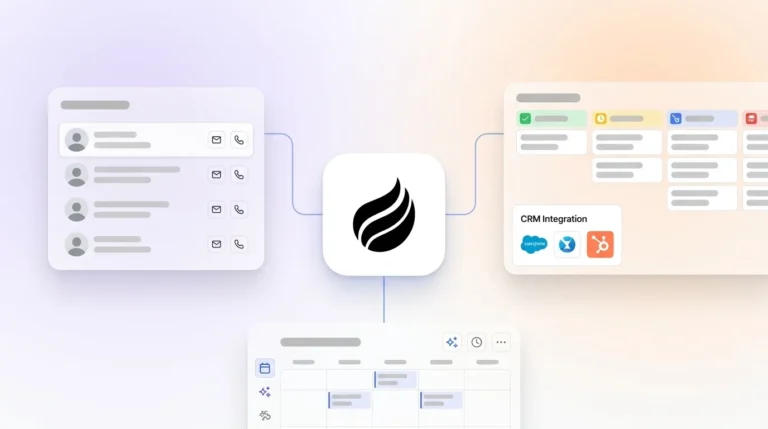
Enterprise platforms frequently need months of IT involvement before going live. In contrast, Coffee’s companion app connects to existing Salesforce or HubSpot instances in minutes. Autonomous agent operations then maintain data quality, so teams gain reliable records without manual upkeep.
Security and Compliance for Mid-Market Needs
Security expectations differ across segments. Many SMB-focused tools keep costs low by limiting advanced security features. Enterprise platforms often overbuild compliance controls that slow procurement and deployment. Coffee maintains SOC 2 Type 2 compliance while keeping processes straightforward, which lets mid-market teams satisfy security requirements without an enterprise-style buying cycle.
How to Evaluate Conversation Intelligence Software for SMB and Mid-Market
Effective evaluation uses a structured framework that goes beyond simple feature lists. One proven approach is micro1’s Human-in-the-Loop Evaluation framework, where real professionals conduct actual conversations with AI systems. This method generates rich assessment data across 12 dimensions, including contextual understanding and conversational flow.
For SMB and mid-market teams, focus your evaluation on these criteria:
- Data Quality Foundation: Aim for 85% or higher transcription accuracy with reliable speaker identification.
- Automation Depth: Confirm that autonomous data capture removes the need for manual CRM entry.
- Adoption Simplicity: Review setup time and the amount of user training required.
- ROI Measurement: Track time savings and the quality of pipeline insights produced.
- Scalability Path: Ensure the platform can support growth without forcing a future migration.
The Strands Evals framework from AWS adds another layer by defining evaluation across Cases, Evaluators, and Experiments. Mid-market teams can use this structure to test conversation intelligence platforms against specific use cases and success metrics before committing.
Best-Fit Tools and Practical Use Cases
The conversation intelligence market aligns different tools with distinct segments. Enterprise teams often select Gong for its advanced analytics and enterprise focus. SMB teams frequently choose Fireflies for its free tiers and scalable paid plans.
Coffee stands out for mid-market teams through its agent-led approach to common SMB scaling challenges. This approach delivers tangible results. One company with more than $10 million in annual revenue replaced spreadsheet-based sales management after adopting Coffee’s autonomous data capture, pipeline comparison features, and API access for custom briefings. Coffee achieves this flexibility through a dual-model strategy. Nascent SMBs use the Standalone CRM, while HubSpot-committed teams rely on the Companion App for smooth integration.

Risks and Long-Term Conversation Intelligence Planning
Each segment carries its own risk profile. Enterprise conversation intelligence software often brings high total cost of ownership, multi-year commitments, and extensive customization work. SMB tools can struggle as teams grow, which creates scalability and data consistency issues.
Coffee addresses these long-term risks with a data warehouse architecture that preserves conversation history and context across tools and stages. This approach aligns with Techaisle’s 2026 findings on the shift from co-pilot tools to autonomous agentic systems. Unified data layers support that shift while avoiding the heavy complexity of traditional enterprise stacks.
Decision Framework: Match Your Profile to a Coffee Solution
This summary matrix helps you connect your company profile with a recommended conversation intelligence setup. Use it as a quick reference when shortlisting tools.
| Company Profile | Primary Need | Recommended Solution |
|---|---|---|
| SMB (10-50 employees) | Replace spreadsheets, basic automation | Coffee Standalone CRM |
| Mid-market (50-200 employees) | Scale existing CRM, eliminate manual entry | Coffee Companion App |
| HubSpot-committed teams | Enhance existing workflows | Coffee HubSpot integration |
| Salesforce enterprises | Improve data quality, reduce admin | Coffee Salesforce companion |
Find your company profile in the matrix above and review Coffee’s pricing for your growth stage.
Frequently Asked Questions
What is the best conversation intelligence software for HubSpot SMB teams?
Coffee’s Companion App fits HubSpot-focused SMB teams by adding an intelligent agent layer for data capture, meeting summaries, and pipeline insights. The agent enriches HubSpot records automatically and delivers custom briefings while your team continues using the familiar HubSpot interface.
How does Gong compare to Coffee for mid-market companies?
Gong focuses on enterprise customers with complex analytics and higher per-user costs. Coffee focuses on mid-market efficiency through autonomous agent operations. The platform removes much of the manual data entry that consumes 71% of sales reps’ time and converts that work into 8–12 hours of weekly savings through active automation instead of passive recording and analysis.

Which 2026 AI agent trends benefit SMB conversation intelligence?
Autonomous AI agents now give SMB teams access to insights that once required enterprise budgets. Coffee’s agent-led approach captures unstructured data from emails and calls, structures it automatically, and surfaces real-time pipeline intelligence. Many teams previously needed dedicated RevOps staff to maintain this level of visibility.
What is the difference between SMB and enterprise conversation intelligence pricing?
Enterprise platforms typically charge $100–200 per user each month with annual commitments. SMB tools usually range from $10–50 per user each month with more flexible terms. Coffee sits between these tiers with transparent seat-based pricing that includes unlimited agent labor and avoids complex metering or hidden fees.
How should I evaluate conversation intelligence software for a growing sales team?
Prioritize automation depth over raw feature counts. Measure how much manual work the platform removes, how easily it connects to your existing tools, and how well it scales without forcing a migration. Coffee’s agent manages the full data lifecycle from capture to insights, so accurate inputs produce reliable forecasts and coaching signals.