Written by: Doug Camplejohn, CEO & Co-Founder, Coffee | Last updated: August 18, 2026
Key Takeaways
- Stage-based minimum required fields keep early-stage records light and late-stage forecasts complete.
- Mandatory next-step fields with future due dates improve pipeline discipline and forecast accuracy across every active deal.
- Standardized dropdowns replace free-text fields and remove variant spellings and reporting inconsistencies in multi-rep environments.
- Real-time post-call automation via AI agents removes hours of manual CRM updates and captures structured qualification data during discovery.
- The Coffee Agent automates CRM data entry end to end, and pricing shows how to remove manual updates for your team.
1–6. Data Capture Best Practices
1. Use Stage-Based Required Fields to Control Deal Progression
A single universal field checklist applied to every deal stage creates two problems at once. Early-stage records get overloaded with fields that cannot yet be answered. Late-stage records escape without the data that accurate forecasting requires. Scian.io’s April 2026 pipeline guide frames required fields as stage-transition controls, the minimum evidence a rep must document before advancing a deal, not a static intake form.
The table below shows how required fields grow more specific as deals progress. Early stages focus on directional signals such as pain point and timeline. Later stages demand firm commitments such as signed agreements and implementation dates. This progression keeps early intake fast and protects late-stage forecast quality.
| Stage | Minimum Required Fields | Exit Criterion | Forecast Probability |
|---|---|---|---|
| Lead / Discovery | Owner, pain point confirmed, budget authority identified, timeline discussed | Contact established, pain and timeline confirmed by buyer | 10% |
| Qualified | MEDDPICC elements documented, 2+ stakeholders engaged, use case confirmed, next step with date | Need, authority, budget posture, and success criteria captured | 25% |
| Proposal | Proposal delivered, economic buyer engaged, decision criteria agreed, competitive status, compelling event confirmed | Champion buy-in confirmed, technical requirements signed off | 70% |
| Closed-Won | Final terms, signed order form or agreement, implementation start date, close reason | Signed contract received | 100% |
The Coffee Agent enforces this model automatically. When a call transcript or email thread shows that a deal has progressed, the Agent updates the stage and flags missing required fields before the record saves, without the rep opening the CRM.
2. Require a Next Step and Date on Every Active Deal
Mandatory next-step fields with a future due date keep deals moving and forecasts honest. No active deal should save without a documented next step and a future due date.
A recommended Salesforce validation rule requires a Next Step field of at least 10 characters before advancing an opportunity past Qualification, using the formula AND(ISPICKVAL(StageName, "Needs Analysis"), LEN(Next_Step__c) < 10). In HubSpot, the equivalent control uses a conditional required property on the deal record.
Documented next steps and next-step dates correlate strongly with forecast accuracy. Treating this field as optional creates a structural forecasting error that compounds every quarter.
3. Standardize Key Fields with Dropdowns Instead of Free Text
Apollo’s 2026 guidance recommends replacing free-text fields with picklists for Industry, Company Size, Lead Source, and Stage to remove variant spellings at the point of entry and reduce reporting inconsistencies in multi-rep CRM environments. A single field such as Lead Source can accumulate dozens of variants like “Website,” “website,” “Web,” and “Inbound Web” that quietly break attribution reports.
Virtual Assist USA’s July 2026 HubSpot setup guide specifies that fields such as service interest, lead source, industry, and reason lost must use standardized dropdown options instead of free text to prevent inconsistent data that breaks reporting.
The implementation checklist for dropdown standardization follows a clear sequence. First, audit every free-text field used in a report or dashboard to find which ones damage attribution or segmentation. Next, define a closed picklist of 10 to 15 values per field, enough to capture real differences without creating a new variant problem. Then migrate existing free-text values to the nearest picklist match so historical data aligns with the new structure. Finally, lock the field to picklist-only entry at the CRM configuration level and assign a RevOps owner to approve any new picklist values so the variant problem does not return.
4. Automate Post-Call Updates in Real Time
Sales reps in 2026 still spend several hours per week on manual CRM updates. They type notes, change deal stages, enrich contacts, log follow-ups, and reconcile data across tools.
The most powerful improvement removes the post-call update entirely and automates it as soon as the call ends.
The Coffee Agent joins every sales call through its AI Meeting Bot, transcribes the conversation, generates a structured summary aligned to BANT, MEDDIC, or SPICED, identifies next steps, and writes everything back to the CRM record in Salesforce or HubSpot before the rep closes their laptop. Reps avoid manual note-taking and end-of-day CRM catch-up.
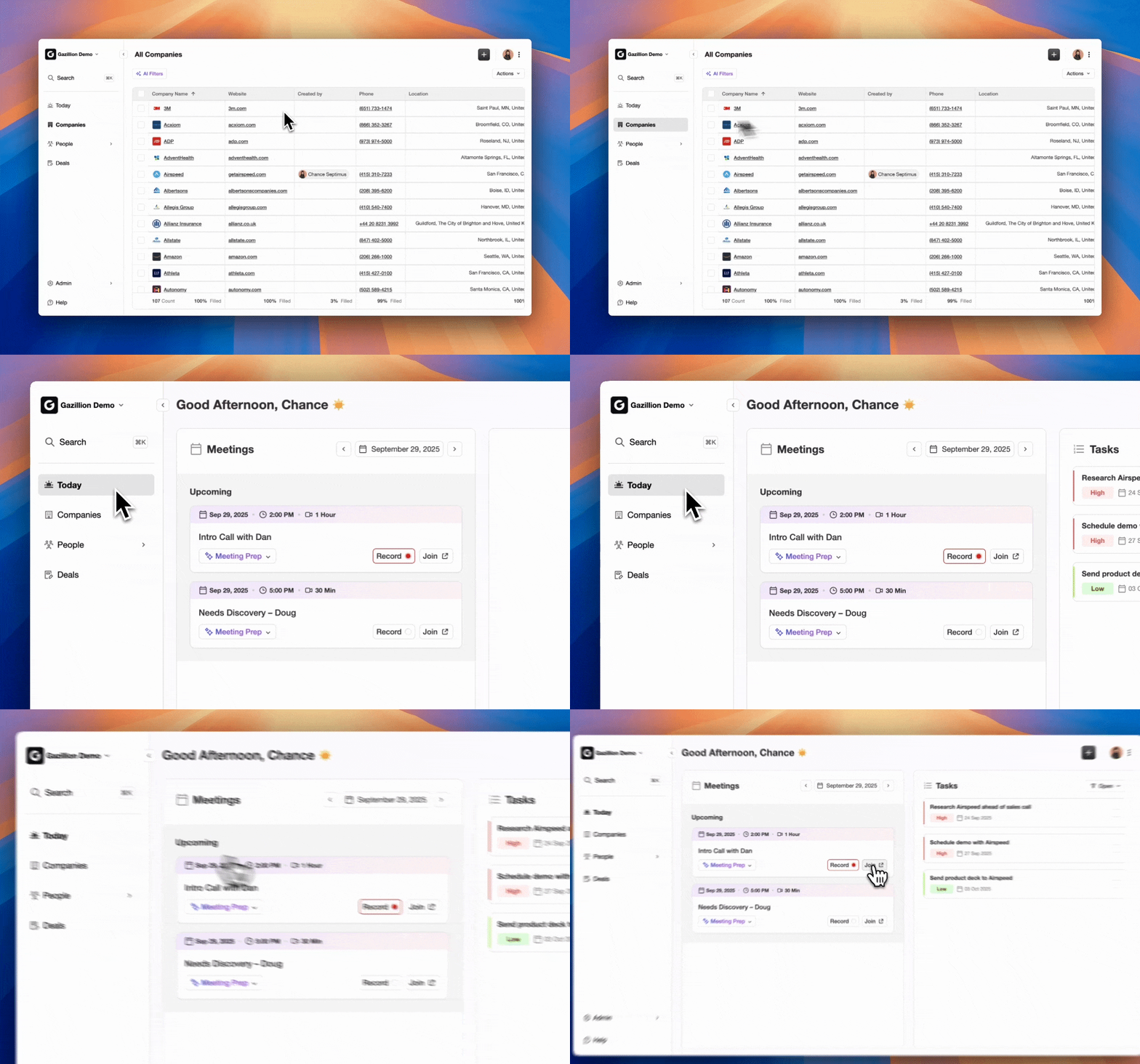
AI-powered CRM automation delivers a 60–80% reduction in admin time by removing manual data entry and updates, with one team reporting that reps spent two hours less per day on administrative tasks after implementation.

5. Stop Duplicates at Record Creation
Duplicate-matching rules on record creation should use email address, phone number, and company domain as primary match keys with fuzzy name matching as a secondary signal to alert reps or block saves. Duplicates that enter the system split activity history, break SDR-to-AE handoffs, and corrupt lead scoring models.
Duplicate record rate should stay under 5% across contacts and deals. Higher rates split activity history and break SDR-to-AE handoffs. The Coffee Agent prevents duplicates from forming by scanning emails and calendars to auto-create contacts and companies, matching against existing records before writing anything new to the system of record.

The duplicate prevention configuration checklist follows a specific order. Enable native duplicate rules in Salesforce or HubSpot on Contact and Company objects. Set primary match keys as email address, phone number, and company domain, then enable fuzzy name matching as a secondary signal. Configure the rule to block saves on high-confidence matches instead of only warning reps. Assign a RevOps data steward to review the dedupe queue weekly so potential conflicts resolve quickly.
6. Capture Qualification Data During Discovery Conversations
Extra required fields beyond owner, stage, and next step slow updates, increase stale data, and push data entry to the end of the day, which often means it never happens. The practical fix captures qualification data during the conversation itself, structured by a sales methodology, instead of asking reps to reconstruct it later.
The Coffee Agent applies BANT, MEDDIC, or SPICED frameworks to call transcripts in real time. It extracts budget signals, authority confirmation, timeline statements, and pain articulation directly from the buyer’s words. This process produces ground-truth qualification data instead of rep interpretation entered hours later.
Every downstream AI use case in CRM, including scoring, forecasting, and personalization, depends on complete activity data captured automatically, because a predictive model that reasons over incomplete contact data produces confident but inaccurate outputs.
7–12. Enforcement and Measurement Best Practices
Strong data capture practices only work when enforcement and measurement keep standards high over time. Without guardrails and monitoring, even well-designed fields drift toward incomplete and unreliable records. The next six practices focus on controls and metrics that preserve data quality across every rep and stage.
7. Block Stage Changes When Required Fields Are Missing
Salesforce validation rules act as enforcement mechanisms for sales process discipline by blocking the save action before bad data enters the system. When a rep tries to advance a deal without completing required fields, the platform evaluates the validation rule formula and displays a custom error message that prevents the record from saving.
Flawless Inbound’s 2026 guide recommends enforcing mandatory properties by never allowing a user to advance a deal stage without filling out required fields, such as requiring the Decision Maker property before moving a deal to the Contract Sent stage.
A practical validation rule prevents close dates in the past for open opportunities using the formula AND(NOT(IsClosed), CloseDate < TODAY()). Many unaudited pipelines contain open deals with close dates that have already passed and no updated activity, which inflates near-term forecast windows.
8. Use Staleness Alerts to Surface Inactive Deals
Staleness checks act as a core CRM data quality mechanism. Automated workflows should notify a rep and their manager if a deal remains in the same stage for more than 30 days without logged communication. Without this control, late-stage deals with no activity receive the same probability weighting in forecasts as actively engaged deals.
CRM exports often reveal a large share of open pipeline value tied to records with stagnation signals such as no logged activity in the prior 30 days or lapsed close dates.
Staleness enforcement configuration follows four steps.
- Define the staleness threshold for each pipeline stage, such as 14 days for Proposal and 30 days for Qualified.
- Build an automated workflow that sends a Slack or email alert to the rep and manager when the threshold is crossed.
- Require a next-step update to reset the staleness clock.
- Auto-move deals that exceed twice the threshold to a Nurture or At-Risk stage for manager review.
9. Give Data Stewardship to a Named RevOps Owner
A named data steward in RevOps should own data quality standards, resolve conflicts, and run the dedupe queue on a weekly review and monthly deep audit cadence. Without a named owner, data quality governance defaults to nobody.
Sales Ops owns the rules, structures, and enforcement mechanisms that keep CRM data clean, including field definitions, required fields, data entry standards, deduplication logic, and regular audits.
The RevOps data steward’s operating cadence follows three layers.
- Weekly: Review the dedupe queue, audit open-deal completeness and pipeline freshness on in-quarter deals, and flag stage-age anomalies.
- Monthly: Run required field completion rates by rep, audit contacts per opportunity by segment, and review close date movement frequency.
- Quarterly: Run a full data quality audit that covers duplicate rates, accuracy spot-checks on 50 to 100 recently touched records, and picklist consistency.
10. Track Five Core Metrics on a Data Quality Dashboard
CRM data quality dashboards work best with a segmented design that separates field quality metrics from outcome metrics. Field quality metrics include completeness, freshness, consistency, and duplicates. Outcome metrics include routing accuracy, scoring reliability, outreach safety, and AI agent quality.
FullstackGTM recommends starting a CRM data quality dashboard with just two metrics, open-deal completeness and pipeline freshness, automating them weekly, then adding more dimensions once each stabilizes. Together, the five core metrics below show how healthy your data is and how reliable your forecast can be.
- Open-deal completeness: Percentage of open deals with amount, close date, and next step populated, with a target of at least 90%.
- Pipeline freshness: Percentage of open deals with logged activity within the staleness budget, with a target of at least 85%.
- Duplicate creation rate: New duplicate pairs per week by source system, with a target near zero from automated sources.
- Validity rate: Percentage of records passing format and picklist rules, with a target of at least 98%.
- Forecast field accuracy: Close date, amount, and stage all current on commit-category deals, with a target of 100%.
Teams that track all seven CRM hygiene metrics see forecast variance drop by 30–40% within one quarter. The Coffee Agent’s Pipeline Compare feature surfaces week-over-week changes automatically, including progressed deals, stalled opportunities, and new additions, so pipeline reviews shift from interrogation to strategy without manual CSV exports.
11. Automate Enrichment to Keep Data from Decaying
B2B contact data decays at roughly 22% per year, with one in five records becoming inaccurate within twelve months due to job changes, mergers, and email turnover. Manual enrichment workflows cannot keep pace with this decay rate at meaningful scale.
Companies that use AI for automated CRM updates reduce missing-field rates and improve downstream forecast accuracy. The Coffee Agent triggers an enrichment-on-create workflow for every new contact. It pulls company size, industry, funding stage, and LinkedIn profile from licensed data partners and writes a structured briefing directly into the CRM record, with no manual step for the rep.

AI agents for CRM data hygiene raise CRM completeness rates within the first few months of deployment and keep them high as records age.
12. Treat Data Quality as a Revenue Risk, Not IT Hygiene
76% of organizations say less than half their CRM data is accurate, which means most ML models train on noise and sales prediction accuracy depends more on data quality than on algorithm design. Data quality functions as a revenue risk that belongs on the Head of Sales’ weekly agenda, not as a background IT concern.
An AI solutions company generating tens of millions in revenue managed sales in spreadsheets and rejected Salesforce and HubSpot because they required too much manual work. After deploying the Coffee Agent, automatic contact creation from Google Workspace kept the CRM clean without human effort. The Pipeline Compare feature automated their weekly pipeline reviews and removed the manual reporting layer that had consumed RevOps time.
Organizations that deploy agentic CRM systems see higher win rates and faster deal cycles because reps spend time selling instead of updating records.
Framing data quality as a revenue metric, not an administrative one, drives executive sponsorship and sustained adoption.
See how Pipeline Compare and automated enrichment eliminate manual reporting in a live walkthrough.
Frequently Asked Questions
What fields are required at each pipeline stage?
The minimum required fields vary by stage and should act as stage-transition controls instead of a single static checklist. At the Lead or Discovery stage, every deal needs an owner, a confirmed pain point, an identified budget authority, and a discussed timeline. At the Qualified stage, all MEDDPICC elements must be documented, at least two stakeholders must be engaged, and a next step with a future date is mandatory.
At the Proposal stage, the economic buyer must be engaged, decision criteria must be agreed upon, competitive status must be captured, and a compelling event must be confirmed. At Closed-Won, final terms, a signed agreement, an implementation start date, and a close reason are all required. Configuring these as stage-specific required fields in Salesforce or HubSpot, instead of applying them universally, keeps early-stage intake fast while ensuring late-stage records contain everything forecasting needs.
How do you enforce next-step discipline in CRM?
Next-step discipline requires both a technical enforcement mechanism and a clear cultural expectation. On the technical side, configure a validation rule that blocks any deal from advancing past the Qualification stage unless the Next Step field contains at least 10 characters and a future Next Step Date is populated. In HubSpot, use conditional required properties to enforce the same rule.
On the process side, the RevOps data steward should include next-step completeness in the weekly pipeline review dashboard and flag any active deal without a future next step as an at-risk record. Mandatory next-step fields reduce deals without scheduled meetings, shorten pipeline reviews, and support better forecast accuracy. An autonomous agent such as Coffee removes the enforcement burden by identifying next steps from call transcripts and writing them to the CRM record automatically.
What CRM data quality metrics should RevOps track monthly?
RevOps should track five core metrics on a weekly-to-monthly cadence. Open-deal completeness measures the percentage of open deals with amount, close date, and next step populated, with a target of 90% or higher. Pipeline freshness measures the percentage of open deals with logged activity within the defined staleness budget, typically 30 to 45 days, with a target of 85% or higher.
Duplicate creation rate tracks new duplicate pairs per week by source system, with a target near zero for records created by automated sources. Validity rate measures the percentage of records passing format and picklist rules, with a target of 98% or higher. Forecast field accuracy confirms that close date, amount, and stage are all current on every commit-category deal, with a target of 100%. These five metrics should be reported per rep and per segment, not as a single blended score, because a blended score can hide serious gaps in specific areas.
How do you prevent duplicate records in a CRM used by multiple reps?
Duplicate prevention works best when enforced at the point of record creation, not after the fact. Enable native duplicate matching rules in Salesforce or HubSpot on the Contact, Lead, and Company objects, using email address, phone number, and company domain as primary match keys and fuzzy name matching as a secondary signal. Configure the rule to block the save action on high-confidence matches instead of issuing a warning that reps can dismiss.
Assign a RevOps data steward to review the dedupe queue weekly and resolve merge decisions within 48 hours of detection. For teams using the Coffee Agent, duplicate prevention happens upstream. The Agent scans emails and calendars to auto-create contacts and companies, matching against existing records before writing anything new to the CRM, so duplicates are prevented from forming instead of cleaned up later.
What is the business impact of poor CRM data quality on sales forecasting?
Poor CRM data quality has a direct and measurable impact on sales forecasting. Companies with CRM data completeness above 85% report forecast accuracy 22% higher than those below 60% completeness, a gap driven by data quality. In pipelines that have not undergone a formal data quality audit, field completeness and structural credibility rates can vary widely, which means a portion of reported pipeline may not be reliable.
Poor data quality costs organizations millions per year, with that cost showing up as forecast variance through missed pipeline targets, misallocated sales capacity, and hiring decisions based on inflated revenue projections. Companies that improve CRM data hygiene increase forecast accuracy and make better resourcing decisions.
Ready to eliminate manual CRM data entry?
Every practice in this guide depends on one condition, data that is complete, current, and accurate at every pipeline stage. Manual enforcement through validation rules, RevOps audits, and rep training reduces the problem but cannot remove it, because it still relies on busy humans to enter and maintain records consistently. The Coffee Agent removes that dependency.
It captures activity from emails, calendars, and call transcripts, enforces stage-based required fields automatically, enriches every new record at creation, and surfaces pipeline risk before the weekly forecast meeting, all without a rep touching the CRM.