Written by: Doug Camplejohn, CEO & Co-Founder, Coffee | Last updated: September 10, 2026
Key Takeaways
- Build a compliant LinkedIn prospect list by defining your ICP first, then using Sales Navigator filters or Coffee’s Lead Finder to create a focused 100–300 lead cohort.
- Stay within LinkedIn’s User Agreement by avoiding browser extensions, scrapers, and automation tools. Native exports and licensed CRM data sources keep you safe.
- Use the 3/2/1, 4-1-1, and 80/20 prospecting rules to pace outreach, segment your list, and focus 60–70% of effort on the highest-intent tier.
- Export and enrich directly inside your CRM so the list stays current and ready for multi-step email sequences with stop-on-reply enabled.
- Ready to build your first compliant list without the risk? Build your first list in Coffee.
Why Building LinkedIn Prospect Lists The Right Way Matters
The cost of a bad list includes wasted outreach and a restricted account. LinkedIn’s enforcement ladder runs from a soft warning to a feature limit to a full restriction, and a single ban can wipe out 2–4 weeks of pipeline for a small sales team. A compliant, well-built list compounds over time. Saved searches refresh automatically, enrichment keeps records current, and outreach sequences run without account risk.
Common Mistake: Building a list before defining the ICP. You get 5,000 names that match nothing and a search you cannot refine.
Before You Start: Put The Right Foundations In Place
Start list building only after four pieces are ready. You need a written ICP that covers industry, headcount, geography, seniority, function, and target titles. You also need a Sales Navigator seat or a Coffee account, a connected mailbox for outreach, and a CRM that will hold the list instead of a spreadsheet.
Compliant Vs. Non-Compliant: Using Sales Navigator’s own filters and saved searches is compliant. Installing a browser extension that injects code into LinkedIn pages violates the rules. LinkedIn’s User Agreement explicitly prohibits software, scripts, browser plugins, and add-ons used to scrape or copy profiles and other data from the Services.
Ready to skip the spreadsheet and keep everything in one place? Create your first CRM-native list in Coffee.
How To Build LinkedIn Prospect Lists: 7 Steps
- Define your ICP in Sales Navigator.
- Run advanced searches.
- Write Boolean strings.
- Stay compliant with LinkedIn’s User Agreement.
- Export and enrich without a scraper.
- Apply the prospecting rules of thumb.
- Turn the list into outreach.
Step 1: Define Your ICP In Sales Navigator
Sales Navigator provides access to over 30 advanced search filters, organized into Lead Filters, Account Filters, and Spotlight Filters. The practical staples for ICP definition are:

- Job Title, using exact match with Boolean variants
- Seniority Level, such as Director, VP, or C-Suite
- Function, such as Sales, Marketing, or Finance
- Company Headcount, which narrows to your serviceable market
- Industry, available via Account search or self-described profiles
- Geography, such as country, region, or metro
- Years In Current Position, because someone less than one year into a new role has budget to spend and a mandate to make changes
A search returning 12,000 results is too broad, and under 50 is too narrow. The target range is 100–300 leads, which creates a cohort tight enough to personalize and large enough to build a pipeline. Hitting that range usually means using four to seven filters. Fewer than four filters make lists too broad, while more than seven over-constrain the search. Because ICP definition is a strategic call, this step belongs to the founder or sales lead rather than the SDR. The signal that the step is complete is a saved search returning 100–300 leads.
Compliant Vs. Non-Compliant: Using Sales Navigator filters is compliant. Scraping the result set with an extension violates LinkedIn’s rules.
Steps 2–3: Run Advanced Searches And Write Boolean Strings
LinkedIn’s own documentation (help article a168061) lists exactly three Sales Navigator fields that run Boolean operators: company, title, and keywords. Other filters such as seniority, geography, and headcount use dropdowns. The documented operators are AND, OR, NOT, quotation marks for exact phrases, and parentheses for grouping logic.
Use these example Boolean strings for common ICP targets:
(Director OR VP) AND "SaaS"("Head of Sales" OR "VP of Sales") NOT recruiter(Founder OR CEO) AND (fintech OR payments)
Start broad, then tighten the search. Preview the result count before saving the search. Sales Navigator allows each seat to save up to 50 lead searches and 50 account searches, which automatically refresh and surface new matching leads without manual effort. That turns a one-time list build into an ongoing pipeline feed.
Common Mistake: LinkedIn requires AND, OR, and NOT in uppercase or it treats them as ordinary words. Lowercase operators break the logic silently. LinkedIn also only supports standard, straight quotation marks. Curly quotes from Google Docs or Notion are not supported and cause silent failures.
Compliant Vs. Non-Compliant: Boolean search inside Sales Navigator is compliant. Running the same query through a third-party scraper is not.
Step 4: Stay Compliant With LinkedIn’s User Agreement
LinkedIn’s User Agreement (last updated May 5, 2026) prohibits users from developing, supporting, or using software, devices, scripts, robots, or any other means or processes, including crawlers, browser plugins, and add-ons, to scrape or copy the Services, including profiles and other data. The prohibition applies to users who employ scraping tools, not only to the developers who build them.
When an account crosses the line, LinkedIn’s enforcement typically follows a graduated five-stage ladder:
- Soft warning (“We noticed unusual activity”) with nothing blocked
- Feature limit that temporarily prevents profile views, invitations, or other actions
- Account restriction requiring verification, appeal, or waiting
- Permanent restriction
- Fake-account removal
Evaboot, PhantomBuster, and Wiza all fall within the categories of tools that LinkedIn’s User Agreement prohibits. Evaboot and Wiza are browser extensions that inject code into the LinkedIn DOM. PhantomBuster uses cloud automation with session cookies. The agreement explicitly prohibits crawlers, bots, browser plug-ins, and browser extensions that scrape or automate activity on LinkedIn. LinkedIn’s anti-automation detection layer monitors session behavior and request patterns, flagging activity that does not originate from a genuine user session, including browser extensions that inject code into LinkedIn pages. Getting “flagged,” “restricted,” or “banned for using an extension” already has real examples. In late March 2026, LinkedIn sent a cease-and-desist to HeyReach, forcing the product to remove all LinkedIn functionality within weeks. The table below compares the main list-building methods side by side so you can see which ones carry account risk and where the resulting list lives.
| Method | Compliant With LinkedIn User Agreement? | Account Risk | Where The List Lives |
|---|---|---|---|
| Sales Navigator filters + saved search | Yes | None | Sales Navigator |
| Manual CSV export from Sales Navigator | Yes | None | Spreadsheet or CRM |
| Browser extension (Evaboot, PhantomBuster) | No | High — restriction or ban | Third-party tool |
| Cloud automation tool (Wiza, HeyReach) | No | High — restriction or ban | Third-party tool |
| Coffee Lead Finder | Yes | None | Inside the CRM |
Build your LinkedIn prospect list without risking your account. See Coffee’s pricing and plans.
Step 5: Export And Enrich Without A Scraper
The manual, compliant export path uses Sales Navigator’s own export function. Exporting your own connections via LinkedIn’s data export is entirely within LinkedIn’s rules. Routing that export through a third-party scraper, even once, is the action that triggers restrictions.
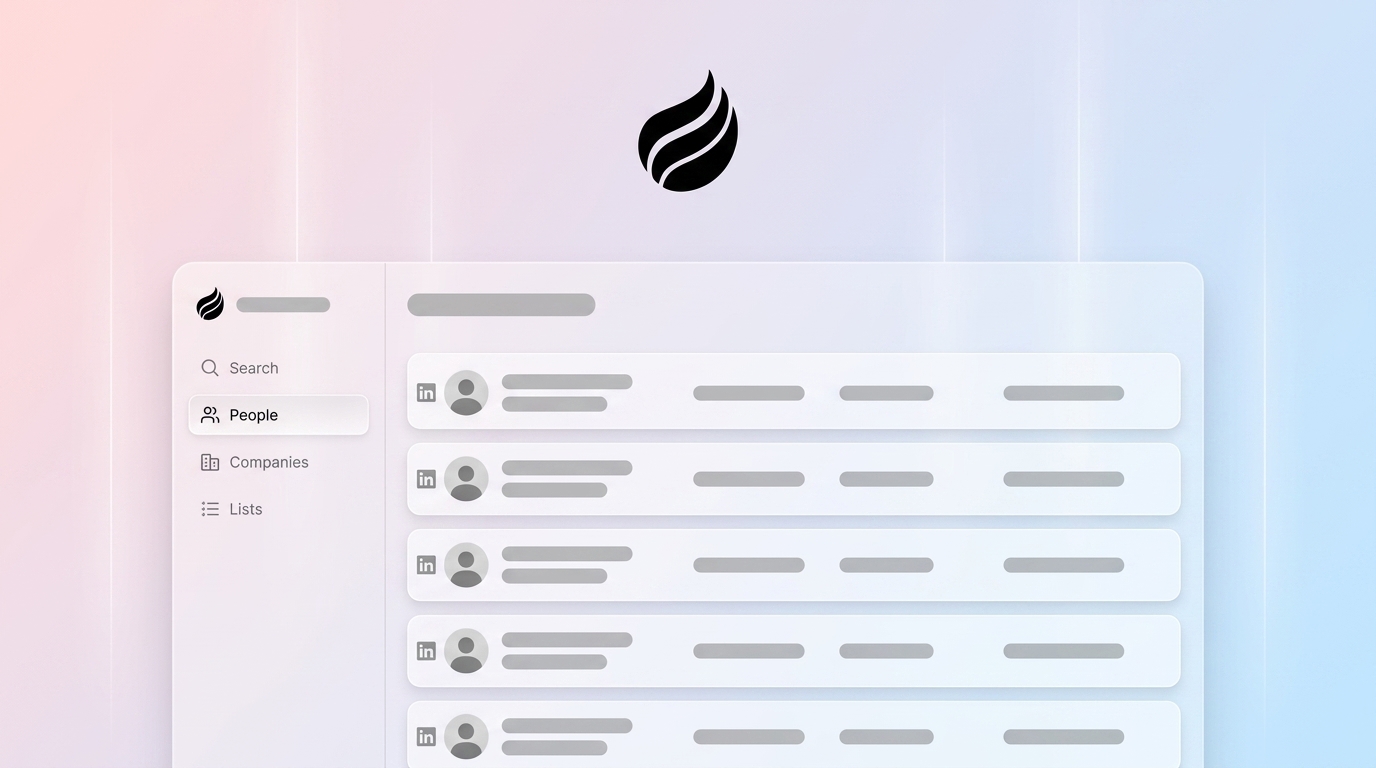
The in-CRM alternative is Coffee’s Lead Finder. A user types a plain-English command such as “Find me VPs of Sales at SaaS companies with 50–200 employees.” The agent interprets the request, previews how it understood the query, and shows a sample of matching results before generating the final list. The resulting LinkedIn prospect list lives directly inside Coffee alongside every other record. It is ready to be enriched with job titles, funding data, and LinkedIn profiles via licensed data partners and then enrolled into Campaigns, with no CSV exports between tools.

Common Mistake: Exporting to a third-party scraper “just this once.” Scraping or mass data extraction carries a very high risk rating. That single action is what triggers restrictions.
Step 6: Apply The Prospecting Rules Of Thumb
Three named rules govern how aggressively to work a LinkedIn prospect list. Each rule has a clear definition and a direct list-building implication.
The 3/2/1 Rule
The 3/2/1 rule is a multichannel prospecting sequence: three emails, two LinkedIn touches, and one phone call per prospect. In list-building terms, add 15–25 prospects per day instead of 200. Sending 50 or more connection requests in a single day from an account with low acceptance history is one of the six behavioral signals that trigger LinkedIn account flags.
The 4-1-1 Rule
The 4-1-1 rule is a content-mix ratio: for every six posts, four share or build on useful content from others, one is a repost or personal update, and one directly promotes you or your product. In list-building terms, split effort 80/20 between research and outreach. A prospect list built with this ratio in mind is segmented by intent signal. Active LinkedIn posters, new-in-role buyers, and funded accounts each get a different angle.
The 80/20 Rule
The 80/20 rule, drawn from the Pareto Principle, states that roughly 20% of a prospect list will produce 80% of written premium revenue. In list-building terms, tier your list and spend 60–70% of outreach time on the top tier. A-tier prospects are those with fit, intent, and reachability signals, such as new-in-role buyers at funded, growing companies who have posted on LinkedIn in the past 30 days.
Compliant Vs. Non-Compliant: Applying these rules to a compliant list keeps your outreach safe. Applying them to a scraped list only scales the risk.
Step 7: Turn Your List Into Outreach
The finished LinkedIn prospect list becomes pipeline through Coffee Campaigns. Multi-step email sequences are generated in plain English and sent from the rep’s own connected mailbox. Stop-on-reply is on by default, and built-in send throttling protects deliverability. Dynamic lists then auto-enroll new contacts as the campaign runs, so the LinkedIn prospect list keeps working after launch without manual re-import.
A coordinated multi-touch cadence across three channels lands a 4–7% reply rate, with 30% higher meeting conversion than any single-channel campaign. Coffee Campaigns close the loop from lead discovery to reply-aware outreach inside one agent. You avoid separate sequencing tools, extra subscriptions, and new data silos.
Common Mistake: Launching outreach without stop-on-reply. You burn the reply and the relationship. Coffee’s stop-on-reply is on by default, so the moment a prospect responds, the sequence pauses automatically.
Your Pre-Build Compliance Checklist
- ICP is written and saved as a Sales Navigator search.
- Search returns 100–300 leads, not 12,000 and not 12.
- Boolean operators are uppercase and quoted phrases use straight quotes.
- No browser extension or scraper is installed.
- The list lives in the CRM, not a spreadsheet.
- Records are enriched with title and company data.
- Outreach sequences have stop-on-reply enabled.
Frequently Asked Questions
How Long Does It Take To Build A LinkedIn Prospect List?
With LinkedIn Sales Navigator and a defined ICP, building a first targeted prospect list typically takes about 30 to 60 minutes, though it can take up to one to two hours. That time usually goes into configuring filters, writing Boolean strings, and saving the search. The bottleneck is usually ICP definition, not the search itself. With Coffee’s Lead Finder, a natural-language query builds and enriches the list in minutes, because the agent interprets the request, previews the results, and populates records with job titles, funding data, and LinkedIn profiles without manual field-by-field entry.
Is Sales Navigator Required To Build LinkedIn Prospect Lists?
Sales Navigator is helpful but not mandatory. It gives you advanced filters, saved searches, and Spotlight signals that make targeting precise. Coffee’s Lead Finder builds targeted lists from its own licensed database using natural language search, so you can work without a Sales Navigator seat. The resulting list lives inside Coffee alongside every other record and is ready to enrich and enroll into Campaigns without leaving the CRM.
What Do The 3/2/1 And 4-1-1 Rules Mean?
As covered in Step 6, the 3/2/1 rule paces outreach across three channels and the 4-1-1 rule governs content mix. Both rules guide how you work the list after it is built rather than how you construct it.
Is Exporting LinkedIn Prospect Lists Allowed?
Exporting your own connections via LinkedIn’s built-in data export (Settings → Data Privacy → Get a copy of your data) is allowed and within LinkedIn’s rules. Using a browser extension, scraper, or cloud automation tool to export search results from Sales Navigator or LinkedIn’s member directory violates the User Agreement. That behavior is the most common trigger for account restrictions and bans.
How Is Coffee’s Lead Finder Different From Scraping Tools?
Scraping tools extract data from LinkedIn’s pages by injecting code into the browser or running automated sessions through cloud infrastructure. LinkedIn’s User Agreement explicitly prohibits both methods. Coffee’s Lead Finder builds and enriches lists from its own licensed data partners inside the CRM. There is no browser extension, no automated LinkedIn session, and no account risk. The list is generated, enriched, and ready for outreach without touching LinkedIn’s servers in an unauthorized way.
Conclusion
The seven steps, from defining your ICP through launching outreach, form a complete, repeatable system for building LinkedIn prospect lists that are targeted, CRM-ready, and account-safe.
The tools the AI Overview recommends are the tools LinkedIn prohibits. Evaboot, PhantomBuster, and Wiza operate through browser extensions and automated sessions that LinkedIn’s User Agreement explicitly bans. The compliant alternative is a better workflow. Coffee’s Lead Finder builds and enriches the list inside the CRM using licensed data, and Coffee Campaigns turns that list into reply-aware, throttled outreach from the rep’s own mailbox without scrapers, exports, or account risk.
Build your LinkedIn prospect list the compliant way. Start your Coffee trial.