Key Takeaways
- AI automation removes manual MEDDIC scorecard data entry, so reps reclaim 71% of admin time and spend it selling.
- Structured MEDDIC frameworks deliver 42% higher win rates, 21.6% faster closes, and 80%+ forecast accuracy versus ad hoc qualification.
- Follow a 7-step process: define your rubric, map scores to stages, build CRM fields, automate with AI, enforce softly, review consistently, and track ROI.
- Coffee AI Agent auto-captures qualification data from emails and calls, fills scorecards in Salesforce or HubSpot, and flags gaps without extra rep work.
- Start automating MEDDIC scorecards with Coffee to gain 15-30% higher win rates and save 8-12 hours per rep each week.
Why MEDDIC Scorecard Implementation Matters Now
MEDDIC scorecards tackle sales challenges that have intensified since 2021. B2B sales cycles have lengthened during this period, and this extension often signals poor pipeline quality because reps chase unqualified deals that drag on without closing. Only 43.5% of sales professionals in the RepVue Cloud Sales Index hit quota in Q1 2024.
The risks of weak qualification are substantial. Organizations with quality-focused pipeline management achieve 80% or higher forecast accuracy, compared to 45-55% for volume-focused teams. This gap explains why revenue leaders struggle to meet forecasts, because their teams lack structured qualification that drives predictable outcomes.
To address these qualification and forecasting gaps, you need specific prerequisites before rolling out MEDDIC scorecards. Secure CRM admin access in Salesforce or HubSpot, complete MEDDIC training for your team, and confirm leadership buy-in for the qualification process. The implementation timeline typically spans 1-2 weeks, with dependencies on Google Workspace or Microsoft 365 integration for automated data capture. Coffee’s AI automation handles these integrations automatically, which often reduces setup time from weeks to just a few days.

7-Step MEDDIC Scorecard Implementation Guide
1. Define Your MEDDIC Scoring Rubric
The DemandFarm MEDDIC model uses a 100-point weighted scoring rubric that provides clear criteria for each element. This scoring system keeps evaluation consistent across your sales team and supports accurate pipeline health assessment.
| MEDDIC Element | Max Points | Full Criteria | Health Band |
|---|---|---|---|
| Economic Buyer | 25 | EB met, authority confirmed, value aligned | 85+ Dark Green |
| Metrics | 20 | ROI quantified and tied to EB priorities | 60-84 Light Green |
| Decision Criteria | 15 | Criteria documented and influenced | 30-59 Orange |
| Decision Process | 15 | Steps, timeline, and approvals mapped | Below 30 Red |
| Identify Pain | 15 | Pain quantified and tied to metrics | – |
| Champion | 10 | Champion tested and selling internally | – |
Choose between MEDDIC and MEDDPICC based on deal complexity. MEDDPICC adds Paper Process and Competition elements for enterprise deals with longer sales cycles and more stakeholders. Document your chosen rubric in a shared resource that every team member can access. Once your scoring rubric is defined, the next step is translating those scores into actionable stage gates inside your CRM workflow.
2. Map MEDDIC Scores to CRM Deal Stages
Set stage gates that stop deals from advancing when qualification scores fall below your standards. The table below shows recommended minimum scores for each stage, with enforcement that starts as soft warnings and progresses to hard blocks as deals approach forecast commits.
| Deal Stage | Minimum MEDDIC Score | Gate Type | Coffee Auto-Fill |
|---|---|---|---|
| Discovery | 30 points | Soft warning | Yes |
| Solution Alignment | 45 points | Validation rule | Yes |
| Proposal | 60 points | Hard block | Yes |
| Negotiation | 80 points | Hard block | Yes |
Sales leaders require minimum MEDDPICC scorecard thresholds (typically 70%+) before deals enter commit forecast, which improves forecast accuracy more than most other process changes.
3. Build MEDDIC Scorecard Fields in Your CRM
Create custom fields in Salesforce or HubSpot for each MEDDIC element. Ebsta uses a 1-10 scoring model with color bands across MEDDPICC’s eight criteria, giving sales reps a visual at-a-glance view inside Salesforce. Use picklist fields with 1-10 scoring options for each element, and add text fields for supporting evidence and notes.
Configure formula fields that calculate composite MEDDIC scores automatically based on your weighted rubric. Add conditional formatting that displays health bands with color coding that matches your scoring thresholds. Include required field validation for critical elements such as Economic Buyer and Metrics identification.
4. Automate MEDDIC Capture with Coffee AI Agent
The Coffee AI Agent removes manual MEDDIC scorecard work by capturing qualification data from emails, calls, and meeting transcripts. The agent converts unstructured conversation data into your MEDDIC fields, which keeps scorecards consistently populated without extra effort from reps.

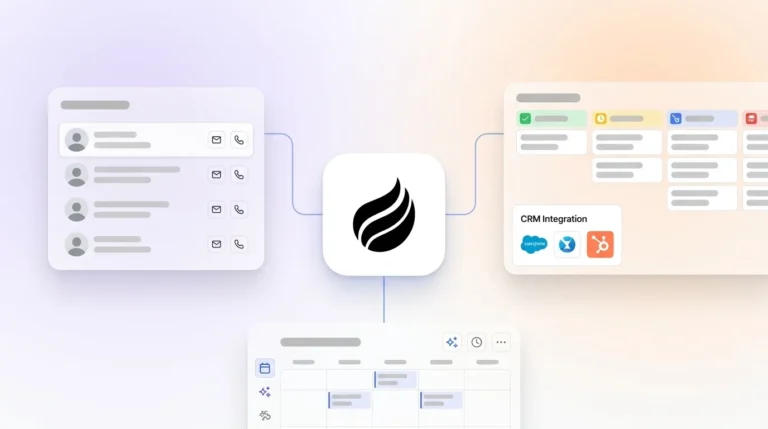
Coffee’s Standalone CRM includes built-in MEDDIC automation for small teams. The Companion App connects to existing Salesforce or HubSpot instances and auto-populates scorecard fields. The agent enriches buyer intelligence, tracks decision-maker changes, and updates qualification scores as new information appears in sales interactions.
❌ Common mistake: teams rely on manual scorecard completion, which often results in 70% incomplete data and strong rep resistance. Coffee’s automation reaches 80%+ field population without manual entry, which drives higher adoption and better data quality.
5. Implement Soft Enforcement Strategies
Use soft enforcement instead of hard validation rules that block deal progression and create rep frustration. Build gentle pressure through dashboard alerts, pipeline review flags, and coaching conversations. To foster ongoing MEDDPICC culture and reduce rep resistance, celebrate sales reps who disqualify bad deals early, shifting focus from pipeline volume to quality.
Coffee’s AI agent automatically scores deals and flags qualification gaps without blocking progression. This non-blocking approach lets you apply minimum thresholds to forecast commits rather than to stage advancement, so deals can keep moving while you still protect forecast accuracy. Apply the 70%+ threshold mentioned earlier specifically to commit forecasts, which keeps poorly qualified opportunities out of your predictions.
6. Structure Pipeline Reviews Around MEDDIC
Turn pipeline reviews into strategic conversations by centering them on MEDDIC qualification gaps. Use Coffee’s Compare feature to visualize week-over-week changes in deal scores and overall qualification health. Create review scripts that walk through each MEDDIC element in a consistent order.
Focus coaching on specific qualification weaknesses that scorecard data reveals. Korn Ferry research shows sales organizations with over 75% adoption of their sales methodology achieve 15% higher win rates.
7. Build ROI Dashboards and Analytics
Build dashboards that connect MEDDIC scores with win rates, deal velocity, and average selling price. Track which qualification elements most strongly predict deal success for your market and sales motion. Use Coffee’s List Builder to surface prospects that match your ideal qualification profile based on historical win patterns.

Monitor adoption metrics such as scorecard completion rates, time to qualification, and forecast accuracy improvements. Companies with high CRM data completion rates often achieve higher win rates. Coffee’s built-in analytics dashboards track these metrics automatically, giving you real-time visibility into MEDDIC adoption and its impact on win rates.
Validation and Success Criteria
Successful MEDDIC scorecard implementation produces clear, measurable outcomes. Target 80% automated field population through AI capture, which removes most manual data entry. Use the 80%+ forecast accuracy benchmark from quality-focused pipeline management as your long-term success target.
Plan for 15-30% improvement in win rates within the first quarter of implementation. Sales teams using structured qualification frameworks achieve 42% higher win rates than those using ad hoc approaches. Track rep adoption and aim for 90% consistent scorecard usage without heavy-handed enforcement.
Coffee’s automation saves sales reps 8-12 hours per week that previously went to manual data entry and qualification documentation. Track deal velocity improvements as well, because properly qualified opportunities close 21.6% faster than unqualified ones.
Implementation Variations and Scaling with Coffee
Small businesses with 1-20 employees gain from Coffee’s Standalone CRM with built-in MEDDIC automation, which removes the complexity of configuring legacy systems. Mid-market companies with 20-500 employees usually adopt Coffee’s Companion App to enhance existing Salesforce or HubSpot setups with AI-powered qualification capture.
Simple sales motions can use basic MEDDIC with six elements. Complex enterprise deals benefit from MEDDPICC with eight elements, including Paper Process and Competition analysis. MEDDIC works best for complex B2B deals that involve longer sales cycles and multiple stakeholders.
Organizations that run multiple CRM systems can unify qualification data through Coffee’s data warehouse. This approach keeps MEDDIC scoring consistent across platforms while preserving system-specific workflows and reporting.
Frequently Asked Questions
How does Coffee automate MEDDIC scorecard completion?
Coffee’s AI agent automatically captures qualification data from emails, calendar events, call transcripts, and meeting notes. The agent converts this unstructured conversation data into your MEDDIC scorecard fields, identifies economic buyers, quantifies metrics, maps decision processes, and tracks champion engagement without manual rep input. The system keeps scores current as new information appears in ongoing sales interactions.

What is the difference between MEDDIC and BANT for deal qualification?
MEDDIC provides deeper qualification for complex B2B deals compared to BANT’s basic budget, authority, need, and timeline framework. MEDDIC focuses on economic buyers rather than any contact with authority, quantified business metrics rather than general budget discussions, and detailed decision processes rather than simple timelines. MEDDIC fits longer sales cycles with multiple stakeholders, while BANT works better for transactional sales with shorter cycles and fewer decision makers.
How long does MEDDIC scorecard setup take in CRM systems?
Basic MEDDIC scorecard implementation usually takes 1-2 weeks, including field creation, validation rule setup, and team training. Coffee’s automated approach shortens this timeline by removing manual field mapping and data entry configuration. The system includes pre-built MEDDIC templates for Salesforce and HubSpot that teams can deploy within days instead of weeks of custom development.
What security measures protect MEDDIC qualification data?
Coffee maintains SOC 2 Type 2 compliance and GDPR adherence for all qualification data processing. Customer conversation data is encrypted in transit and at rest, and access controls limit visibility to authorized team members. The AI agent processes data without using it to train public models, which keeps your competitive qualification insights confidential and secure.
Should we use MEDDIC or MEDDPICC for our sales process?
Use MEDDIC for mid-market deals under $500K that have straightforward decision processes and fewer than five stakeholders. Choose MEDDPICC for enterprise deals over $500K that involve complex procurement, multiple approval layers, and competitive evaluations. The additional Paper Process and Competition elements in MEDDPICC add needed qualification depth for longer cycles, while simpler deals usually do not require that extra complexity.
Conclusion: Turn MEDDIC into a Low-Lift, High-Impact Habit
These seven steps create a MEDDIC scorecard program that strengthens qualification without adding manual busywork for sales reps. Coffee’s AI agent removes the primary barrier to MEDDIC adoption by capturing and structuring qualification data directly from sales interactions. Use Coffee to roll out automated MEDDIC scorecards in Salesforce or HubSpot and give your team a faster path to accurate forecasts and higher win rates.