Key Takeaways
- Demandbase’s $50K+ pricing and enterprise complexity overwhelm most SMB and mid-market teams, so many now look for leaner, automated options.
- Coffee uses an AI agent to handle data entry, enrichment, visitor identification, and pipeline updates, saving reps 8–12 hours each week.
- Apollo delivers budget-friendly outbound at $49/user/month with strong email accuracy, but it lacks deeper automation and visitor tracking.
- Cognism specializes in GDPR-compliant EU data, while 6sense and ZoomInfo fit enterprises with larger budgets and advanced ABM programs.
- Teams that want faster, cleaner sales workflows can start a Coffee free trial and connect it to their CRM within minutes.
Why Teams Move Away From Demandbase
Traditional ABM platforms like Demandbase create fragmented workflows across prospecting, data enrichment, and visitor identification tools. Teams juggle multiple point solutions while Sales reps spend 71% of their workweek on administrative work, data entry, and preparation, leaving only 35% for actual selling activities.
Teams that switch focus on data quality, automation, pricing, and compliance. Apollo, for example, claims a 91% email accuracy rate for verified emails. Coffee scores 10/10 on automation. Apollo’s Basic plan starts at $49/user/month (billed annually). Buyers also evaluate Salesforce and HubSpot integrations, visitor identification, and EU compliance for global operations.
Apollo fits budget-conscious outbound prospecting, and Cognism covers GDPR-compliant European data. Coffee stands apart by unifying these capabilities through an AI agent that removes manual processes from daily sales work.
Top 10 Demandbase Alternatives 2026: Hands-On Rankings
The rankings below compare each platform on automation strength, pricing accessibility, and ideal use cases. Every tool appears where it delivers the clearest value relative to its cost and complexity.
1. Best for Agent-Driven Sales Automation: Coffee
Coffee’s AI agent handles data entry, enrichment, and visitor identification automatically, which removes the manual grind that slows traditional CRMs. The agent creates contacts from emails, enriches records with job titles and funding data, and converts anonymous website visitors into named prospects with suggested leads that match your buyer persona.
This flexibility extends to deployment because Coffee works as a standalone CRM or as a Salesforce and HubSpot companion. The seat-based pricing model scales with team size, so smaller teams can start without enterprise contracts. Bottom line: Coffee turns reps from data clerks into strategic sellers through end-to-end automation.

2. Best for Budget Outbound: Apollo
Apollo combines a large contact database with high email accuracy and built-in sequencing at a low entry price. The Basic plan starts at $49/user/month (billed annually). Pros include an affordable starting point, broad contact coverage, and solid CRM integrations.
Cons include credit overages that can sharply increase costs and limited automation compared with agent-driven tools. Verdict: Apollo suits cost-conscious teams that run high-volume outbound and can manage credits closely.
3. Best for EU Compliance: Cognism
Cognism delivers GDPR-compliant B2B contact data with Diamond Data® ensuring high accuracy in EMEA markets. Custom pricing typically ranges $1,000–$3,000 monthly.
Pros include strong European data coverage, regulatory compliance, and phone-verified contacts. Cons include higher cost than Apollo and limited US coverage. Verdict: Cognism is essential for teams that focus heavily on European markets.
4. Best for Enterprise ABM Programs: 6sense
6sense provides comprehensive account-based marketing with intent data and predictive analytics. Pricing is fully custom and targets larger organizations.
Pros include advanced intent signals and enterprise-grade features. Cons include complex setup, high cost, and a feature set that often exceeds SMB needs. Verdict: 6sense fits large enterprises with dedicated ABM resources.
5. Best for Data Depth: ZoomInfo
ZoomInfo offers an extensive B2B database with advanced filtering and intent tracking. Pricing starts around $15,000+ annually.
Pros include comprehensive data coverage and strong integrations. Cons include high pricing and a complex commercial structure. Verdict: ZoomInfo works best for teams that prioritize data breadth over cost efficiency.
6. Best for Mid-Market ABM Advertising: RollWorks
RollWorks focuses on account-based advertising and retargeting with custom pricing models. It centers on ad programs rather than broad sales workflows.
Pros include strong advertising capabilities and a clear account-based focus. Cons include limited prospecting features and the need for a meaningful ad budget. Verdict: RollWorks fits teams that already invest heavily in digital advertising.
7. Best for Affordable Enrichment: Lusha
Lusha provides contact enrichment and prospecting at competitive pricing. Pros include low cost, easy setup, and a convenient Chrome extension.
Cons include limited automation and a smaller database than major competitors. Verdict: Lusha serves as a good starter tool for small teams that need basic enrichment.
8. Best for API-First Data Enrichment: Clearbit
Clearbit offers real-time data enrichment through APIs. Pros include a developer-friendly design and live updates that feed product and marketing systems.
Cons include technical setup requirements and limited native prospecting features. Verdict: Clearbit suits technical teams that want to build custom data flows.
9. Best for Full-Funnel ABM: Terminus
Terminus provides an ABM platform with advertising and analytics. Pros include comprehensive ABM features and strong reporting.
Cons include high cost and complex implementation. Verdict: Terminus targets enterprises that want a full-funnel ABM environment.
10. Best for GDPR-Friendly Visitor Identification: Leadfeeder
Leadfeeder offers GDPR-compliant visitor identification with European data storage. Pros include a privacy-focused design and real-time visitor tracking.
Cons include limited prospecting features and a strong focus on European traffic. Verdict: Leadfeeder works well for EU-focused visitor identification.
Coffee differentiates itself by unifying unstructured data from emails and calls with structured CRM data, which removes many manual tasks that slow traditional tools. No other platform combines an AI agent with deep visitor identification and pipeline intelligence in a single workflow.

Side-by-Side Comparison Table
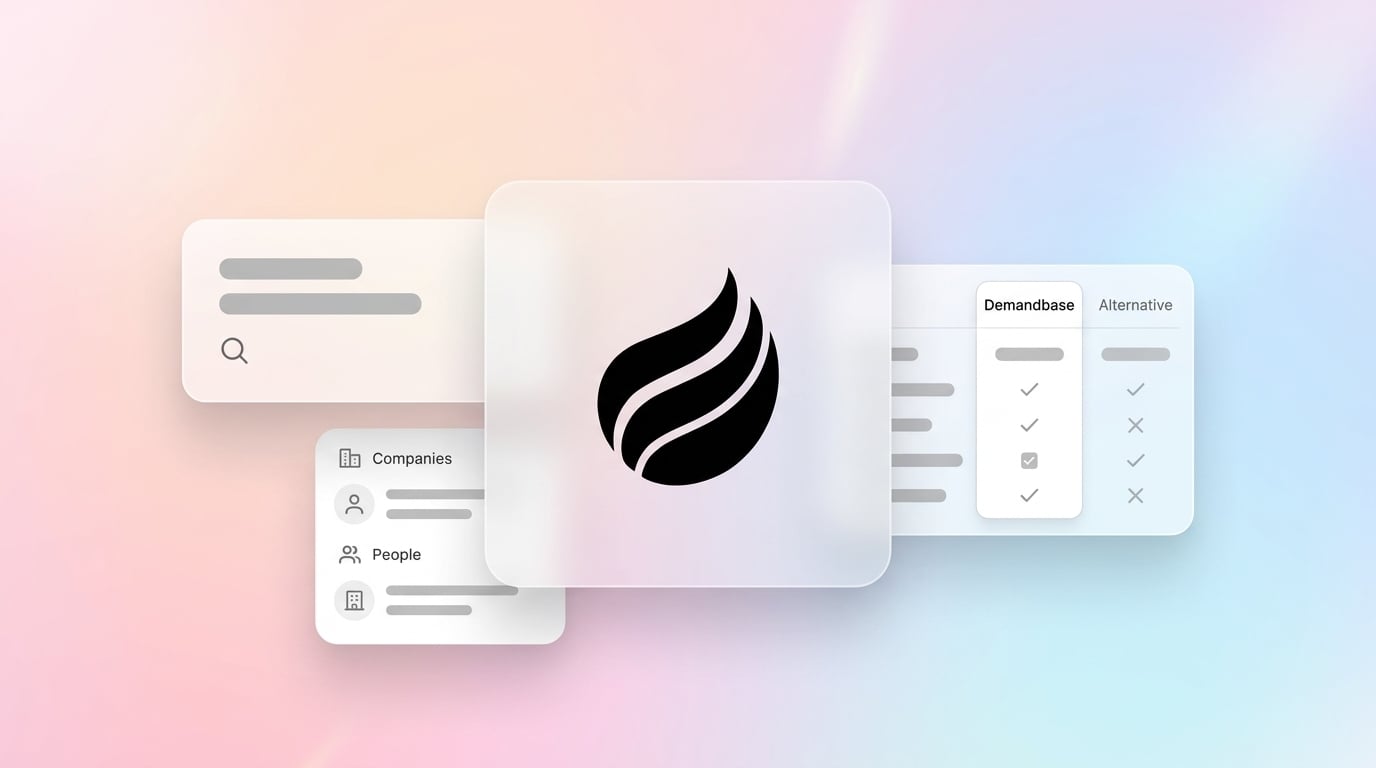
The table below compares leading alternatives against Demandbase as a baseline, so you can see pricing and automation differences at a glance.
| Tool | Pricing 2026 | Best For | Automation Score (1-10) | Stack Reduction |
|---|---|---|---|---|
| Coffee | Seat-based | SMB automation | 10 | High |
| Apollo | Basic plan $49/user/month (billed annually) | Budget outbound | 7 | Medium |
| Cognism | $1–3K/month | EU data | 6 | Low |
| Demandbase | $50K+ | Enterprise ABM | 4 | Low |
Coffee leads the automation scores through its agent-first architecture, while traditional platforms rely on heavier manual configuration and ongoing maintenance.
Key Comparisons and Real-World Use Cases
Apollo vs Demandbase for Budget Teams
Apollo’s $49/user/month Basic plan contrasts sharply with Demandbase’s $50,000+ annual commitment, which makes Apollo the clear choice for cost-conscious teams. Apollo delivers core prospecting and sequencing without the heavy ABM layer.
Cognism for EU-Focused Sales Teams
Cognism’s GDPR compliance and Diamond Data® accuracy in EMEA markets address European data requirements that Apollo and ZoomInfo struggle to cover fully.
Best for SMB Automation: Coffee vs 6sense
Coffee’s AI agent removes manual data entry for SMB teams, while 6sense typically requires dedicated ABM staff and enterprise budgets. Coffee works as a standalone CRM or as a HubSpot and Salesforce companion, so it can grow with the team.
SMB teams gain the most from Coffee’s standalone automation. Mid-market teams often pair HubSpot with Coffee to combine marketing automation and sales execution. Large enterprises with complex ABM programs may still justify 6sense’s added complexity. Coffee’s ideal customers feel frustrated with manual CRM upkeep and need automated data entry, visitor identification, and clear pipeline insights.

Eliminate manual prospecting workflows. See how Coffee’s agent handles data entry automatically in your first week.
Why Coffee Ranks #1 Among Demandbase Alternatives
Hands-on testing shows that Coffee’s agent replaces both Demandbase’s ABM complexity and Apollo’s manual processes. The agent automatically creates contacts from email interactions, enriches records with funding and hiring data, joins meetings for transcription, and tracks pipeline changes without human intervention. Recent SOC2 compliance and intelligence layer updates signal Coffee’s readiness for more demanding buyers.

One AI firm dropped spreadsheet-based sales tracking after Coffee removed manual data entry entirely. The agent processed unstructured data from emails and calls while keeping structured CRM records accurate, which finally solved their “good data in, good data out” problem.

Potential limitations include reliance on Zapier for some integrations and data depth that matches, but does not exceed, ZoomInfo’s coverage. For most SMB and mid-market teams, however, Coffee’s automation and time savings outweigh these tradeoffs.
Risks and How to Decide Between Tools
Apollo’s credit overages can double stated costs, which makes budget predictability difficult for high-volume users. Cognism faces a different limitation because its US market coverage remains weaker than domestic providers, which matters if you target North American prospects. Coffee has its own constraint, since it is not designed for very large enterprises that need complex approval workflows or heavy customization.
A simple decision checklist helps narrow options. Smaller teams often favor Coffee, while large enterprises consider 6sense. Tight budgets point toward Apollo, and ROI-focused teams that value time savings lean toward Coffee. EU compliance needs push buyers toward Cognism. You should also review CRM integration requirements and your internal technical capacity.
Ready for agent-powered automation? Start your free trial to see whether Coffee’s agent fits your decision criteria, with no enterprise commitment.
FAQ
How does Coffee’s enrichment compare to Apollo’s database?
Coffee’s agent pulls data from multiple sources and enriches records in real time. Apollo, by contrast, requires manual list building and credit management. Coffee removes the export, enrich, and re-import cycle that many Apollo users manage today.
What does Demandbase cost in 2026?
Demandbase pricing starts around $50,000+ annually with enterprise-focused features that most SMB and mid-market teams do not need. The platform targets large organizations with dedicated ABM resources and significant advertising budgets.
What’s the best free Demandbase alternative?
Apollo offers a free tier with limited credits, and Lusha provides basic enrichment capabilities. These free plans usually include strict limits on data access, automation, and integrations, which restrict practical use for growing teams.
Does Coffee integrate with Salesforce?
Yes, Coffee operates as a Companion App that syncs with existing Salesforce and HubSpot installations. The agent writes enriched data, meeting summaries, and pipeline insights directly into your CRM while handling manual data entry tasks automatically.
How does Coffee’s visitor identification work?
Coffee’s tracking pixel identifies anonymous website visitors and suggests specific contacts within visiting companies based on your buyer persona. Unlike tools that only show company-level data, Coffee recommends which individuals to contact and surfaces their LinkedIn profiles for immediate outreach.
How does Coffee compare to 6sense for mid-market teams?
Coffee’s AI agent and seat-based pricing scale efficiently for mid-market teams, while 6sense requires enterprise budgets and dedicated ABM resources. Coffee delivers visitor identification, data enrichment, and pipeline management without the cost and complexity of full ABM platforms.