Written by: Doug Camplejohn, CEO & Co-Founder, Coffee | Last updated: September 14, 2026
Key Takeaways
- Accurate B2B email enrichment is measured by real deliverability rates. Independent benchmarks show most tools fall far below their advertised 95–98% accuracy claims.
- Waterfall enrichment across multiple data sources consistently delivers 20–40% higher coverage on hard-to-find contacts when paired with strong verification layers.
- Most enrichment tools create a recurring CRM write-back problem. Data decays at 22.5% annually because teams export, import, and manually reconcile records.
- Among the seven tools ranked, Coffee stands out for mid-market teams because its AI-first CRM Agent continuously enriches and writes verified contact data directly into Salesforce or HubSpot without CSV exports or separate subscriptions.
- Eliminate the export-import-decay cycle. See Coffee’s seat-based pricing and keep accurate B2B contact data built into your CRM from day one.
How B2B Email Accuracy Is Actually Measured
Three core metrics govern B2B email accuracy. Vendors often blend them into headline numbers that overstate real-world performance.
Find rate (also called coverage or match rate) is the share of submitted contacts for which a tool returns an email. Validity rate (also called accuracy or deliverability) is the share of returned emails that pass verification. Real rate is the strictest measure. It counts emails that actually deliver, divided by contacts submitted, with hard bounces and wrong domains removed.
The denominators differ, and that difference creates the gap between vendor claims and production reality. A tool that returns an email for 45 of 100 submitted contacts and gets 41 of those right can honestly advertise “92% accuracy” while covering under half your list. Prospeo is the clearest published example. In Anymail Finder’s June 2026 benchmark it returned an email for 45.2% of 5,000 submitted contacts with 92.5% of returned emails valid, while its own site headlines “98% email accuracy.” Both figures rely on different denominators.
Vendor-published accuracy claims cluster at 95–98%. The same Anymail Finder benchmark measured a 58.9% median coverage across 14 tools on 5,000 B2B decision-maker contacts. Dropcontact’s 20,000-contact live-send test found real enrichment rates ranging from 14.2% to 54.9%.
A match (a record was found) differs from a verified deliverable email (the address will not bounce), which is why match rate alone misleads as an accuracy metric for B2B contact data. The real test of an email enrichment tool is accuracy on hard-to-find contacts such as mid-market managers at 50-person companies. Those contacts separate a useful tool from a demo that looks good on 20 rows.
Revenue Boost’s 2026 cold email benchmark, drawn from active B2B client campaigns run between Q1 2025 and Q1 2026, defines bounce rate performance bands as: bottom quartile above 5%, average 2.1%, top quartile below 1.5%, and top 10% below 0.8%. An enrichment stack should target bounce rates below 2% for healthy sending, with under 1% representing best-in-class list hygiene. Meeting that bar requires enrichment that runs continuously, not a one-time purchase.
Enrich contacts inside your CRM with Coffee so accuracy improves and stays high over time.
Waterfall Vs. Single-Source Enrichment For Better Coverage
Waterfall enrichment queries multiple data sources in sequence and takes the first verified match. Single-source enrichment checks one database and stops, leaving the record empty if no match appears.
Single-source B2B databases top out at a 50–75% match rate on a real ICP list, while a multi-provider waterfall querying 25+ sources clears 85%+ on the same list. The coverage math is simple fallback logic. A miss on provider one becomes an attempt at provider two. Waterfall enrichment typically produces find rates 20–40% higher than single-source approaches on the same contact list.
Waterfall enrichment improves coverage, and verification gates preserve accuracy. Because the waterfall stops at the first answer it gets, providers with looser standards naturally claim a larger share of the list, pushing guessed addresses into outreach where they later appear as bounces. A verification gate after every match prevents this.
Single-source enrichment still has advantages such as speed, simplicity, one contract, and one bill. A single source works for a small, single-market list where one provider already covers the segment well. Waterfall logic becomes essential when coverage is the constraint, the list is large enough that a few extra percentage points mean hundreds of extra contacts, and bounce risk threatens the sending domain.
Build enrichment into your CRM with Coffee so verified contacts land on the right records automatically.
Ranked Comparison: Best Email Enrichment Tools For Accurate B2B Contact Data
1. Coffee — Best For CRM Data Quality
Overview: Coffee is an AI-first CRM Agent that auto-creates and enriches contacts and companies from Google Workspace or Microsoft 365. It serves small to mid-market teams that want accurate B2B contact data without buying a separate enrichment subscription.

Accuracy Approach: Built-in enrichment augments records with job titles, funding, and LinkedIn profiles via licensed data partners and writes everything directly into the CRM. The Coffee Agent handles data entry continuously, so enriched B2B contact data is created, updated, and logged in the CRM automatically. Accuracy becomes a maintained state instead of a one-time purchase.

Strengths: Data never needs exporting, re-importing, or manual reconciliation. Coffee works as a standalone AI-first CRM or as a Companion App on top of Salesforce or HubSpot. The Agent saves reps 8–12 hours per week on data entry.
Limitations: Coffee does not target large enterprises with complex custom workflows or heavily regulated industries that require multi-year security reviews.
Ideal Fit: RevOps and sales leaders at 20–200 person companies who want accurate B2B contact data built into the CRM instead of bolted on.
Pricing Model: Simple seat-based pricing. You pay for human seats and the Agent’s unlimited labor is included.
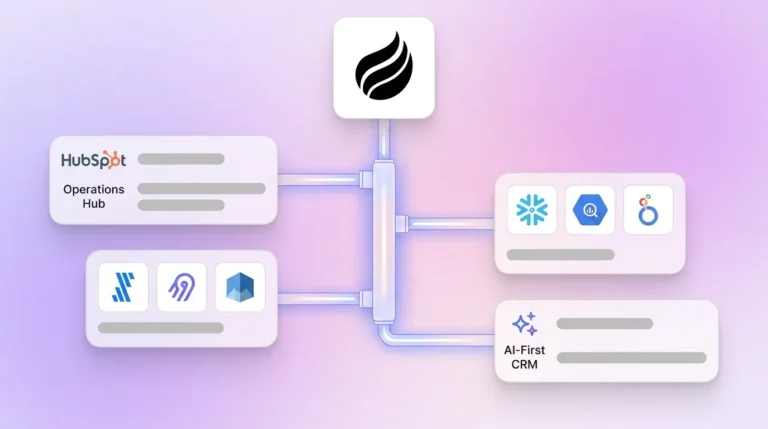
Implementation And Integrations: Connects to Google Workspace or Microsoft 365, syncs and enriches data, and writes insights back to Salesforce or HubSpot through a simple authentication. Coffee is SOC 2 Type 2 and GDPR compliant, and it does not use data to train public models.
2. Clay — Best For Custom Multi-Source Waterfall Workflows
Overview: Clay is an enrichment orchestration platform rather than a database. It connects to 150+ third-party data providers in a spreadsheet-like interface. The typical customer is an ops team with capacity to build and maintain workflows.
Accuracy Approach: Clay runs waterfall enrichment across configured providers, with a confidence threshold that governs whether borderline matches are accepted or pushed further down the chain. Accuracy depends heavily on which providers are configured and how the threshold is set. Clay’s 2025 benchmark of work email providers found that no single provider cleared both 95% quality and 90% coverage because quality and coverage trade off by design.
Strengths: Clay offers maximum flexibility and can reach 80–92% effective email coverage with a well-built waterfall.
Limitations: Clay is not API-first. A basic workflow takes 2–4 hours to build and a full production workflow typically takes 1–2 days. Credit consumption can also vary significantly from stated amounts.
Ideal Fit: Technical ops teams building bespoke enrichment pipelines.
Implementation And Integrations: Native pushes to HubSpot, Salesforce, and common sequencing tools.
3. ZoomInfo — Best For Enterprise-Grade Database Scale
Overview: ZoomInfo is a full sales intelligence platform with intent data, org charts, and visitor identification. The typical customer is an enterprise with a formal procurement cycle.
Strengths: ZoomInfo offers one of the deepest enterprise datasets and best-in-class North American direct dial coverage.
Limitations: Sales-led setup can take weeks. Data freshness lags competitors because updates run quarterly instead of in real time, and SMB data is weaker.
Ideal Fit: Enterprise teams with budget and procurement capacity.
Pricing Model: Enterprise pricing is custom-quoted and typically starts around $15,000+ per year on annual contracts.
Implementation And Integrations: Native Salesforce and HubSpot apps, REST API, MCP server, and CLI.
4. Apollo — Best For Budget-Conscious All-In-One Teams
Overview: Apollo maintains its own proprietary contact database, cited at 210M+ contacts in one comparison and 270M+ in another, and bundles it with email sequences, a dialer, and CRM integrations. The typical customer is a startup or SMB wanting one tool for prospecting and outreach.
Accuracy Approach: Apollo runs a single-source database with an optional waterfall feature that cascades to connected third-party sources when its own database lacks a field. Apollo distinguishes verified, valid, and catch-all email tiers.
Strengths: Apollo offers a free tier, broad all-in-one functionality, and a low entry price.
Ideal Fit: Budget-conscious teams wanting a database and sequencer in one.
Pricing Model: Apollo offers a free tier and paid plans starting at $49/user/month.
Implementation And Integrations: Native HubSpot, Salesforce, and Pipedrive sync, plus a Chrome extension for LinkedIn prospecting.
5. Cognism — Best For EMEA Compliance And Phone-Verified Mobiles
Overview: Cognism is known for European data coverage and phone-verified mobile numbers. The typical customer is a team selling into UK, DACH, or Nordic markets.
Accuracy Approach: Diamond Data phone verification confirms mobile numbers by live call. GDPR compliance is built into data sourcing.
Limitations: North American data trails Apollo and ZoomInfo, API capabilities are limited, and the UI feels less intuitive.
Ideal Fit: EMEA-focused outbound teams.
Pricing Model: Pricing is custom-quoted and typically starts around $15,000/year.
Implementation And Integrations: CRM integrations and API access, though less extensible than Clay or People Data Labs.
6. Lusha — Best For Lightweight Contact Lookup
Overview: Lusha is a contact data tool with a browser extension, popular with individual reps and small teams. The typical customer is a rep doing manual prospecting.
Accuracy Approach: Lusha focuses on contact data only, with GDPR compliance via ISO 27701 certification. It does not provide company enrichment, intent, or tech stack data.
Strengths: Lusha is simple to use and has a low entry price. Users receive 50 free credits per month.
Ideal Fit: Individual reps and small teams doing manual lookup.
Pricing Model: Plans start at $49/month (Pro) and $79/month (Premium), with custom Scale pricing.
Implementation And Integrations: Browser extension and CRM integrations.
7. Clearbit — Best For HubSpot-Native Company Enrichment
Overview: Clearbit, acquired by HubSpot in 2023 and now integrated as Breeze Intelligence, is known for company-level data and website visitor identification. The typical customer is a HubSpot-native team.
Accuracy Approach: Company-level data such as industry, revenue, tech stack, and employee count ranks among the most accurate available. Email coverage is narrower at 55–65% with limited phone data.
Strengths: Clearbit provides excellent firmographic data, Reveal visitor identification, and native HubSpot workflows.
Limitations: Clearbit is weaker than Apollo or ZoomInfo for broad contact coverage and now ties closely to HubSpot, which limits Salesforce users.
Ideal Fit: HubSpot-native teams needing company-level enrichment for lead scoring and routing.
Pricing Model: Pricing starts at $99/month for enrichment credits, bundled with HubSpot plans.
Implementation And Integrations: Native HubSpot integration.
Keep CRM data current automatically with Coffee so enrichment becomes part of everyday workflows.
Head-To-Head Comparisons On Accuracy
Clay Vs. ZoomInfo Accuracy
Clay’s waterfall approach produces higher coverage on hard-to-find contacts by chaining 150+ providers, while ZoomInfo’s proprietary database offers deeper enterprise coverage and phone data with a single contract. Neither ZoomInfo nor Cognism appears in any of the three published third-party email accuracy benchmarks reconciled by Cleanlist’s 2026 analysis. Clay’s accuracy depends on configuration, and ZoomInfo’s accuracy depends on how closely your ICP matches its North American enterprise strength.
Apollo Vs. Cognism Email Accuracy
Apollo is the only large sales-intelligence platform measured in any of the three major published third-party benchmarks, at 68.1% coverage and 91.3% validity in Anymail Finder’s June 2026 test. Cognism publishes no accuracy percentage and does not appear in those benchmarks, but its Diamond Data phone verification focuses on EMEA markets where Apollo’s coverage is weaker.
Side-By-Side Comparison Table
The table below shows how the seven tools compare on four key dimensions: best-fit use case, accuracy approach, and pricing model.
The table highlights a clear tradeoff. Tools with the broadest coverage such as Clay’s waterfall and ZoomInfo’s enterprise database carry the highest cost and complexity. Tools with the lowest entry price such as Apollo and Lusha carry coverage gaps that show up as bounce rates. For teams evaluating the best enrichment tool for CRM data quality, the column that matters most is whether enriched data lands in the CRM cleanly and stays clean. Built-in enrichment with Coffee wins that comparison because the data never has to be exported, re-imported, or manually reconciled. Every other tool in this table requires a separate step to get enriched data into the system of record, and that step is where decay begins.
Eliminate the export-import gap with Coffee so enrichment and CRM hygiene stay connected.
What Happens After Enrichment: The CRM Write-Back Problem
Most teams buy an enrichment tool, export a CSV, import it into the CRM, and then watch the data decay within months because nothing keeps it current. B2B contact data decays at approximately 22.5% annually, and in high-turnover sectors like SaaS and tech the rate can reach 70% per year. In total, 70.8% of business contacts experience at least one change within 12 months, including job title shifts, company moves, email address changes, and phone number updates.
Periodic data cleanup fails structurally because decay is continuous while cleanup is periodic. A database cleaned in January is already measurably degraded by February. The problem compounds in three ways. Duplicate records split account histories. Missing activity history breaks pipeline reporting. The manual reconciliation burden turns standalone enrichment into a recurring cost instead of a lasting fix.
A 2022 report from Validity found that 44% of companies believe they lose over 10% of their annual revenue specifically because of poor-quality CRM data. Sales representatives spend 27% of their time, over 550 hours per year, dealing with inaccurate records.
Coffee’s built-in enrichment addresses this directly. The Coffee Agent handles data entry continuously, so enriched B2B contact data is created, updated, and logged in the CRM automatically. Accuracy becomes a continuous property of the system of record instead of a periodic project. There is no CSV export step, no import step, and no reconciliation step. The enrichment loop runs inside the CRM.
Stop paying to re-clean decayed data with Coffee and keep records accurate as work happens.
Best Email Enrichment Tool By Use Case
Different team sizes, geographies, and technical profiles benefit from different tools. The recommendations below mirror how practitioners typically structure their evaluations.
- Startup Or Small Team: Use Apollo’s free tier for a budget-conscious database-plus-sequencer, or Coffee’s standalone CRM if you want enrichment built in from the start without a separate subscription.
- Mid-Market CRM-Centric Team: Choose Coffee for accurate B2B contact data without a separate enrichment subscription. The Agent enriches contacts continuously and writes everything back to Salesforce or HubSpot automatically.
- EMEA-Focused Team: Choose Cognism for European coverage and Diamond Data phone verification on UK, DACH, and Nordic contacts.
- Enterprise: Choose ZoomInfo for database scale, intent data, and strong North American direct dial coverage.
- Technical Buyer Evaluating A Contact Enrichment API Or Data Enrichment AI: Use Clay for orchestration flexibility across 150+ providers, or Coffee’s Companion App for CRM write-back without building a custom pipeline.
For technical buyers, CRM write-back behavior is the most important integration consideration. A waterfall that produces 90% coverage but writes to a flat CSV instead of a CRM record still requires manual reconciliation. Coffee’s Companion App authenticates directly to Salesforce or HubSpot and writes enriched data to the correct record automatically. That design choice turns enrichment from a one-time purchase into a continuous function.
How To Evaluate An Email Enrichment Tool: A Checklist
Teams should run this evaluation framework against their own data before committing to any enrichment tool or stack.
- Test Bounce Rate On Your Own Hard-To-Find Contacts. Pull 300–500 real contacts from your ICP, strip them to name and company, and submit the identical file to every vendor on the same day. Measure find rate, validity rate, and real rate separately.
- Ask How Match Rate Is Measured. Require a direct answer. Clarify whether the headline percentage is a find rate or a validity rate, and confirm the denominator.
- Confirm Verification Layers. Triple email verification, which checks each address across three independent validators, is the current standard for maintaining a bounce rate under 1%. Ask which verifiers the tool uses and whether they operate independently.
- Check CRM Write-Back And Deduplication Behavior. Confirm whether enriched data writes directly to CRM records or requires a CSV import step. Ask how the tool handles near-duplicate records and field-level overwrite conflicts.
- Review Pricing For Hidden Per-Record Costs. Per-attempt billing, expiring credits, and minimum volume commitments inflate the effective cost per verified contact. Compare cost per usable record instead of cost per API call.
- Confirm Data Security Posture. Coffee is SOC 2 Type 2 and GDPR compliant and does not use data to train public models. Require equivalent documentation from any vendor handling contact data.
FAQ
What Is The Best B2B Contact Database Right Now?
No single database fits every use case. ZoomInfo leads on enterprise North American coverage and direct dial phone data. Cognism leads on EMEA coverage and phone-verified mobile numbers. Apollo offers broad all-in-one functionality at the lowest entry price. Clay’s waterfall approach produces the highest coverage on hard-to-find contacts by chaining 150+ providers. For teams that want accurate B2B contact data built into their CRM instead of maintained as a separate subscription, Coffee’s built-in enrichment is the strongest option because it removes the export-import-decay cycle entirely.
What Are The Best Data Enrichment Tools For B2B Companies?
The best data enrichment tools for B2B companies depend on team size, geography, and whether enrichment should live inside the CRM or outside it. Coffee is the best option for mid-market teams that want enrichment built into the CRM. Clay is the best option for technical ops teams building custom waterfall workflows. ZoomInfo is the best option for enterprises with procurement budgets. Apollo is the best option for budget-conscious teams wanting a database and sequencer in one. Cognism is the best option for EMEA-focused outbound teams. Lusha is the best option for individual reps doing manual lookup. Clearbit is the best option for HubSpot-native teams focused on company-level enrichment.
How Accurate Are B2B Email Enrichment Tools Really?
Vendor-published accuracy claims typically range from 95–98%, but independent benchmarks show lower real-world performance. Anymail Finder’s June 2026 benchmark of 14 tools against 5,000 B2B decision-maker contacts found coverage ranging from 41.3% to 87.1%, with a median of 58.9%. Dropcontact’s 20,000-contact live-send test measured real enrichment rates between 14.2% and 54.9%. Together, these studies show that claimed accuracy often sits far above measured coverage on real lists.