Written by: Doug Camplejohn, CEO & Co-Founder, Coffee | Last updated: August 21, 2026
Key Takeaways
- AI sales productivity tools automate research, data capture, outreach, and pipeline analysis so reps spend more time selling and less on admin work.
- 87% of sales organizations now use AI for at least one task, yet most US B2B teams still rely on fragmented stacks that force reps to act as data-entry clerks.
- Consolidating from multiple tools into a single agentic layer can deliver up to 40% productivity gains and 25% shorter sales cycles.
- Teams of 5–20 reps benefit most from single-platform adoption to avoid integration overhead and lengthy Salesforce rollouts.
- Start consolidating your stack with Coffee today to retire up to four tools and reclaim hours each week, and see pricing for your team size.
The number of tools you can consolidate depends directly on your team size and current stack. The table below shows how many tools Coffee can retire for teams of 5–100 reps.
Team-Size Decision Table: How Many Tools Can Your Team Retire?
| Team Size | Typical Fragmented Stack | Tools Retirable with Coffee | Recommended Coffee Model |
|---|---|---|---|
| 5–20 reps | Apollo + HubSpot/Salesforce + Gong + Outreach/Salesloft | Up to 4 (Apollo, Gong, Clay, Outreach/Salesloft) | Standalone CRM or Companion App |
| 21–50 reps | ZoomInfo + Salesforce/HubSpot + Gong + Clay + Outreach | Up to 4 (enrichment, conversation intelligence, sequencing, enrichment layer) | Companion App for Salesforce or HubSpot |
| 51–100 reps | ZoomInfo + Salesforce Enterprise + Gong + Clay + Outreach + Clari | 3–4 (enrichment, sequencing, conversation intelligence, pipeline add-ons) | Companion App for Salesforce |
Teams of 5–20 reps typically benefit most from single-platform adoption to avoid integration overhead, while Enterprise-level Salesforce rollouts with multiple clouds and integrations often take six to twelve months or more. Coffee compresses that timeline by deploying as a single authenticated layer.
Calculate your consolidation savings with Coffee.
1. Coffee: One Agentic Layer for Prospecting, Calls, Enrichment, and Pipeline
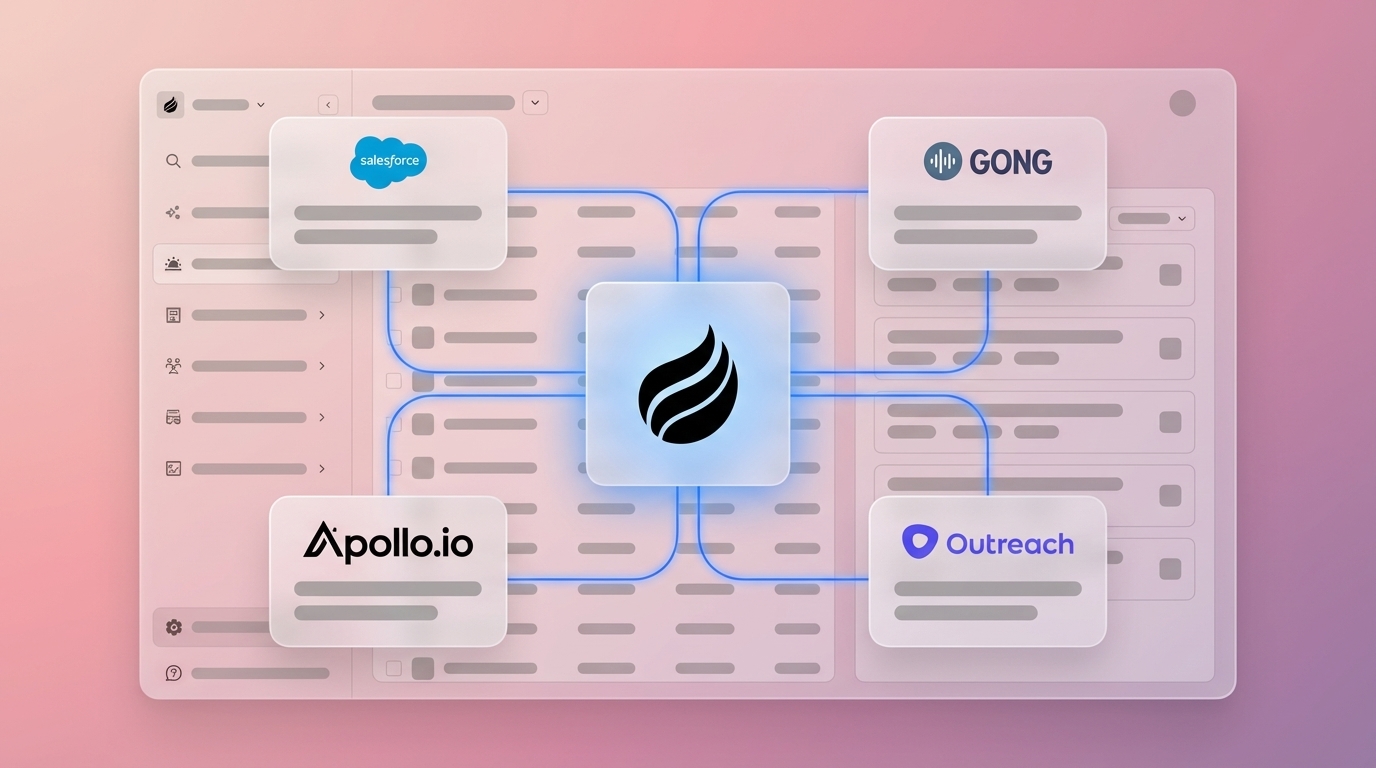
Coffee is the world’s best CRM Agent for US B2B teams that want one system instead of a four-tool stack. Every other tool in this guide acts as a passive database or a single-function point solution. Coffee deploys an autonomous agent that handles data unification, enrichment, meeting intelligence, outreach sequencing, pipeline tracking, and visitor identification inside one system.

Teams can run Coffee in two ways. The Standalone CRM replaces spreadsheets or legacy CRMs for teams of 1–20. The Companion App sits on top of existing Salesforce or HubSpot instances and writes enriched data back to the system of record.
Coffee breaks the “garbage in, garbage out” cycle that slows most CRMs. 71% of sales reps say they spend too much time on data entry, leaving only 35% of their time for actual selling. Coffee’s agent ingests structured data such as contacts, companies, and deal fields, along with unstructured data such as email threads, call transcripts, and calendar events, into a built-in data warehouse. Historical context stays intact when fields change, so the agent always has the full story.

These capabilities work together to replace four separate tools and keep reps in one workspace.
- Lead Finder (replaces Apollo/ZoomInfo): Natural-language prospect search across Coffee’s own database. A prompt like “Find me VPs of Sales at SaaS companies with 50–200 employees” returns a list ready for enrichment and outreach without a CSV export.
- Campaigns (replaces Outreach/Salesloft): AI-generated multi-step email sequences sent from the rep’s own mailbox with stop-on-reply logic and per-step analytics.
- Conversation Intelligence (replaces Gong): Coffee launched Custom Meeting Briefings and Summaries in February 2026. Teams can define exact formats, from high-level executive summaries to granular MEDDIC or BANT breakdowns. Call recording expanded in January 2026 via Zapier integration with Fathom, Gong, Fireflies, and a Desktop app for macOS, Windows, and Linux.
- Data Enrichment (replaces Clay): The agent auto-creates contacts and companies from Google Workspace or Microsoft 365. It augments records with job titles, funding, and LinkedIn profiles via licensed data partners, and logs all activity automatically.
- Pipeline Intelligence (replaces Clari/manual exports): Coffee’s AI search on deals, released January 2026, answers natural-language questions such as “Which deals are stuck in negotiation?” or “What’s closing this month?” Pipeline Compare then visualizes week-over-week changes without spreadsheets.
- Visitor Identification: A single tracking pixel turns anonymous website traffic into named prospects with suggested outreach targets matched to the buyer persona. This goes further than RB2B or Warmly, which surface only company-level data.
- Intelligence Layer: Coffee introduced an Intelligence layer in February 2026 that stores deep context on business model, ICP, product specifics, and competitors. The agent uses this context to tailor AI suggestions across every workflow.
Coffee saves reps 8–12 hours per week by automating data entry, meeting prep, post-call summaries, and follow-up drafting. It is SOC 2 Type 2 and GDPR compliant, and customer data is never used to train public models. That stance matters as 20 US states now have comprehensive consumer data privacy laws that require detailed disclosures of personal information use and grant broad consumer rights.

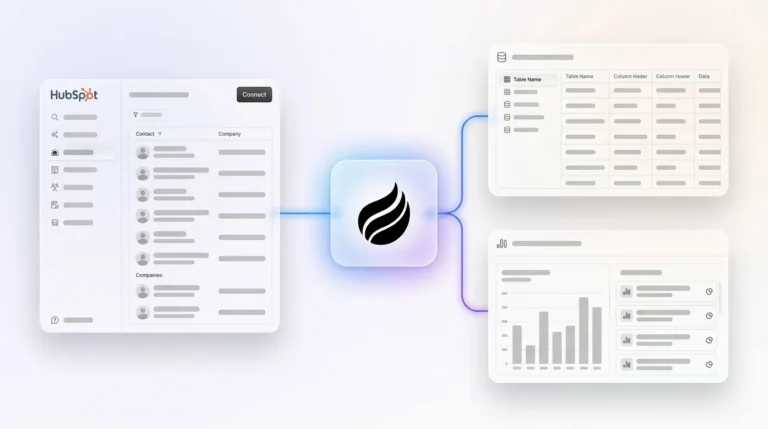
Salesforce and HubSpot integration runs through a simple authentication that syncs data bidirectionally. Improved summary templates released in November 2025 are customizable and writable back to Coffee, HubSpot, or Salesforce. Coffee is currently the only agentic layer with deep understanding of Salesforce required fields, quotas, and forecasting objects.

2. Apollo: Prospecting and Sequencing Only
Apollo.io is a prospecting database and sequencing platform with over 240 million contacts and native multichannel outreach. Apollo works well for lean SDR teams of 5–20 reps running consistent high-volume outbound campaigns, and its free tier helps pre-revenue teams start quickly.
Apollo’s strengths include a large contact database, affordable entry pricing at $49 per user per month, and a self-serve onboarding path. Its scope remains narrow. Apollo focuses on prospecting and sequencing only and does not provide conversation intelligence, pipeline forecasting, or CRM data enrichment from live call transcripts.
Teams still need a separate CRM, a separate recording tool, and a separate enrichment layer to match Coffee’s full capability set. Gong is overkill for teams under 20 reps, and Apollo alone leaves the conversation intelligence and pipeline gaps unfilled. Apollo fits 5–20 rep outbound-heavy teams that have not yet invested in a full stack. Integration includes native HubSpot and Salesforce sync, though field mapping requires manual configuration.
3. Gong: Conversation Intelligence for Larger Teams
Gong is the market-leading conversation intelligence platform that analyzes calls and emails to produce deal health scores, coaching insights, and forecast signals. AI call summaries help accelerate deal closures and support manager coaching.
Gong’s strengths include deep coaching analytics, deal likelihood scoring based on more than 300 signals, and enterprise-grade data residency options. Its economics favor larger teams. Gong’s ROI math requires a minimum of 10–15 reps and $25K+ average deal size to justify the $5,000+ platform fee plus $1,200–$1,600 per user per year.
Gong does not prospect, enrich contacts, or run outreach sequences. It operates as a single-function intelligence layer. Gong fits 21–100 rep teams with active coaching programs and high call volume. Integration includes Salesforce and HubSpot bidirectional sync, and implementation typically takes 6–12 weeks.
4. Clay: Enrichment and Orchestration, Not a CRM
Clay is a data enrichment and workflow automation platform that aggregates more than 150 data providers through waterfall enrichment and an AI research agent called Claygent. Clay can significantly accelerate account research and enrichment compared to manual processes.
Clay’s strengths include broad enrichment coverage, flexible table-based workflows, and strong fit for RevOps-led teams that build custom data pipelines. Its scope remains limited to enrichment and orchestration. Clay is not a CRM, sequencer, or conversation intelligence platform.
Clay splits usage into separate Data Credits and Actions, where Actions cover orchestration tasks such as enriching, running tables, calling AI, sending data out, and exporting. This model creates unpredictable billing at scale. Clay fits SDR-led mid-market teams of 21–100 reps with a dedicated RevOps function to manage the tooling. Integration pushes enriched data to Salesforce, HubSpot, and Outreach via Zapier or native connectors.
5. Outreach and Salesloft: Enterprise Sales Engagement
Outreach and Salesloft are enterprise sales engagement platforms that offer multichannel sequences, AI-assisted personalization, pipeline management, and conversation intelligence. Outreach is designed for larger revenue organizations of 50–100+ reps with established SDR and BDR teams that need multichannel sequences and engagement analytics across territories.
These platforms excel at mature workflow governance, territory management, and deep Salesforce integration for enterprise teams. They often feel heavy for smaller groups. Both platforms are overcomplicated and overpriced for teams under 20 reps.
A mid-market standard 5-SDR stack using HubSpot or Salesforce plus Outreach or Salesloft, Warmly, and ZoomInfo carries significant costs before AI automation layers. Neither platform handles contact enrichment or conversation intelligence natively. Both require Clay and Gong to complete the stack. Outreach and Salesloft fit 51–100 rep teams with a RevOps function and established sales processes. Integration includes native Salesforce and HubSpot bidirectional sync.
To evaluate whether consolidation makes sense for your stack, compare tools across four dimensions that directly affect both cost and productivity.
Side-by-Side Comparison Matrix: Automation Depth, Data Handling, Total Cost of Ownership, and US Data-Privacy Compliance
| Tool | Automation Depth | Data Handling | Estimated TCO (20-rep team/year) | US Data-Privacy Compliance |
|---|---|---|---|---|
| Coffee | Full agentic: enrichment, sequencing, conversation intelligence, pipeline, visitor ID, one system | Structured and unstructured data unified in built-in data warehouse, history preserved | Seat-based; replaces four tools, see pricing calculator | SOC 2 Type 2, GDPR compliant, data not used to train public models |
| Apollo | Prospecting and sequencing only, no conversation intelligence or pipeline forecasting | Structured contact and company data, no unstructured data ingestion | ~$49/user/month ($11,760/year for 20 reps) plus CRM, recording, and enrichment tools | SOC 2 Type 2; verify DPA for model-training opt-out |
| Gong | Conversation intelligence and coaching, no prospecting, enrichment, or sequencing | Unstructured call and email data, limited structured CRM enrichment | $1,200–$1,600/user/year + $5,000+ platform fee ($29,000–$37,000/year for 20 reps, before CRM and sequencing) | Enterprise data residency options, SOC 2 Type 2 |
| Clay | Enrichment and orchestration only, no CRM, sequencing, or conversation intelligence | Structured enrichment via 150+ providers, no unstructured data warehouse | Credit-based billing, costs scale unpredictably with usage volume | SOC 2 Type 2; verify DPA for enrichment data sourcing under state privacy laws |
| Outreach / Salesloft | Sequencing and pipeline management, no enrichment or conversation intelligence | Structured engagement data, requires Clay and Gong for full data picture | Part of a multi-tool stack with significant costs when combined with CRM, enrichment, and intelligence tools | SOC 2 Type 2, GDPR compliant |
Retire These Three Tools: Apollo, Gong, and Clay vs Coffee Cost Math
A 20-rep team running the standard Apollo, Gong, and Clay stack faces the following annual costs.
- Apollo at $49 per user per month: $11,760 per year
- Gong at $1,200–$1,600 per user per year plus $5,000+ platform fee: $29,000–$37,000 per year
- Clay: credit-based billing that scales with usage, typically $500–$2,000+ per month for active enrichment workflows ($6,000–$24,000 per year)
- Outreach or Salesloft: included in a total stack cost for a typical mid-market setup plus RevOps admin overhead
Consolidating from a fragmented five-tool stack to a one or two platform approach reduces total annual TCO and yields substantial yearly savings for a 5-SDR team. Savings compound further at 20 reps. Coffee’s seat-based pricing, where the agent’s unlimited labor is included and there is no complex metering on LLM usage or actions, removes the credit-bundle and per-action billing risks that make Clay and Salesforce Agentforce difficult to forecast. Per-action pricing failure modes include surprise bills triggered by workflow testing, bad prompts causing retries, and agent loops across records.
See how much you will save by retiring your stack with Coffee.
2026 US-Specific ROI: Time Saved and Quota Lift
Beyond direct cost savings, productivity gains from consolidation deliver measurable ROI in rep time and quota attainment.
- Gartner’s May 2026 survey finds AI sales tools save the average seller 4.8 hours per week. Coffee’s agent targets 8–12 hours per week by automating enrichment, meeting prep, post-call notes, and follow-up drafting simultaneously.
- No McKinsey 2025 B2B Sales Pulse survey is documented; sources instead report 40–50% reductions in CRM data entry time from Salesforce and Optifai benchmarks.
- Heavy daily AI users can hit quota at higher rates than light or non-users.
- Recovering 3 hours per week per rep in a 20-rep team generates $264,000 to $374,000 per year in recovered capacity at an average cost of $85–$120 per sales rep hour (OTE).
- Only 6% of organizations report achieving satisfactory ROI on a typical AI use case within the first year.
- McKinsey reports that AI-powered decision-making can drive a 10–20% revenue uplift for sales and marketing teams.
Best AI Sales Tools for Salesforce Teams
Salesforce teams face a specific challenge because the platform’s 25 years of legacy architecture mean unstructured data such as call transcripts, email threads, and meeting notes is not natively captured or warehoused. Real-world total cost of ownership for Salesforce is typically 1.75x to 2.5x the base license fee once implementation, training, add-ons, and support are included. Adding Gong, Clay, and Outreach on top pushes TCO even higher.
Coffee’s Companion App deploys as an authenticated agent layer on top of Salesforce. It writes enriched contacts, activity logs, meeting summaries, and pipeline signals back to Salesforce required fields, quotas, and forecasting objects without a rip-and-replace migration. Newer AI CRM alternatives like Day.ai and Clarify lack the depth of Salesforce integration that Coffee has built, which makes Coffee the only agentic layer purpose-built for established Salesforce stacks.
AI Tools That Replace Gong and Apollo in One System
RevOps leaders often want one tool that replaces both Gong’s conversation intelligence and Apollo’s prospecting database. In 2026, Coffee fills that role. The Lead Finder replaces Apollo’s prospecting database with natural-language search. The AI Meeting Bot, Custom Briefings, and Automated Summaries replace Gong’s conversation intelligence.
AI call summarization significantly reduces time spent on post-call notes, and Coffee delivers that capability natively without a separate Gong subscription. The Campaigns feature then closes the loop from prospect discovery to sequenced outreach inside one agent.
Best AI Sales Tools for 5–20 Reps
Teams of 5–20 reps typically benefit from single-platform adoption to avoid integration overhead, and G2’s 2026 analysis confirms that native CRM integrations drive 40% faster rep adoption and 2x higher ROI for small teams. For this segment, the fragmented Apollo, Gong, and Outreach stack becomes both financially unjustifiable and operationally complex. As noted in the Gong analysis, most 5–20 rep teams fall below the 10–15 rep threshold where the platform fee makes economic sense, which means they overpay for a tool they cannot fully use.
Coffee’s Standalone CRM is built for this segment. Teams get simple authentication, no implementation project, seat-based pricing with no credit metering, and an agent that handles enrichment, sequencing, meeting intelligence, and pipeline tracking from day one.
Choosing the Right Solution: Match Team Size, CRM, and Budget
The decision hinges on whether you have an existing CRM investment to preserve and how many reps you support.
- 1–20 reps with no existing CRM or on spreadsheets: Choose Coffee Standalone CRM. The agent replaces HubSpot, Apollo, Gong, and Outreach or Salesloft in one seat-based subscription.
- 5–50 reps already committed to HubSpot: Use the Coffee Companion App. The agent enriches and writes back to HubSpot, retiring Apollo, Gong, and Clay while preserving the existing system of record.
- 21–100 reps already committed to Salesforce: Use the Coffee Companion App. Deep Salesforce integration handles required fields, quotas, and forecasting objects that newer AI CRMs cannot support.
- Teams with strict budget constraints: Coffee’s seat-based model with no per-action or credit metering keeps TCO predictable at any team size. B2B SDRs often use multiple tools daily, which creates context-switching costs that reduce productive time. Consolidating onto Coffee removes that overhead.
Frequently Asked Questions
How many tools can a 5–20 rep team retire with Coffee?
A 5–20 rep team can typically retire up to four separate tools. These tools include a prospecting database like Apollo or ZoomInfo, a conversation intelligence platform like Gong, a data enrichment tool like Clay, and a sales engagement platform like Outreach or Salesloft. Coffee’s Lead Finder handles prospecting, the AI Meeting Bot and Custom Summaries handle conversation intelligence, the agent handles enrichment automatically from email and calendar data, and Campaigns handles multi-step outreach sequencing. All of this runs inside one system with one seat-based subscription and no credit metering.
Does Coffee maintain SOC 2 Type 2 and US data-privacy compliance?
Yes. Coffee is SOC 2 Type 2 and GDPR compliant. Customer data is not used to train public AI models, which directly addresses the procurement requirement that vendors confirm in their DPA or MSA that customer data will not be used for model training. This requirement grows more important as US state privacy laws expand. As of 2026, 20 US states have comprehensive consumer data privacy laws requiring detailed disclosures of personal information use and granting broad consumer rights, Connecticut’s amended Data Privacy Act requires covered controllers to include a clear statement in their privacy notices disclosing whether they collect, use, or sell personal data to train large language models, and California’s Data Broker Deletion Request Portal began processing deletion requests on August 1, 2026. Coffee’s compliance posture covers these requirements for US B2B sales teams.
What is the 2026 ROI of replacing Apollo, Gong, and Clay with Coffee?
ROI appears in two dimensions: cost reduction and productivity recovery. On cost, consolidating from a fragmented multi-tool stack to a single platform reduces total annual TCO by $90K–$120K for a 5-SDR team based on 2026 market pricing data. On productivity, Coffee saves reps 8–12 hours per week by automating data entry, meeting prep, post-call summaries, and follow-up drafting.
For a 20-rep team, recovering even 3 hours per week per rep generates $264,000–$374,000 per year in recovered selling capacity at average OTE rates. At the same time, only 6% of organizations report achieving satisfactory ROI on a typical AI use case within the first year, which makes a clear, measurable consolidation case even more valuable.
How does Coffee unify structured and unstructured data?
Legacy CRMs store only structured data such as company name, deal stage, and close date in relational databases where historical context disappears when a field is updated. Coffee’s agent ingests both structured data such as contacts, companies, and deal fields and unstructured data such as email threads, call transcripts, calendar events, and meeting notes into a built-in data warehouse that preserves the full history of every interaction.
The agent can then answer natural-language questions like “Which deals are stuck in negotiation?” by reasoning across both field-level CRM data and the actual content of calls and emails. Apollo, Gong, and Clay cannot deliver this unified view individually or in combination without significant manual stitching.
Which Coffee model fits Salesforce versus HubSpot stacks?
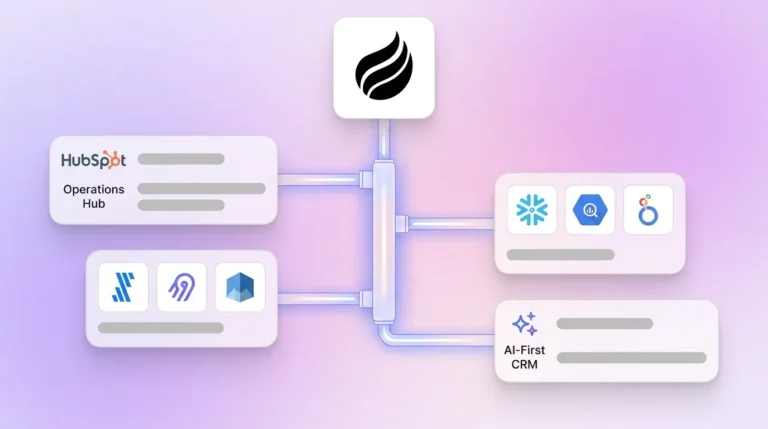
Both Salesforce and HubSpot stacks use the Coffee Companion App model. The agent authenticates with the existing CRM and writes enriched contacts, activity logs, meeting summaries, and pipeline signals back to the system of record.
For Salesforce specifically, Coffee has deep integration with required fields, quotas, and forecasting objects. Newer AI CRM alternatives like Day.ai and Clarify lack the technical depth to serve established teams at this level. For HubSpot, Coffee’s summary templates are customizable and writable back to HubSpot properties, which preserves existing workflows while eliminating the need for separate enrichment, recording, and sequencing tools.
How many hours per week do reps save with Coffee?
Coffee targets 8–12 hours per week in time savings per rep by automating the four highest-burden administrative tasks. Contact and company enrichment previously required manual research of 30–60 minutes per account. Post-call note-taking and CRM updates consume about 45 minutes per day for high-volume reps without automation. Meeting prep briefings now generate automatically from email and calendar context, and follow-up email drafting happens immediately after each call for rep review and send.
Gartner’s May 2026 survey puts the industry average at 4.8 hours saved per week across all AI sales tools. Coffee’s full-stack automation aims for the upper end of that range.
Ready to Replace Four Tools with One Agent?
US B2B sales leaders and RevOps heads running fragmented stacks in 2026 pay for four tools, manage four vendor relationships, and watch reps spend 65% of their time on work that an agent can handle. Coffee consolidates Apollo, Gong, Clay, and Outreach or Salesloft into one autonomous system that delivers good data in and accurate insights out for Salesforce teams, HubSpot teams, and teams ready to replace their CRM entirely.
See how much time your team can reclaim, then book a demo with Coffee.