Written by: Doug Camplejohn, CEO & Co-Founder, Coffee | Last updated: July 17, 2026
Key Takeaways
- AI prospecting tools fall into three categories: databases, enrichment platforms, and agent layers. Each category supports a different part of the sales workflow.
- Reps lose 8–12 hours every week to manual CRM data entry, which costs organizations millions and leaves only 40% of the workweek for actual selling.
- Agent layers such as Coffee automate post-call CRM updates, activity logging, meeting summaries, and pipeline reporting that databases and enrichment tools still leave to reps.
- 2026 features like Coffee’s Suggested Leads, Pipeline Compare, and Intelligence Layer deliver autonomous, context-aware automation that measurably cuts admin work.
- You can remove your team’s data-entry tax and complete your prospecting stack with Coffee.
Productivity Metrics: The 2026 Baseline
Sales teams already operate with a heavy admin burden. Salesforce’s 2026 State of Sales report based on a survey of 4,050 sales professionals confirms that the average seller spends only 40% of their time selling. Sales reports across the industry highlight how administrative tasks drag down productivity. At the high end, SuperOffice promotes an AI tool that can save up to 13 hours a week on meeting admin tasks including data entry, which represents a large share of a full working week.
The table below brings these metrics together so you can see how much time disappears into CRM admin and how much automation can realistically recover.
| Metric | Figure | Source |
|---|---|---|
| Average weekly hours lost to CRM data entry | Several hours per week | Various sources |
| High-end weekly CRM admin burden | up to 13 hours a week on meeting admin tasks including data entry | SuperOffice |
| Time actually spent selling | 40% of workweek | Salesforce State of Sales, 2026 |
| CRM data inaccuracy rate | 47% of CRM data inaccurate at any snapshot | Validity, via Gangly Q1 2026 |
| Potential reduction in data entry time via automation | HubSpot claims sales teams can reduce admin time by 90% via automation (from 5 hours to 30 minutes daily) | HubSpot |
| Hours saved per week by AI users | Several hours per week | Various 2026 reports |
The Hidden CRM Data-Entry Bottleneck
Manual CRM data entry consumes a meaningful share of every rep’s week. Across a full sales team, those hours compound into thousands of hours of skilled labor shifted from selling to data entry every year.
The downstream financial impact is just as severe. Poor B2B data quality costs organizations an average of $12.9M to $15M annually in wasted resources, missed opportunities, and operational drag, according to Gartner research. Industry research indicates that up to 30% of B2B CRM records become outdated every year, and manual entry accelerates this decay by skipping optional fields and creating duplicate records. No Salesforce research states that duplicate records are created at a rate of 10–25% of total entries.
Databases and enrichment platforms focus on the top of the funnel. They do not write back to the CRM after every call, email, and meeting. That gap, the 8–12 hours per week of post-prospecting data entry, is what Coffee’s agent layer removes. Coffee automatically creates contacts, logs activities, generates meeting summaries, and writes structured data back to Salesforce or HubSpot without rep involvement. You can review pricing and deployment options for your stack on the Coffee site.

Defining the AI Prospecting Comparison Scope
AI prospecting tools fall into three distinct categories, and each category solves a different part of the workflow.
- Prospecting databases (Apollo, ZoomInfo, LinkedIn Sales Navigator): Provide verified contact and company data, intent signals, and outreach sequencing. They excel at top-of-funnel discovery but offer limited or no post-call CRM write-back.
- Enrichment platforms (Clay, Cognism, Clearbit): Pull data from 50+ sources to build and score prospect lists. They still need a connected sequencer and a separate CRM integration to complete the workflow.
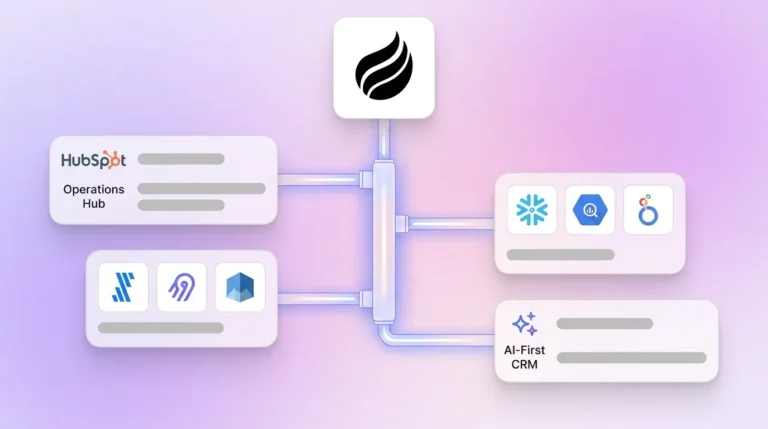
- Agent layers (Coffee): Sit on top of existing CRMs or replace them. They ingest output from databases and enrichment tools, then automate downstream work such as activity logging, meeting summaries, deal stage updates, and pipeline reporting that databases and enrichment platforms leave to the rep.
No single database or enrichment tool covers the full workflow from enrichment through sequencing to CRM updates; optimal stacks combine an enrichment layer, a sequencing layer, and an intelligence layer. Coffee serves as that intelligence and automation layer.
With these three categories defined, you can now evaluate specific tools within each category against the criteria that matter most for mid-market sales leaders.
Evaluation Criteria for AI Prospecting Tools
This comparison evaluates tools on five criteria that matter to mid-market sales leaders and RevOps heads.
- Hours saved per rep per week: Measured across research, enrichment, outreach, and CRM maintenance.
- Data quality: Accuracy rates, decay management, and deduplication logic.
- Salesforce/HubSpot integration depth: Native bidirectional sync compared with shallow API connectors or manual export and import.
- Stack consolidation potential: Whether the tool reduces or increases the number of point solutions in the stack.
- 2026 AI advancements: Agent-level capabilities such as autonomous CRM updates, visitor identification, and pipeline intelligence.
Side-by-Side Comparison of Leading Tools
The table below compares tools across databases, enrichment platforms, and agent layers. Focus on hours saved per rep, CRM integration depth, and 2026 AI capabilities that reduce manual work across the full workflow.
| Tool | Est. Hours Saved/Week | CRM Integration Depth | 2026 AI Advancements |
|---|---|---|---|
| Coffee (Agent Layer) | 8–12 hrs (full workflow automation) | Native bidirectional sync, writes contacts, activities, summaries, and deal stages to Salesforce or HubSpot automatically | Suggested Leads, Pipeline Compare, Visitor Identification, Intelligence layer, Custom Meeting Briefings |
| Apollo.io | 4+ hrs (research and list building) | Native sync with Salesforce and HubSpot, activity logging requires sequencing triggers | AI email writing, intent signals, 275M+ contact database |
| ZoomInfo | 2 hrs/day on research (Apricorn: 5 hrs/week) | Bidirectional CRM sync, Chorus writes call outcomes to Salesforce, HubSpot, Dynamics | GTM Context Graph (1.5B daily signals), Copilot, Chorus conversation intelligence |
| Clay | ~3–5 hrs (list building time reduction) | Direct API to HubSpot and Salesforce, enriched records pushed on demand, not continuously | 50+ source waterfall enrichment, AI scoring, natural-language list building |
| HubSpot Breeze AI | 40% reduction in repetitive CRM tasks within 90 days | Fully native, no connectors required, reads and writes to same data layer as CRM | Breeze Prospecting Agent, AI lead scoring, automated sequences, GPT-5 default (Jan 2026) |
| Salesforce Einstein / Agentforce | 2–3 hrs/week from automated CRM updates and email drafting | Native within Salesforce, autonomous record updates without rep intervention via Agentforce | Agentforce autonomous actions, Einstein Activity Capture, Prediction Builder |
| Gong | 10 hrs/week (Anthropic deployment), 60% rep capacity lift (Canva) | Revenue Graph writes call notes and CRM fields automatically, deep Salesforce and HubSpot integration | Revenue Graph, deal intelligence, cross-deal querying, coaching analytics |
| Outreach | 4–7 hrs/week (40% of reps), prep time 20 min → 2 min | Deep bidirectional sync with Salesforce and Dynamics, sequence outcomes auto-logged to CRM records | AI sequence optimization, sentiment analysis, autonomous follow-up triggers |
| LinkedIn Sales Navigator | Reduces account research time, native CRM sync for Salesforce, Dynamics, HubSpot | Bidirectional activity tracking and contact creation, preserves LinkedIn interaction history in CRM | AI-powered lead recommendations, intent signals, org chart mapping |
| Amplemarket | 45–50 hrs/week recovered across 15 BDRs (Scrut Automation) | Covers discovery through execution in one platform, CRM sync available but not native agent-level write-back | Duo Voice AI, 70M records refreshed weekly, <3% bounce rate, full prospecting workflow in one tool |
2026 AI Advancements That Actually Move the Needle
Recent AI progress now allows autonomous agents to remove humans from the data-entry loop instead of just speeding up individual tasks. This shift changes how mid-market teams think about CRM upkeep and pipeline visibility.
Coffee’s agent capabilities deliver a complete version of this shift for Salesforce and HubSpot teams.

- Suggested Leads: When a company visits your website, Coffee’s Visitor Identification pixel identifies individual visitors, including name, title, email, and LinkedIn profile. It then applies your buyer persona to recommend the two or three people inside that company most worth contacting. Competitors such as RB2B and Warmly surface company-level data or undifferentiated people lists. Coffee closes the loop from pixel hit to LinkedIn outreach without leaving the agent.
- Pipeline Compare: Coffee captures all pipeline history in a built-in data warehouse and automatically visualizes week-over-week changes such as progressed deals, stalled opportunities, and new additions. This replaces manual CSV exports and end-of-week interrogation sessions.
- Intelligence Layer: Launched in February 2026, Coffee’s Intelligence layer lets users define and store deep context on business model, product specifics, ICP, and competitors for tailored AI suggestions and insights.
- Custom Meeting Briefings and Summaries: Also launched in February 2026, these features let users define exact formats, from high-level executive summaries to granular technical breakdowns, written back to Coffee, HubSpot, or Salesforce automatically.
The same Salesforce report projects that AI agents will slash research time by 34% and content creation by 36%. By 2028, 60% of B2B seller work will be executed through conversational user interfaces via generative AI sales technologies, up from less than 5% in 2023.
Category-by-Category Analysis
Prospecting Databases (Apollo, ZoomInfo, LinkedIn Sales Navigator)
- Setup: Fast, connect to CRM via native integration or Chrome extension.
- Data capture: Strong on contact and company data, limited on post-call activity logging.
- Usability: Built for SDRs who create lists and run sequences.
- Reporting: Offers sequence analytics and engagement tracking, while pipeline reporting still depends on the CRM.
- Automation depth: Automates outreach but not CRM updates after conversations.
- Long-term flexibility: Scales well for outbound volume, yet the data-entry tax remains downstream.
Enrichment Platforms (Clay, Cognism, Clearbit)
- Setup: Requires connection to a sequencer and CRM to complete the workflow.
- Data capture: Delivers multi-source enrichment, and Clay can significantly reduce list-building time.
- Usability: Feels technical and suits RevOps and growth engineers more than frontline reps.
- Reporting: Lacks native pipeline reporting, so outputs feed into a CRM or sequencer.
- Automation depth: Automates enrichment and scoring but does not log calls or meetings.
- Long-term flexibility: Highly customizable but adds complexity to the stack.
Agent Layers (Coffee, HubSpot Breeze, Salesforce Agentforce)
- Setup: Coffee connects to Google Workspace or Microsoft 365 and to existing Salesforce or HubSpot instances through simple authentication.
- Data capture: Operates autonomously and logs calls, emails, meetings, and enrichment without rep action. The agent handles the full workflow described earlier.
- Usability: Designed to serve the rep so the software handles busywork instead of demanding manual input.
- Reporting: Pipeline Compare and forecast accuracy improve because the underlying data set is complete.
- Automation depth: Covers the full workflow from contact creation through post-call CRM write-back.
- Long-term flexibility: Consolidates multiple point solutions, and Coffee’s seat-based pricing includes unlimited agent labor.
Best-Fit Use Cases by Company Size and Tech Stack
Mid-market teams on Salesforce or HubSpot (50–500 employees): These teams usually already rely on Apollo or Clay for prospecting and ZoomInfo or Gong for intelligence. The remaining gap is the CRM data-entry tax. Coffee’s Companion App deploys as an agent layer on top of the existing Salesforce or HubSpot instance and handles data unification and write-back without a CRM migration. Coffee also understands Salesforce and HubSpot architecture such as quotas, forecasting, and required fields, which newer CRM alternatives such as Day.ai and Clarify do not yet match.

Small and early-stage teams (1–20 employees): Teams that have outgrown spreadsheets but view HubSpot or Pipedrive as expensive manual chores can move to Coffee’s Standalone CRM. In that setup, the agent manages the entire system of record from day one.
Teams evaluating stack consolidation: Scrut Automation recovered 45–50 hours per week across 15 BDRs after consolidating from ZoomInfo, Lusha, a separate intent platform, and a sequencer into a single platform. Coffee delivers similar consolidation by taking on enrichment, recording, meeting intelligence, and CRM maintenance in one agent.
Operational Considerations
- Change management: Agent layers require reps to trust the system to handle data entry. Coffee addresses this trust barrier through its design, where the agent handles busywork and reps review outputs rather than create them, which accelerates adoption compared with tools that add new manual steps to existing workflows.
- Training: Coffee connects to Google Workspace or Microsoft 365 through simple authentication, and the agent begins populating contacts and logging activities immediately. Scrut Automation’s new BDRs reached full productivity in under one week after consolidating their stack.
- Data hygiene: AI-automated CRM updates can reduce missing field rates. Coffee’s agent ingests both structured data such as contact fields and deal stages and unstructured data such as email text and call transcripts into a built-in data warehouse, which preserves historical context that legacy CRMs overwrite.
- Scalability: Coffee’s seat-based pricing includes unlimited agent labor. There is no metering on LLM usage or automated processes, so cost remains predictable as headcount grows.
Risks and Limitations
Prospecting databases: Apollo, ZoomInfo, and LinkedIn Sales Navigator automate outreach but do not eliminate the post-call CRM update. AI auto-logging can reduce CRM update time after a call from 12 minutes to 2 minutes, but that reduction requires an agent layer to handle the write-back, a capability that databases alone do not provide. Reps still spend time logging call outcomes, updating deal stages, and noting next steps manually.
Enrichment platforms: Clay and similar tools require technical configuration and a connected sequencer and CRM to complete the workflow. Clay pushes enriched data via direct integration or Zapier but still needs a sequencing tool and CRM integration to complete the full workflow. RevOps teams comfortable with technical setup can manage this, while frontline sales leaders often experience it as added complexity.
Agent layers (general): Newer CRM alternatives such as Day.ai and Clarify lack the integration depth required for established Salesforce and HubSpot instances with complex quotas, forecasting configurations, and required fields. Coffee is built specifically for these environments. Coffee’s current third-party integrations run through Zapier, and deeper native integrations are in development.
Fully automated outbound: Fully automated volume plays drop raw reply rates to 2.9%, below the 4.7% human baseline, while hybrid AI plus human pods outperform both human-only teams and fully autonomous AI on cost per qualified opportunity and reply quality. The agent layer should handle data entry and research, while humans still own send decisions and live conversations.
Decision Framework for Completing Your Stack
Mid-market sales leaders need a combination of tools that removes the full workflow tax instead of a single point solution. The framework below maps common starting points to the missing layer.
- Already have Apollo or ZoomInfo? You have prospecting coverage, and the gap is post-call CRM maintenance. Add Coffee as a Companion App on your existing Salesforce or HubSpot instance.
- Already have Clay? You have enrichment coverage, and the gap is sequencing and CRM write-back. Coffee handles the write-back layer, and you can pair it with your existing sequencer.
- Already have Gong? You have conversation intelligence. Coffee’s Pipeline Compare and meeting summaries overlap with Gong’s capabilities, so you can evaluate whether consolidation reduces cost and complexity.
- No CRM yet? Coffee’s Standalone CRM deploys the agent as the system of record from day one and removes the need to bolt an agent onto a legacy platform.
- On Salesforce or HubSpot with low adoption? Coffee’s Companion App addresses the root cause, because reps avoid the CRM when it demands manual input. The agent handles input, and reps receive accurate output.
Frequently Asked Questions
How long does it take to implement Coffee on an existing Salesforce or HubSpot instance?
Coffee connects to Salesforce or HubSpot through a simple authentication flow. Once authenticated, the Coffee Agent scans emails and calendars to auto-create contacts, log activities, and enrich records immediately. Most teams see the agent actively populating their CRM within the same day they connect. There is no lengthy implementation project, data migration, or custom field mapping required for the core Companion App functionality. Teams with complex Salesforce configurations such as custom objects, required fields, and quota structures benefit from Coffee’s deep understanding of these environments, which sets it apart from newer CRM alternatives that lack this integration depth.
Does Coffee replace Apollo, Clay, or ZoomInfo, or does it work alongside them?
Coffee is designed to complete the stack rather than replace the prospecting layer. Apollo, ZoomInfo, and Clay handle contact discovery, enrichment, and outreach sequencing. Coffee handles everything that happens after a prospect enters the workflow, including activity logging, call transcription and summarization, meeting briefings, deal stage updates, and pipeline reporting. Coffee also includes built-in data enrichment via licensed data partners, which covers most mid-market use cases and reduces the need for a separate enrichment tool. Teams that want the highest-fidelity enrichment for large-scale outbound campaigns may keep Clay or ZoomInfo alongside Coffee, while teams with moderate enrichment needs often consolidate onto Coffee alone.

Is Coffee secure, and how does it handle sensitive sales data?
Coffee is SOC 2 Type 2 certified and GDPR compliant. Data processed by the Coffee Agent does not train public AI models. The agent ingests emails, calendar events, and call transcripts to populate and maintain CRM records, and this data remains within your Coffee environment and is not shared externally. Teams in regulated industries such as healthcare or finance that require multi-year security reviews or custom compliance frameworks may need a different solution. For mid-market B2B sales teams, Coffee’s security posture meets standard enterprise requirements.
What does Coffee cost, and how is pricing structured?
Coffee uses seat-based pricing. You pay for the human seats on your team, and the Coffee Agent’s labor, including contact creation, activity logging, meeting summaries, enrichment, and pipeline reporting, is included without extra metering on AI usage or automated processes. This structure keeps cost predictable as headcount scales. There is no separate charge for the number of contacts the agent creates, the number of calls it transcribes, or the number of CRM records it updates. Pricing details for both the Standalone CRM and the Companion App for Salesforce and HubSpot are available at the Coffee pricing page.
How does Coffee’s Visitor Identification feature differ from tools like RB2B or Warmly?
RB2B and Warmly identify the company visiting your website or provide undifferentiated lists of people associated with that company. Coffee’s Visitor Identification goes further in two ways. First, it identifies named individuals, including name, title, email, and LinkedIn profile, rather than stopping at the company level. Second, it applies your buyer persona to recommend the two or three people inside the visiting company who are the highest-fit contacts to reach out to. These Suggested Leads appear in real-time Slack notifications, and with one click the prospect is added to Coffee with all enrichment pre-filled, ready for a LinkedIn connection request, an outbound email, or auto-enrollment in a drip campaign. The entire loop from pixel hit to outreach action happens inside the Coffee agent without switching tools.