Written by: Doug Camplejohn, CEO & Co-Founder, Coffee | Last updated: August 31, 2026
Key Takeaways
- Instantly.ai excels at cold email but lacks automated data entry and full CRM functionality, which forces teams to maintain a fragmented stack of tools.
- Apollo.io, Smartlead, Reply.io, and Lemlist each address specific outreach needs but still require manual data entry and separate CRMs.
- Agentic CRMs like Coffee use AI agents to automatically capture, enrich, and log customer data from emails, calendars, and calls without human input.
- Coffee saves sales reps 8–12 hours per week on data entry while unifying outreach, meeting management, and pipeline tracking in a single platform.
- Coffee offers a trial for teams that want to test the agentic CRM experience before committing.
Why Instantly Falls Short as a CRM (The Core Pain)
Instantly.ai was built to send cold email at scale, and it does that well. As a CRM, it operates under a fundamental architectural constraint. Instantly’s CRM dashboard includes an Opportunities view, Salesflows for dynamic filtering, and a Reports section with metrics like Pipeline Value and Closing Rate. These are functional features. They do not replace a CRM that maintains itself.
Instantly’s ability to automatically capture unstructured data from emails, calendar events, or call transcripts is not clearly documented. It does not enrich contacts without manual effort or a separate credit purchase. This lack of automation forces manual handoffs. When Instantly and a CRM are not integrated, every reply becomes a manual handoff and every interested lead requires three copy-paste steps, which leaves pipeline data days behind reality. A broken Instantly-to-CRM integration can cause outreach to hit active opportunities, ignore opted-out contacts, and create duplicate CRM records.
71% of sales reps say they spend too much time on data entry, and sales reps spend only about 35% of their time selling, with the rest absorbed by administrative work. Instantly’s architecture compounds this problem. Teams using Instantly as their system of record inevitably run a parallel stack: Instantly for sending, a separate CRM for pipeline, a third tool for enrichment, and a fourth for meeting recording.
Instantly’s real monthly cost for production use ranges from $150 to $400 once teams add the plans required for leads, a functional CRM, and the send volume most serious teams need. Most active users land between $94 and $194 per month when they add the lead database and AI Reply Agent. The fragmented stack creates both workflow friction and budget waste.
If this situation feels familiar, Coffee offers an alternative that replaces the fragmented stack with a single agentic CRM.
The Shift: From Passive Databases to Agentic CRMs
Legacy CRMs like Salesforce and HubSpot act as passive databases. They store data but rely on humans to input it correctly. Poor data quality, complex integrations, and low user adoption are three top AI implementation challenges that map directly to the friction of running a cold email tool alongside a separate CRM. Even newer tools like Attio follow the same passive logic, where the human remains responsible for data entry.
An agentic CRM is a platform where autonomous AI agents can read, write, and act on customer data without human intervention for every step, and the agent executes rather than merely suggests actions. This model forms a strict superset of AI-native CRM. Every agentic CRM is AI-native, while many AI-native CRMs still behave like passive databases.
The market is moving toward agentic automation. 87% of sales organizations now use some form of AI for tasks like prospecting, forecasting, lead scoring, or drafting outbound emails, according to Salesforce’s State of Sales 2026 survey of 4,050 sales professionals. Gartner projects that 40% of enterprise applications will embed task-specific AI agents by the end of 2026. Sales teams now face a practical decision about which platform delivers this automation without a Salesforce-level implementation.
Coffee leads this category. Unlike tools that bolt AI features onto a traditional CRM, Coffee was built from the ground up as an agent that handles data entry, enrichment, meeting management, and pipeline intelligence so teams can focus on selling instead of administration.
Evaluation Criteria: How To Judge AI CRMs
Feature checklists often mislead buyers. A tool can ship dozens of features and still fail to solve the core problem. The criteria that determine whether a tool will actually save your team time are:
- Data entry automation: Does the tool automatically capture and log interactions from email, calendar, and calls, or does it require manual input?
- Data quality: Does the tool enrich records with accurate, up-to-date information without requiring a separate subscription?
- Pipeline management: Can you track deals through stages, see historical changes, and generate accurate forecasts without manual exports?
- Integration with existing stack: Does the tool work with Gmail, Outlook, Slack, and your current tools, or does it create new silos?
- User adoption: Will reps actually use it, or will they revert to spreadsheets and Notion?
- Pricing and scalability: Is pricing predictable and seat-based, or does it charge separately for credits, add-ons, and AI features?
The following comparison evaluates each tool against these criteria, with particular focus on data entry automation and pricing predictability.
Side-by-Side Comparison: Apollo.io, Smartlead, Reply.io, Lemlist, and Coffee
The table below summarizes each tool’s core strength, key automation focus, and pricing model. Notice that only Coffee automates data entry at the CRM level, while the others still rely on manual updates or separate systems of record.
| Tool | Best For | Key Automation Feature | Pricing Model |
|---|---|---|---|
| Apollo.io | Built-in lead database + CRM | AI sequence building and lead scoring tied to live contact data | Per-seat, starts ~$49/user/month (annual) |
| Smartlead | High-volume email with inbox rotation | Automated warmup and inbox rotation | Volume-based, starts ~$32/month (annual) |
| Reply.io | Multi-channel outreach (email, LinkedIn, SMS) | Jason AI for reply triage and autonomous meeting booking | Per-mailbox + per-user hybrid, from $49/mailbox/month |
| Lemlist | Personalized visual campaigns | Lemwarm deliverability engine + dynamic prospect-specific images | Per-user, starts ~$39/user/month |
| Coffee | Agentic CRM that automates data entry and unifies outreach | AI agent auto-creates contacts, logs activities, joins meetings, and tracks pipeline changes | Seat-based; agent’s unlimited labor included |
Now look at how these differences play out when you examine each tool in detail, starting with Apollo.io.
Apollo.io: Built-In Lead Database With Manual CRM Upkeep
Apollo.io is the most popular Instantly alternative for teams that want a lead database and CRM in one platform. It unifies a 240M+ person database with multi-channel sequencing across email, phone, and social. It also offers AI-powered lead scoring and bi-directional sync with Salesforce, HubSpot, Zoho, and Pipedrive. Apollo holds a 38% adoption rate in the Sales Data Providers category as of July 2026, up 5 percentage points year-over-year, according to Ramp’s vendor data.
Apollo offers AI sequence building, call summaries, and lead scoring. The CRM still behaves like a passive database. It stores what you put in but does not proactively capture unstructured data from email and calendar. Data entry remains a human responsibility.
- Pros: Deep lead database, strong CRM features, good integrations, free tier available
- Cons: Credit-based pricing can be unpredictable, data entry is still manual, platform can feel bloated for teams that want a simple CRM
- Best For: Teams that need a built-in lead database and accept manual data entry as part of their workflow
While Apollo.io blends database and CRM, Smartlead focuses almost entirely on email infrastructure.
Smartlead: High-Volume Email With Limited CRM Depth
Smartlead is the go-to Instantly alternative for teams focused on email deliverability at scale. It offers unlimited mailboxes, automated inbox rotation, a built-in warmup engine with a reward-based pool, and automatic DNS/SPF/DKIM/DMARC configuration. Smartlead’s SmartProspect feature earns verified leads per emails sent but lacks an independent contact database.
Smartlead’s automation focuses on email infrastructure. It offers AI agents for outreach automation and CRM updates, yet CRM functionality remains limited compared to dedicated platforms. Teams using Smartlead still need a separate system of record.
- Pros: Excellent deliverability, flat pricing for unlimited users, strong API for custom workflows
- Cons: No native lead database, limited CRM depth, email-only focus with no native LinkedIn or calling
- Best For: Teams that already have a separate CRM and need a high-volume email sending tool with superior deliverability
Where Smartlead optimizes email volume, Reply.io leans into multi-channel engagement.
Reply.io: Multi-Channel Outreach With Heavier Setup
Reply.io positions itself as a multi-channel sales engagement platform, supporting email, LinkedIn, phone, SMS, and WhatsApp in automated sequences. Its Jason AI assistant classifies inbound replies, routes or responds to them, and autonomously books meetings, which positions it as an AI SDR-style automation tool. Reply.io offers deeper CRM integration than Lemlist, adding Copper to the standard Salesforce, HubSpot, and Pipedrive integrations.
Reply.io’s pricing starts at $49/month per mailbox for email-only and $89/user/month for multichannel, with a complex mixed model that makes cost prediction difficult. The setup burden is heavier than Instantly or Smartlead. The CRM integration still requires manual data entry for many workflows.
- Pros: True multi-channel automation, strong AI assistant, good CRM integrations
- Cons: Complex pricing, heavier setup, per-seat costs add up for larger teams
- Best For: Structured sales teams that need multi-channel outreach and are willing to invest in setup
Lemlist takes a different angle again, centering on creative personalization rather than CRM depth.
Lemlist: Personalization-Focused Outreach With Minimal CRM
Lemlist is known for its creative personalization capabilities. It offers dynamic prospect-specific images and videos, a mature Lemwarm deliverability engine backed by inbox rotation and spam-score checks, and LinkedIn steps inside campaigns. Lemlist’s pricing ranges from $39/user/month for Email Starter to $159/user/month for Outreach Scale.
Lemlist’s automation centers on personalization and deliverability. It supports email, LinkedIn, and phone tasks, but lacks the multi-channel depth of Reply.io, with no SMS or WhatsApp. CRM functionality stays minimal, so teams using Lemlist still need a separate system of record.
- Pros: Best-in-class personalization, strong deliverability, simpler entry point than Reply.io
- Cons: Per-user pricing multiplies costs for teams, limited CRM functionality, no native SMS or WhatsApp
- Best For: Solo founders and small teams that prioritize creative personalization over CRM depth
Coffee: Agentic CRM That Automates Data Entry and Unifies Outreach
Coffee is fundamentally different from every other tool in this comparison. Coffee is an agentic CRM, an AI agent that actively handles data entry, enrichment, meeting management, and pipeline intelligence without requiring human intervention for every step. Unlike cold email tools with a CRM bolted on, Coffee was built from the ground up as an agent.
When you connect Google Workspace or Microsoft 365, the Coffee Agent scans emails and calendars. It then auto-creates contacts, companies, and activities. It enriches records with job titles, funding, and LinkedIn profiles via licensed data partners, which removes the need for a separate ZoomInfo or Apollo subscription. Coffee’s Stripe integration, launched in January 2026, automatically imports customers and companies, enriches them, and adds paid invoices to deals as Closed Won. Coffee’s AI search on deals, released in January 2026, answers natural-language questions such as “Which deals are stuck in negotiation?” or “What’s closing this month?”
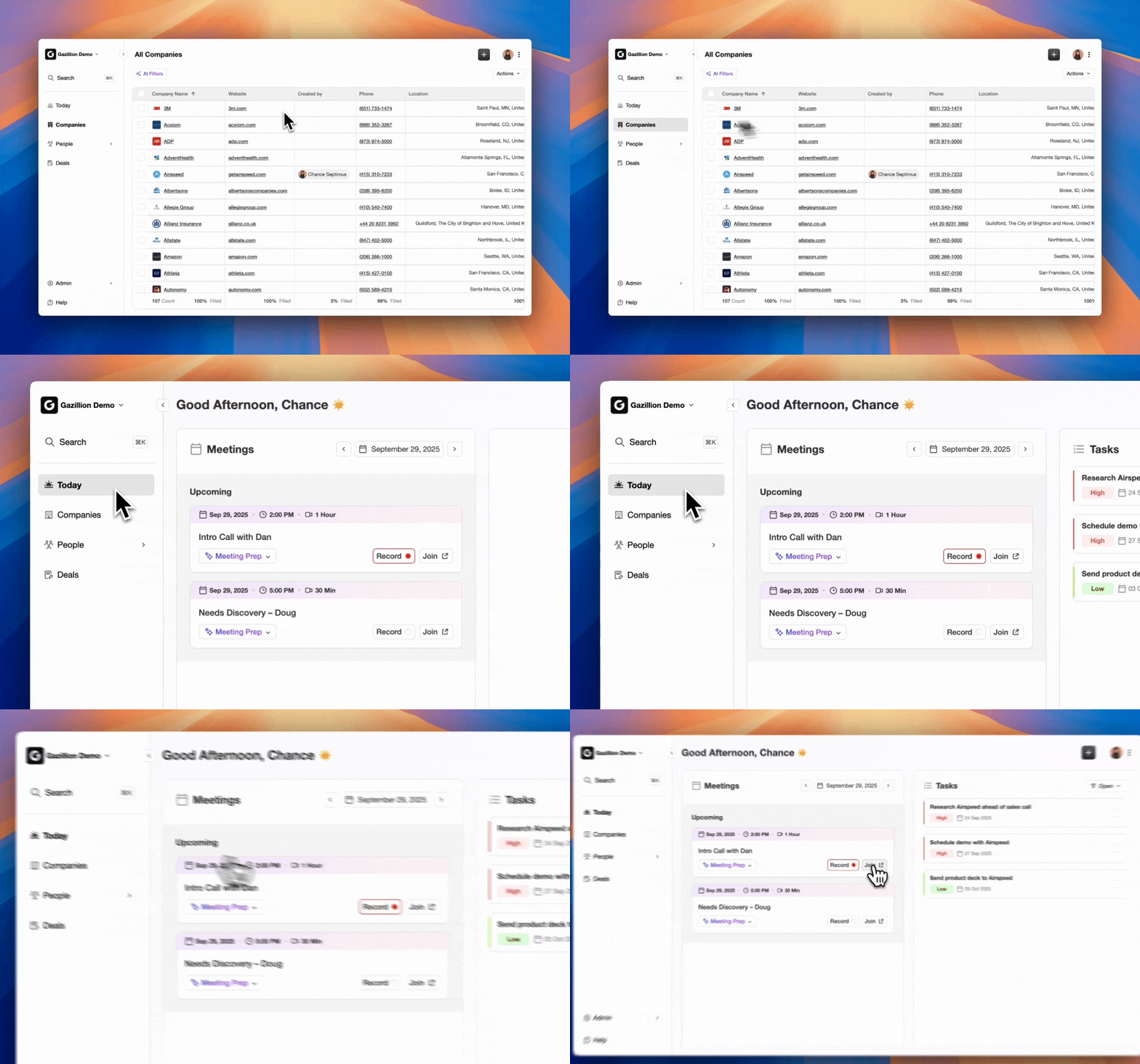
The agent joins calls on Zoom, Teams, and Meet to record and transcribe. It then generates summaries, action items, and follow-up drafts automatically. Custom Meeting Briefings and Summaries, launched in February 2026, allow users to define exact formats and focuses, from high-level executive summaries to granular technical breakdowns. This meeting intelligence feeds directly into Pipeline Compare, which tracks all pipeline changes week-over-week and highlights progressed deals, stalled opportunities, and new additions without manual CSV exports.

Coffee extends this automation to prospecting and outreach. Visitor Identification turns anonymous website traffic into named, qualified prospects with suggested leads matched to your buyer persona. Lead Finder builds targeted prospect lists from Coffee’s own database using natural language search. Campaigns then run multi-step email sequences natively from the rep’s own mailbox, with stop-on-reply and send throttling built in.

The agent saves reps 8–12 hours per week on data entry, according to company data. It works with both structured and unstructured data and runs on a data warehouse that preserves historical context, which legacy CRMs struggle to match.

Coffee offers two deployment options. The Standalone CRM serves small-to-mid-sized businesses that want to replace their entire stack. The Companion App layers the agent on top of existing Salesforce or HubSpot instances. Coffee is SOC 2 Type 2 and GDPR compliant, and data is not used to train public models.
- Pros: True agentic automation, eliminates manual data entry, unifies outreach and pipeline, flexible deployment (standalone or companion), seat-based pricing with agent included
- Cons: Less suited to large enterprises with complex custom workflows, integrations beyond Zapier are still on the roadmap
- Best For: Teams that want an AI agent to handle data entry and unify their outreach without the manual upkeep of traditional CRMs
Decision Framework: Matching Tools to Your Sales Needs
The right tool depends on your team’s specific constraints and priorities. Use this framework to identify your fit:
- Need a built-in lead database and are okay with manual data entry: Choose Apollo.io. It is the most comprehensive all-in-one platform, while data entry and credit management remain human responsibilities.
- Need high-volume email with superior deliverability and already have a separate CRM: Choose Smartlead. It is the strongest email infrastructure tool in this group and will sit alongside your CRM.
- Need multi-channel outreach (email, LinkedIn, SMS, calls) and have a structured sales team: Choose Reply.io. It is powerful and flexible, and per-seat pricing can add up.
- Prioritize creative personalization and are a solo founder or very small team: Choose Lemlist. It excels at standout campaigns, while you still rely on a separate CRM.
- Want an AI agent that handles data entry, unifies outreach, and delivers pipeline intelligence without manual upkeep: Choose Coffee. It is the only agentic CRM in this comparison and delivers the time savings described earlier.
For a quick reference, use the checklist below to map common needs to tools:
- Want to stop doing manual data entry → Coffee
- Need a massive built-in lead database → Apollo.io
- Sending 100,000+ emails per month → Smartlead
- Need SMS and WhatsApp in your sequences → Reply.io
- Want dynamic images in your cold emails → Lemlist
Frequently Asked Questions
Can AI replace a CRM?
AI cannot replace the concept of a CRM, because teams still need a system of record for customer data. AI agents can replace the manual labor of maintaining that CRM. An agentic CRM like Coffee automates data entry, enrichment, and activity logging, so the CRM maintains itself without human effort. For most sales teams, AI replaces the data entry clerk role, and the productivity gains are significant. Research shows that automating activity logging alone can save 25 to 75 minutes per rep per day, which makes it the highest-impact CRM automation available.
Which AI-based CRM is the best?
As of 2026, the best AI-based CRM depends on your team’s needs. Apollo.io offers the strongest built-in lead database with AI features layered on top. Reply.io has the most advanced multi-channel AI assistant for structured sales teams. For teams that want true agentic automation, where the AI actively handles data entry and pipeline management without human intervention, Coffee is the strongest option. It is the only tool in this comparison built from the ground up as an agent, rather than a database with AI bolted on. Coffee’s dual deployment model, as a Standalone CRM or Companion App for Salesforce and HubSpot, also gives it flexibility that no other tool in this category matches.
How much does Instantly AI cost?
Instantly.ai’s pricing as of 2026 starts at $47/month for the Outreach Growth plan, which includes 1,000 active contacts and 5,000 emails per month. The Outreach Hypergrowth plan costs $97/month and includes 25,000 contacts and 100,000 emails. The real cost is higher because leads, verification, and AI features live on bundles and credit packs. The Bundle Starter plan costs $94/month and adds 1,500 lead credits per month from the 450M+ database. The Bundle Scale plan costs $194/month and includes the AI Reply Agent. Most active users land between $94 and $194 per month when they add the lead database and AI features. Annual billing reduces prices by roughly 10–20%.
Is Instantly AI worth it?
Instantly is worth it if your primary need is high-volume cold email with strong deliverability and flat-fee pricing. It falls short if you are looking for a CRM. The built-in CRM is functional but limited, because it lacks automated data entry, does not capture unstructured data from emails and calls, and requires manual reconciliation with any separate CRM you run alongside it. Teams needing full pipeline management, automated data entry, or multi-channel outreach will outgrow it quickly. If your team spends more than an hour a day on manual data entry and CRM reconciliation, Instantly likely costs more in lost productivity than it saves in subscription fees.
What are free Instantly.ai alternatives?
Instantly.ai does not have a free plan as of 2026. Apollo.io offers a free tier with limited credits and database access, which makes it the most accessible free entry point in this comparison. Lemlist offers a 14-day free trial. Coffee offers a trial for teams that want to test the agentic CRM experience before committing. Free tiers across these tools are generally limited in sending volume and database access, so they work best for evaluation rather than production use. Teams evaluating Coffee specifically should focus the trial on the automatic data entry and Pipeline Compare features, because these deliver the most immediate time savings.
How does Coffee compare to Instantly?
Coffee and Instantly solve different problems. Instantly is a cold email sending tool with a basic CRM bolted on. Coffee is an agentic CRM that automates data entry, unifies outreach, and provides pipeline intelligence. As mentioned earlier, Coffee saves reps 8–12 hours per week on data entry, according to company data, while Instantly requires manual data entry and separate tools for enrichment and pipeline management. Coffee also includes a native meeting bot, Pipeline Compare for week-over-week deal tracking, Visitor Identification, Lead Finder, and Campaigns in one system. Instantly works well when you only need to send cold email at scale. Coffee is the better choice when you want an AI agent to handle the busywork and give you a clean, unified CRM.
Conclusion: Move Beyond Data Entry Work
The core problem with Instantly.ai comes from its design. It was never built to function as a full CRM. Teams that try to use it as one end up stitching together a fragmented stack of sending tools, enrichment databases, meeting recorders, and manual data entry workflows. The result is hours of lost productivity every week and pipeline data that lags behind reality.
Agentic CRMs solve this by automating the busywork instead of adding another passive database. Coffee is the only tool in this comparison that does this at the CRM level, through an AI agent that handles data entry, enriches contacts, joins meetings, tracks pipeline changes, and unifies outreach in one system. This time savings compounds over weeks and quarters and supports both standalone CRM use and companion deployments alongside Salesforce or HubSpot.
If you are ready to stop acting like a data entry clerk and want an agent to handle the busywork, consider Coffee as your AI CRM alternative.