Written by: Doug Camplejohn, CEO & Co-Founder, Coffee | Last updated: August 31, 2026
Key Takeaways
- Most Salesforce teams face one main pipeline problem: bad data, inaccurate forecasting, slow deal velocity, or weak prospecting. Choose AI that targets that specific issue.
- Coffee leads for automated data capture and pipeline intelligence. It removes manual entry and gives leaders instant visibility without spreadsheet exports.
- Salesforce Agentforce, Gong, Clari, and ZoomInfo each focus on a different use case: native automation, conversation intelligence, forecasting, and prospecting data.
- Successful AI rollouts start with a focused pilot, clean data, and native bidirectional sync. Hidden implementation costs can double or triple first-year spend on enterprise tools.
- Teams ready to remove manual data entry and move toward autonomous pipeline management can start a Coffee trial today.
Pick the Right AI App for Your Salesforce Pipeline Problem
Start by naming your primary pain point. Most Salesforce teams fall into one of four categories:
- Bad data and low adoption: Reps skip logging activities, fields stay incomplete, and leaders cannot trust reports. You need automated data capture and enrichment.
- Inaccurate forecasting: Your pipeline looks strong one week and collapses the next. Most forecasting failures are data problems, not AI problems. You need predictive analytics built on clean records.
- Slow deal velocity: Deals stall, follow-ups slip, and reps lack coaching. You need conversation intelligence and deal-risk detection.
- Insufficient prospecting: Your pipeline is thin at the top. You need data enrichment and outbound list building.
Match each pain point to a clear AI capability. Automated data entry fixes bad data. Conversation intelligence speeds deal velocity. Predictive analytics improves forecasting. Data enrichment powers prospecting. Reps recover 15–25% of effective selling time through AI automation of low-value administrative tasks, but only when the tool addresses the real bottleneck. The tools below follow this use-case structure.
Top AI Apps for Salesforce Pipeline by Use Case
| AI App | Primary Use Case | Best For |
|---|---|---|
| Coffee | Automated data capture & pipeline intelligence | Fixing bad data and low CRM adoption |
| Salesforce Agentforce | Native AI automation & forecasting | Teams wanting built-in AI without extra vendors |
| Gong | Conversation intelligence & deal coaching | Improving deal velocity and rep performance |
| Clari | Pipeline inspection & revenue forecasting | Larger teams needing accurate forecasts |
| ZoomInfo | B2B data enrichment & prospecting | Outbound teams building targeted lists |
Coffee: Fix Bad Data and Automate Pipeline Management
Best for: Teams struggling with manual data entry, low CRM adoption, and unreliable pipeline visibility.
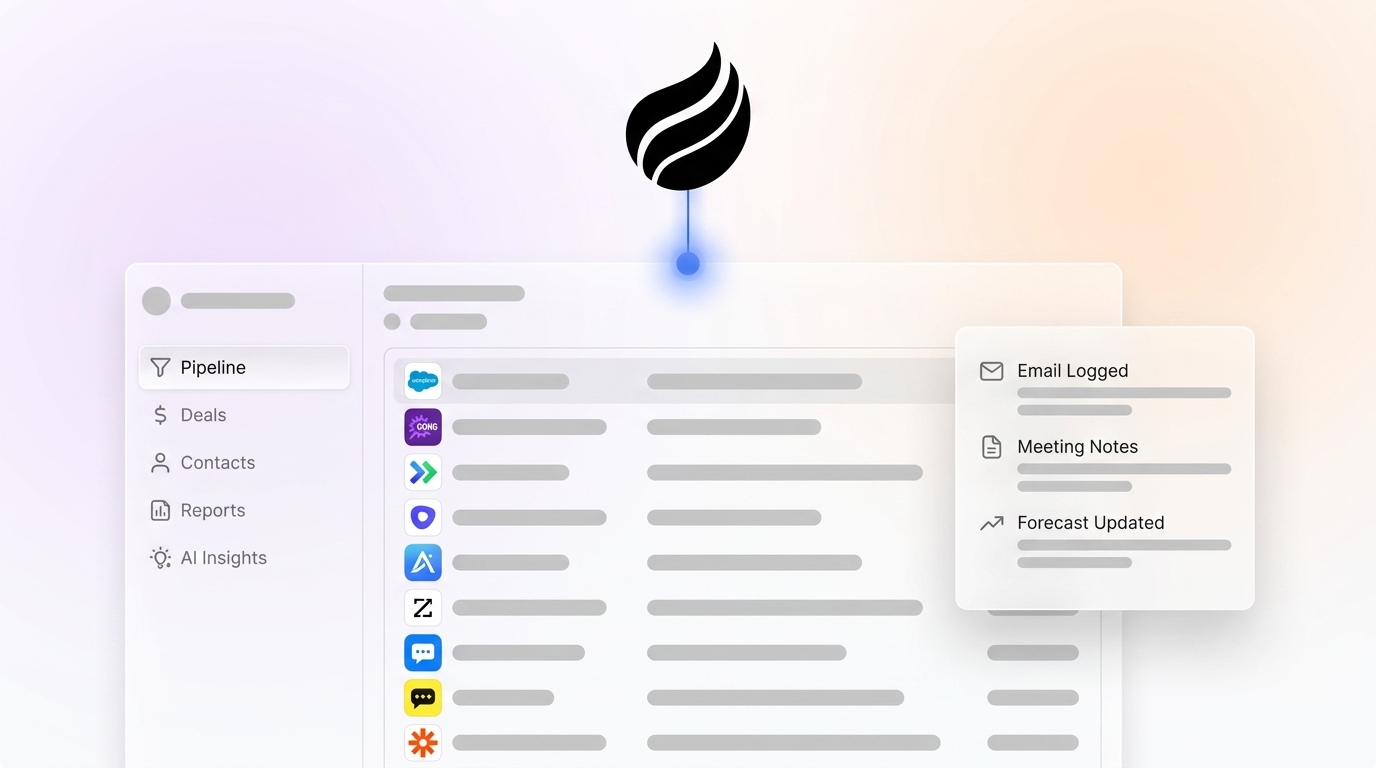
Coffee is an autonomous CRM agent that runs as a Companion App on top of your existing Salesforce instance. Coffee actively scans emails, calendars, and call transcripts to automatically create and enrich contacts, companies, and activities. It syncs bidirectionally with Salesforce, so every interaction is logged without a rep lifting a finger. Coffee’s AI search on deals answers natural-language prompts such as “Which deals are stuck in negotiation?” or “What is closing this month?”. Sales leaders get instant pipeline visibility without exporting CSVs.
Key features include automatic contact and company creation from Google Workspace or Microsoft 365. Data enrichment adds job titles and LinkedIn profiles so records stay complete. AI-powered meeting briefings and post-call summaries keep reps prepared and reduce note-taking. Pipeline Compare visualizes week-over-week pipeline changes without manual CSV exports. Summary templates are customizable to match workflows and write back to Salesforce automatically. Coffee also offers Visitor Identification to turn anonymous website traffic into named leads, plus Lead Finder for built-in prospecting.

Coffee saves reps 8–12 hours per week on data entry. Its agent-led model fits the 2026 shift toward autonomous AI, and its simple seat-based pricing, where the agent’s unlimited labor is bundled into the seat cost, keeps it accessible for SMBs and mid-market teams. For Salesforce users dealing with “garbage in, garbage out,” Coffee provides a direct and practical fix.

Try Coffee free and see how much manual data entry you can remove from your Salesforce workflow.

Salesforce Agentforce: Native AI for Salesforce-First Teams
Best for: Teams already on Salesforce Enterprise or Unlimited that want built-in AI instead of another subscription.
While Coffee focuses on fixing bad data at the source, Salesforce Agentforce embeds AI directly into the Salesforce platform. Salesforce Agentforce is the native AI layer inside Salesforce. In 2026, it spans predictive AI for lead scoring and opportunity insights, generative AI for email drafting and summarization, and agentic AI for autonomous agents that qualify leads and update records. The Summer ’26 release introduced the Customer Engagement Agent for 24/7 lead qualification and Momentum, which captures and structures every customer interaction and writes it back to Salesforce in real time.
The 2026 Anthropic partnership, called Claudeforce, brings Claude’s reasoning capabilities into Salesforce through the Headless 360 architecture. It provides 37 pre-built sales skills that let sellers reason over live revenue data and update pipeline records without leaving Claude. Salesforce in Claude is available to select pilot customers today, with an open beta planned for September 2026.
Agentforce’s strengths are its native integration and the Einstein Trust Layer, which offers zero data retention and PII masking. Its main drawbacks are cost and complexity. Agentforce requires Salesforce Enterprise edition at $175 per user per month or higher, plus an Einstein Platform add-on, and 77% of Agentforce implementations fail due to data issues. Most Salesforce Einstein customers spend $50,000–$200,000 on implementation before seeing AI value. For teams under 20 reps without a dedicated Salesforce admin, Agentforce usually feels like overkill.
Gong: Conversation Intelligence to Speed Deals
Best for: Teams focused on improving rep performance, coaching, and accelerating deals through call insights.
For teams that already trust their data but want sharper deal execution, Gong focuses on conversations. Gong records, transcribes, and analyzes sales calls to surface deal risks, competitor mentions, and coaching opportunities. Its AI Data Extractor pushes confirmed budget ranges, next steps, and objections into custom Salesforce fields, and its Salesforce integration ships as a managed AppExchange package with bidirectional sync. Gong launched in 2015 and now serves more than 5,000 companies, with Gartner naming it a Leader in the inaugural 2025 Magic Quadrant for Revenue Action Orchestration.
Buyer-reported pricing places Gong near $1,400–$1,600 per user per year for Foundations. Bundled Engage and Forecast add-ons can push pricing toward $2,880–$3,000 per user per year. Gong delivers strong value for larger teams with RevOps support, but it usually feels excessive for teams under 20 reps.
Clari: Pipeline Inspection and Revenue Forecasting
Best for: Larger teams that need accurate revenue forecasts and real-time pipeline visibility across multiple segments.
After conversation intelligence, the next common need is reliable forecasting. Clari is a revenue platform that uses AI to predict revenue, flag risks, and provide pipeline inspection. It pulls data from Salesforce to create a real-time view of the pipeline. Clari highlights which deals are likely to close, which are stalled, and where the forecast sits at risk. Advanced AI forecasting tools in 2026 deliver 85–92% average forecast accuracy for B2B organizations, compared with 60–70% for manual spreadsheet methods.
Clari’s implementation and setup fees of $10,000–$30,000 stack on top of per-seat cost. The full combined platform can reach $200–$310 or more per user per month before implementation. Clari suits revenue organizations with dedicated RevOps teams rather than SMBs.
ZoomInfo: Data Enrichment and Prospecting Fuel
Best for: Outbound-focused teams that need accurate contact and company data to build targeted lists and feed the top of the pipeline.
Once forecasting and deal execution are covered, many teams turn to prospecting scale. ZoomInfo provides B2B contact and company data, buyer intent signals, and enrichment that syncs directly into Salesforce. Its data platform includes 500 million contacts, 100 million companies, and a verification pipeline backed by 300+ human researchers achieving up to 95% accuracy on first-party data. ZoomInfo’s Buyer Intent tracks signals from 210 million IP-to-Organization pairings monthly, revealing which companies actively research topics relevant to your product.
ZoomInfo Copilot requires ZoomInfo Advanced starting near $24,995 per year or Elite starting near $39,995 per year, with most mid-sized teams reporting $30,000–$60,000 per year all-in. ZoomInfo acts as a data foundation rather than a pipeline management solution. It enriches records but does not automate data capture the way Coffee does.
How to Use AI to Boost Salesforce Pipeline Performance
Once you select a tool for your main bottleneck, roll it out in stages. Key principles for a successful rollout include:
- Ensure data hygiene first: AI on bad data does not produce bad results, it produces bad results with confidence, which is more dangerous than no results at all. Clean your core objects before you scale AI.
- Start with a pilot: Pick one pain point, one team, and one tool. Prove value on a small scope before expanding.
- Frame adoption clearly: Train reps by positioning the tool as a way to remove disliked admin work and support their judgment.
- Measure specific metrics: Track time saved on data entry, forecast accuracy changes, deal velocity shifts, and rep adoption rates.
- Choose native sync over middleware: Tools with bidirectional Salesforce sync, such as Coffee’s Companion App, avoid integration overhead that adds cost and complexity.
- Account for total cost of ownership: Non-license costs for AI sales agent deployments can add 2x to 5x the annual license fee in the first year. Include implementation, training, and data work in your budget.
2026 Trend: Agentforce, Claudeforce, and Autonomous Sales Agents
Salesforce’s expanded Agentforce platform and the Anthropic partnership define the 2026 AI landscape. Salesforce rebuilt the Agentforce runtime over six months, delivering 30 system-wide enhancements that reduced latency by 70% across the platform. Agentforce Operations, generally available as of April 2026, reduces cycle times by 50–70% for processes like auditing and onboarding and removes 80% of manual tasks such as data entry.
This shift moves teams toward autonomous agents that act on behalf of sellers instead of passive tools that wait for input. Native AI keeps improving, while third-party tools still provide depth in specific areas: Gong for conversation intelligence, Clari for forecasting, and ZoomInfo for data. Coffee’s agent-led approach fits this trend. It acts as an autonomous agent that solves the “data in” problem so Salesforce’s native AI, and every other tool in the stack, can rely on clean data. For SMBs and mid-market teams, a practical 2026 strategy pairs Salesforce’s native capabilities with an agent like Coffee that keeps the underlying data accurate.
Frequently Asked Questions
What AI works best with Salesforce?
The right AI for Salesforce depends on your main challenge. Salesforce Agentforce fits teams that want native automation and already run Enterprise or Unlimited with a dedicated Salesforce admin. Gong fits teams that want better deal velocity through conversation intelligence and rep coaching. Clari fits larger revenue organizations that need accurate forecasting and pipeline inspection across segments. ZoomInfo fits outbound-focused teams that need a reliable B2B data foundation for prospecting. Coffee fits the most common and foundational problem: bad data and low CRM adoption. Coffee’s Companion App integrates bidirectionally with Salesforce, automatically creates and enriches contacts, logs activities from emails and calendars, and writes pipeline intelligence back to Salesforce without middleware or extra effort from reps.
How do I integrate AI apps with Salesforce?
Most AI sales apps connect to Salesforce in three main ways. Some use native AppExchange managed packages. Others rely on OAuth-based API connections. A third group uses middleware platforms such as Zapier. Native tools like Agentforce require no integration work because they live inside Salesforce. Third-party tools like Gong use managed AppExchange packages that provision custom Salesforce objects and establish bidirectional sync. Coffee’s Companion App uses a simple OAuth authentication flow. After you connect it, the agent scans emails and calendars, enriches records, and writes summaries and pipeline data back to Salesforce in real time. No middleware is required, and a Salesforce admin is not needed to maintain the connection. When you evaluate integration depth, check whether the tool writes data back to standard Salesforce objects, which keeps it queryable in reports, or only reads from Salesforce without contributing structured data.
Are AI apps worth the cost for Salesforce teams?
AI apps pay off for teams with a clear pain point and reasonably clean data. AI forecasting tools deliver much higher forecast accuracy than manual methods, and the time savings mentioned earlier translate directly into more selling time. Hidden costs still matter. Implementation, training, and data infrastructure can add heavily to the annual license fee in year one. This impact is especially strong for enterprise platforms like Agentforce and Clari, where setup fees alone can reach five or six figures. Coffee’s seat-based pricing model avoids most of this complexity. The agent’s unlimited labor is included in the seat cost, with no per-conversation or per-credit metering. For SMBs and mid-market teams that cannot absorb large implementation budgets, Coffee’s pricing structure keeps the ROI calculation straightforward. Reps save hours per week on data entry, and Salesforce records stay accurate without extra headcount.
Can AI replace manual data entry in Salesforce?
AI can replace most routine data entry tasks in Salesforce. Autonomous CRM agents like Coffee scan emails, calendars, and call transcripts to automatically create and enrich contacts, companies, and activities, which removes the need for reps to log interactions by hand. As mentioned earlier, Coffee saves reps 8–12 hours per week on data entry and keeps Salesforce records aligned with real deal activity. Salesforce’s Momentum feature, introduced in the Summer ’26 release, also captures customer interactions and writes them back to Salesforce in real time. The main difference lies in scope. Momentum is a native Salesforce feature that requires Enterprise edition and sits inside a broader Agentforce deployment. Coffee is a standalone Companion App that runs on top of any existing Salesforce instance with minimal setup. For teams that want automated data entry without a large implementation project, Coffee offers a faster route to clean CRM data.
Conclusion: Align Each AI App With a Specific Pipeline Bottleneck
The best AI app for your Salesforce pipeline is the one that fixes your biggest bottleneck, not the one with the most features. If your problem is bad data and low adoption, Coffee is the strongest overall choice. It automates data capture, enriches records, and delivers pipeline intelligence without forcing reps to change how they work. If your problem is deal velocity, Gong stands out. If your problem is forecasting, Clari delivers. If your problem is prospecting, ZoomInfo feeds the pipeline. For SMBs and mid-market teams buried in manual data entry, Coffee turns Salesforce from a chore into a reliable revenue asset.
Ready to fix your data problem? Start with Coffee and give your Salesforce pipeline the clean data foundation every other AI tool depends on.