Written by: Doug Camplejohn, CEO & Co-Founder, Coffee | Last updated: September 6, 2026
Key Takeaways
- Leadfeeder only identifies companies, not individuals, so sales teams still perform manual research to find decision-makers.
- Person-level visitor identification tools like Coffee surface named prospects with LinkedIn profiles and emails, which turns anonymous traffic into actionable outreach.
- Company-level tools cover 20–35% of B2B traffic, while person-level tools typically match 5–20% and work best for US-based visitors due to GDPR restrictions.
- Coffee differentiates with Suggested Leads that recommend the specific two or three humans inside a visiting company who match your buyer persona, plus real-time Slack alerts and one-click CRM enrichment.
- US-based B2B teams can turn anonymous website visitors into named pipeline with Coffee, without the limitations of Leadfeeder.
Top Leadfeeder Alternatives For US B2B Teams
The market for website visitor identification software has consolidated significantly in 2026. To help you choose, this list ranks the leading options by relevance to US-based B2B teams, with a focus on person-level identification, pricing transparency, and integration ease.
- Coffee — Person-level visitor identification with Suggested Leads, real-time Slack alerts, and one-click CRM enrichment for Salesforce and HubSpot. It recommends the specific two or three humans inside a visiting company who match your buyer persona.
- RB2B — Person-level identification was removed in 2026, so it now offers only company-level coverage globally. The free tier covers 150 companies per month, and paid plans start from $79 per month.
- Warmly — AI-powered signal orchestration with person-level identification for roughly 15% of visitors and company-level coverage for roughly 65%. Paid plans start at $10,000 per year and the product has been acquired by HubSpot.
- HubSpot Breeze Intelligence — HubSpot's native identification tool built on Clearbit Reveal data. It requires a HubSpot subscription with custom pricing and syncs visitor data directly into HubSpot CRM.
- 6sense and Demandbase — Enterprise ABM platforms that combine visitor tracking with predictive intent data. Pricing is custom, with annual contracts starting in the thousands per month.
- Visitor Queue — Its domain now redirects to Leadinfo as of 2026, so it no longer operates as a standalone product.
Teams that want person-level identification with built-in actionability can use Coffee's Visitor Identification to move beyond raw lists of names or company records and into real outreach.
How Coffee's Visitor ID Works In Practice
Coffee's Visitor Identification starts with a single tracking pixel. You drop a custom-generated script into the <head> tag of your site, and Coffee immediately begins identifying visitors. Implementation stays simple, and you avoid separate vendor contracts for enrichment.
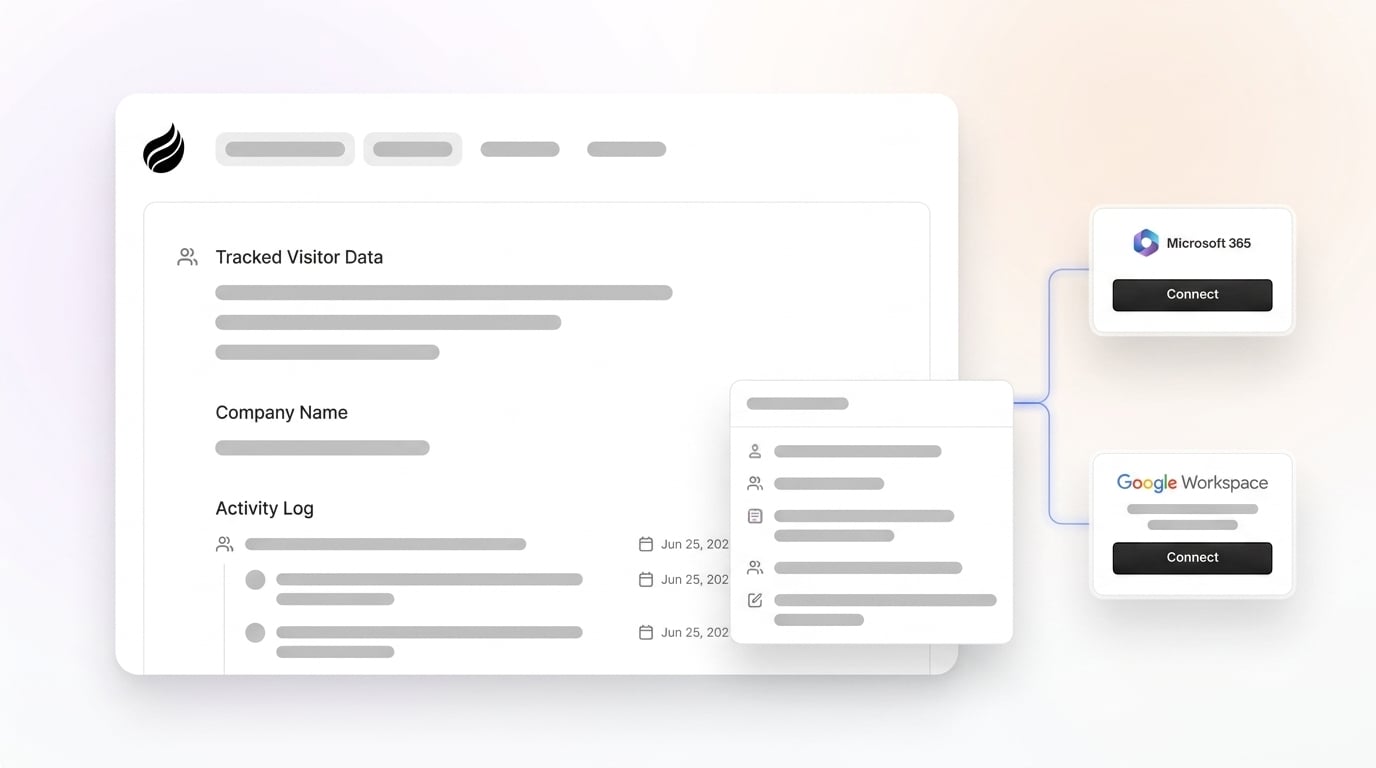
The intelligence layer goes beyond company-level data. Coffee infers who the person is: name, title, email, and LinkedIn profile. It also captures company, pages visited, time on site, and whether the visit was first-time or returning. Leadfeeder, Visitor Queue, and Leadinfo tell you that a company visited. Coffee tells you which person visited.
The Suggested Leads differentiator sets Coffee apart from every other tool in this category. RB2B (before removing person-level ID in 2026) and Warmly surface raw people lists or company names. Coffee instead uses your buyer persona to recommend which two or three humans inside a visiting company you should contact, with LinkedIn profiles surfaced for instant outbound. You see the two people worth calling instead of a list of 40 employees.
The action loop stays closed inside one agent. Real-time Slack notifications surface high-fit visitors the moment they land. With one click, the prospect is added to Coffee with all enrichment pre-filled, ready for a LinkedIn connection request, an outbound email, or auto-enrollment into Campaigns for automated follow-up. Coffee works as a Companion App on top of existing Salesforce or HubSpot instances, or as a Standalone CRM, so visitor identification feeds directly into the system your team already uses.
Company-Level Vs. Person-Level Visitor Tracking
The most important decision in anonymous website visitor tracking is choosing the identification tier your team actually needs.
Company-level tools such as Leadfeeder, Leadinfo, Snitcher, and Albacross use reverse-IP lookup to identify the organization visiting your site. Company-level identification typically covers roughly 20–35% of B2B traffic. Person-level tools go further and identify the specific individual. Person-level identification covers roughly 5–20% of traffic and is primarily US-only due to GDPR restrictions.
Company-level only creates a structural problem. A person buys software, not a company. Knowing that “Acme Corp visited your pricing page” still leaves you guessing which of Acme's 500 employees to contact. Teams still need to find the right contact, validate timing, enrich the record, and build context before outreach. Leadfeeder does not handle those steps, which creates an action gap.
Person-level tools introduce a trade-off around match rate. Person-level identification match rates of 5–15% are declining further due to cookie loss and browser privacy changes. Any vendor quoting 70% or higher match rates is counting differently. The only reliable metric is your own trial data on your own traffic.
In plain terms, Leadfeeder shows you the company. RB2B, when it offered person-level data, showed you raw people lists. Coffee shows you the right people who match your ICP and surfaces their LinkedIn profiles for immediate outreach. That distinction determines whether visitor identification creates pipeline or just fills a spreadsheet.
Geographic And Privacy Considerations For Visitor Tracking
The US vs. EU divide in visitor tracking shapes which tools are legally viable for your traffic.
Most person-level identification tools are US-only because GDPR makes identifying named EU individuals without consent legally indefensible. RB2B is legally restricted to US traffic for person-level identification. Leadfeeder is EU-built and GDPR-first, with strong European data coverage, which helps European teams but does little for US-focused teams whose ICP sits in North America.
The legal picture by region looks like this:
- US (CCPA/CPRA): The CCPA is an opt-out regime, not opt-in. Person-level identification is generally permissible with notice at collection, opt-out mechanisms including Global Privacy Control, and vendors contracted as service providers rather than third parties.
- EU/UK (GDPR/ePrivacy): Company-level identification can rest on legitimate interest under Article 6(1)(f) with a documented Legitimate Interest Assessment. Person-level identification of EU visitors without consent fails the GDPR balancing test because no reasonable EU visitor expects an anonymous browse to place their name in a vendor's dashboard.
Teams with mostly US-based traffic, which is typical for US B2B SaaS, can use person-level identification in a legally defensible and commercially valuable way. Coffee's single pixel identifies named individuals for US traffic while remaining compliant. Teams with meaningful EU-based traffic should rely on company-level identification as the defensible architecture.
Industry-standard B2B visitor identification match rates run 20–30% at company level, and remote work has lowered that figure over time as employees use residential IPs. If a vendor tells you they can name individual EU visitors compliantly, ask for the lawful basis in writing. Silence usually follows.
Coffee is built for US-based B2B teams that need person-level identification with full compliance confidence.
How To Choose The Right Leadfeeder Alternative
Four criteria help you decide which anonymous website visitor tracking tool fits your team.
- Traffic geography: Mostly US-based traffic makes person-level tools viable. Meaningful EU traffic calls for company-level or region-aware tools to stay compliant.
- CRM: Coffee works as a Companion App on top of Salesforce or HubSpot, or as a Standalone CRM. HubSpot Breeze Intelligence requires a HubSpot subscription. Warmly limits CRM integrations to HubSpot and Salesforce and now sits inside HubSpot's ecosystem following acquisition.
- Budget: Coffee uses predictable per-seat pricing. Leadfeeder's usage-based pricing scales with identified companies and can reach €899 per month for high-traffic sites. Warmly and 6sense require enterprise contracts starting at $10,000 or more per year.
- Data granularity: Company-level data suits account-based marketing teams. Person-level data is essential if your SDRs want to contact specific decision-makers without manual research.
Three pitfalls often derail evaluations.
- Match rate inflation: Run a free trial on your own traffic for at least two weeks before committing. The only number that matters is what the tool identifies on your traffic, not a vendor's headline claim.
- GDPR overreach: Any vendor claiming they can name individual EU visitors compliantly without consent should not handle your compliance posture.
- The action gap: Identifying visitors is step one. If your tool does not tell you which specific person to contact and let you act immediately through LinkedIn, email, or campaign enrollment, your team returns to manual research and loses pipeline.
DIY B2B Visitor Tracking Stack
A DIY stack using GA4, enrichment tools, and a CRM can work for RevOps teams with technical resources. The components and their realistic costs look like this:
- GA4 + Google Tag Manager: Free, but requires careful configuration, including event naming, custom dimensions, attribution windows, and consent-aware tag firing. A proper B2B GA4 setup takes two to three days of focused work.
- Enrichment tools (Apollo, Instantly, ZoomInfo): Costs range from $79–$300 per user per month on seat-based plans, or $0.10–$2.50 per record on usage-based APIs. Mid-market teams typically spend $6,000–$12,000 annually on enrichment once refresh cycles are included.
- CRM (Salesforce, HubSpot): These platforms store and route identified leads. Neither provides visitor identification natively without additional modules.
- Middleware (Zapier, Make): These tools connect enrichment outputs to CRM records. Budget $20–$60 per month for basic automation.
The trade-offs are significant. GA4 gives you traffic data, not identity, and enrichment tools match 20–35% of traffic at company level, which still leaves you unsure which person to contact. Without ongoing RevOps maintenance, tags break, event definitions drift, and data quality degrades. Even with a complete DIY stack, you still lack the action layer, including Suggested Leads, one-click LinkedIn outreach, and automated campaign enrollment. Costs accumulate quickly, as enrichment, CRM seats, and middleware together approach the price of an all-in-one tool while still missing the layer that converts identification into pipeline.
A DIY stack suits teams with dedicated RevOps resources and low traffic volume. Teams that want person-level identification with built-in actionability see better results with a purpose-built tool like Coffee and avoid maintenance overhead.
Frequently Asked Questions
How Do I Identify Anonymous Website Visitors?
Anonymous visitor identification relies on two primary methods. Company-level tools use reverse-IP lookup to match a visitor's IP address to a company record, which identifies the organization rather than the individual. Person-level tools like Coffee go further by using a tracking pixel combined with data enrichment and buyer persona matching to surface named individuals with LinkedIn profiles and email addresses. As mentioned earlier, company-level tools cover roughly 20–35% of traffic, while person-level tools cover roughly 5–20% and work best for US visitors. The practical starting point is installing a tracking pixel and running a two-week trial on your own traffic to measure actual match rates before committing to any tool.
Can I Track Who Visits My Website?
You can track visitors within the bounds of applicable privacy law. Company-level tools like Leadfeeder and Leadinfo show which organizations visit your site. Person-level tools like Coffee identify named individuals, including name, title, email, and LinkedIn profile, alongside their company. The right choice depends on your traffic geography, your CRM, and whether your team needs company-level data for account-based marketing or person-level data for direct SDR outreach. For US-based B2B SaaS teams, person-level identification is legally viable under CCPA's opt-out regime when you give notice at collection, honor opt-outs including Global Privacy Control signals, and contract your vendor as a service provider. For EU traffic, company-level identification under legitimate interest remains the defensible architecture. Coffee identifies both the company and the specific people within it who match your buyer persona, then recommends which two or three humans to contact first.
Is Leadfeeder Being Discontinued?
Leadfeeder continues to operate. It merged with Echobot to form Dealfront in 2022, then rebranded back to Leadfeeder in March 2026, consolidating under the stronger consumer brand. The product now focuses on European markets with company-level identification, a proprietary database of more than 60 million companies and 400 million contacts, and strong DACH, Nordics, and Benelux coverage. Its EU-centric data coverage underperforms for US-focused teams, and its company-level-only identification means teams still need separate tools to find decision-makers, which drives many US B2B teams to evaluate alternatives.
What Is The Best Leadfeeder Alternative For US-Based Traffic?
For US-based B2B teams that need person-level identification, the realistic shortlist in 2026 is small. RB2B, as noted earlier, no longer offers person-level identification and now focuses on company-level data globally. Warmly starts at $10,000 per year and has been acquired by HubSpot. Coffee stands out because it surfaces more than raw people lists. Its Suggested Leads feature recommends the specific humans inside each visiting company who match your buyer persona, with LinkedIn profiles surfaced for instant outreach. Combined with real-time Slack alerts, one-click CRM enrichment, and native Campaigns for automated follow-up, Coffee closes the loop from pixel hit to pipeline without requiring a separate enrichment tool, sequencing platform, or manual research step.
What Match Rate Should I Expect From A Visitor Identification Tool?
Realistic expectations keep evaluations grounded. Company-level tools typically identify 20–35% of B2B traffic under normal conditions. Sites with more corporate, office-based visitors see higher rates, while remote workers on residential ISPs, VPNs, and mobile networks are harder to match. Person-level tools identify 5–20% of traffic, and that figure is declining as browser privacy changes erode third-party cookie graphs. Any vendor claiming 60% or higher match rates without showing methodology is likely counting repeat visits as unique identifications or using a looser matching standard. The only reliable benchmark is running a free trial on your own traffic for at least two weeks and measuring identified visitors against your total session count.
Conclusion: Turning Visitor Data Into Pipeline
Leadfeeder shows you companies, not people, which forces US-based B2B teams into hours of manual research to find the right contact at each visiting account or accept missed opportunities while intent is still warm. The fundamental fork in visitor tracking concerns whether your tool closes the gap between “a company visited” and “here is the specific person to call.”
Coffee's Visitor Identification closes that gap with a single tracking pixel, person-level identification, Suggested Leads that surface the right humans based on your buyer persona, real-time Slack alerts, one-click CRM enrichment, and seamless integration with Salesforce, HubSpot, and Campaigns for automated follow-up. Stop chasing companies and start talking to the right people by starting a Coffee trial on your own traffic.