Written by: Doug Camplejohn, CEO & Co-Founder, Coffee | Last updated: August 27, 2026
Key Takeaways
- Automated sales pipeline tools replace manual CRM updates with structured workflows that surface pipeline risk and forecast revenue automatically.
- Legacy CRMs like Salesforce and HubSpot rely on human data entry, which creates incomplete records and 13–17% forecast variance for most B2B teams.
- Modern alternatives such as visitor ID tools, prospecting databases, and sales engagement platforms create data silos that require manual action and add subscription costs.
- Coffee’s agent architecture autonomously captures contacts, activities, and transcripts from emails and calendars, which supports higher forecast accuracy without manual data entry.
- Teams evaluating their pipeline stack this quarter can deploy Coffee’s agent to ensure reliable pipeline intelligence.
Team-Size Recommendations and How This Guide Uses Them
The table below outlines team-size recommendations that this guide references in later sections, especially in the Scenario Guidance section.
| Team Size | Recommended Architecture | Primary Risk |
|---|---|---|
| 1–20 reps | AI-first standalone CRM (e.g., Coffee Standalone) | Outgrowing spreadsheets without adding admin overhead |
| 15–40 reps | Agent companion layer on Salesforce or HubSpot | Low CRM adoption and fragmented point-solution stack |
| 40+ reps | Enterprise CRM plus dedicated RevOps headcount | Complex custom workflows requiring governance layers |
With these benchmarks in mind, the next sections walk through how each tool category affects data capture, forecasting, and rep workload.
Evaluation Criteria for Automated Pipeline Tools
Use these ten criteria when scoring any tool category in this guide.
- Data capture method, passive human entry versus active agent automation.
- CRM field completion rate, which directly affects forecast accuracy because missing fields hide risk.
- Setup and time-to-value, measured in days to first insight instead of months.
- Integration depth, native bidirectional sync instead of brittle Zapier webhooks.
- US compliance posture, including SOC 2 Type II, CAN-SPAM suppression, and CCPA/CPRA deletion workflows.
- Total cost of ownership, license fees plus hidden data-entry labor.
- Forecast accuracy improvement, shown as measurable variance reduction.
- Rep adoption friction, whether the tool serves the rep or demands service from the rep.
- Unstructured data handling for emails, call transcripts, and meeting notes.
- Vendor architecture, passive database versus active agent.
Legacy CRMs: Data Quality Gaps and Maintenance Burden
Salesforce and HubSpot dominate the legacy CRM category and both rely on relational databases that humans must populate. Traditional CRMs were built primarily for management reporting rather than sales execution, functioning like digital filing cabinets that wait for humans to feed them information.
This structure has predictable consequences. Sales professionals spend 70% of their time on non-selling tasks, and CRM data decay from job changes, mergers, and dead emails quietly undermines analytics initiatives. When fields stay empty, forecasts degrade, and the median B2B sales team misses its quarterly revenue forecast by 13% to 17% because leaders lack real-time visibility into deal engagement and stage progression.
HubSpot provides built-in GDPR tools and configurable data retention policies, one-click right-to-erasure workflows, and consent tracking integrated with forms and emails. Salesforce offers field-level encryption via Salesforce Shield and automated data subject request processing via Privacy Center. These compliance controls help with downstream obligations, yet they do not solve the upstream problem because neither platform captures data autonomously.
Modern CRMs and Visitor Tools: New Interfaces, Old Data Problems
If legacy CRMs cannot solve the data capture problem alone, newer alternatives must be evaluated through the same lens. Despite modern interfaces, newer CRMs such as Clarify and Day.ai still rely on passive-database logic that creates data quality problems in Salesforce and HubSpot.
Day.ai focuses on unstructured productivity data but lacks the Salesforce and HubSpot integration depth that 15–40 person teams require, including quota management, required fields, and forecasting hierarchies. Clarify also falls short on integration maturity for established mid-market stacks, which limits its usefulness as a system of record for growing teams.
Standalone website visitor identification tools such as RB2B and Warmly surface company-level or undifferentiated people data from anonymous traffic. They add a helpful signal layer but create another silo that requires manual action to move a visitor into the CRM and into outreach. The data does not automatically enrich existing records or trigger sequences without additional tooling, which keeps reps in the loop for basic data plumbing.
Implementation friction compounds these issues. Single-workflow sales automation setup often takes about two weeks, and full enterprise rollouts can require several months. For a 15–40 person team without dedicated RevOps headcount, that timeline represents a significant opportunity cost and slows adoption.
Prospecting Databases and Sales Engagement: Integration Gaps and Stack Cost
ZoomInfo and Apollo.io provide large contact databases with firmographic and technographic filters. Both add separate subscription costs and require manual export-import workflows or Zapier connections to sync with the CRM. They also face the same data decay problem, as B2B contact data decays at roughly 22.5% per year on average, which makes one-time enrichment at list import insufficient for automated outbound sequences.
Sales engagement platforms such as Outreach and Salesloft execute multi-step sequences but operate as a separate system of action from the CRM system of record. RevOps leaders report that clean data sync between automation and CRM is the single biggest lever for improving pipeline accuracy because real-time writeback makes forecasts reliable and prevents duplicate records. When that sync is fragile or manual, the benefit disappears and teams revert to spreadsheets.
These integration gaps also increase cost. The combined spend on a prospecting database, a sales engagement platform, a CRM license, and a visitor identification tool creates a four-subscription stack that a 15–40 person team must integrate, maintain, and train reps to use at the same time.
Coffee Agent Architecture vs. Passive Databases
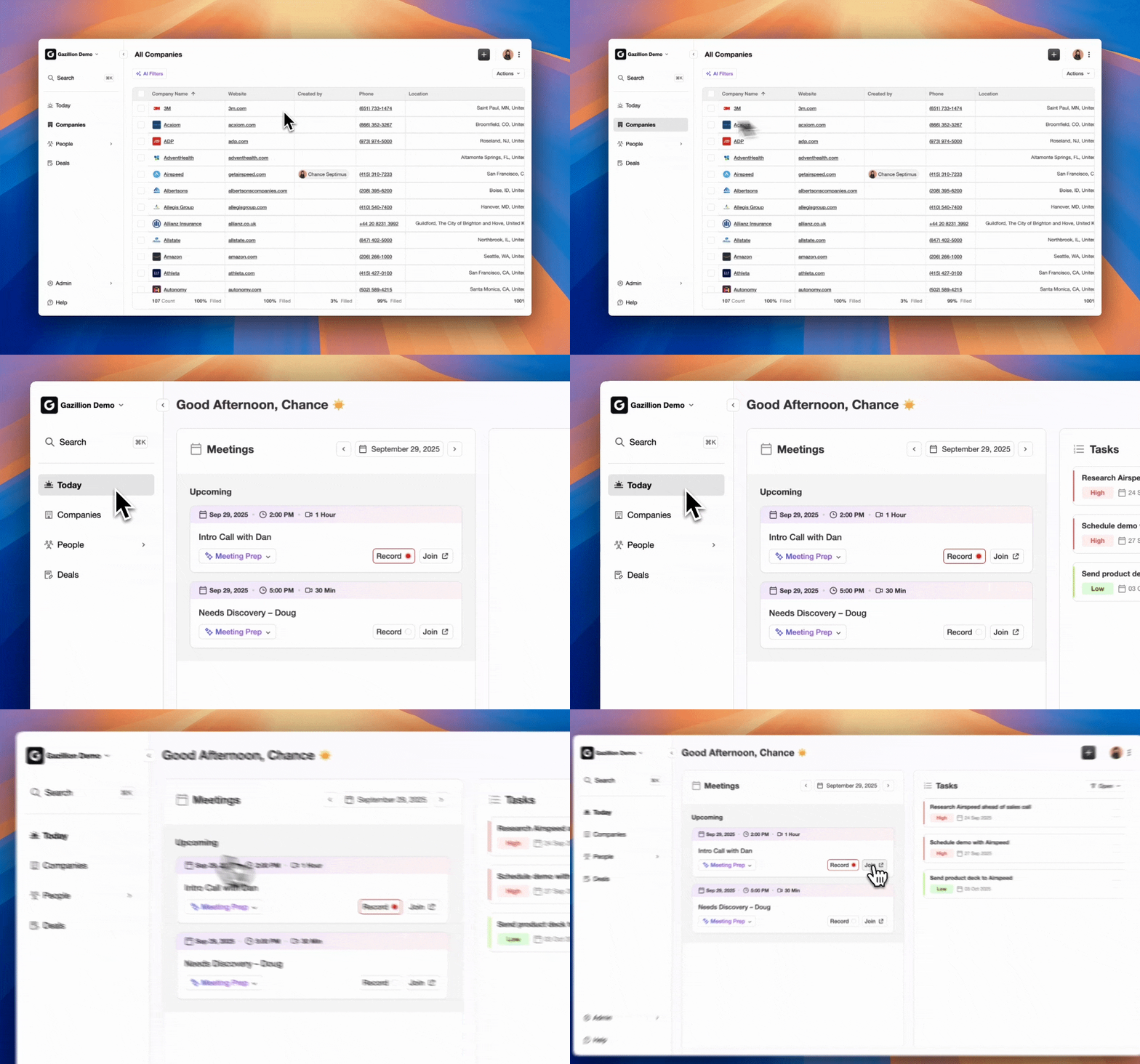
The following table shows how Coffee’s agent architecture addresses each limitation of passive CRMs, from setup friction to forecast accuracy, by automating the data capture that legacy systems leave to human entry.
| Dimension | Legacy / Passive CRM | Coffee Agent |
|---|---|---|
| Setup | Manual field mapping, admin configuration, rep training | Connect Google Workspace or Microsoft 365, and the agent begins populating records immediately |
| Data capture | Human entry required for contacts, activities, and stage updates | Agent auto-creates contacts, logs activities, and updates deal state from emails, calendars, and call transcripts |
| Unstructured data | Not natively processed, stored as free-text notes if entered at all | Ingested and structured from emails, transcripts, and meeting recordings into the data warehouse |
| Pipeline visibility | Dependent on rep discipline, stale data is common | AI search answers natural-language queries such as “Which deals are stuck in negotiation?” or “What is closing this month?” |
| Integration model | System of record that requires external tools for enrichment, sequencing, and visitor ID | Standalone CRM or companion layer on Salesforce or HubSpot that consolidates enrichment, sequencing, visitor ID, and forecasting |
| Forecast accuracy | Manual methods (rep roll-ups) average ±25–35% variance from actual quarter-end revenue | Agent-ensured data completeness supports substantially higher AI-assisted forecast accuracy for teams with active CRM data |
| Customization | Extensive but requires admin hours and developer resources | Custom meeting briefings, summary formats, and an Intelligence layer storing ICP, product, and competitor context for tailored AI outputs |
See Coffee in your own stack and watch an agent manage pipeline data for you.
Scenario Guidance for Early-Stage, Growing, and Established Teams
Early-stage (1–15 reps, no CRM yet): The Coffee Standalone CRM gives small teams an AI-first starting point. The agent handles contact creation, activity logging, and meeting management from day one, which prevents the manual-entry habits that corrupt data in legacy systems before the team grows large enough to fix them.

Growing teams (15–40 reps, committed to HubSpot or Salesforce): The Coffee Companion App runs as an agent layer on top of the existing system of record. Simple authentication allows the agent to sync, enrich, and write insights back to HubSpot or Salesforce without a migration. Summary templates are customizable and writable back to Coffee, HubSpot, or Salesforce, which preserves existing reporting structures.

Established teams with entrenched Salesforce or HubSpot workflows: The Companion App improves data quality without disrupting quota hierarchies, required fields, or forecasting roll-ups. Coffee’s understanding of Salesforce and HubSpot integration complexity, including forecasting categories and required field validation, differentiates it from newer alternatives that lack this integration maturity.

US B2B Data Privacy and Forecasting Under Compliance Pressure
As of early 2026, 20 US states have enacted comprehensive data privacy laws with no federal privacy standard in place, which creates overlapping obligations for any automated pipeline tool that processes contact data. The most significant change for B2B teams is that California’s B2B exemption under the CCPA expired on January 1, 2023 when the CPRA amendment took effect, so work emails, direct dials, and job titles tied to California residents now count as protected personal information.
For outbound email, CAN-SPAM requires a physical mailing address in every email, a clear opt-out mechanism, and honoring of opt-out requests, with violations carrying penalties of up to $53,088 per email. Any automated sales pipeline tool sending at scale must enforce suppression lists at the workflow level instead of relying on manual checks.
Forecast accuracy remains a widespread problem, as discussed earlier, and the compliance landscape increases the stakes. Teams must maintain accurate, consent-aware data while still capturing enough activity detail to support reliable forecasts.
Coffee is SOC 2 Type II and GDPR compliant. Data is not used to train public models, and the agent’s suppression and deletion workflows are built into outbound campaign execution by default.
Five High-ROI Automation Workflows with Coffee
- Inbound speed-to-lead: A website visitor identified by Coffee’s pixel triggers real-time enrichment with name, title, company, pages visited, and LinkedIn profile. A Slack notification surfaces the lead, and one click adds the enriched record to Coffee and enrolls the prospect in a Campaign sequence, all without leaving the agent.
- Pre-meeting briefing: The agent prepares a “Today” page before each call, pulling attendee roles, past interaction history, and deal context. This preparation removes the research time that often delays follow-up, and B2B companies that contact inbound leads within one hour are nearly seven times as likely to qualify them as those that wait even one additional hour, so briefings help reps move faster while arriving more prepared.
- Post-call data capture: The Coffee AI Meeting Bot joins Zoom, Teams, or Meet calls, records and transcribes, then generates summaries structured to BANT, MEDDIC, or SPICED and writes them back to the CRM record automatically. This workflow removes manual note-taking, which most reps skip.
- Outbound prospecting to sequence: The Lead Finder accepts a natural-language query such as “Find me VPs of Sales at SaaS companies with 50–200 employees,” builds the list, enriches it, and enrolls contacts directly into a Campaign. Behavior-triggered branching in sequences consistently outperforms day-based linear sequences because it responds to actual intent signals, and Coffee’s stop-on-reply default prevents automated emails from firing after a real conversation begins.
- Pipeline compare and weekly review: The agent visualizes week-over-week pipeline changes, including progressed deals, stalled opportunities, and new additions. This view replaces manual CSV exports and turns pipeline reviews from interrogation sessions into strategic discussions.
Common CRM Mistakes to Avoid in 2026
The most common CRM mistakes in 2026 share a pattern because they treat symptoms instead of root causes. Teams often scale outbound volume before validating data quality, and this approach damages sender reputation and conversion rates when targeting and data quality are weak.
Leaders frequently treat low CRM adoption as a training problem when it is actually an architecture problem, since tools that demand service from reps instead of delivering it will always face resistance. Many teams also buy separate point solutions for enrichment, sequencing, and visitor ID without a unifying agent to sync them, which multiplies integration work.
Some organizations ignore state-level privacy obligations and then scramble to catch up, even as US businesses increase spending on privacy compliance due to state-by-state legal analysis requirements. Others deploy AI forecasting on top of incomplete CRM data, despite evidence that automated forecasting accuracy depends first on data completeness, then history depth, then model fit.
Total Cost of Ownership Including Hidden Data-Entry Time
License fees appear on invoices, but rep time rarely does. When reps spend most of their working hours on non-selling tasks, the effective cost per selling hour rises sharply. A 20-person team where each rep loses even five hours per week to manual CRM maintenance gives up 100 hours of selling capacity weekly, and that lost capacity never shows up as a software line item.
A four-tool stack that includes a CRM, a prospecting database, a sales engagement platform, and a visitor identification tool brings four license fees, four renewal negotiations, four integration maintenance burdens, and four onboarding cycles for every new hire. Coffee consolidates five functions, CRM, enrichment, prospecting, engagement, and visitor ID, into a single agent with seat-based pricing. The agent’s labor is included, and there is no extra metering on AI usage or automated processes.
Decision Checklist and Summary Matrix
Use this checklist before committing to any tool category this quarter.
- Does the tool capture data autonomously, or does it require rep input to stay current?
- Can it process unstructured data such as emails and transcripts and write structured outputs back to the CRM?
- Does it include built-in suppression list enforcement and CAN-SPAM compliance at the sequence level?
- Is it SOC 2 Type II certified, and does the vendor provide a countersigned DPA naming sub-processors?
- Does it support CCPA/CPRA deletion and opt-out propagation through the automation chain?
- Will it work alongside your existing Salesforce or HubSpot instance, or does it require a migration?
- Does it reduce the number of subscriptions and integration points, or add to them?
- Can it demonstrate forecast accuracy improvement tied to CRM field completion rates?
| Tool Category | Data Capture | Forecast Impact |
|---|---|---|
| Legacy CRM (Salesforce, HubSpot) | Manual (human entry) | ±25–35% variance from actual revenue (see legacy CRM analysis above) |
| Modern CRM (Clarify, Day.ai) | Partially automated with limited integration depth | Insufficient data for established mid-market benchmarks |
| Visitor ID tools (RB2B, Warmly) | Company-level or undifferentiated people data that requires manual action | No direct forecast impact, signal layer only |
| Prospecting DB (ZoomInfo, Apollo) | Static list export that decays at roughly 22.5% per year | No direct forecast impact, sourcing layer only |
| Coffee Agent (Standalone or Companion) | Autonomous agent captures contacts, activities, transcripts, and enrichment | Agent-ensured completeness supports substantially higher forecast accuracy for teams with active CRM data |
Frequently Asked Questions
How long does Coffee implementation take for a 15–40 person team?
For teams using the Coffee Companion App on an existing Salesforce or HubSpot instance, implementation begins with a simple authentication that connects Coffee to the existing CRM. The agent starts populating records from emails and calendars immediately after connection. Teams avoid lengthy data migration, field remapping projects, and rep retraining cycles while they begin capturing data. Teams using the Coffee Standalone CRM follow the same connection process, linking Google Workspace or Microsoft 365 so the agent can build contact and activity records from existing communication history. Most teams see their first automated pipeline insights within the first week of connection.
What internal expertise is required to maintain an agent-based pipeline?
Coffee serves Heads of Sales and RevOps leaders at companies without dedicated CRM administrators. The agent handles ongoing maintenance tasks that typically require admin hours in legacy CRMs, including contact deduplication, activity logging, field updates, and enrichment refreshes. The Intelligence layer lets users define ICP, product specifics, and competitor context in plain language, which the agent uses to tailor outputs without developer configuration. Zapier remains available for teams that need connections to tools outside Coffee’s native integrations, and deeper integrations sit on the product roadmap.
How does migration effort compare when keeping Salesforce or HubSpot as system of record?
When a team deploys Coffee as a Companion App, no migration is required. Salesforce or HubSpot remains the system of record. Coffee authenticates against the existing instance, reads the data already present, enriches records, and writes summaries, activity logs, and pipeline updates back into existing CRM fields. Quota structures, required fields, forecasting hierarchies, and reporting dashboards built in Salesforce or HubSpot stay intact. This approach contrasts with newer CRM alternatives that require teams to move their system of record, a project that typically takes months and carries significant data-integrity risk for established teams.
How does Coffee handle US data privacy and SOC 2 Type II requirements?
Coffee is SOC 2 Type II certified, so its security controls for access management, encryption, monitoring, and incident response have been assessed for both design and operating effectiveness over an extended period. Data processed by the Coffee Agent is not used to train public AI models. For US compliance, Coffee’s Campaigns feature includes stop-on-reply sequencing and suppression list enforcement at the workflow level, which supports CAN-SPAM opt-out requirements. The agent’s contact enrichment relies on licensed data partners, and the platform supports CCPA/CPRA deletion and correction workflows. Teams operating in multiple US states should confirm their specific state-level obligations because 20 states now have active comprehensive privacy laws with varying thresholds and requirements.
Conclusion: Choosing the Right Automated Pipeline Stack This Quarter
The architectural distinction that matters most for 15–40 person US B2B SaaS teams concerns active versus passive data capture, not which CRM lists the most features. Forecast accuracy across enterprise sales teams still averages below 75%, and the root cause is incomplete, stale, human-dependent data.
Legacy CRMs, modern CRM alternatives, visitor tools, prospecting databases, and sales engagement platforms each address one layer of the pipeline problem while leaving the data-entry burden on reps. Coffee’s agent architecture addresses the root cause by ensuring good data enters the system autonomously so accurate pipeline intelligence, forecasts, and outreach can emerge, whether Coffee operates as the standalone CRM or as a companion layer on an existing Salesforce or HubSpot instance.
Teams evaluating their pipeline stack this quarter can map where manual data entry degrades CRM field completion rates, calculate the rep hours consumed by that entry, and decide whether their current architecture can fix the input problem without adding headcount. When the answer is no, an agent-based approach becomes the only structural solution.