Key Takeaways for AI-Native CRM Buyers
-
Legacy CRMs like Salesforce and HubSpot drain productivity through manual data entry, so reps spend only 28% of their time selling.
-
AI-native platforms built agent-first automate unstructured data from emails, calls, and calendars, which creates deeper and more reliable automation.
-
Coffee leads as a dual-mode CRM agent, offering standalone replacement or companion integration while saving reps roughly 8–12 hours each week.
-
Platforms such as Attio, Aurasell, and Lightfield focus on specific needs, from custom data models to automatic pipeline population.
-
SMB and mid-market teams can experience this CRM shift with Coffee, which supports easy migration and agent-led insights.
Why AI-Native CRM Architecture Beats Legacy Systems
Legacy CRMs fail because they act as passive containers that demand constant manual maintenance. Systems of record like legacy CRMs will lose primacy as AI agents read, write, and reason directly across operational data, turning ITSM and CRM systems from passive databases into background persistence tiers.
The core flaws include fragmented workflows that force reps to toggle between multiple tools, outdated relational database architectures that lose historical context when fields update, and poor user experiences that drive low adoption.
In contrast, AI-native platforms solve these issues through agent-led automation that unifies structured and unstructured data. AI-native startups like Clay and Actively captured 78% market share in the sales category by targeting workflows outside Salesforce such as research, personalization, and enrichment using unstructured data. Automation depth extends beyond simple data entry into intelligent workflow orchestration and predictive insights that guide daily selling.

|
Platform Type |
Data Model |
Automation Level |
Integration Approach |
Ideal For |
|---|---|---|---|---|
|
Legacy Average |
Relational DB |
Manual Entry |
Point Solutions |
Enterprise Scale |
|
Salesforce |
Custom Objects |
Workflow Rules |
AppExchange |
Large Teams |
|
HubSpot |
Flexible Schema |
Sequences |
Marketplace |
Marketing-Led |
|
Coffee |
Data Warehouse |
Agent-Led |
Google Workspace/Microsoft 365 |
SMB/Mid-Market |
Top 7 AI-Native CRM Platforms Reshaping Sales in 2026
1. Coffee
Coffee operates as a CRM agent that can run as a standalone CRM or as a companion app for existing Salesforce and HubSpot instances. Coffee.ai introduced an Intelligence layer that allows users to define and store deep context on business models, product specifics, ICP, and competitors for tailored AI suggestions and insights in February 2026.
The agent automatically creates and enriches contacts from Google Workspace or Microsoft 365, handles meeting orchestration with AI briefings and summaries, and provides pipeline intelligence through automated change tracking.

Key Strengths: Dual standalone and companion modes for flexible migration, typical savings of 8–12 hours per week for reps, SOC 2 Type 2 and GDPR compliance, automated BANT and MEDDIC qualification.
Limitations: Current integrations rely on Zapier, with deeper native integrations on the roadmap.
Best Fit: SMBs and mid-market teams that want to replace legacy tools without taking on rip-and-replace risk.

2. Attio
Attio, an emerging AI-native CRM platform with $116M total funding, including a Series B led by Google Ventures, targets high-growth tech companies needing custom data models by adapting to user-structured information rather than forcing data into pre-built fields. The platform offers flexible programmable architecture but requires more initial setup than traditional CRMs.
Key Strengths: Flexible data models, modern UI, strong developer ecosystem.
Limitations: Setup-heavy experience, more passive and less agent-driven than some competitors.
Best Fit: Technical teams at high-growth startups that require custom workflows.
3. Aurasell
Aurasell, founded by an ex-Harness CRO and CTO, raised a $30M seed round from Menlo Ventures and Unusual Ventures, and is an AI-native platform that replaces 15+ GTM tools while offering a GTM OS layer runnable on top of existing Salesforce or HubSpot instances. The platform focuses on intelligence augmentation rather than full CRM replacement.
Key Strengths: Non-disruptive overlay approach and broad GTM tool consolidation.
Limitations: Limited standalone capabilities and dependence on the quality of the underlying CRM.
Best Fit: Teams committed to Salesforce or HubSpot that want an AI enhancement layer.
4. Lightfield
Lightfield, an AI-native CRM built around “complete customer memory,” connects an inbox and automatically populates the pipeline without manual data entry, raised $81M at a $300M valuation, and onboarded 2,500 companies, including 100+ YC startups, in three months. The platform centers on automated pipeline population through email integration.
Key Strengths: Automatic pipeline population, strong YC ecosystem adoption, and $36 per user pricing.
Limitations: Best suited for teams of roughly 50 employees or fewer, with a strong focus on founder-led sales.
Best Fit: Early-stage startups with founder-led sales through about 50 employees.
5. Octolane
Octolane, a Y Combinator Winter 2024 company that raised $2.6M, positions itself as a self-driving CRM using its custom-trained Octolane Driver 3 model to autonomously manage the sales cycle by listening to calls, reading emails, and monitoring signals. The platform currently reports 200 active customers.
Key Strengths: Fully autonomous sales cycle management and proven legacy migration success.
Limitations: Early-stage platform with limited enterprise-grade features.
Best Fit: Teams that want near-complete automation of sales cycle management.
6. Reevo
Reevo, founded by David Zhu (ex-Head of Engineering at DoorDash, which scaled from $700M to $75B market cap) and alumni from DoorDash, Square, and Stripe, raised $80M from Khosla Ventures and Kleiner Perkins and aims to replace the entire GTM stack across marketing, sales, and customer success. The platform generates its own first-party activity data with an engineering-heavy 90-person team.
Key Strengths: Complete GTM stack replacement, strong engineering team, and significant funding.
Limitations: Complex implementation that may feel over-engineered for simple use cases.
Best Fit: Mid-market companies that want a comprehensive GTM transformation.
7. Monaco
Monaco, founded by Sam Blond (ex-CRO of Brex and ex-Founders Fund), raised $35M from Founders Fund and top angels and is an AI-native CRM featuring a prospect database and AI agents supervised by experienced human salespeople that book opt-in appointments directly into calendars. The platform is in public beta and focuses on outbound-first motions.
Key Strengths: Human-supervised AI agents, direct calendar booking, and a strong founder pedigree.
Limitations: Public beta stage and limited focus on outbound-first use cases.
Best Fit: Outbound-first seed and Series A startups.
Side-by-Side Comparison of CRM Capabilities
The comparison highlights distinct approaches to AI-native CRM architecture. Coffee excels in agent-led companion mode, which enables gradual migration without rip-and-replace risk, a crucial benefit for teams that rely on Salesforce or HubSpot today.
If you are evaluating a gradual transition strategy, explore Coffee’s companion mode to see how it fits into your current setup.

|
Capability |
Coffee |
Attio + Others Avg |
Legacy Average |
|---|---|---|---|
|
Data Automation |
Agent-Led |
Workflow-Based |
Manual Entry |
|
Meeting AI |
Full Orchestration |
Recording Only |
None |
|
Pipeline Insights |
Automated Tracking |
Dashboard Views |
Manual Reports |
|
Migration Ease |
Companion Mode |
Full Replacement |
N/A |
The main tradeoff involves SMB agility versus enterprise scale. AI-native platforms focus on speed and automation, while legacy systems favor extensive customization that often brings complexity. AI deals convert to production at a 47% rate versus 25% for traditional SaaS, which signals higher buyer commitment and faster realized value from AI solutions.
Migration Playbook for Moving Off Salesforce or HubSpot
Teams that migrate successfully follow a phased approach that reduces disruption. A multinational manufacturing conglomerate with 45,000 employees showed this impact when it moved from an on-premise legacy CRM to Salesforce Sales Cloud. The shift reduced sales rep administrative time by 11 hours per week, increased pipeline visibility from 52% to 89%, improved forecast accuracy by 34%, and delivered annual ROI in seven months.
Step 1: Data Audit – Assess current data quality, identify critical fields, and map integration requirements. This audit creates the baseline you need to configure your AI agent correctly.
Step 2: Companion Testing – With data requirements mapped, deploy Coffee’s companion mode alongside your existing CRM to validate automation without disruption. This parallel run lets you confirm data accuracy before a full cutover.
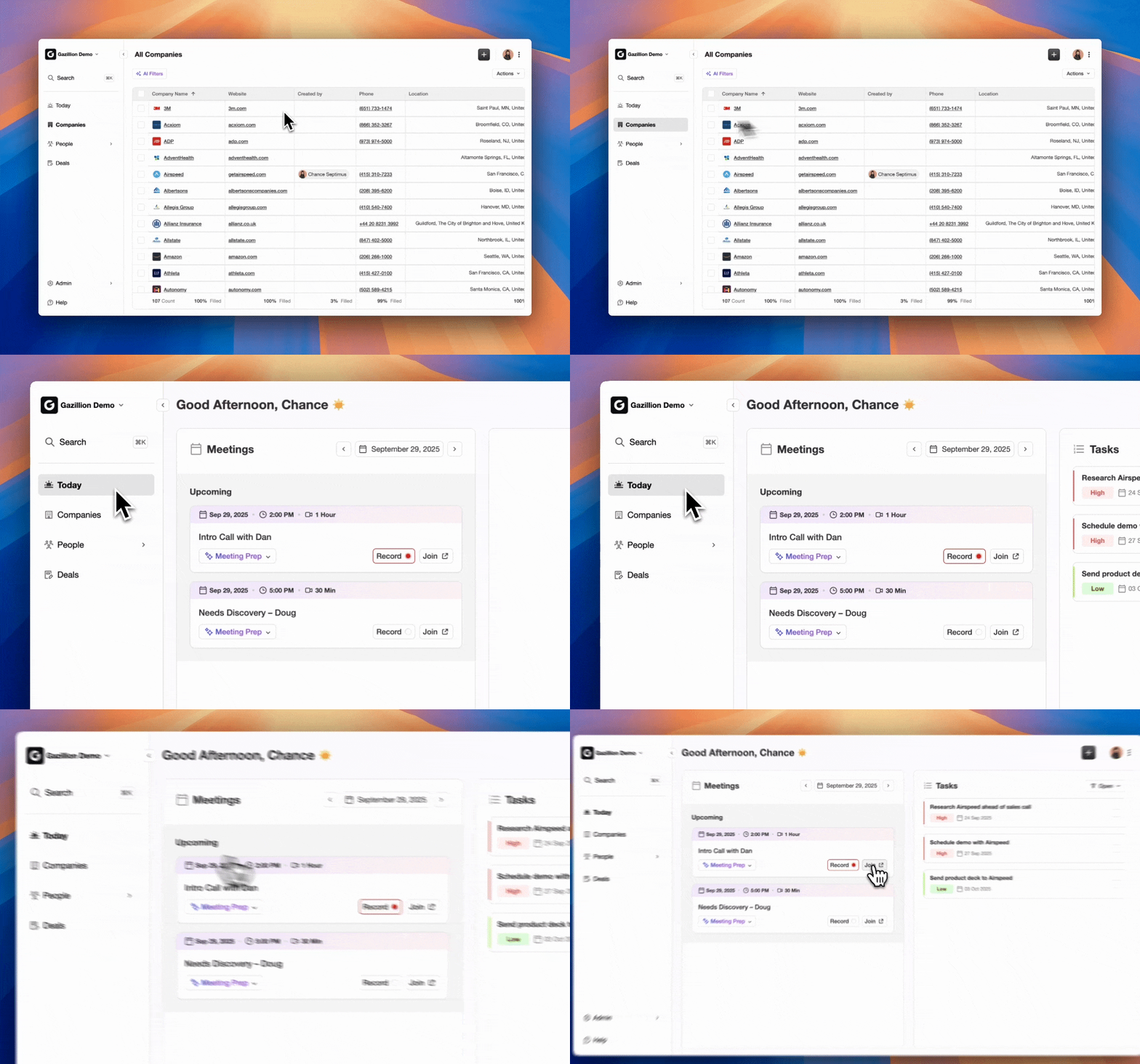
Step 3: Gradual Sync – After validating companion performance, use Zapier integrations to sync data bidirectionally while you train teams on agent workflows. This gradual sync avoids the productivity dip that often follows abrupt system changes.
Step 4: Agent Training – As teams grow comfortable with new workflows, configure AI agents with company-specific context, sales methodologies, and workflow preferences. This tuning step unlocks deeper automation and better recommendations.
Common pitfalls include vendor lock-in concerns and resistance to change. Coffee’s companion approach addresses both by allowing gradual adoption while you keep existing investments in place. One company generating tens of millions in revenue successfully replaced Salesforce and spreadsheets using Coffee’s automated data entry and Pipeline Compare features.
How to Choose the Right AI-Native CRM
Platform selection depends on team size, existing tech stack, and budget. By 2026, SMBs and mid-market firms will shift from monolithic suites to AI-native platforms, subscribing to unbundled AI-powered micro-functions. Teams with fewer than 20 employees often benefit from standalone solutions like Coffee or Lightfield, while established Salesforce or HubSpot users should consider companion approaches such as Coffee or Aurasell.
Get started with Coffee to compare standalone and companion options that match your current infrastructure.
Frequently Asked Questions
Which AI-native CRM works best for existing Salesforce users?
Coffee’s companion mode provides a smooth transition path for Salesforce users. The agent operates as an intelligent layer that automates data entry, enrichment, and insights while preserving your existing Salesforce investment. This approach removes the need for costly rip-and-replace migrations and delivers immediate productivity gains through automated workflows.
How secure are AI-native CRM platforms with sensitive sales data?
Leading AI-native CRMs follow enterprise-grade security standards, including SOC 2 Type 2 and GDPR compliance. Coffee processes data within secure AWS environments and does not use customer information to train public models. These platforms rely on encryption in transit and at rest, role-based access controls, and regular security audits to protect sensitive sales information.
Do AI agents really outperform human data entry accuracy?
AI agents typically outperform manual data entry because they remove common human errors and capture every interaction. Humans forget to log calls or mistype contact information, while agents automatically process emails, calendar events, and call transcripts to maintain accurate, current records. The “good data in, good data out” principle then produces higher-quality insights and forecasting.
What CRM trends should teams expect in 2026?
The agent inflection point will accelerate in 2026 as passive databases evolve into active workflow engines. Teams will move from manually combing through CRMs to relying on agents that surface patterns and summaries automatically. The focus will shift from human-friendly interfaces toward machine-readable systems tuned for agent processing and coordination across business functions.
How do you calculate ROI for AI-native CRM migration?
ROI calculation centers on time savings and productivity gains. Coffee users often save 8–12 hours per week on administrative tasks, which translates into roughly 20–30% more time for selling activities. Additional gains include improved forecast accuracy, faster deal cycles through automated follow-ups, and reduced reliance on multiple point solutions. Most organizations reach positive ROI within three to six months through higher sales velocity and lower operational overhead.
Conclusion: Where CRM Is Heading Next
The 2026 CRM landscape favors AI-native platforms that automate the manual grind built into legacy systems. Coffee leads this transformation with the dual-model approach described earlier, where agents handle busywork, and humans focus on strategic selling. The agent-led architecture ensures high-quality data flows in and actionable insights flow out, which unlocks the weekly time savings that change sales productivity.
Get started with Coffee to experience a CRM where agents do the heavy lifting and your team spends more time closing deals.