Written by: Doug Camplejohn, CEO & Co-Founder, Coffee | Last updated: July 26, 2026
Key Takeaways for Affinity Alternatives in 2026
Affinity’s high per-user pricing and API limits push many small and mid-size funds toward alternatives in 2026.
Reddit users consistently point to 4Degrees as the closest Affinity substitute for mid-market PE and VC teams.
Attio attracts technical teams that want API-first flexibility, while HubSpot and Salesforce mainly fit when a team already uses those ecosystems.
Manual data entry remains the top CRM complaint across platforms, cutting adoption by 60% and damaging data quality.
Teams can get started with Coffee to remove manual entry and streamline relationship intelligence without adding engineering work.
Why Teams Are Leaving Affinity in 2026
Price, API friction, and team-size mismatch drive most Affinity churn in 2026 Reddit threads. Affinity pricing starts near $2,000 per user per year (~$167 per user per month) with seat minimums and is quote-only. For a 10-person fund, real quotes and medians place Affinity at $50,000–$80,000+ annually, far above the simple per-user tier estimate of roughly $20k–$23k.
Side-by-Side Comparison: Reddit Pain Points and Pros/Cons
The table below pairs each platform’s most common Reddit complaints with its strengths and weaknesses, highlighting where pricing, API quality, and implementation effort create the sharpest trade-offs.
Platform
Reddit Pain Points
Pros
Cons
Affinity
“$2k+ per user is insane for a 6-person fund”, “API is basically read-only for anything useful”, “overkill unless you’re a mega-fund”
Best-in-class relationship intelligence, deep email/calendar capture, PitchBook and Crunchbase enrichment built in
pricing starts near $2,000 per user per year (~$167 per user per month) with seat minimums and is quote-only, API limitations frustrate technical teams, implementation overhead for small funds
Attio
“Customization is great but you’re basically building your own CRM”, “data model flexibility is a double-edged sword”, “migration out is painful”
“If you’re picking a CRM in 2026 because of how it looks, you’re picking the wrong thing. The interface is the smallest part of what a CRM does once you start automating around it.” — Gabe Upton, Founder & Principal Engineer, Catalyst Consulting
Attio fits teams that treat the CRM as a data platform and have engineering capacity to build around it. VC and PE teams that want relationship intelligence without a technical build often see the configuration burden as a blocker.
“The relationship intelligence capabilities transformed our sourcing approach from reactive to predictive. We’re identifying opportunities 60–90 days earlier than competitors through systematic relationship monitoring and automated warm introduction pathways.” — CTO, $2.1B AUM mid-market PE firm
HubSpot and Salesforce show up in Affinity alternative threads when teams already rely on those stacks or need automation depth that VC-specific tools lack. HubSpot CRM starts at $0 for the free plan or $20/user/month for the Starter plan, which makes it attractive for basic pipeline tracking without relationship intelligence.
Threads from r/venturecapital, r/SaaS, and r/CRMSoftware through mid-2026 reveal a stable pattern across three platform categories.
On Affinity: Reddit users view Affinity as the strongest relationship intelligence tool but priced for large funds. Teams under 15 users often feel the cost-to-value ratio breaks. API limits appear as a growing concern as automation usage expands.
On Attio: Users praise API quality and flexibility and criticize the configuration effort. Technical teams that want a custom data model recommend it. Teams that want a working VC CRM on day one usually do not.
On 4Degrees: Commenters most often recommend 4Degrees as a direct Affinity alternative for mid-market PE and VC. They rate relationship intelligence as comparable for most scenarios at a lower price.
On HubSpot and Salesforce: Reddit users recommend these platforms when existing stack integration or deep automation needs make them the logical choice. They rarely appear as first-choice Affinity replacements for relationship-driven VC or PE teams.
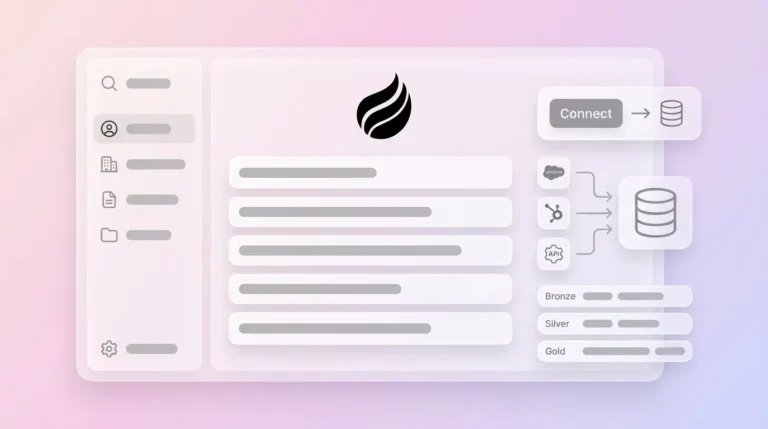
Agent manages data entry on top of the current instance without migration work
Practical Checklist: Validate CRM Options Against Constraints
After you identify your team profile and budget from the framework above, use this checklist to confirm whether a candidate platform fits your real-world constraints.
Data quality: Confirm the platform captures email and calendar passively. As noted earlier, platforms that rely on manual input see adoption collapse, so passive capture is non-negotiable for relationship-driven teams and shapes every other decision.
Implementation effort: Even strong platforms fail when implementation drags. Many CRM projects exceed their original budget, so request a fixed-scope implementation quote before signing to avoid overruns that stall momentum.
Workflow fit: Once you understand capture quality and implementation scope, map your actual deal workflow before you review features. Tools with more features than your process needs create adoption drag that undermines data quality.
How long does it take to implement a new CRM when switching from Affinity?
Implementation timelines in 2026 depend on team size and data complexity. Small teams often complete migrations in a few weeks. Mid-market teams with custom objects and multiple pipelines should plan for three to five months.
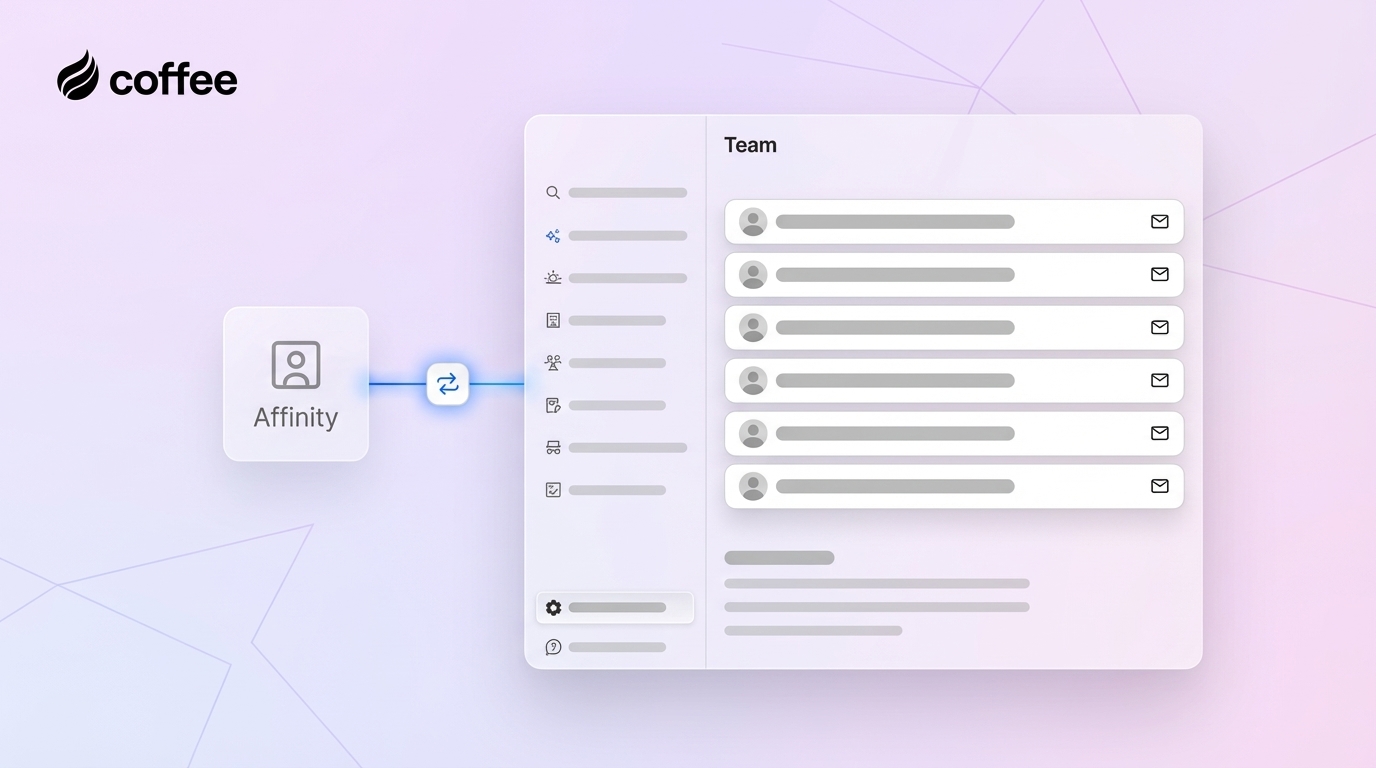
Field mapping, workflow rebuilds, and integration wiring consume most of that time, not raw data transfer. Teams that move to an agent-based platform like Coffee reduce implementation effort because the agent handles ongoing data capture from day one and removes the need to rebuild manual logging workflows.
Create instant meeting follow-up emails with the Coffee AI CRM agent
What are the real costs of migrating CRM data from Affinity?
Visible costs such as licenses and consultant fees usually represent only 40–60% of total migration spend. Hidden costs include pre-migration data cleanup, automation rebuild work, user training, and productivity loss during parallel runs.
Teams should budget roughly two weeks and 20–30% of total effort for data cleanup alone. Project complexity drives the rest, with simple migrations costing far less than enterprise moves that include ERP integration. Because 20–40% of legacy CRM data is typically obsolete, auditing data before migration cuts cost and reduces the risk of carrying bad records forward.
What integration considerations matter most when evaluating Affinity alternatives?
Four criteria define integration quality: API completeness, webhook reliability, rate limits, and schema flexibility. API completeness means every UI action is available via API. Webhook reliability covers granular, replayable events. Rate limits determine whether the system can handle required volume without hitting walls. Schema flexibility controls how well the CRM models your process.
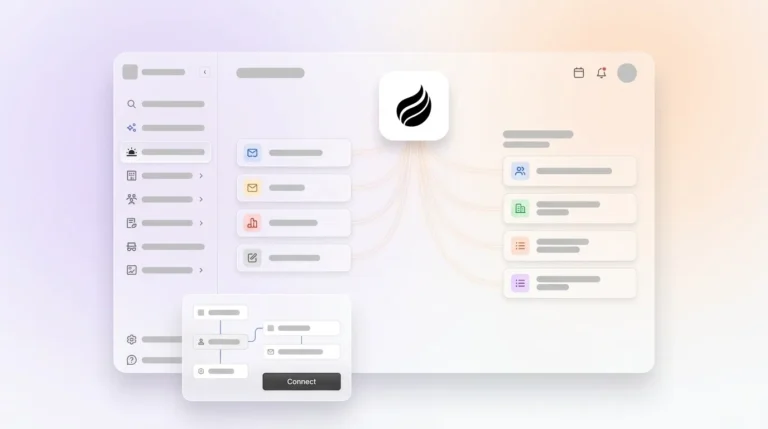
Attio scores highest on API-first design among the alternatives. HubSpot offers the broadest API surface but shows inconsistent rate limits across tiers. Salesforce supports deep integrations but demands significant engineering investment to maintain. Teams that want integrations without engineering overhead can use an agent-based approach that handles data capture natively and connects to existing Salesforce or HubSpot instances.
How does data quality differ across Affinity alternatives?
Data quality tracks how much a platform relies on human input instead of automated capture. Affinity’s relationship intelligence depends on consistent email, calendar, and contact sync across the team, so one disconnected inbox creates gaps in the graph. 4Degrees follows a similar passive capture model.
Attio needs more configuration to reach comparable capture coverage. HubSpot and Salesforce lean heavily on rep input, which contributes to the finding that 76% of CRM users say less than half of their organization’s CRM data is accurate and complete. Agent-based platforms like Coffee address this at the architecture level by treating automated capture as the default. The agent ingests emails, calendars, and call transcripts without requiring rep action.
Build people lists automatically with Coffee AI CRM Agent
Is Coffee secure enough for VC and PE firms handling sensitive deal data?
Coffee is SOC 2 Type 2 and GDPR compliant, and it does not use customer data to train public models. For VC and PE firms, the key security questions involve data residency, access controls, and procurement review outcomes.
Coffee’s compliance posture covers baseline requirements for most relationship-driven teams in the 5–25 user range. Heavily regulated institutions or firms with multi-year security review processes should review Coffee’s detailed compliance documentation before they commit.
Conclusion: Turning Reddit Insights into a CRM Decision
The 2026 Reddit view on Affinity alternatives centers on pricing and API limits as primary switch triggers. The right replacement depends on team size, budget, and the level of relationship intelligence required. 4Degrees functions as the closest direct substitute for mid-market PE and VC. Attio serves technical teams that want API-first flexibility. HubSpot and Salesforce work when existing stack commitments or deep automation needs justify them.
The manual entry problem identified across every platform carries a measurable cost: up to $15 million per year in poor data quality. Coffee’s agent-based approach removes that dependency entirely. The Coffee Agent captures contacts, logs interactions, enriches records, and prepares meeting briefings automatically, whether you use Coffee as a standalone CRM or as a companion layer on top of Salesforce or HubSpot.