Key Takeaways for ABM in B2B
- ABM for B2B uses three approaches: Strategic (1:1) for whale accounts, Lite (1:few) for segments, and Programmatic (1:many) for scale, each with specific investments and ROI timelines.
- AI agents like Coffee automate data hygiene, visitor identification, and workflow orchestration, so sales reps reclaim time from manual data entry and focus on selling.
- The 8-step framework covers ICP definition, account tiering, team alignment, pixel deployment, auto-enrichment, multi-channel plays, AI monitoring, and account-level measurement.
- A complete ABM tech stack includes CRM, enrichment, visitor ID, automation, and orchestration, and Coffee unifies these as a standalone platform or companion AI agent.
- Implement ABM with Coffee today, and supercharge your B2B wins with automated, precise account targeting.
Executive Overview: Matching ABM Types to Your B2B Motion
Account based marketing for B2B runs through three main approaches, each aligned to different scales and resource levels. Strategic ABM (1-to-1) targets 5-25 whale accounts with dedicated teams and budgets of $50,000-$250,000 per account annually. ABM Lite (1-to-few) focuses on clusters of similar accounts with segment-level personalization. Programmatic ABM (1-to-many) uses automation to reach hundreds of accounts with personalized messaging at scale.
The table below shows how account volume, investment, and ideal use case differ across these three ABM types, so you can match your budget and sales motion to the right tier.
| ABM Type | Account Volume | Investment Per Account | Best For |
|---|---|---|---|
| Strategic (1:1) | 5-25 accounts | $50K-$250K annually | Enterprise deals $500K+ |
| ABM Lite (1:few) | 50-200 accounts | $5K-$15K annually | Mid-market segments |
| Programmatic (1:many) | 500+ accounts | $500-$2K annually | Scale with automation |
The core ABM framework centers on five pillars: ideal customer profile (ICP) definition, sales-marketing alignment, technology integration, multi-channel execution, and account-level measurement. When these pillars work together, companies with strong sales-marketing alignment through ABM often deliver higher win rates compared to traditional approaches. Access Coffee’s ABM templates with pre-built workflows for each tier to put this framework into practice quickly.
Before you move into execution details, you need a clear view of how the ABM landscape has evolved and why older tools now hold teams back.
Market Context: ABM Evolution to AI-Powered Precision in 2026
The shift from spray-and-pray marketing to account-based precision has accelerated dramatically. 72% of B2B companies now use some form of ABM strategy, up from previous adoption rates. At the same time, legacy CRM systems still create significant friction in ABM execution.
Traditional CRMs like Salesforce and HubSpot act as passive databases that demand constant manual maintenance. Sales teams bounce between multiple tools, such as CRM for records, ZoomInfo for data, SalesLoft for outreach, and Fathom for recording. This fragmented setup creates data silos and drags down productivity. B2B marketing professionals frequently discuss the pain of manual data enrichment and complex integrations.
The 2026 evolution centers on AI agents that actively manage data quality and workflow orchestration. Instead of only storing information, intelligent agents like Coffee automatically capture, enrich, and unify customer data across touchpoints. This agent-led approach removes the manual busywork that has historically undermined ABM effectiveness. The contrast becomes clear when you compare how legacy CRMs and AI agents handle core ABM workflows.
| Approach | Data Management | Integration | Efficiency |
|---|---|---|---|
| Legacy CRM | Manual entry required | Point-to-point connections | 35% time selling |
| AI Agent-Powered | Automated enrichment | Unified orchestration | 65%+ time selling |
With this market context in place, you can now look at how ABM actually runs day to day inside a B2B organization.
How Account Based Marketing Runs Day to Day in B2B
Account based marketing for B2B follows a systematic workflow that aligns sales and marketing around high-value targets. Teams start with ICP selection using firmographic, technographic, and behavioral criteria. They then build personalized outreach campaigns tailored to each account’s pain points and buying committee structure.
The operational data flow begins with visitor identification pixels that capture anonymous website traffic. This data flows into enrichment systems that append contact information, job titles, and company details. Modern ABM platforms then unify this structured data with unstructured information from emails, call transcripts, and meeting notes to create complete account profiles.

Tracking and nurturing span multiple touchpoints, including email sequences, social media engagement, content consumption, and direct sales outreach. The key differentiator is account-level orchestration instead of isolated lead management. All activities focus on moving the entire buying committee through defined stages, and this shift changes how you track progress and allocate effort.
Once you understand the operational flow, you can make informed decisions about which ABM strategy fits your goals and constraints.
Strategic Trade-offs When Choosing Your B2B ABM Model
Selecting the right ABM approach means balancing depth and scale based on your resources and target market. Strategic 1-to-1 ABM delivers maximum personalization but requires significant investment per account. Programmatic 1-to-many ABM supports broader reach with lighter customization for each account.
Critical factors include data quality requirements, team alignment maturity, and technology integration complexity. These foundational elements directly affect your ability to execute, so organizations with fragmented data or weak sales-marketing coordination should fix these issues before rolling out advanced ABM tactics. The investment required reflects this complexity, with cost per account ranging from about $500 annually for programmatic approaches to $250,000 for strategic enterprise programs.
The table below summarizes how personalization, resources, and time to value differ across the three ABM models, helping you weigh the trade-offs.
| Factor | 1:1 Strategic | 1:Few Lite | 1:Many Programmatic |
|---|---|---|---|
| Personalization Depth | Maximum custom content | Segment-level messaging | Dynamic personalization |
| Resource Requirements | Dedicated team per account | Shared resources | Automated workflows |
| Time to Value | 6-12 months | 3-6 months | 1-3 months |
After you choose your ABM model, the next step is selecting the technology that will power and automate your strategy.
ABM Tech Stack with AI Agents: Coffee vs Other Platforms
The essential ABM tech stack includes five core components: CRM system of record, data enrichment platform, visitor identification tools, marketing automation, and an orchestration layer. Coffee stands out as the primary AI agent that unifies these functions while working as either a standalone CRM or a companion app to existing Salesforce and HubSpot instances.
Coffee’s agent automatically handles data entry by scanning emails and calendars to create contacts and companies. The Intelligence layer introduced in February 2026 lets users define deep context on business model, product specifics, ICP, and competitors for tailored AI suggestions. The visitor identification feature turns anonymous website traffic into named prospects with suggested leads that match your buyer persona.

This individual-level precision sets Coffee apart, because many competitors only show company-level data. Coffee identifies specific people and surfaces their LinkedIn profiles for immediate outreach. The Stripe integration launched in January 2026 automatically imports customers and companies, enriches them, and adds paid invoices to deals as Closed Won. This setup removes manual data transfer between systems.
The table below compares Coffee and three other ABM platforms across automation depth, CRM integration, and visitor identification, so you can see where each solution fits.
| Platform | Automation Depth | CRM Integration | Visitor ID |
|---|---|---|---|
| Coffee | Full workflow automation | Native + Companion | Named individuals + suggestions |
| Demandbase | Campaign orchestration | API connections | Company-level only |
| RB2B | Basic identification | Webhook integration | Company + raw lists |
| Warmly | Chat automation | Third-party sync | Company + basic people |
8 Steps to Launch Account Based Marketing for B2B
Successful account based marketing for B2B depends on disciplined execution across eight clear phases. This framework builds a solid foundation first, then scales advanced tactics with automation.
1. Define ICP Using Coffee List Builder: Use natural language commands like “Find VPs of Sales in North America at $10M+ funding companies using Salesforce” to build targeted prospect lists with integrated enrichment.

2. Tier Target Accounts: Segment accounts into strategic (1:1), lite (1:few), and programmatic (1:many) tiers based on revenue potential, strategic value, and resource requirements.

3. Align Teams via Coffee Views: Create shared account dashboards that give sales and marketing unified visibility into engagement history, pipeline status, and next actions.
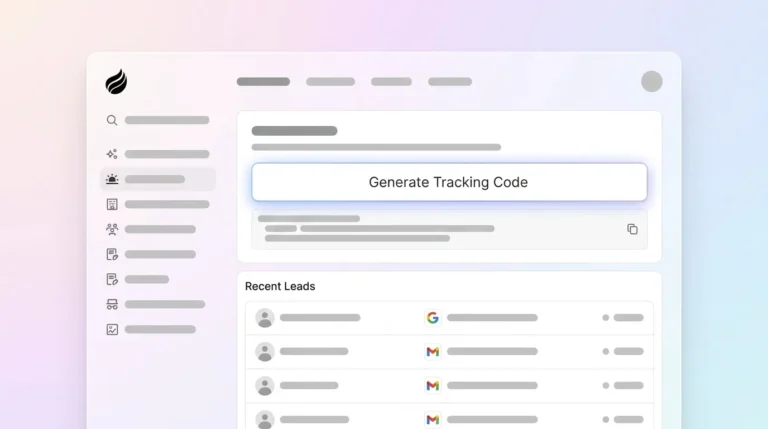
4. Deploy Visitor Identification Pixel: Install Coffee’s tracking script to capture anonymous website visitors and convert them into named prospects with enriched profiles.
5. Auto-Enrich and Log Activities: Let Coffee’s agent automatically create contacts, append job titles and LinkedIn profiles, and log all email and calendar interactions without manual entry.
6. Orchestrate Multi-Channel Plays: Trigger coordinated campaigns across email, social media, and direct outreach based on account behavior and engagement signals.
7. Monitor with AI Pipeline Compare: Use Coffee’s AI search on deals to answer natural-language prompts like “Which deals are stuck in negotiation?” or “What is closing this month?”
8. Measure Account-Level Metrics: Track pipeline velocity, win rates, and deal sizes at the account level instead of individual lead metrics to improve ABM performance.
Implement this framework with Coffee using pre-built workflows that automate each step while maintaining data quality.
ABM Metrics, Real-World Examples, and Common Pitfalls
Measuring ABM success requires account-centric KPIs that reflect the collaborative nature of B2B buying committees. ABM-led programs can achieve higher win rates compared to broad-reach demand generation when teams execute them with discipline.
The table below outlines how ABM typically outperforms traditional approaches across four core sales metrics, using qualitative benchmarks to show the relative lift.
| Metric | ABM Benchmark | Traditional Benchmark | Improvement |
|---|---|---|---|
| Win Rate | Higher | Lower | Often improved |
| Sales Cycle | Shorter | Longer | Faster |
| Deal Size | Larger | Smaller | Larger on average |
| Pipeline ROI | Higher | Lower | Significantly higher |
A technology company generating tens of millions in revenue previously managed sales through spreadsheets before adopting Coffee’s AI agent. The team achieved about 40% faster sales cycles, which reflects the “shorter” and “faster” improvements shown in the table, by automating contact creation from Google Workspace and using Pipeline Compare features for weekly reviews. The agent removed manual data entry and delivered accurate forecasting through automated activity logging.

Common ABM pitfalls include poor data quality, misaligned teams, and weak technology integration. Coffee addresses the data quality challenge through automatic enrichment and unification of structured and unstructured information. Organizations that skip baseline metrics or attempt to scale too quickly often see weaker returns on ABM investments.
ABM Readiness Checklist and Practical Implementation Guide
Before you launch account based marketing for B2B initiatives, evaluate your organization’s readiness across four critical dimensions. Team maturity depends on dedicated resources and clear role definitions between sales and marketing. Technology infrastructure must support data integration and workflow automation. Data quality standards protect targeting accuracy and reporting. Leadership commitment secures budget and strategic alignment.
ABM Readiness Checklist:
- Dedicated ABM team with defined roles and responsibilities
- CRM system with clean, standardized data fields
- Sales-marketing SLA defining lead handoff and follow-up processes
- Technology stack supporting bidirectional data sync
- Budget allocation for tools, content, and campaign execution
- Executive sponsorship and success metrics agreement
Conclusion: Turn Your ABM B2B Playbook into Revenue
Account based marketing for B2B turns generic lead generation into precise targeting that delivers measurable results. The 2026 playbook centers on AI agent automation that removes manual busywork while preserving data quality. The results speak for themselves, because the higher win rates, faster sales cycles, and larger deal sizes mentioned throughout this guide show ABM’s impact when executed systematically.
Success depends on the right technology foundation, strong team alignment, and consistent execution. Coffee’s AI agent supplies the automation layer that makes ABM scalable without losing personalization. Transform your B2B sales process with Coffee and implement intelligent account-based marketing that actually works.
Frequently Asked Questions
What is the best ABM tool for B2B companies in 2026?
Coffee stands out as a leading AI agent for ABM because it works as both a standalone CRM and a companion app to existing Salesforce or HubSpot instances. Instead of acting as a passive database, Coffee actively manages data quality through automatic contact creation, enrichment, and activity logging. The platform includes visitor identification that turns anonymous website traffic into named prospects with suggested leads that match your buyer persona. Coffee’s agent removes the manual data entry that often consumes a large share of sales reps’ time, so teams can focus on strategic selling activities.
How does Coffee integrate with existing CRM systems?
Coffee offers flexible integration options based on your current setup. As a companion app, Coffee syncs bidirectionally with Salesforce and HubSpot through native authentication, automatically enriching existing records and writing insights back to your primary CRM. The agent manages data unification across email, calendar, and call transcripts without disrupting established workflows. For teams that want a modern alternative, Coffee operates as a standalone AI-first CRM with built-in data warehouse capabilities that preserve historical context. Both approaches are SOC 2 Type 2 compliant and support GDPR requirements for data security.
What are the pricing models for ABM platforms?
Coffee uses transparent seat-based pricing where you pay for human users while the AI agent’s unlimited labor is included. This structure avoids complex metering on LLM usage or process automation that other platforms often charge for. The pricing model scales with your team size instead of penalizing you for higher automation efficiency. Many ABM platforms charge separately for data enrichment, visitor identification, and workflow automation, but Coffee bundles these capabilities into a single agent that handles multiple functions at once.
How quickly can B2B companies see ROI from ABM implementation?
ABM ROI timelines vary by program type and execution quality. Programmatic ABM using Coffee’s automation can show early results within 1-3 months through better lead quality and faster qualification. Mid-market ABM lite programs typically reach positive ROI within 3-6 months as sales and marketing alignment improves. Strategic 1-to-1 ABM usually needs 6-12 months for full value realization because enterprise sales cycles run longer. Data quality acts as the main accelerator, and Coffee’s automatic enrichment and activity logging remove the 3-6 month ramp often required for manual data cleanup and adoption.
What metrics should B2B teams track for ABM success?
Teams should focus on account-level metrics instead of simple lead volume indicators. Pipeline velocity measures how quickly target accounts move through sales stages. Win rate comparison between ABM and non-ABM accounts reveals program effectiveness. Average deal size growth shows improved targeting and value proposition alignment. Account engagement depth tracks buying committee coverage and multi-touch interactions. Sales-marketing alignment scores reflect the quality of team coordination. Coffee’s Pipeline Compare feature automatically tracks these metrics by visualizing week-over-week changes in deal progression, which removes manual spreadsheet reporting and provides clear insights for pipeline reviews.