Written by: Doug Camplejohn, CEO & Co-Founder, Coffee
Key Takeaways for MEDDIC Automation with Coffee
- Manual MEDDIC data entry wastes 71% of sales reps’ time, while AI automation captures qualification data from calls, emails, and meetings so teams can focus on selling.
- Mapping MEDDIC elements to custom CRM fields with stage gates enforces Metrics, Pain, and Economic Buyer identification before deals move forward.
- AI agents like Coffee auto-populate Salesforce and HubSpot fields, build role-tailored dashboards, and support predictive forecasting from unified data.
- MEDDIC fits deals under $25K with cycles under 60 days, while MEDDPICC suits complex enterprise sales with procurement and competition factors.
- Using Coffee’s AI agent for MEDDIC automation helps teams reach 90%+ field completion and save 8-12 hours per week per rep.
Executive Overview: How MEDDIC Strengthens Revenue Operations
MEDDIC stands for Metrics (measurable business impact), Economic Buyer (budget authority), Decision Criteria (evaluation factors), Decision Process (approval sequence), Identify Pain (business problems), and Champion (internal advocate). This qualification framework creates a shared language for RevOps data hygiene and pipeline accuracy in complex B2B sales.
Successful MEDDIC CRM integration operates across three core dimensions. Fields and stages define the structure through custom properties and validation rules. Automation and agents then fill those fields with AI-powered data capture. Reporting and reviews finally turn that structured data into pipeline intelligence and forecasting. See Coffee in action with a free agent demo to watch these three dimensions work together.
Why MEDDIC Automation Matters in Today’s CRM Landscape
Traditional MEDDIC implementations rely on manual spreadsheets and suffer from low adoption rates. Legacy CRMs like Salesforce and HubSpot behave like passive databases that demand constant human maintenance, which fragments data across multiple tools.
Recent advances in AI agents now change this dynamic by automating the data capture that previously required manual effort. Tools like Rattle and Clari offer basic automation, while Coffee differentiates through proactive data unification that captures MEDDIC elements from emails, calls, and meetings. This agent-led approach turns unstructured conversation data into structured qualification records, which especially helps SMB and mid-market teams without dedicated data entry resources.
Coffee’s Intelligence layer, introduced in February 2026, allows users to define and store deep context on business model, product specifics, ICP, and competitors for tailored AI suggestions and insights. This context enables more sophisticated MEDDIC qualification than passive CRM tools can provide.
How MEDDIC CRM Integration Runs Day to Day
Effective MEDDIC CRM integration follows a workflow that moves from raw data to actionable insight. It starts with data ingestion, where the system auto-logs Metrics and Pain from conversations. That raw data then flows into intelligent mapping, which enriches Champion details and identifies Economic Buyers. Once mapped, stage gate enforcement applies validation rules that protect data quality before deals advance. Finally, this validated data powers intelligence outputs such as forecasting and pipeline reviews.
Coffee automates this entire workflow by joining sales calls, transcribing conversations, and creating contacts and activities with MEDDIC qualification data. The agent drafts follow-up emails, structures notes according to BANT, MEDDIC, or SPICED methodologies, and writes back to Salesforce or HubSpot without manual effort from reps.

Coffee’s AI search on deals, released in January 2026, answers natural-language questions such as “Which deals are stuck in negotiation?” or “What’s closing this month?”. This capability turns pipeline reviews from manual data gathering into focused conversations about deal progression and risk.
1. Map MEDDIC to Custom CRM Fields
Map MEDDIC framework elements to specific CRM fields and picklists, including a dropdown for “qualification framework used,” Yes/No or dropdown fields for each element such as “Economic Buyer identified?,” and short text boxes for notes on metrics, pain, and challenges.
Coffee populates these fields by analyzing conversation transcripts and email exchanges. Create dropdown options like “Metrics: Defined / Rough / Not defined” and “Economic Buyer: Met / Identified / Not identified” to standardize entries and support consistent reporting across the sales organization.
2. Enforce MEDDIC Stage Gates
Define required MEDDIC elements at each CRM stage, such as Metrics, Pain, and a named Economic Buyer for stage 2 opportunities, and train reps to update them as part of call or meeting workflows.
Block weak deals from advancing by requiring Pain identification and Champion confirmation before proposal stages. By stopping unqualified deals early, you prevent pipeline pollution, which inflates forecasts without real closing potential. This qualification discipline throughout the sales process then improves forecast accuracy.
3. Automate Data Capture with AI Agents
Coffee joins Zoom, Teams, and Google Meet calls to record, transcribe, and extract MEDDIC elements from conversations. The agent flags moments when prospects mention budget constraints as Economic Buyer signals, quantify business impact as Metrics, or describe internal advocates as Champion indicators.
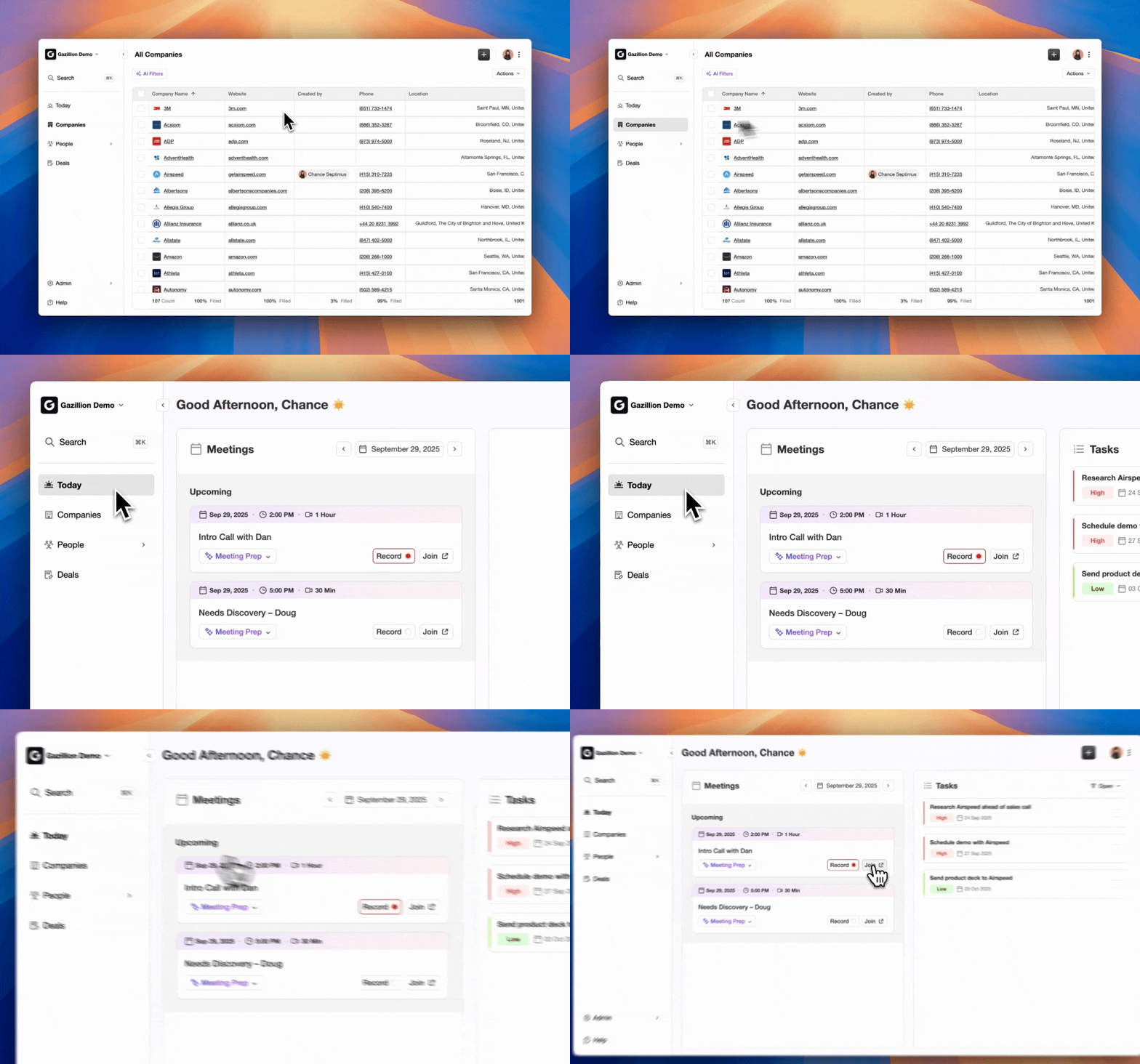
Coffee’s improved summary templates, released in November 2025, are customizable to match workflows and writable back to Coffee, HubSpot, or Salesforce. These summaries remove manual note-taking and keep MEDDIC data consistent across every customer interaction.
4. Build Role-Tailored MEDDIC Dashboards
Role-specific dashboards keep each team focused on the MEDDIC data that matters most to their work. SDRs see Pain and Metrics completion rates, AEs view full MEDDIC scorecards, and managers track pipeline health metrics.
Coffee’s Pipeline Compare feature visualizes week-over-week changes in MEDDIC qualification status. This view highlights deals that progressed, stalled, or regressed so leaders can quickly spot where to intervene.
5. Implement Visual DMU and Champion Mapping
Visual decision-making unit (DMU) maps clarify who influences a deal and where champions sit inside the account. Use LinkedIn enrichment and organizational charts to surface potential champions within target companies.
Coffee enriches contact records with job titles, reporting structures, and influence indicators that support champion development strategies. Mapping relationships between champions and economic buyers then reveals internal influence patterns and guides your approach to complex buying committees.
6. Enable AI-Powered Deal Reviews
AI-powered deal reviews shift conversations from data inspection to strategy. Coffee’s Pipeline Compare feature tracks MEDDIC element changes over time so managers no longer need to interrogate reps about CRM updates.
The agent flags deals with incomplete MEDDIC profiles, recent champion changes, or stalled progression. Managers can then coach on specific qualification gaps and next steps before deals slip.
7. Automate List Building for MEDDIC Prospects
Automated list building ensures outbound efforts start with the right targets. Use natural language queries to build prospect lists based on MEDDIC criteria.

Coffee supports commands like “Find me VPs of Sales in North America at companies with $10M+ funding using Salesforce” to identify prospects who match your ideal Economic Buyer profile. This automation removes manual list work and keeps outreach focused on contacts with authority and budget.

8. Match MEDDIC or MEDDPICC to Deal Complexity
Use MEDDIC for sales deals with ACV under $25K, sales cycles under 60 days, and no procurement team, while MEDDPICC fits deals with ACV over $50K, cycles over 90 days, and legal or procurement involvement.
For complex enterprise deals, extend MEDDIC with Paper Process and Competition fields. MEDDPICC includes eight elements compared to MEDDIC’s six, which makes it a heavier framework. Select the lightest framework that still matches your deal complexity so reps can maintain adoption.
9. Turn MEDDIC Data into Predictive Insights
High-quality MEDDIC data improves forecast accuracy by cleaning the underlying CRM dataset. Reliable data then supports predictive models that identify at-risk deals, ideal close timing, and smart resource allocation.
Coffee’s data warehouse architecture preserves historical MEDDIC progression. This history enables machine learning models that predict deal outcomes based on qualification patterns and progression speed.
10. Use Templates for Reviews and Qualification
Standardized templates keep MEDDIC qualification consistent across teams. Use downloadable templates for stage-gate reviews, champion development, and economic buyer engagement.
Coffee generates qualification summaries from these templates, which cuts preparation time for pipeline reviews and ensures every MEDDIC element receives coverage.
11. Tailor MEDDIC to Salesforce and HubSpot
Create custom properties in HubSpot CRM for MEDDPICC elements such as “Economic Buyer Name,” “Identified Pain,” and “Paper Process Status” and make key MEDDPICC fields mandatory in HubSpot CRM before deals can advance to late-stage pipeline stages.
Coffee syncs natively with both Salesforce and HubSpot, writing MEDDIC qualification data to custom fields and properties. This sync avoids complex integration projects and reduces ongoing maintenance.
12. Track ROI and Adoption for MEDDIC Automation
Clear metrics prove whether MEDDIC CRM integration works. Track MEDDIC field completion rates, forecast accuracy, and pipeline velocity to measure impact.
The time savings mentioned earlier, 8-12 hours per week per rep, combine with 90%+ field completion rates to show strong ROI from autonomous logging. Monitor these gains alongside win rates to build the business case for continued investment.
Strategic Trade-offs in MEDDIC Automation
MEDDIC CRM integration requires a balance between automation depth and user adoption. Coffee’s agent-based approach removes the usual trade-off between data quality and rep productivity by taking over qualification busywork.
Evaluate integration complexity, adoption barriers, and cost structure when choosing your MEDDIC automation approach. Coffee uses simple authentication instead of custom development, achieves near-total adoption through an agent that works in the background, and offers seat-based pricing instead of per-process fees.
Common MEDDIC Pitfalls and How Coffee Avoids Them
Reddit’s r/sales community consensus is that most sales teams abandon qualification frameworks like MEDDIC or MEDDPICC within 90 days because they feel like busywork. Teams can avoid this outcome by automating data capture instead of layering on manual requirements.
Coffee addresses the abandonment problem by making MEDDIC qualification invisible to reps while still capturing complete data. The agent applies the framework automatically, which removes the sense of extra administrative work.
Conclusion: Turning MEDDIC into a Competitive Edge
These 12 practices turn MEDDIC from a manual qualification burden into an automated competitive advantage. AI agents like Coffee remove the old trade-off between data quality and sales productivity by handling qualification tasks autonomously.
Try Coffee to roll out these MEDDIC CRM integration practices and capture the forecast accuracy, pipeline velocity, and close rate improvements that drive revenue growth.
Frequently Asked Questions
What’s the difference between MEDDIC and MEDDPICC for CRM implementation?
MEDDIC suits simpler deals, while MEDDPICC adds Paper Process and Competition elements for complex enterprise sales. As outlined in the framework selection section, MEDDPICC’s additional elements address legal reviews, security assessments, and competitive evaluations that appear in larger deals. The framework you choose then defines your CRM field requirements and stage gate complexity.
How does Coffee integrate with existing Salesforce and HubSpot instances?
Coffee acts as a Companion App that uses simple authentication to sync with existing Salesforce or HubSpot CRM environments. The agent creates contacts, companies, and activities while writing MEDDIC qualification data to custom fields and properties. No complex integration work or ongoing maintenance is required, because Coffee manages data unification and write-back while preserving current workflows and reporting structures.
What security measures protect MEDDIC data captured by AI agents?
Coffee maintains SOC 2 Type 2 compliance and GDPR adherence for all captured conversation data and CRM synchronization. Call transcripts and qualification data stay encrypted in transit and at rest, with access controls that block unauthorized viewing. Customer data never trains public AI models, which keeps competitive intelligence and deal details confidential inside your security perimeter.
Can I download MEDDIC templates for immediate implementation?
Teams can download standardized templates for stage-gate reviews, champion development conversations, and economic buyer qualification calls as part of effective MEDDIC implementation. These templates support consistent framework use across the sales team and reduce preparation time for pipeline reviews. Coffee then generates qualification summaries from these templates, which removes manual formatting work while keeping MEDDIC coverage complete.
What does Coffee’s MEDDIC automation cost compared to manual processes?
Coffee uses straightforward seat-based pricing where you pay for human users while the agent’s qualification work is included. This model removes complex metering on AI usage or per-process fees. The investment typically pays for itself through the 8-12 hours per week saved on manual data entry, plus better forecast accuracy and higher close rates from consistent MEDDIC application. Most teams see ROI within the first quarter through productivity gains and stronger pipeline quality.