Written by: Doug Camplejohn, CEO & Co-Founder, Coffee
Einstein Scoring Problems and How Coffee Helps
- Einstein Opportunity Scoring uses historical win and loss patterns, engagement, stage velocity, and qualification data to predict deal outcomes.
- Organizations need at least 200 closed-won opportunities in the last 24 months; below that, Salesforce defaults to a generic global model that may not match your ICP or sales motion.
- Poor data quality, fragmented entry, missing activity logs, and unstructured data exclusion usually cause scores to misrepresent real deal health.
- Custom formula or Flow-based scoring can be cheaper but cannot match machine-learning accuracy when data is clean and complete.
- Coffee automates activity logging, call transcription, and qualification data capture so Einstein receives trustworthy inputs. See how Coffee ensures data quality.
How Salesforce Deal Scoring Works Day to Day
Einstein Opportunity Scoring is Salesforce’s machine-learning feature that assigns each open opportunity a score from 1 to 99 that reflects its likelihood of closing. It analyzes historical win and loss patterns alongside real-time engagement, stage velocity, and field completeness to highlight which deals deserve immediate attention. Within Pipeline Inspection, those scores appear next to deal-change indicators, so managers see where rep sentiment diverges from underlying data signals. The output stays only as reliable as the data that feeds it.
How Einstein Opportunity Scoring Builds Its Model
Einstein Opportunity Scoring uses machine learning to analyze historical closed-won and closed-lost opportunities, including opportunity records, history, related activities, accounts, products, quotes, and price books. The model identifies patterns across those records and applies them to open deals, updating scores every few hours as new data enters Salesforce. Salesforce Pipeline Inspection combines those historical snapshots with Einstein AI scoring to help managers spot deals where rep optimism does not match data signals.
Effective opportunity scoring models weigh five categories at the same time: Deal Overview, Engagement, Qualification, Stage Velocity, and Historical Win Patterns. Stage name and close date alone are weak predictors. Engagement activity and qualification depth correlate far more strongly with outcomes. The model also surfaces the top contributing factors, positive and negative, for each score. Reps can then act on specific gaps instead of treating the score as a black box.
Key Einstein Inputs and Structural Limits
Understanding which factors Einstein weighs most heavily explains why scores sometimes diverge from sales intuition. The primary inputs Einstein evaluates include:
- Engagement patterns: meeting cadence, response times, and whether new stakeholders have entered or existing ones have gone silent.
- Qualification depth: completion of frameworks like MEDDPICC or BANT with current, validated information instead of placeholder entries.
- Stage velocity: how quickly a deal progresses compared with historical norms for deals of similar size and segment.
- Historical win patterns: a live deal’s characteristics compared with the profile of past closed-won deals at the same stage.
The model also carries hard structural constraints. Einstein Opportunity Scoring requires at least 200 closed-won opportunities from the last 24 months, each with a lifespan of at least 2 days. Organizations below that threshold fall back to a global model trained on anonymous data from other Salesforce customers. That global model has never seen the organization’s specific ICP, deal size, or sales motion. Einstein Opportunity Scoring can also produce skewed results when an organization’s win rate exceeds 90%, because win-rate calculations rely on the standard Stage field and the last two years of closed opportunities.
Step-by-Step: Enabling Opportunity Scoring in Salesforce
Enablement follows a direct path through Setup:
- Navigate to Setup → Einstein → Einstein Opportunity Scoring.
- Click Get Started and review the data sharing agreement.
- Select the opportunity record types to include in the scoring model.
- Choose whether to use a global model or wait for a custom model built from your historical data.
- Enable Pipeline Inspection under Setup → Pipeline Inspection to surface scores alongside deal-change indicators for managers.
- Add the Opportunity Score field and the Score Factors component to the Opportunity page layout using the Lightning App Builder.
After Einstein Opportunity Scoring is enabled, Salesforce may take up to 48 hours to analyze data, build the scoring model, and populate scores on opportunity records. Testing in a sandbox requires a full sandbox refresh first, as Einstein Lead Scoring requires at least 1,000 leads created in the last 200 days, while Einstein Opportunity Scoring requires at least 200 closed won opportunities.
Einstein Opportunity Scoring Licensing and Access
Einstein Opportunity Scoring is available natively in Performance and Unlimited editions of Salesforce and as an add-on for Enterprise Edition. High Einstein licensing costs make AI scoring inaccessible for most mid-market businesses, so many teams either rely on gut instinct or explore custom scoring alternatives.
Why Einstein Scores Fail in Practice
Poor data quality is the most common stumbling block for AI implementation in Salesforce, and incomplete datasets make Einstein Opportunity Scoring worthless. Three failure patterns appear most often in mid-market environments.
Fragmented data entry. SDRs waste 27% of potential selling time following bad data, and 75% of respondents in a Validity report admit staff fabricate data to tell leaders the desired story. That behavior corrupts the behavioral and demographic inputs Einstein requires. When reps toggle between email, a sequencing tool, a recording platform, and Salesforce, activity logs go missing and qualification fields stay blank.
Missing activity logs. Deal Health Agents cannot score risk accurately if activity data is logged inconsistently, because they rely on signals including stage velocity, stakeholder engagement, activity recency, and qualification completeness. An opportunity with no logged calls or emails looks identical to a stalled deal, and Einstein scores it that way.
Unstructured data exclusion. Gartner has estimated that 80–90% of all newly generated enterprise data is unstructured, including transcripts, emails, call recordings, and meeting notes, and organizations frequently underuse unstructured data in analytics. Einstein operates on structured Salesforce objects and cannot ingest raw call transcripts or email text unless that content has been parsed and written back into structured fields.
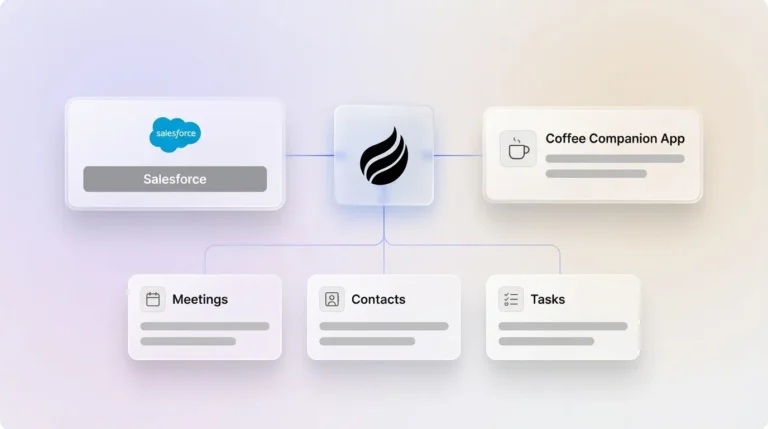
Coffee Companion App closes this gap directly. Coffee deploys an autonomous agent on top of an existing Salesforce instance. It connects to Google Workspace or Microsoft 365, automatically logs every email and calendar interaction as a Salesforce activity, joins calls to generate transcripts and summaries, and writes structured qualification data, such as BANT, MEDDIC, or SPICED, directly into the opportunity record. As a result, every field Einstein reads is populated with ground-truth data captured without manual entry from the rep. Einstein’s model then operates on a complete, current dataset instead of a partially filled record.

Comparing Einstein With Custom Scoring Approaches
Organizations that cannot meet Einstein’s data thresholds, or that find its licensing cost too high, often evaluate formula-based or Flow-based custom scoring models. The table below compares the three approaches across four operational dimensions.
Many organizations start with rule-based scoring to establish clean data practices before layering in Einstein predictive models. This sequenced approach respects Einstein’s dependency on data maturity.
Salesforce Opportunity Scoring Best Practices
Data readiness checklist before enabling or re-evaluating Einstein:
Start by verifying that critical fields, such as Industry, Job Title, Company Size, Stage, Close Date, and Amount, are populated on at least 85% of recent opportunities. These fields form the baseline attributes Einstein uses to match current deals against historical patterns. Next, confirm that outcome fields, including Closed Reason and Won or Lost flags, have been filled in reliably, because models learn from noise when these fields are blank or inconsistent. Once field completeness looks solid, verify that at least 200 closed-won and 200 closed-lost opportunities exist in the last 24 months so the model does not fall back to the global version. Finally, ensure activity is logged for every open deal at least every 5 to 7 days, and use automated reminders or an agent integration to enforce this standard without manual burden.
Quarterly validation steps:
- Review conversion rate by score band, MQL-to-SQL acceptance rate, and false positive rate to detect model drift.
- Audit B2B contact data for decay; as noted earlier, CRMs lose over 20% of valid records annually without continuous verification.
- Score Salesforce data across completeness, accuracy, timeliness, consistency, and traceability; below a minimum threshold, agent recommendations become directional rather than actionable.
- Flag opportunities with no activity for more than 30 days automatically to eliminate phantom revenue that causes forecasts to collapse.
Frequently Asked Questions
Which Salesforce editions include Einstein Opportunity Scoring?
Einstein Opportunity Scoring is available in Performance and Unlimited editions and as an add-on for Enterprise Edition of Salesforce Sales Cloud. Professional and Essentials editions require an upgrade to access the feature. Organizations evaluating cost should remember that licensing is a recurring per-seat expense on top of the base Sales Cloud subscription, so many mid-market teams explore formula-based or Flow-based alternatives first.
How long before Einstein Opportunity Scoring becomes reliable?
After enablement, Salesforce may take up to 48 hours to analyze existing data, build the scoring model, and populate scores on opportunity records. Producing reliable scores differs from producing any scores, however. If the organization lacks the minimum historical volume mentioned earlier, Einstein falls back to a global model trained on anonymous data from other Salesforce customers. That global model may produce scores quickly, but those scores reflect other companies’ sales patterns rather than your own. Building a custom model that you can trust requires both sufficient historical volume and consistent field population across that history.
Why do Einstein scores sometimes not match what the sales team knows?
Missing or inconsistent data in Salesforce usually causes the mismatch. Einstein scores what it can see, including logged activities, populated qualification fields, stage history, and engagement records. When reps conduct calls that are never transcribed and written back to the opportunity, or when MEDDIC fields stay blank after a discovery call, Einstein interprets the absence of data as a signal of low engagement or poor qualification. The deal may be progressing well in reality, but the model scores the record, not the relationship. A secondary cause is the global model fallback, where limited closed history forces Einstein to reflect industry-wide patterns that may not match a specific sales motion or deal size.
Can Coffee work alongside Einstein Opportunity Scoring?
Yes. Coffee Companion App deploys as an agent layer on top of an existing Salesforce instance and does not replace Salesforce or require a CRM migration. After connecting to Google Workspace or Microsoft 365, the Coffee Agent automatically logs email and calendar interactions as Salesforce activities, joins sales calls to generate transcripts and structured summaries, and writes qualification data back into opportunity fields using frameworks like BANT, MEDDIC, or SPICED. Einstein then reads a complete, current record instead of a partially filled one. Coffee handles the data-in process so that Einstein’s model operates on the ground-truth data it needs to produce trustworthy scores.

What minimum data quality standard does Einstein need?
Salesforce does not publish a single threshold beyond the 200 closed-won and 200 closed-lost requirement. In practice, research on Salesforce scoring implementations shows that critical fields should be populated on at least 85% of recent opportunities before scores align with sales team experience. Below that level, the model trains on gaps and produces scores that do not reflect actual deal health. The most important fields are Stage, Close Date, Amount, and any qualification fields used in the sales process. Activity recency matters equally, because opportunities with no logged activity in 30 or more days produce weak engagement signals that drag scores down regardless of actual deal status.
Conclusion: Fix the Data, Then Trust the Scores
Unreliable Salesforce deal scoring starts as a data problem before it becomes a model problem. Many revenue professionals identify data quality as a top obstacle to AI creating value in CRM, and when AI sits on messy, incomplete, and conflicting CRM data, it amplifies chaos and produces unreliable forecasts. Einstein Opportunity Scoring is a capable model. Its failure mode in mid-market environments almost always comes from fragmented, manually entered, and incomplete data, not from the algorithm itself.
Coffee Companion App solves that problem at the source. By automating activity logging, call transcription, qualification field population, and contact enrichment directly inside Salesforce, Coffee ensures that every signal Einstein reads reflects what is actually happening in the deal. The result is scores that sales teams trust, pipeline reviews that focus on strategy instead of data disputes, and forecasts that hold.