Written by: Doug Camplejohn, CEO & Co-Founder, Coffee | Last updated: July 22, 2026
Key Takeaways for Choosing an AI-Native CRM
- AI-native CRMs are built from the ground up with autonomous agents as core infrastructure, unlike legacy platforms that bolt AI onto old architectures.
- Coffee leads this comparison with perfect autonomy scores (5/5) across data entry, meeting management, pipeline intelligence, and deep Salesforce and HubSpot integration.
- Seven evaluation criteria matter most: data quality automation, implementation effort, workflow fit, forecasting accuracy, integration depth, total cost of ownership, and long-term flexibility.
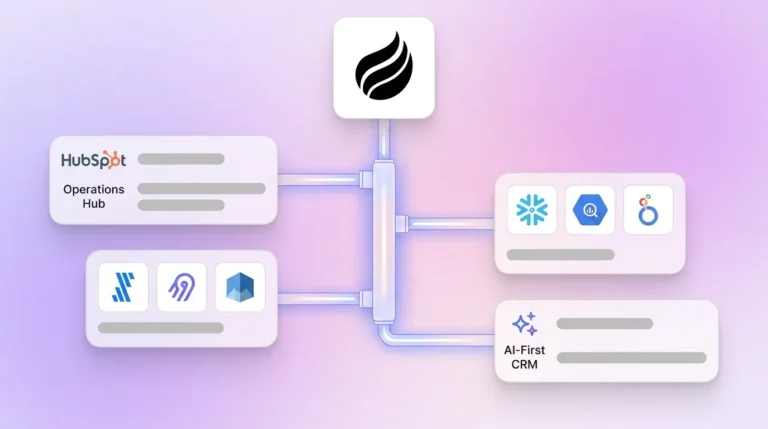
- Coffee offers two deployment models: a standalone CRM for small teams replacing spreadsheets and a Companion App that writes enriched data back into existing Salesforce or HubSpot instances without migration.
- Teams ready to eliminate manual data entry and fragmented tool stacks can explore Coffee’s standalone and Companion pricing to pick the deployment model that fits their current stack.
AI-Native vs AI-Enhanced CRM Architectures
AI-native CRMs design their data architecture around model training and inference from day one. AI-enhanced products keep their original data structure and let AI consume that data as an add-on feature.
AI-enhanced products maintain their original data architecture and add AI as a consumer of that data, while AI-native products design data architecture around model training and inference from the start. Applied to these architectural tests, Salesforce Agentforce and HubSpot Breeze fail the database test because their AI runs as a metered bolt-on over schemas that predate the modern AI era by 15–25 years. A wrapper AI inherits data drift because it reads from synced copies rather than the live single store.
No McKinsey 2025 survey of 1,400 technology companies reported that AI-native products generated 2.6x faster revenue growth than AI-enhanced alternatives. Some analyses have examined initial infrastructure costs and cost-per-user at scale for AI-native products compared to AI-enhanced equivalents.
Evaluation Criteria for AI-Native CRMs
Seven dimensions shape the real impact of an AI CRM. Data quality ranks first because pipeline accuracy affects every downstream decision, from forecasting to compensation. Implementation effort ranks second because long migrations delay that accuracy improvement and consume budget that could fund the platform itself.
Workflow fit comes next because it determines whether you can layer the solution onto existing systems or must migrate, which then drives implementation scope. The remaining four criteria build on this foundation: forecasting accuracy, integration depth, total cost including hidden tools, and long-term flexibility.
- Data quality and enrichment: AI-powered automatic capture can improve data completeness and forecast accuracy. Evaluate whether enrichment runs autonomously or still requires human initiation.
- Implementation effort: A professional CRM migration typically takes 8–12 weeks for most mid-sized businesses, with smaller projects in 4–6 weeks and complex ones requiring 3–6 months, and data engineering plus cleansing can consume a large share of the total migration budget.
- Workflow fit: Decide whether the platform will serve as a standalone system of record, a companion layer on top of an existing CRM, or both.
- Manager visibility and forecasting accuracy: Sellers spend a large portion of their time on delegatable activities. Agent-led pipeline intelligence helps reclaim that time for high-impact work and improves forecast reliability.
- Integration depth: Assess native connector coverage, API maturity, and whether the AI reads from a live database or a synced copy that can suffer from data drift.
- Total cost including hidden tools: Licensing fees represent only 30–40% of actual CRM expenditure, while implementation, administration, and add-ons comprise the remaining 60–70%.
- Long-term flexibility: Look at vendor lock-in risk, data portability, and whether the architecture can support growth without another re-platforming project.
Autonomy Scoring Rubric and Why It Matters
After you understand these seven criteria, autonomy scores show how each platform performs in day-to-day work. The 0–5 scale below measures how autonomously a platform handles four core CRM labor categories that drive data quality and manager visibility.
Platforms that score 4 or 5 in these categories remove manual bottlenecks that create hidden costs and inaccurate forecasts. A score of 0 means fully manual operation, while 5 means the agent executes without human initiation.

| Platform | Data Entry & Enrichment | Meeting Management | Pipeline Intelligence | Legacy Integration Depth |
|---|---|---|---|---|
| Coffee | 5, agent auto-creates contacts, enriches records, logs activity from email and calendar | 5, briefings, bot joins calls, auto-drafts summaries and follow-ups | 5, Pipeline Compare tracks week-over-week changes autonomously | 5, deep Salesforce and HubSpot write-back with quota, forecasting, and required-field awareness |
| Attio | 3, AI Attributes auto-populate fields via web research agents, manual entry still required for unstructured data | 2, no native meeting bot, relies on integrations | 3, Kanban and list views filter instantly, no autonomous pipeline change tracking | 2, flexible data model but limited native Salesforce and HubSpot sync depth |
| monday.com CRM | 2, AI assists with field suggestions, data entry remains largely manual | 2, workflow automations exist but are trigger-based, not agent-led | 3, dashboards and automations surface pipeline status, no autonomous deal-risk scoring | 3, broad integrations via native connectors and iPaaS |
| symbioz.ai | 4, multi-agent architecture for prospecting, enrichment, and qualification | 3, AI-assisted follow-up sequencing | 4, continuous signal analysis for at-risk deal detection | 2, built ground-up, legacy CRM integration depth not publicly documented |
| Day.ai | 3, strong on unstructured data capture, structured enrichment limited | 3, meeting summaries and follow-up drafts | 2, productivity focus, pipeline forecasting limited | 1, limited Salesforce and HubSpot integration sophistication |
| Clarify | 3, AI-assisted data capture, modern UI | 3, meeting intelligence features present | 3, pipeline views with AI suggestions | 1, integration capabilities insufficient for established mid-market stacks |
Platform Comparisons Using the Evaluation Framework
With the criteria and autonomy scores in place, you can now compare platforms on the dimensions that move TCO and productivity the most. The tables below focus on four high-impact areas: data entry automation, integration depth with Salesforce and HubSpot, hidden cost profile, and pipeline intelligence.
For readability, the comparison appears in two tables. The first covers Coffee, Attio, and monday.com CRM. The second covers symbioz.ai, Day.ai, and Clarify. As you scan each row, pay attention to how specific each capability description is, because vague claims often signal limited proof from real enterprise deployments.
| Criterion | Coffee | Attio | monday.com CRM |
|---|---|---|---|
| Data entry automation | Agent auto-creates contacts and logs activity from Google Workspace or Microsoft 365 on connection, eliminates about 70% of manual entry | AI Attributes auto-populate fields via web research agents, unstructured data handling limited | AI field suggestions, manual entry remains the primary input method |
| Salesforce/HubSpot integration | Deep write-back with quota, forecasting, required-field, and pipeline-stage awareness, Companion App model preserves existing system of record | Flexible data model, integration depth with Salesforce and HubSpot not equivalent to native sync | Broad integrations via native connectors and iPaaS middleware |
| Hidden cost profile | Seat-based pricing, agent labor included, consolidates enrichment, recording, and forecasting tools | Seat-based, third-party enrichment and meeting tools add cost | iPaaS integration adds $2,000–$5,000 or more per year, add-on marketplace increases TCO |
| Pipeline intelligence | Pipeline Compare visualizes week-over-week changes, autonomous deal-state tracking | Kanban and list views, no autonomous pipeline change detection | Dashboard automations, trigger-based rather than agent-initiated |
| Criterion | symbioz.ai | Day.ai | Clarify |
|---|---|---|---|
| Data entry automation | Multi-agent architecture for prospecting, enrichment, and qualification | Strong unstructured data capture, structured enrichment limited | AI-assisted capture, modern interface, enrichment depth unverified |
| Salesforce/HubSpot integration | Built ground-up, legacy CRM integration depth not publicly documented at enterprise complexity level | Limited Salesforce and HubSpot integration sophistication for quota and forecasting workflows | Integration capabilities insufficient for established mid-market stacks per company context |
| Hidden cost profile | Newer entrant, migration and integration costs not independently benchmarked | Productivity-focused, pipeline forecasting add-ons likely required | Modern UI, enterprise integration gaps may require middleware spend |
| Pipeline intelligence | Continuous signal analysis for at-risk deal detection | Productivity and meeting focus, pipeline forecasting limited | Pipeline views with AI suggestions, autonomous tracking depth unclear |
Review Coffee pricing for standalone and Companion models after comparing these dimensions.
AI Autonomy vs Assistance in Daily CRM Work
Autonomous agents commit real changes to operational records under permission rules, while assistive features only draft suggestions that a human must review and execute. Three architectural tests distinguish the two: the database test, the memory test, and the action test, which together show whether the AI can act directly on live records with persistent context.

The impact shows up in time saved. SuperAGI reports that AI users save an average of 12 hours per week and are 47% more productive by automating routine tasks. Assistive features that require human confirmation capture only a fraction of that gain because the confirmation step reintroduces a manual bottleneck.
Best AI CRM Choice for SMBs Replacing Salesforce
SMB sales teams feel the impact of manual CRM work most directly. For a 10-person team, the 12-hour weekly savings cited earlier translates to 120 hours per week redirected from data entry to selling, or 480 hours per month, which approximates a full headcount in reclaimed capacity.
The hidden cost of staying on Salesforce compounds that time loss. Salesforce implementations typically run 3–5 times the annual license fee in services, and third-party AI tool stacks such as Gong, Outreach AI, and Clari add significant subscription costs before you account for CRM licensing and integration overhead. Coffee’s seat-based model bundles enrichment, meeting intelligence, and pipeline tracking, which removes much of the fragmented point-solution stack that inflates that figure.
Coffee AI vs Attio: Where Each Platform Fits
Attio offers a flexible data model that tracks custom objects alongside standard contacts and companies, which suits teams that need schema customization without Salesforce complexity. Its AI Attributes allow fields on any object to auto-populate via AI by summarizing records from interaction data, classifying contacts into ICP tiers, or running web research agents to fill company details like headcount and funding stage.
Attio’s architecture does not include a native meeting bot, autonomous pipeline change tracking, or deep Salesforce and HubSpot write-back that accounts for quotas, required fields, and forecasting hierarchies. Coffee operates in two modes Attio does not offer: as a full standalone CRM for teams of 1–20 replacing spreadsheets or legacy tools, and as a Companion App that writes enriched, agent-captured data directly back into an existing Salesforce or HubSpot instance.
Teams committed to Salesforce gain clean data without replacing their system of record. Teams ready to replace Salesforce or HubSpot gain an agent-led CRM without the implementation overhead of a traditional legacy migration.
Standalone vs Companion: How to Choose Coffee’s Deployment Model
The choice between Coffee’s two deployment models depends on current CRM commitments and team size. Standalone works best when you want a fresh system of record. The Companion App fits when you want better data in an existing CRM without a migration.
Choose the Standalone CRM if:
- The team is 1–20 people and has outgrown spreadsheets or Notion
- No existing Salesforce or HubSpot contract is in place
- The priority is speed to value with minimal implementation effort
- The team wants an agent to serve as the full system of record
Choose the Companion App if:
- The team is 10–50 people with an active Salesforce or HubSpot contract
- CRM adoption is low and data quality is poor despite the existing investment
- RevOps needs clean pipeline data without a re-platforming project
- The Head of Sales or RevOps owns the evaluation and needs a fast ROI case
See pricing for both deployment models and calculate your ROI against current tool stack costs.
Risks, Limitations, and Buyer Fit Considerations
Agent-led CRM does not fit every organization. Several constraints apply, and each one maps to a specific buyer profile that should weigh it carefully.
Integration gaps affect teams with complex middleware stacks, because Coffee currently connects to external tools via Zapier while deeper native integrations remain on the roadmap, so these teams should audit connector coverage before committing. Security review timelines matter most for heavily regulated industries such as healthcare and finance, where multi-year security reviews may exceed Coffee’s current certification scope even though Coffee is SOC 2 Type 2 and GDPR compliant and does not use customer data to train public models.
Large enterprise complexity affects organizations with deeply customized Salesforce orgs, multi-cloud architectures, or thousands of users, because workflow sprawl can exceed Coffee’s current product scope. AI model accuracy drift affects all deployments but hits hardest in industries with rapid product or regulatory change, which means any agent-led platform requires ongoing data hygiene governance.
The adoption misconception affects teams that expect automation to replace process discipline. Agent-led CRMs reduce manual entry but do not remove the need for clear sales processes, and the three dominant failure modes for AI sales agent deployments in 2026 are broken CRM write-back, deliverability damage from over-sending, and fragmentation across point tools that causes context loss, all of which require active oversight.
Buyer Checklist and Scenario Matrix
| Scenario | Best-fit options | Key consideration |
|---|---|---|
| 1–20 person team, no CRM, outgrown spreadsheets | Coffee Standalone, Day.ai, Clarify | Speed to value, agent autonomy level, enrichment depth |
| 10–50 person team, active Salesforce or HubSpot, low adoption | Coffee Companion App, symbioz.ai | Write-back depth, quota and forecasting field awareness, seat cost versus point-solution stack cost |
| 10–50 person team, evaluating Salesforce replacement | Coffee Standalone, Attio, monday.com CRM | Data model flexibility, migration effort, pipeline intelligence autonomy |
| Team requiring deep schema customization without Salesforce | Attio, Coffee Standalone | Custom object support, AI enrichment on custom fields |
| Team prioritizing lowest 3-year TCO | Coffee (consolidated stack), Clarify | Given that most TCO lives outside licensing fees (see criterion 6 above), evaluate tool consolidation savings against migration cost |
Frequently Asked Questions
How long does it take to implement Coffee?
Coffee connects to Google Workspace or Microsoft 365 through a simple authentication flow. Once authenticated, the agent begins auto-creating contacts, logging activity, and enriching records immediately. There is no multi-week configuration sprint or certified administrator requirement.

Teams using the Companion App on Salesforce or HubSpot follow the same authentication path, and the agent then syncs, enriches, and writes data back to the existing system of record. Most teams reach operational use within days rather than the weeks or months typical of legacy CRM migrations.
What is the migration effort if we are moving from Salesforce or HubSpot?
Teams choosing Coffee’s Standalone CRM as a Salesforce or HubSpot replacement should plan for a data export and import process. Coffee’s agent handles ongoing data capture automatically after migration, while historical data from the legacy system requires a one-time transfer.
The scope of that effort depends on record volume and data cleanliness. Teams with heavily customized Salesforce orgs that include complex workflow rules, custom objects, and multi-cloud integrations face higher migration complexity and should evaluate the Companion App model first to validate fit before committing to a full replacement. Teams choosing the Companion App skip migration entirely because Coffee layers on top of the existing system without displacing it.
Is Coffee’s data secure, and who owns the data?
Coffee is SOC 2 Type 2 and GDPR compliant, and customer data is not used to train public AI models. The agent processes emails, calendar events, and call transcripts to populate CRM records, but that data remains within the customer’s account.
Teams in heavily regulated industries such as healthcare or finance should review Coffee’s security documentation against their specific compliance requirements, because multi-year security review cycles in those sectors may exceed Coffee’s current certification scope.
How does Coffee’s enrichment quality compare to dedicated tools like ZoomInfo or Apollo?
Coffee’s agent enriches records with job titles, funding data, and LinkedIn profiles via licensed data partners, which removes the need for a separate enrichment subscription for most use cases. The enrichment quality is roughly on par with standalone tools for the majority of SMB and mid-market needs.

Teams with highly specialized enrichment requirements, such as detailed technographic signals, intent data feeds, or complex enterprise account hierarchies, should evaluate Coffee’s enrichment output against their specific data needs during a trial before retiring existing enrichment contracts.
Is Coffee the right fit if we are not ready to replace our CRM?
Coffee’s Companion App is designed for teams committed to Salesforce or HubSpot that want agent-led data quality without a re-platforming project. The agent handles the data-in problem by auto-creating contacts, logging activity, enriching records, and writing pipeline intelligence back to the existing system, so the system of record becomes accurate without human effort.
This model is particularly relevant for RevOps leaders who need to improve forecast accuracy and CRM adoption before they can justify a full replacement evaluation to leadership.
Conclusion: Applying the Framework to Your CRM Decision
The 2026 CRM market divides along one architectural line: systems that rely on humans as data-entry clerks and systems that deploy autonomous agents to handle that labor. A large share of repetitive commercial tasks can now be automated by AI, and teams that delay the transition absorb that cost in rep hours, shadow CRMs, and fragmented point-solution spend.
Your decision process can stay simple. Score each platform against the seven evaluation criteria, apply the architectural tests that separate assistive wrappers from true AI-native systems, and match the deployment model to your current stack commitment. Coffee is the only platform in this comparison that passes all three tests and operates as either a standalone system of record or a companion layer on Salesforce and HubSpot, which makes it a single agent-led path to good data in and accurate pipeline intelligence out for both SMBs and mid-market teams.