Written by: Doug Camplejohn, CEO & Co-Founder, Coffee | Last updated: June 19, 2026
Key Takeaways for Revenue Leaders
- Manual CRM data entry creates unreliable sales forecasts. Autonomous agents remove this bottleneck by capturing clean data automatically.
- Pipeline intelligence tools need deep native Salesforce and HubSpot sync so structured insights write directly into CRM objects without middleware.
- Forecast accuracy improves when upstream data quality improves. Tools that capture emails, transcripts, and calendars outperform those that rely on rep-entered records.
- Mid-market teams see faster ROI with seat-based pricing that combines enrichment, recording, and forecasting in one platform.
- See how Coffee’s autonomous agent replaces manual data entry and delivers trustworthy forecasts.
How Pipeline Intelligence Differs From Standard CRM Reporting
Pipeline intelligence uses automated capture, unification, and analysis of structured and unstructured sales data, including emails, call transcripts, calendar events, and CRM fields. The result is a trustworthy, continuously updated revenue forecast that does not depend on human data entry. A pipeline intelligence tool ingests activity signals from multiple sources, validates and enriches them, then surfaces deal-level insights and forecast projections that reflect the real pipeline state.
Standard CRM reporting summarizes what humans typed into forms. Pipeline intelligence tools record what actually happened. Emerging agentic pipelines combine AI-assisted automation with metadata, observability signals, and intelligent decisioning to validate, govern, and deliver data predictably while incorporating self-adapting and self-healing capabilities. This architecture separates genuine pipeline intelligence from dashboards that sit on top of stale manual records.
Evaluation Criteria for Pipeline Intelligence Tools
Six criteria determine whether a pipeline intelligence tool will improve CRM forecasting accuracy for a mid-market team.
- Autonomous data capture vs. manual entry: The tool should eliminate rep data-entry work instead of depending on human input to populate models.
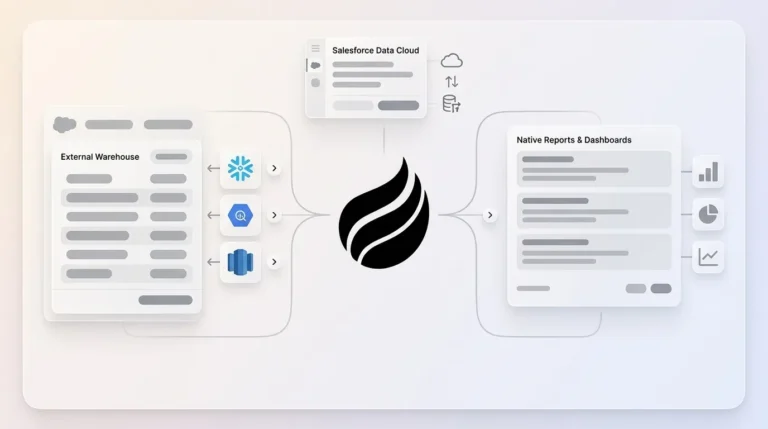
- Native Salesforce/HubSpot sync depth: The tool should write structured insights back to standard and custom CRM objects natively, without middleware or CSV exports.
- Accuracy lift: The vendor should quantify forecast reliability improvements and clarify how much comes from better data versus model tuning.
- Implementation effort: Deployment should fit your team’s bandwidth, with clear expectations for setup time and ongoing maintenance.
- Mid-market workflow fit: The product should support teams of 10–200 reps without enterprise-scale configuration overhead.
- Total cost of ownership: Pricing should include accuracy-critical features instead of pushing enrichment or recording into separate tools.
Many data leaders report that their data is not clean or trustworthy enough for AI, which means most pipeline intelligence deployments start on a weak foundation before the forecast model even runs. The comparison below evaluates how each tool addresses these six criteria, with special focus on which solutions fix data quality at the source versus those that assume clean input.
Side-by-Side Comparison: Coffee, Clari, Gong, and Legacy CRMs
The table below compares Coffee, Clari, Gong, and legacy CRMs (Salesforce or HubSpot without an intelligence layer) across the criteria most directly tied to forecasting accuracy. All figures come from product documentation, company context, and cited research.
| Criterion | Coffee | Clari / Gong | Legacy CRM (Salesforce / HubSpot) |
|---|---|---|---|
| Data capture model | Autonomous agent, captures emails, calendars, transcripts automatically | Partial automation, still requires rep-entered CRM data as base layer | Manual entry required, manual data mapping is time-consuming and error-prone |
| Native CRM sync | Deep native write-back to Salesforce and HubSpot standard and custom objects via simple authentication | Native connectors available, some tools require custom API development or middleware | Native and self-contained, no external intelligence layer |
| Rep data-entry time saved | Eliminates 71% of rep data-entry time (Coffee market data) | Reduces entry for call data, deal-stage updates remain manual | No reduction, manual entry without automated sync consumes significant time and introduces errors |
| Unstructured data handling | Full ingestion of emails, transcripts, and calendar context into data warehouse | Gong strong on call transcripts, Clari limited unstructured ingestion | Relational database only, unstructured data not natively processed |
| Mid-market TCO | Seat-based pricing with agent labor included, replaces enrichment, recording, and forecasting add-ons | Per-seat plus platform fees, enrichment tools such as ZoomInfo typically additional | Base license plus required add-ons for forecasting, enrichment, and intelligence |
Data Entry Automation With Autonomous Agents
Manual data entry consumes a large share of selling time, which reduces both productivity and forecast reliability. As the data above shows, reps lose the majority of their selling hours to administrative work instead of customer conversations. Coffee’s autonomous agent removes this bottleneck by scanning connected Google Workspace or Microsoft 365 accounts to auto-create contacts, log activities, enrich records with job titles and funding data, and update deal states without any rep action.

Clari and Gong improve on legacy CRMs by capturing call and email signals, yet both tools still depend on reasonably accurate underlying CRM records. AI data integration uses machine learning to automate field mapping and deliver a unified view without manual intervention, but that capability must live inside the pipeline intelligence layer itself, not only in the CRM. Legacy CRMs lack this automation. Organizations using over 1,000 applications experience 70% of systems remaining disconnected, which fragments data and blocks accurate unified reporting and forecasting.
From Meeting to Forecast: Coffee’s Pipeline Compare Workflow
Coffee’s Companion App converts every sales call into structured forecast data through a three-step agent workflow. The agent prepares a pre-meeting briefing, runs live transcription through an AI Meeting Bot, then generates a post-call summary with next steps logged directly to the CRM record. Sales methodologies such as BANT, MEDDIC, and SPICED are applied by the agent during note generation so qualification fields stay consistent across every deal.

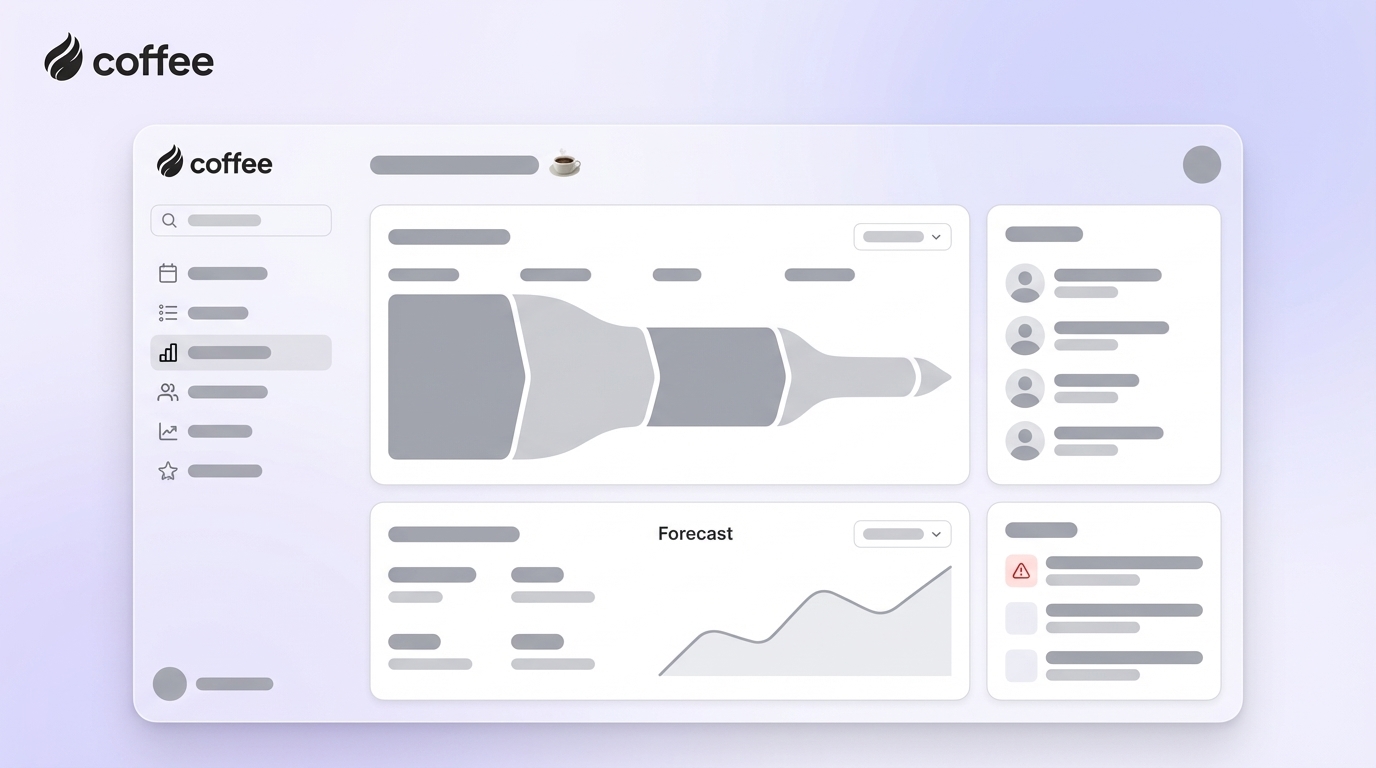
The Pipeline Compare feature surfaces week-over-week deal movement, including progressed opportunities, stalled deals, and new additions, without spreadsheets or manual CSV exports. This shift turns pipeline reviews from data-gathering sessions into strategic conversations. Gong offers strong call analytics but sends intelligence into a separate interface instead of writing structured data back to the CRM forecast layer. Clari provides forecast rollups but relies on rep-entered stage data as its primary input signal. Sales pipeline acceleration and forecasting automation in Salesforce includes automatically updating pipeline stages, triggered forecast rollups that eliminate manual reporting, and real-time dashboards for management visibility. Coffee delivers this behavior natively through its agent rather than through a separate automation platform.

Best-Fit Use Cases for Salesforce and HubSpot Teams
Mid-market teams that already use Salesforce or HubSpot gain the lowest-disruption path to pipeline intelligence with Coffee’s Companion App. A single authentication connects the Coffee agent to the existing CRM instance. The agent then manages data capture, enrichment, and write-back without a system migration. Integration of process intelligence tools with Salesforce proceeds more efficiently when the platforms can connect cleanly with the new intelligence layer. Coffee’s native integration architecture is designed for this requirement.
Teams willing to replace their CRM entirely can deploy Coffee as a standalone system of record, where the agent manages the full data lifecycle from first contact to closed-won. This approach fits companies that have outgrown spreadsheets but view Salesforce and HubSpot as too maintenance-heavy for their current size. Explore Coffee pricing and choose the deployment model that fits your stack.
Operational Risks, Compliance, and Change Management
Change management often becomes the most underestimated implementation variable. Even autonomous tools still need initial configuration of field-mapping rules and sync preferences. Existing schema flaws become worse after integration because the process magnifies any data structure issues, and fixing them post-integration is exponentially more costly. A data audit before connecting any pipeline intelligence tool is essential.
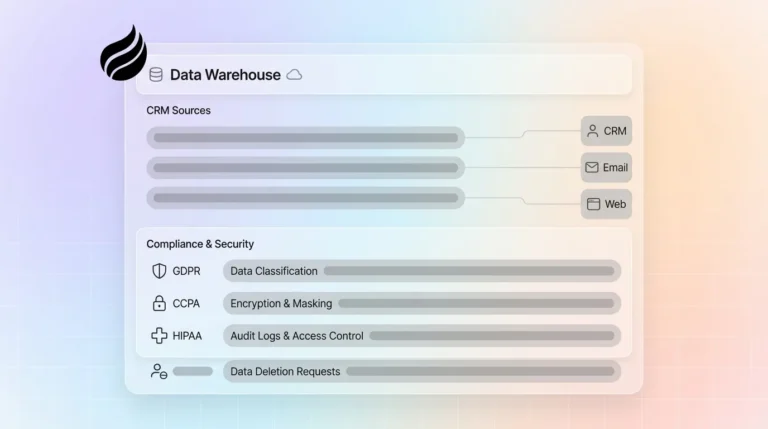
Compliance requirements also shape tool selection for teams that operate across regions. Coffee is SOC 2 Type 2 and GDPR compliant, and data is not used to train public models. Providers must maintain GDPR and CCPA certifications and allow configuration of rules by region with opt-out workflows, so teams should verify this before finalizing any vendor. Over-reliance risk remains real because autonomous capture is only as reliable as the connected data sources. Teams should monitor sync health and schedule quarterly field-mapping audits as a standard operating procedure.
Decision Framework and Checklist for Tool Selection
Use the following checklist to match a pipeline intelligence solution to your current environment. Start with your existing CRM infrastructure, because this determines whether you need a companion layer or a standalone system. Then evaluate team size and primary pain point together, since smaller teams with data entry problems benefit most from autonomous capture, while larger teams with clean data but weak forecasting may need specialized modeling tools.
- Existing CRM: Salesforce or HubSpot → Coffee Companion App; no CRM or spreadsheet-based → Coffee Standalone
- Team size: 5–200 reps → Coffee; 200+ with complex custom workflows → evaluate enterprise platforms
- Primary pain: Manual data entry and poor CRM adoption → Coffee agent; call analytics only → Gong; forecast modeling on existing clean data → Clari
- Budget constraint: Need to consolidate enrichment, recording, and forecasting into one line item → Coffee; budget for multi-tool stack → Clari + Gong + ZoomInfo
- Implementation timeline: Need value within days → Coffee Companion App via simple authentication; can absorb 3–6 month deployment → enterprise platforms
- Compliance requirement: SOC 2 Type 2 and GDPR required → Coffee; additional regional requirements → verify per vendor
Frequently Asked Questions
How long does it take to implement the Coffee Companion App on Salesforce or HubSpot?
Implementation uses a single authentication step that connects Coffee to your existing Salesforce or HubSpot instance. The agent begins capturing contacts, logging activities, and enriching records immediately after connection. Most teams see the agent actively populating CRM data within the same business day. There is no migration, no data model rebuild, and no extended onboarding period for the core data capture functionality.
What migration effort is involved when adding an autonomous agent layer to an existing CRM?
Adding Coffee as a Companion App involves no data migration because the agent writes to your existing CRM objects instead of replacing them. The primary setup tasks include authenticating your Google Workspace or Microsoft 365 account, configuring field-mapping preferences, and verifying that sync rules align with your current data governance standards. Teams should conduct a data audit before activation to address duplicate records and stale fields, since these issues are amplified rather than resolved by any enrichment or intelligence layer.
What accuracy metrics matter most for CRM forecasting in 2026?
The metrics that most directly predict forecast reliability include data completeness rate, activity coverage, pipeline change velocity, and forecast variance. Data completeness rate measures the percentage of deal records with all required fields populated without manual entry. Activity coverage tracks the percentage of customer interactions captured automatically versus logged manually. Pipeline change velocity measures how quickly deal-stage movements appear in the forecast model. Forecast variance captures the difference between committed forecast and actual closed revenue over a rolling quarter. Data quality is the upstream variable that shapes all of these. As noted earlier, most organizations lack confidence in their data foundation, so accuracy improvements require fixing the data input problem before tuning the forecast model.
What are the integration requirements for native CRM sync with a pipeline intelligence tool?
Native CRM sync requires the pipeline intelligence tool to write directly to standard and custom CRM objects without middleware or manual CSV imports. For Salesforce, the tool must support the Salesforce API and handle field-level permissions, required fields, and custom object schemas. For HubSpot, the tool must respect property-level rules and association logic. Tools that require custom API development or third-party middleware introduce extra failure points and maintenance overhead. Coffee’s Companion App is built specifically for deep Salesforce and HubSpot integration, including quotas, forecasting objects, and required field validation that newer CRM alternatives often lack.
How do you measure quarter-over-quarter forecast improvement after deploying a pipeline intelligence tool?
Start by establishing a baseline forecast variance metric for the two quarters before deployment. Calculate the average percentage difference between your committed forecast at the start of each quarter and actual closed revenue at quarter end. After deployment, track the same metric each quarter. Secondary indicators include CRM data completeness rate, the percentage of activities logged automatically versus manually, and time spent on pipeline review preparation. Pipeline Compare in Coffee surfaces week-over-week deal movement automatically, which provides the granular change data needed to see whether forecast misses come from data gaps, deal slippage, or model assumptions.
Conclusion: Build Forecasts on Data You Trust
Forecast accuracy starts as a data quality problem before it becomes a modeling problem. 67% of organizations report that they don’t fully trust the data their organization is using, so any forecasting tool that sits on top of that foundation will inherit every flaw. The tools that improve forecast reliability in 2026 focus on fixing the input, not just the output. Coffee’s autonomous agent captures clean, structured data from emails, calendars, and call transcripts, then writes it back to Salesforce or HubSpot natively so the forecast reflects what actually happened in the pipeline. Start your free Coffee trial and build forecasts on data you can trust.