Written by: Doug Camplejohn, CEO & Co-Founder, Coffee
Key Takeaways
- ZoomInfo leads in phone and mobile match rates (67%) but requires $15K+ annual contracts with opaque pricing and high lock-in risk.
- Apollo offers transparent pricing starting at $49/user/month and a free tier, yet trails in phone accuracy (41%) and can incur hidden credit overages.
- Both tools still require manual data entry, deduplication, and workflow steps that limit reps to only 28% of their time selling.
- For most SMB and mid-market teams, an agent-based CRM like Coffee removes the need to choose between enrichment platforms by automating contact creation, enrichment, and logging.
- Teams ready to replace manual enrichment overhead can explore Coffee’s pricing and consolidate their stack into a single autonomous agent.
How This Comparison Helps Your ZoomInfo vs Apollo Decision
Five criteria structure this analysis, and each one maps to a common buying headache for SMB and mid-market teams. Data accuracy and phone/email validity looks at verified match rates against a live prospect list, because reachability determines whether campaigns work at all. Pricing transparency and contract risk covers published rates, minimum commitments, and total cost of ownership, since hidden fees often double the initial quote.
Integration complexity evaluates native CRM connectors versus middleware-dependent paths, which affects how much IT and RevOps time the tool consumes. Workflow friction focuses on the manual steps reps must complete before a record is usable, separating tools that save time from those that create busywork. Long-term scalability examines whether the platform grows with your team or creates lock-in that penalizes growth, especially once you pass 20 reps.
ZoomInfo vs Apollo vs Coffee: 2026 Side-by-Side Benchmarks
| Criteria | ZoomInfo | Apollo | Coffee |
|---|---|---|---|
| Email match rate | 84% (1,000-lead benchmark, March 2026) | 78% (same benchmark) | Enrichment via licensed data partners; accuracy on par for most SMB use cases |
| Mobile phone match rate | 67% | 41% | Not a standalone dialer; enrichment included in agent workflow |
| Direct dial coverage | 67% in the March 2026 benchmark | 41% | Not applicable as standalone metric |
| Starting price | ~$15,000/year (annual contract required) | $49/user/month (Basic); free tier available | Seat-based; view pricing details |
| Contract structure | Annual, opaque; requires sales negotiation | Apollo offers monthly or annual billing with transparently published pricing, though the Organization plan requires an annual contract with a minimum of three users. | Simple seat-based; no credit metering |
| Native CRM connectors | Yes (Salesforce, HubSpot, Dynamics) | Yes (Salesforce, HubSpot) | Yes, native Salesforce and HubSpot sync; also standalone CRM |
| Automated data entry | ZoomInfo provides automated data entry and enrichment into CRM via scheduled workflows, real-time sync, and integrations, eliminating manual export/import. | No, sequences automated; record creation manual | Yes, agent auto-creates contacts, logs activity, enriches records |
Data Quality and Phone Accuracy for Real-World Outreach
A March 2026 benchmark across 1,000 B2B leads in five verticals placed ZoomInfo at 84% email match and 67% mobile phone match, versus Apollo at 78% email and 41% mobile. The mobile gap is material for teams running high-volume cold-calling programs. A 26-point difference in mobile match rate turns into many fewer connected calls per list.
For SMB teams prospecting mainly in tech and SaaS via email sequences, Apollo’s lower phone coverage often feels acceptable given its price advantage. For mid-market teams with dedicated SDRs dialing into multi-industry lists, ZoomInfo’s phone depth can justify a higher per-seat cost. Neither provider publishes last-verified timestamps, and record freshness degrades silently, quarterly for Apollo and six or more months for ZoomInfo on smaller accounts.
B2B contact data decays at roughly 2.1% per month, with tech-sector churn reaching 40% annually. Given these accuracy and decay patterns, buyers need to weigh whether premium phone coverage offsets higher contract costs.
Pricing, Contracts, and Long-Term Lock-In Risk
ZoomInfo’s SalesOS Professional starts at approximately $15,000 per year, and most mid-market teams pay $40,000–$80,000 annually for ZoomInfo, while enterprise contracts regularly exceed $60,000. Pricing is not published and requires a sales conversation, which makes budget forecasting difficult. A 2026 Vendr analysis of 1,314 purchases found ZoomInfo’s median contract value is $32,000 annually.
Apollo’s paid plans start at $49/user/month (Basic) and reach $149/user/month for the Organization plan ($119/month billed annually), with a free tier available. The transparent pricing page is a genuine differentiator for smaller teams. However, credit-based pricing models can cause total cost of ownership to spiral, and a tool listed at $49/user/month can reach $500/user/month at scale when enrichment actions are charged separately.
Teams evaluating either platform should model total annual spend with seat expansion, credit overages, and add-on modules before signing. That forecast should extend across at least one renewal cycle to reveal the real lock-in risk.
Integration Effort and Everyday Workflow Friction
Both ZoomInfo and Apollo offer native connectors to Salesforce and HubSpot, which reduces deployment friction compared with Zapier-only paths. Native connectors still push data into CRM fields and stop there. They do not remove the manual work of reviewing, deduplicating, and updating records.
Data professionals spend approximately 44% of their time on data preparation and integration, and that share stays high even when native connectors exist. B2B marketing stacks commonly include 25–60+ products, and adding a standalone enrichment tool to an existing CRM plus sequencing platform increases the manual stitching burden that limits reps to spending only 28% of their time actually selling.
The practical integration question becomes whether a tool reduces or adds to total operational overhead across your stack. ZoomInfo and Apollo both help fill fields, but neither behaves like an assistant that manages CRM hygiene end to end.
What Real Users Complain About on Reddit and Forums
User complaints about ZoomInfo cluster around three themes: contract cancellation difficulty, data accuracy shortfalls on mobile numbers, and aggressive auto-renewal clauses. Threads in r/sales describe teams billed for renewal cycles after submitting cancellation requests within the contractual window, with disputes that required legal escalation. ZoomInfo has also faced class-action litigation related to the use of personal data without consent for marketing purposes, which raises compliance questions for teams in regulated states.
Apollo complaints focus on email deliverability degradation at high send volumes, inconsistent phone data outside North America, and credit burn rates that exceed initial estimates. Users report that the free tier’s credit limits make meaningful prospecting difficult without upgrading, and that the Organization plan’s per-seat cost compounds quickly for teams above 10 reps.
Both platforms receive criticism for the gap between advertised accuracy rates and real-world match rates on niche verticals or smaller company sizes. These reports align with the 2026 benchmark findings, which show performance meaningfully below vendor-claimed figures.
When to Skip ZoomInfo and Apollo for an Agent-Based CRM
Single-source B2B data APIs cap at 50–65% contact match rates. Buyers increasingly favor solutions that combine enrichment, intent analytics, and workflow automation in a single interface, reflecting a clear preference for consolidation over point solutions.
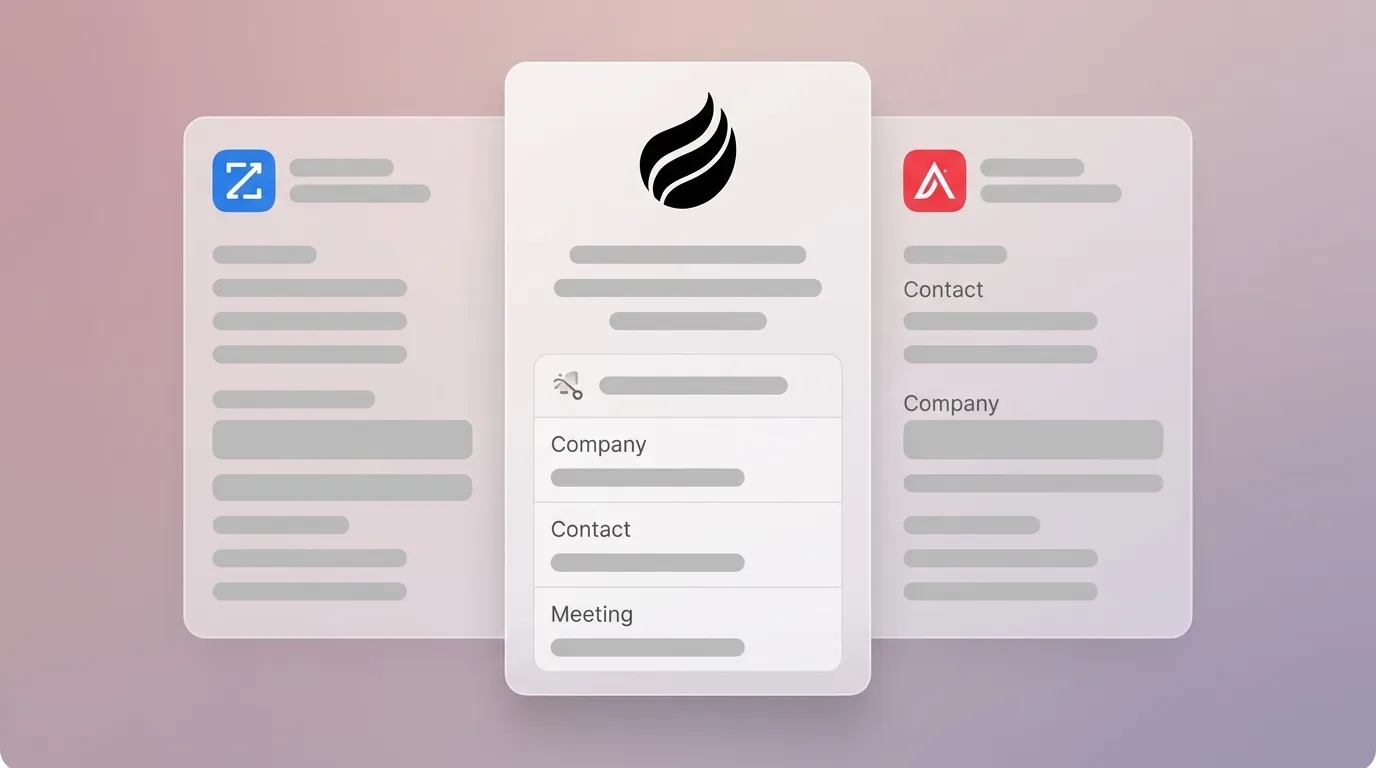
Coffee is an autonomous CRM agent that removes the need to choose between ZoomInfo and Apollo for most SMB and mid-market teams. The Coffee Agent connects to Google Workspace or Microsoft 365 and automatically creates contacts, enriches records with job titles, funding data, and LinkedIn profiles via licensed data partners, and logs every activity without human data entry. It deploys as a standalone CRM for teams of 1–20 or as a Companion App layered on top of existing Salesforce or HubSpot instances, writing enriched data directly back to the system of record.

ZoomInfo and Apollo both require a rep to export a list, import it into a CRM, and manually trigger a sequence. Coffee’s agent handles enrichment and logging as a background process. The result is accurate pipeline data without the overhead of managing a separate enrichment subscription, credit budgets, or manual field updates. Many businesses plan to invest in AI-powered software to increase selling time, and Coffee’s agent architecture is built for that shift.

See how Coffee’s autonomous agent replaces your enrichment stack and works inside the CRM you already use.
Decision Matrix: Which Tool Fits Your Team Profile?
| Profile | ZoomInfo | Apollo | Coffee |
|---|---|---|---|
| 1–10 reps, under $10K/year budget, email-primary outreach | No, minimum ~$15K/year | Yes, free tier or Basic at $49/user/month | Yes, standalone CRM with built-in enrichment |
| 10–50 reps, $10K–$50K budget, mixed email + calling | Possible, stronger phone data at 67% mobile match | Yes, Organization plan at $119–$149/user/month | Yes, Companion App enriches and logs inside existing Salesforce or HubSpot |
| 50+ reps, $50K+ budget, heavy cold-calling, multi-industry | Yes, deepest phone coverage and intent signals | Partial, lower mobile match rate at 41% | Complement, agent handles CRM hygiene; ZoomInfo supplies phone lists |
| Salesforce or HubSpot user with low CRM adoption | No, adds another tool to manage | No, adds another tool to manage | Yes, Companion App writes enriched data directly into existing instance |
| Team replacing spreadsheets, no CRM yet | No, requires separate CRM | Partial, sequences included, CRM basic | Yes, standalone AI-first CRM with agent-managed records |
Frequently Asked Questions
What is the lawsuit against ZoomInfo?
ZoomInfo has faced class-action litigation in the United States related to allegations that it collected and sold personal data, including names, contact information, and professional details, without obtaining explicit consent from the individuals whose data was used. The core legal argument in several cases centers on violations of state right-of-publicity statutes, which prohibit the commercial use of a person’s identity without permission. These lawsuits are distinct from GDPR or CCPA enforcement actions, though ZoomInfo has also faced scrutiny under those frameworks. For sales teams, the practical implication is a compliance review before deploying ZoomInfo data in states with active right-of-publicity laws. Teams in regulated industries should consult legal counsel before signing a ZoomInfo contract.
Is Apollo’s phone data reliable enough for cold calling?
Apollo’s phone data is adequate for email-primary outreach teams but shows meaningful gaps for high-volume cold-calling programs. A March 2026 benchmark placed Apollo direct dial coverage at 41% versus ZoomInfo at 67% on the same 1,000-lead sample. For a team making 50+ dials per rep per day, that gap compounds into a significant number of unreachable contacts. Apollo performs better in tech and SaaS verticals where email is the primary channel and calling volume is lower. Teams that rely on phone as a primary outreach channel and prospect across multiple industries should treat Apollo’s phone data as supplementary rather than primary.
How much does ZoomInfo actually cost in 2026?
ZoomInfo does not publish pricing publicly. Based on verified 2026 market data, the SalesOS Professional plan starts at approximately $15,000 per year for a minimum seat count. Mid-market teams with 5–20 seats often land in the $40,000–$80,000 annual range once platform access fees, onboarding, and seat expansion are included. Enterprise contracts with intent data add-ons, advanced integrations, and higher seat counts regularly exceed $60,000 per year.
A 2026 Vendr analysis of 1,314 purchases found ZoomInfo’s median contract value is $32,000 annually. Final pricing depends heavily on negotiation leverage, contract length, and which add-on modules are included, so teams should expect a sales process rather than a simple price card.
Can an AI agent replace both ZoomInfo and Apollo?
For most SMB and mid-market teams, an AI CRM agent can replace both platforms, with one qualification. An AI CRM agent like Coffee handles enrichment, data entry, activity logging, and contact creation, which are the core jobs ZoomInfo and Apollo usually support. Coffee’s agent connects to Google Workspace or Microsoft 365, automatically populates CRM records with job titles, funding data, and LinkedIn profiles via licensed data partners, and logs every interaction without manual input.
The agent deploys as a standalone CRM or as a Companion App inside Salesforce or HubSpot. Teams running very high-volume cold-calling programs that require deep mobile phone coverage across non-tech verticals may still benefit from ZoomInfo’s phone database as a supplementary list source. For the majority of SMB and mid-market teams whose primary outreach channel is email and whose main pain points are CRM data quality and manual entry overhead, Coffee’s agent removes the need to purchase either platform separately.
Conclusion: How to Make the ZoomInfo, Apollo, or Coffee Call
ZoomInfo wins on phone data depth and enterprise intent signals. Apollo wins on price transparency and time-to-value for small teams. Both require manual data entry, credit management, and ongoing tool administration that consume selling time. The 28% selling-time problem mentioned earlier becomes worse when teams add another point solution instead of consolidating their stack.
The practical decision rule is straightforward. If your team makes 50+ cold calls per day across multi-industry lists and has a $25K+ annual budget, ZoomInfo’s phone coverage can justify the cost. If your team is under 50 reps, email-primary, and budget-constrained, Apollo’s transparent pricing and combined data-plus-sequences model is usually the stronger fit.
If your core problem is CRM data quality, manual entry overhead, and point-solution sprawl, and your team runs on Salesforce, HubSpot, or needs a modern CRM from scratch, the 2026 consolidation trend points toward an agent-based system that removes the enrichment-tool decision entirely. Coffee’s autonomous agent automates enrichment and CRM updates inside your existing stack or as a standalone system, delivering accurate pipeline data without contract risk, credit metering, or manual stitching.
Try Coffee’s AI agent and eliminate the enrichment tool decision entirely.