Written by: Doug Camplejohn, CEO & Co-Founder, Coffee
Key Takeaways for 2026 Visitor Identification
- Website visitor identification tools now operate under stricter 2026 regulations, with GDPR fines exceeding €6 billion and growing scrutiny on fingerprinting and consent practices.
- Company-level IP-to-organization matching carries significantly lower regulatory risk than person-level identification, which often requires explicit consent and is largely restricted outside the U.S.
- Compliant setups use affirmative consent mechanics, honor Global Privacy Control signals, rely on signed DPAs, and follow strict data retention policies such as 90-day deletion windows.
- Accuracy trade-offs exist in 2026, with realistic B2B match rates of 10–40% for company-level and 5–20% for person-level methods, so real-time routing often matters more than raw coverage.
- Coffee’s privacy-first architecture delivers compliant visitor identification that turns anonymous traffic into pipeline, and you can configure Coffee in minutes.
What Website Visitor Identification Actually Collects
Website visitor identification tools turn anonymous traffic into actionable intelligence through two primary privacy vectors. The first is person-level PII: name, email address, LinkedIn profile, and device identifiers tied to a specific natural person. The second is persistent device fingerprinting: a probabilistic signature built from browser attributes, screen resolution, installed fonts, and hardware signals that tracks individuals across sessions without cookies. Each vector carries distinct regulatory exposure, and teams increase risk when they treat them as the same thing.
Why Visitor Identification Compliance Matters in 2026
The GDPR Enforcement Tracker has recorded €6.29 billion in cumulative fines across 3,186 enforcement actions, and the pace is accelerating. DLA Piper’s January 2026 survey reported 443 breach notifications per day across European DPAs, a 22% increase year over year. Cookies and consent remain among the top enforcement priorities: the CNIL issued 83 sanctions totaling €486.8 million in 2025, including two major cookie-consent fines of €325 million and €150 million.
While cookies remain a primary target, the enforcement frontier has now shifted toward fingerprinting, which many teams adopted to avoid cookie consent requirements. On February 25, 2026, the CNIL opened a public consultation on draft recommendations for session replay tools, software that records mouse movements, clicks, scrolling, and form inputs, and addressed GDPR data minimization and consent requirements for both tool providers and publishers. In the U.S., California’s regulations covering ADMT, cybersecurity audits, and risk assessments took effect on January 1, 2026, with ADMT compliance required beginning January 1, 2027, and twenty U.S. states had comprehensive privacy laws in effect as of January 2026.
Company-Level vs Person-Level Identification: Risk Comparison
The table below compares the two primary identification methods across four dimensions, using figures drawn from cited sources.
| Dimension | Company-Level (IP-to-Org) | Person-Level (Cookie / Fingerprint / Identity Graph) |
|---|---|---|
| GDPR Lawful Basis | Generally legitimate interest; identifies organizations, not individuals | Almost always requires explicit consent in the EU |
| CCPA Exposure | Company-level data generally exempt from CCPA sale restrictions | May constitute sale of personal information, so opt-out is required |
| Geographic Scope | Operates globally, including the EU, by default | Primarily limited to U.S.-based traffic due to GDPR and other regulations |
| Realistic Match Rate (B2B) | 10–40% of B2B traffic depending on audience mix and remote work prevalence | 5–20% in independent analysis, despite vendors marketing 60–80% |
The risk differential between these methods is substantial. Insufficient legal basis for processing is a leading GDPR violation category, and person-level identification without valid consent falls directly into that category.
Step 1: Prioritize Company-Level Identification First
Company-level IP-to-organization matching should be the default starting position for any B2B team. Company-level identification is GDPR compliant because it identifies organizations rather than individuals, works globally, and typically achieves 15–40% match rates for B2B traffic. Person-level identification belongs as a second layer only after confirming three conditions: the visitor is U.S.-based, valid consent has been collected, and a signed Data Processing Agreement (DPA) exists with the identification vendor.
Coffee’s Visitor Identification feature follows this hierarchy by design. A single tracking pixel resolves company-level signals first, then surfaces named individuals only where persona match and consent signals support it, so the default posture stays low-PII while still supporting pipeline growth.
Coffee’s Visitor Identification feature follows this hierarchy by design, so you can keep risk low while still acting on high-intent traffic. Configure company-level tracking in Coffee in minutes and add person-level signals only where consent supports it.
Step 2: Build Consent Mechanics That Survive an Audit
Regulators increasingly verify backend alignment by checking whether a consent banner’s promises match the actual behavior of site code. A banner that says “we use analytics cookies” while a visitor identification pixel fires on page load is a documented enforcement pattern. Consent mechanics that survive an audit share four connected elements.
First, pre-ticked boxes are prohibited under GDPR, so every consent signal must be an affirmative action. This affirmative-action standard extends to visual design, because dark patterns such as making “Accept All” visually prominent while burying “Reject” in a secondary menu are an active CNIL enforcement target. Beyond the banner itself, your implementation must honor automated opt-out signals: twelve U.S. states now require recognition of Universal Opt-Out mechanisms including Global Privacy Control signals, and your pixel must respect GPC headers server-side, not just client-side. Finally, double opt-in processes have become standard to create an audit trail of consent for any downstream email outreach triggered by visitor identification.
Step 3: Manage Cross-Border Transfers and Retention Windows
Cross-border data transfer risk now shows up in major enforcement actions. TikTok received a €530 million fine in May 2025 from Ireland’s DPC for illegally transferring EEA user data to China and failing transparency obligations. Any visitor identification vendor that processes EU traffic and stores enrichment data on U.S. servers must operate under Standard Contractual Clauses (SCCs) or an equivalent transfer mechanism, or it risks contributing to the growing GDPR fine total.
The French Council of State upheld CNIL fines against health data companies and confirmed that pseudonymized databases with millions of records still constitute personal data under GDPR when re-identification remains possible using reasonable means. This ruling directly affects enrichment databases used in visitor identification, because a “company-only” dataset that can be cross-referenced to identify individuals does not qualify as automatically exempt.
Retention policies also shape your risk profile. Set explicit deletion schedules in your DPA, because storing identified visitor records indefinitely is a documented compliance failure. A 90-day rolling retention window with automated deletion gives most B2B teams a defensible baseline.
Step 4: Configure Opt-Out Flows and Real-Time Alerts
Implementation details determine whether a visitor identification deployment stays compliant in production.
- Place the tracking pixel in the
<head>tag after consent is granted, not unconditionally on page load. - Update your privacy policy to clearly disclose company-level IP matching and, where applicable, person-level enrichment, because the practical compliance floor under U.S. law requires disclosing what is being tracked.
- Honor data subject access and deletion requests within one month, and document an intake process before you go live.
- Configure GPC signal detection so that visitors broadcasting opt-out intent are excluded from person-level enrichment automatically.
- In Coffee, real-time Slack notifications surface high-fit visitors the moment they land, so route those notifications only to sales reps who understand permissible outreach, because LinkedIn connection requests and cold email to business addresses carry different risk profiles than retargeting ads.
- Execute a signed DPA with Coffee and any downstream enrichment partner before activating the pixel.
Common Compliance Mistakes That Raise Risk
Over-collecting emails at the identification layer. Under GDPR, IP addresses, location data, online identifiers, and cookies all qualify as personal data. Appending a personal email address to a visitor record, even a business email, escalates the record from organizational intelligence to personal data processing and triggers the full GDPR consent stack for EU traffic.
Failing to honor global opt-outs. A consent banner that works correctly for EU visitors but ignores GPC signals from California residents creates a split compliance failure. California’s largest CCPA settlement to date is $2.75 million, reached in 2026 with Disney, and the CPPA has signaled continued enforcement focus on automated profiling tools, which includes visitor identification under the 2026 ADMT regulations.
Assuming pseudonymization equals exemption. The EDPB and EDPS have strongly opposed proposals to redefine “personal data” or empower the Commission to determine when pseudonymized data is no longer personal, so re-identification risk will remain the operative test under GDPR for the foreseeable future.
Accuracy and Privacy Trade-Offs in 2026
Vendor marketing and real-world performance diverge significantly in visitor identification. MarketBetter’s 2026 posts noted that vendors often overstate match rates but did not publish independently verified rates of 5–30%. Many knowledge workers now browse from home networks, which erodes IP-based match rates that reached 60–70% in some B2B contexts five years ago.
Speed-to-contact can offset lower match rates. Leads contacted within five minutes are 21 times more likely to qualify than those reached after 30 minutes, according to the MIT/InsideSales lead response study. A 20% match rate with real-time Slack routing outperforms a 40% match rate reviewed in a weekly CSV export, so architecture shapes outcomes as much as coverage.
Coffee’s Agent Architecture for Privacy-Preserving Identification
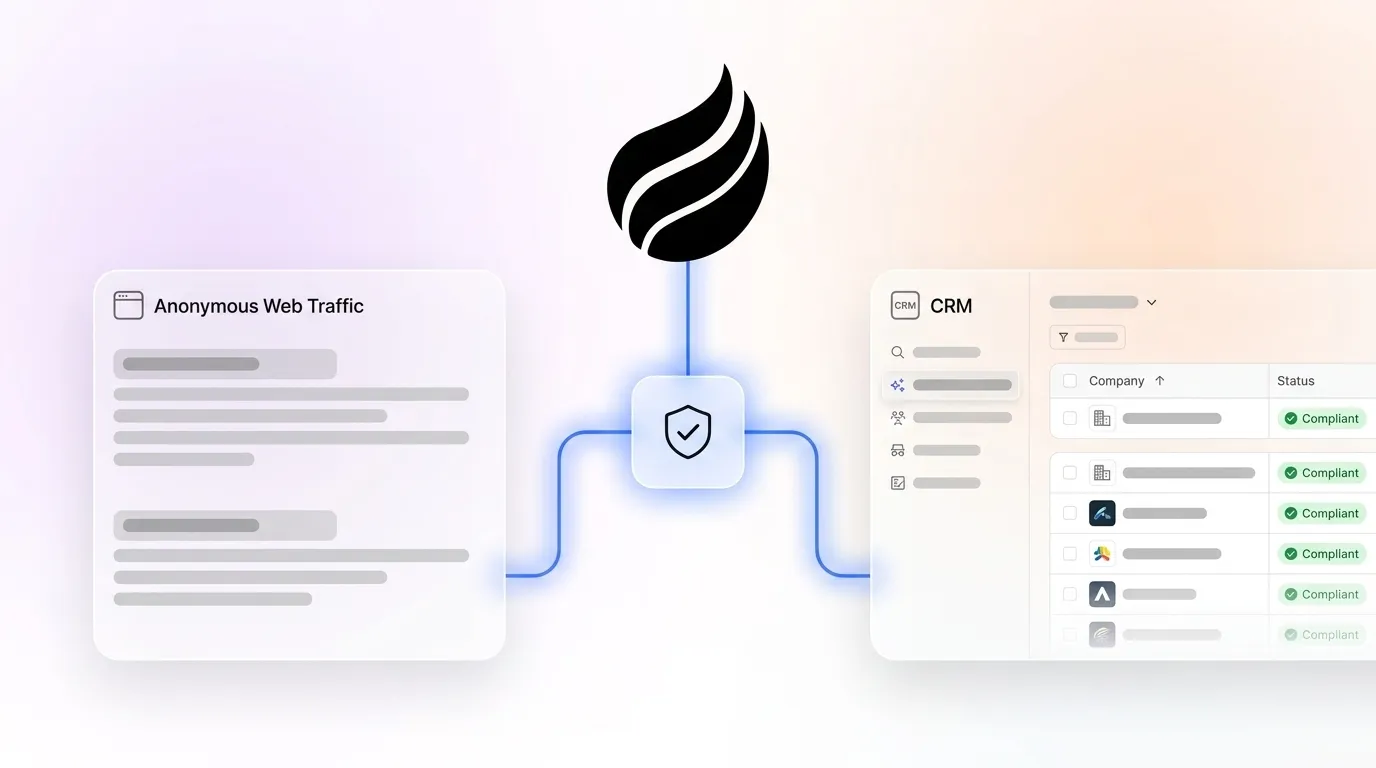
Coffee’s Visitor Identification uses a company-level-first architecture. The pixel resolves organizational signals such as company name, industry, funding stage, pages visited, time on site, and first versus returning visit without processing personal data by default. Named individuals appear only when two conditions are met: the visitor’s geography and consent posture support person-level enrichment, and the individual matches the buyer persona configured in the account.
This company-level-first approach separates Coffee from standalone tools like RB2B and Warmly. Where competitors surface either the company or an undifferentiated list of employees, Coffee’s Suggested Leads feature uses your defined buyer persona to recommend the two or three specific individuals inside that visiting company most worth contacting, with LinkedIn profiles pre-loaded for immediate outreach. The loop from pixel hit to LinkedIn connection request closes inside the agent, without exporting CSVs or switching between tools.
Coffee is SOC 2 Type 2 and GDPR compliant, and customer data is not used to train public models. For teams running Salesforce or HubSpot, the Companion App writes enriched visitor intelligence directly back to the existing system of record.
Ready to deploy a compliant pixel and keep your team focused on selling instead of stitching tools together? Start your Coffee configuration and use the built-in implementation checklist.
Frequently Asked Questions About Visitor Identification
Can websites track me if I do not fill out a form?
Yes. Website visitor identification tools use IP address matching, cookies, device fingerprinting, and identity graph lookups to resolve anonymous sessions into organizational or individual records without any form submission. Company-level identification, which maps your IP address to your employer’s organization, operates without cookies and without your direct interaction. Person-level identification, which attempts to resolve your name and contact details, requires additional signals and, under GDPR for EU visitors, explicit consent before those signals can be processed.
Is an IP address considered personal data under CCPA and GDPR?
Under GDPR, IP addresses qualify as personal data because they constitute an online identifier that can be used to identify a natural person, directly or indirectly. Under CCPA as amended by CPRA, personal information includes internet browsing history and any information that identifies, relates to, or could reasonably be linked with a consumer, a definition broad enough to cover dynamic IP addresses in most contexts. Static IP addresses assigned to a business location receive different treatment from dynamic residential IPs, which helps explain why company-level identification carries lower regulatory risk than person-level tracking.
How do company-level and person-level identification differ for compliance?
Company-level identification maps a visitor’s IP address to an organization using publicly available corporate IP registration data. It identifies the business, not the individual, and in most implementations does not constitute personal data processing under GDPR. It can operate globally under a legitimate interest basis for B2B purposes. Person-level identification attempts to resolve the specific human behind the visit using cookies, device fingerprints, or third-party identity graphs. It processes personal data under both GDPR and CCPA, requires explicit consent for EU traffic, and compliant vendors generally restrict it to U.S.-based visitors. Most B2B teams gain sufficient pipeline intelligence from company-level signals alone, so they avoid the higher-risk layer except where clearly justified.
What consent mechanisms do visitor identification tools require in 2026?
For EU and UK traffic under GDPR, any non-essential tracking, including person-level identification pixels, requires explicit, affirmative opt-in consent before the pixel fires. Pre-ticked boxes do not qualify as valid consent. Consent banners must accurately reflect what the underlying code does, and regulators audit backend behavior against banner promises. For U.S. traffic, the model is opt-out rather than opt-in, but eleven states now require sites to honor Global Privacy Control signals automatically. Every deployment needs a privacy policy that discloses the tracking, a mechanism for visitors to submit deletion requests, and a signed Data Processing Agreement with the identification vendor.
How does Coffee reduce PII exposure in its visitor identification feature?
Coffee defaults to company-level identification for all traffic and resolves organizational signals such as company name, industry, pages visited, and session duration without processing personal data. Named individuals appear only when the visitor’s geography and consent posture support person-level enrichment and when the individual matches the buyer persona defined in the account. This architecture keeps the default output focused on organizational intelligence rather than personal data records. Coffee is SOC 2 Type 2 certified and GDPR compliant, and customer data is not used to train public AI models. Teams can configure real-time Slack notifications for high-fit company visits and add individuals to outreach workflows with one click, using enrichment from compliant data partners.
Conclusion: Build Lower-Risk Pipeline From Anonymous Traffic
Website visitor identification privacy concerns in 2026 reflect an active enforcement environment with nine-figure fines and expanding state-level obligations. B2B growth teams do not need to abandon visitor identification, but they do need to architect it correctly: company-level signals first, person-level enrichment only where consent and geography support it, GPC honored automatically, and retention schedules enforced by the tool instead of by human memory.
Coffee’s agent closes the loop from anonymous traffic to named, persona-matched pipeline without forcing a tradeoff between compliance and conversion. The pixel is privacy-preserving by default, and the Suggested Leads feature removes the manual triage that often turns a 20% match rate into a missed opportunity. Because Coffee operates as either a standalone CRM or a Companion App on top of Salesforce and HubSpot, visitor intelligence writes directly into the system of record your team already uses.
Turn your anonymous traffic into compliant, revenue-ready pipeline without adding a legal headache. Explore Coffee’s pricing and features and design your visitor identification workflow today.