Written by: Doug Camplejohn, CEO & Co-Founder, Coffee | Last updated: July 12, 2026
Why AI-First CRM Changes Daily Sales Work
- AI-first CRMs act as systems of action that capture and structure data automatically, instead of relying on manual rep input.
- Across seven UX criteria, AI-first platforms cut data entry time, simplify navigation, and deliver proactive guidance that menu-driven CRMs cannot match.
- Meeting and pipeline workflows improve when agents handle transcription, summaries, follow-ups, and week-over-week visibility automatically.
- Teams can choose Coffee’s standalone CRM for early-stage needs or its Companion App to enhance existing Salesforce or HubSpot instances without migration.
- Explore Coffee’s pricing to see how an agentic CRM can raise your team’s productivity and data quality.
From System of Record to System of Action
Traditional CRMs work as systems of record, storing whatever humans decide to enter. The architecture assumes that sales reps will log calls, update deal stages, and maintain contact records consistently. Salesforce’s State of Sales report finds that reps spend 60 percent of their time on non-selling tasks including data entry, lead research, and tool-switching, which shows how that assumption breaks down in real teams.
AI-first CRMs operate as systems of action. An agentic platform ingests emails, calendar events, call transcripts, and enrichment signals on its own, then writes structured data back to the record without rep effort. In a traditional system of record, a rep must manually log a call, type notes, update the deal stage, create a follow-up activity, and alert colleagues, while in an AI-powered system of action, the agent transcribes the call, identifies urgency signals, updates the deal stage and close date, creates prioritized activities, and adjusts the revenue forecast within minutes.
Gartner predicts that by 2028, more than 30 percent of enterprise applications including CRMs will incorporate AI agents, and many C-level leaders now treat AI agents as central to their strategic plans. Coffee’s agent architecture supports this shift by acting as the autonomous layer that ensures high-quality data enters the system so accurate insights come out.
Side-by-Side UX Comparison Across Seven Criteria
The following table highlights how AI-first automation changes everyday CRM work. It compares traditional and AI-first experiences across seven UX criteria so you can see where time savings, reduced friction, and better guidance appear in practice.
| UX Criterion | Traditional CRM | AI-First CRM (Coffee) |
|---|---|---|
| Data capture effort | 5.5 hours/week lost to manual entry | CRM sync automation typically recovers 8–12 hours per week for a standard sales rep |
| Interface navigation | Multiple screens to log a single call | Natural-language prompts, agent logs automatically |
| Proactive guidance | Manual report pulls, no next-best-action | Next-best-action matched to historical deal patterns |
| Meeting & follow-up workflows | Rep writes notes, drafts email, logs manually post-call | Agent joins call, generates summary, drafts follow-up automatically |
| Pipeline visibility | Manual CSV exports, periodic reviews | Automated week-over-week pipeline compare with deal-change highlights |
| Adoption friction | 55 percent of CRM implementations fail to meet objectives | AI-driven automation can substantially increase adoption rates |
| Time savings | Baseline, majority of rep time consumed by admin | AI sales tools can save users several hours per week |
Data Capture Effort: Automating CRM Data Entry
Data capture shows the clearest before-and-after UX difference between traditional and AI-first architectures.
Before (traditional CRM): A rep finishes a discovery call, opens the CRM, navigates to the contact record, types call notes, updates the deal stage, sets a follow-up task, and logs the activity. Manual call logging alone accounts for a significant portion of that non-selling time, at 5.5 hours per week for the average rep in 2026.
After (Coffee agent): The agent joins the call via Zoom, Teams, or Meet, transcribes in real time, extracts action items, updates the deal record, and drafts a follow-up email for the rep to review and send. AI-powered CRM integrations in 2026 achieve 95-plus percent accuracy for automated data capture, enabling real-time transcription, sentiment analysis, and context-aware field mapping across voice, email, and call channels.
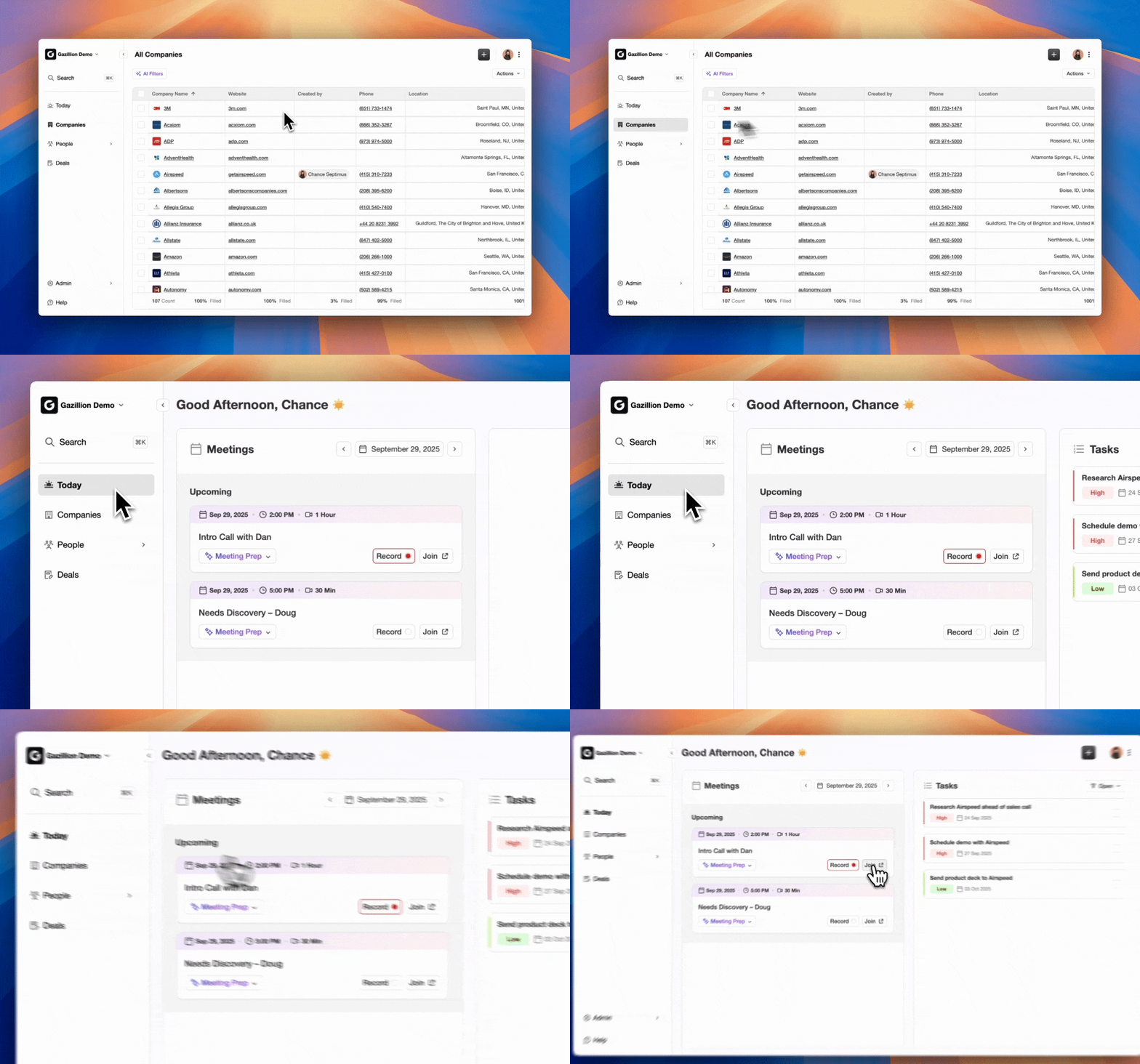
These automation gains apply regardless of your current CRM platform. For mid-market teams already committed to Salesforce or HubSpot, Coffee’s Companion App model delivers the same data-capture benefits without requiring a platform migration. The agent authenticates to the existing instance, syncs data, enriches records with job titles, funding data, and LinkedIn profiles, and writes structured insights back to the primary CRM. Businesses using AI in CRM are more likely to exceed sales goals, and the companion-layer approach makes that outcome accessible while keeping an established tech stack in place.
Navigation and Guidance: Conversational CRM Instead of Menus
Interface navigation shapes how often reps use the CRM at all. Traditional CRM navigation is menu-driven, so logging a call, pulling a pipeline report, or finding a contact’s last activity requires moving through multiple screens, selecting fields, and saving records. Up to 50 percent of CRM implementations fail due to poor user adoption.
AI-first interfaces replace menu navigation with natural-language interaction and proactive surfacing. A rep can ask the agent to pull last week’s pipeline changes, prep a briefing for an upcoming call, or find all contacts at a target account, all without touching a screen hierarchy. CRM adoption across the three largest B2B platforms sits between 40% and 60%, depending on whether you measure logins or actual feature use. With deliberate change management and AI features, adoption can climb higher.
Proactive guidance builds on this conversational layer. AI CRM next-best-action guidance recommends specific moves for each opportunity by matching current deal status against actions that most often advanced similar historical deals, giving new reps the same guidance as veterans. Higher CRM usage correlates with increased sales productivity and reduced reporting time.
Meeting, Follow-Up, and Pipeline Workflows With Agents
Meeting workflows create some of the highest friction in traditional CRM environments. Before a call, reps manually review prior notes and activity history. After a call, they reconstruct the conversation from memory, write a summary, draft a follow-up email, and create tasks, often while rushing to the next meeting.

Coffee’s agent manages the full meeting lifecycle. Before the call, the agent surfaces a briefing with attendee roles, past interactions, and open action items. During the call, the agent records and transcribes. After the call, it generates a structured summary aligned to sales methodologies such as BANT, MEDDIC, or SPICED, drafts a follow-up email in Gmail, and logs all activity to the CRM record automatically. Automating post-call meeting summaries, next steps, and internal recaps enables sellers to move faster after conversations end while giving managers improved visibility into deal history.

Pipeline visibility improves in a similar way. Traditional CRM pipeline reviews depend on manual CSV exports and rep-by-rep updates. Coffee’s Pipeline Compare feature visualizes week-over-week changes automatically, highlighting progressed deals, stalled opportunities, and new additions. This shift turns pipeline reviews from interrogation sessions into strategic discussions. Companies implementing predictive analytics can see improvements in sales forecasting accuracy.
Choosing Between Standalone CRM and Companion App
Coffee’s Standalone CRM fits small and early-stage teams that have outgrown spreadsheets but view traditional CRMs as expensive, manual chores. Setup moves quickly. Connecting Google Workspace or Microsoft 365 activates the agent, and contacts, companies, and activities auto-populate from existing email and calendar data.
The Companion App model serves mid-market teams with established Salesforce or HubSpot instances that struggle with low adoption and poor data quality. A simple authentication deploys the Coffee agent as an intelligent layer, which removes the need for a platform migration while addressing the core data-quality problem.
Training and change management follow a phased roadmap. Agentic CRM implementation uses self-healing data quality capabilities that reduce duplicate contacts, incomplete records, and stale data automatically, improving data quality and reducing admin time compared to legacy systems. Because the agent handles the busywork, rep training focuses on reviewing agent outputs instead of learning complex navigation.
Risks and Limitations of AI-First CRM
AI-first CRM does not fit every environment. Large enterprises with deeply customized Salesforce instances, complex approval hierarchies, or multi-year security review requirements may find that governance overhead outweighs near-term UX gains. Agentic CRM platforms also need a solid data foundation before AI agents can operate reliably.
Heavily regulated industries, especially healthcare and financial services, should review compliance posture carefully before adopting any AI-first platform. Coffee is SOC 2 Type 2 and GDPR compliant, but organizations with bespoke regulatory requirements should still conduct an independent review.
Decision Framework for Selecting Your CRM Model
Use the following criteria together as a simple decision path that links your current constraints to the right operating model.
Start with workload. If your team faces a high manual data entry burden and reps spend many hours each week logging activity, an AI-first CRM or the Companion App can deliver immediate ROI through automated capture.
Next, look at adoption. When CRM adoption sits below 60 percent, conversational interfaces and proactive guidance address the root cause by making the system easier and faster to use.
Then review your existing investments. If you already run Salesforce or HubSpot, Coffee’s Companion App preserves the system of record while adding agent intelligence, which avoids the disruption of a full migration.
Team stage also matters. Small or early-stage teams benefit from Coffee’s Standalone CRM, which removes setup complexity and replaces fragmented point solutions with a single agentic workspace.
Finally, consider governance and forecasting. Complex enterprise or regulated environments may prefer traditional CRM with targeted AI add-ons and extended governance review, while teams with poor pipeline review quality can use automated Pipeline Compare to replace manual CSV exports and improve forecast accuracy.
Frequently Asked Questions
How long does implementation take compared to a traditional CRM?
Coffee’s Standalone CRM activates as soon as you connect Google Workspace or Microsoft 365. The agent begins auto-creating contacts, logging activities, and enriching records from day one with no manual configuration. The Companion App for Salesforce or HubSpot deploys through a simple authentication, after which the agent syncs and enriches data in the existing instance. Traditional CRM implementations usually require weeks of field configuration, data migration, and training before reps can use the system productively.
How accurate is Coffee’s automated data capture?
Coffee’s agent ingests ground-truth data directly from emails, calendar events, and call transcripts, which are more complete and timely than human recollection entered hours after an interaction. The agent converts unstructured data such as call transcripts and email threads into CRM fields automatically and enriches records with job titles, funding data, and LinkedIn profiles via licensed data partners. Because the agent captures every interaction rather than only the ones a rep remembers to log, data completeness becomes substantially higher than in manual-entry environments.
Does Coffee integrate with our existing sales tools?
Coffee connects to Google Workspace and Microsoft 365 natively and integrates with Zoom, Teams, and Google Meet for meeting recording and transcription. For teams on Salesforce or HubSpot, the Companion App writes enriched data and insights back to the primary CRM, which preserves existing workflows and reporting. Broader integrations with third-party tools are available via Zapier, and deeper native integrations are on the product roadmap.
What happens to our existing CRM data if we switch to Coffee’s Standalone CRM?
Coffee supports data migration from existing CRM systems. The agent can ingest historical contact and company records and immediately begins enriching and maintaining them autonomously. Coffee stores interaction history in a built-in data warehouse rather than a flat relational database, so historical context is preserved instead of overwritten when records are updated, which creates a structural advantage over legacy CRM architectures where field updates erase prior values.
Is Coffee suitable for a team that has never used a CRM?
Coffee works well for teams moving off spreadsheets or Notion for the first time. The agent handles data entry, enrichment, and activity logging automatically, so the team avoids a heavy configuration burden. Reps interact with the agent through natural language instead of learning complex menu navigation, which shortens onboarding time compared to traditional CRM platforms.
Conclusion: Matching Coffee to Your CRM Strategy
The UX gap between traditional CRM and AI-first CRM in 2026 appears across every criterion discussed, including data capture effort, interface friction, proactive guidance, meeting workflows, pipeline visibility, adoption rates, and time savings. For mid-market sales and RevOps teams, the key decision now focuses on which deployment model fits the current stack. Coffee supports both paths as a standalone platform and as a companion agent on Salesforce or HubSpot, with the same autonomous data quality at the core.
Compare Coffee’s plans and choose the right deployment model for your team