Written by: Doug Camplejohn, CEO & Co-Founder, Coffee | Last updated: September 6, 2026
Key Takeaways
- Most CRMs underperform because of stale or incomplete data caused by manual entry, rather than the software itself.
- Calculate baseline conversion rates and run stage-by-stage drop-off analysis to pinpoint the biggest revenue leaks.
- Fix data quality first, because dirty records corrupt lead scoring, automation, and forecasting across the entire pipeline.
- Implement lead scoring, 5-minute response automation, and stalled-deal workflows only after records are accurate and complete.
- Ready to turn your CRM into an active conversion engine? Explore Coffee’s pricing and features.
Why Pipeline Conversion Rates Matter And How To Calculate Them
Pipeline conversion rate shows the percentage of deals that move from one stage to the next, or from lead to closed-won. The formula is straightforward:
(Number Of Deals Closed-Won ÷ Number Of Leads Or Opportunities In A Given Period) × 100
For example, 50 opportunities enter the pipeline in a quarter, and 5 close as won. That is a 10% lead-to-close conversion rate. Tracking this metric and its stage-by-stage variants supports revenue predictability, forecasting accuracy, and smarter resource allocation.
Benchmarks vary by industry and sales model. A typical B2B lead-to-close rate falls between 5% and 15%. For service businesses, inbound content-driven leads close at 15–30%, paid ad leads at 5–15%, referrals at 40–70%, and outbound cold outreach at 2–8%. Lead source tracking provides essential context for any conversion benchmark. Focus on stage-by-stage trends over time instead of chasing a single target number.
Diagnose Your Pipeline With Stage-By-Stage Drop-Off Analysis
You need clear measurement before you can improve conversion. Start by pulling CRM data to see exactly where deals stall. Build a diagnostic view with the following structure:
| Stage | Number Of Deals | Conversion Rate To Next Stage | Average Time In Stage |
|---|---|---|---|
| Lead / Inquiry | [Your data] | [Your data] | [Your data] |
| MQL | [Your data] | [Your data] | [Your data] |
| SQL / Discovery | [Your data] | [Your data] | [Your data] |
| Demo / Evaluation | [Your data] | [Your data] | [Your data] |
| Proposal Sent | [Your data] | [Your data] | [Your data] |
| Closed-Won | [Your data] | — | [Your data] |
In Salesforce, use Pipeline reports filtered by stage. In HubSpot, use the Deal Funnel report under Reports. Review at least 30 to 50 leads passing through a stage within a given reporting period before drawing conclusions, because smaller samples skew percentages dramatically. Once you identify the biggest drop-off gap, focus first on that stage instead of changing the entire process at once.
Data Quality: The Hidden Killer Of Conversion Rates
Poor data quality, including incomplete records, duplicates, and outdated contacts, is the central conversion killer. Validity’s 2025 State of CRM Data Management report found that 76% of organizations say less than half of their CRM data is accurate and complete, and 37% of CRM users reported losing revenue as a direct consequence of poor data quality.
The “garbage in, garbage out” problem compounds across every downstream function. Automation applied to dirty data spreads errors faster instead of correcting them. Lead scoring, territory routing, forecasting, attribution, and any AI layered on top all inherit the quality of the records beneath them. Gartner estimates that poor data quality costs organizations an average of $12.9 million annually, with sales bearing a disproportionate share.
The manual entry model creates this structural problem. According to market data shared by Coffee, 71% of sales reps say they spend too much time on data entry, leaving only 35% of their time for selling. When no agent handles the busywork, the CRM shifts from a productivity tool into a productivity drain.
Coffee addresses this at the root. As an AI CRM Agent, Coffee automatically captures emails, calendars, and call transcripts to keep records clean and current, saving reps 8–12 hours per week. It works as a Standalone CRM for SMBs or as a Companion App layered on top of existing Salesforce or HubSpot instances. Coffee writes enriched data back to the system of record without manual effort.

See how Coffee cleans your CRM data automatically and turns your CRM into an active conversion engine.
Lead Scoring And Qualification Rules In Your CRM
Lead scoring ranks high-intent prospects so reps focus on the hottest leads first. Effective scoring criteria include job title, company size, email engagement, demo attendance, and page visits. Medium-sized companies implementing AI-supported lead scoring saw an average of 38% higher conversion rates from lead to opportunity, according to a Forrester report on AI in B2B Sales.
Once your data is clean, you can trust the signals that drive prioritization. In Salesforce, configure lead scoring natively or through Pardot (now Marketing Cloud Account Engagement). In HubSpot, use the Lead Scoring tool under Contacts. Automation updates scores continuously based on behavior, so the prioritization list stays current without manual intervention.
The conversion lift from AI lead scoring comes from wiring scores into a six-step chain: Score, Prioritize, Route, Next-Best-Action, Personalize, and Follow-Up SLA. Each stage amplifies the previous one, and breaking any link reduces conversion impact. Scoring alone does not drive results unless it connects end-to-end to automated routing and timed follow-up.
Coffee automatically captures and structures interaction data from emails, calls, and calendars. That means the signals feeding your scoring model are accurate and complete, instead of relying on what a rep remembered to log.
Speed-To-Lead And Follow-Up Automation With A 5-Minute Response
Response time is one of the highest-leverage variables in pipeline conversion. Research from Harvard Business Review and Lead Connect shows that responding to an inbound lead within 5 minutes makes the lead 21x more likely to convert than responding after 30 minutes. The 2026 Speed-to-Lead Benchmark from ArtemisGTM reports that the median B2B team takes 42 hours to respond to an inbound lead, and only about 7% of teams respond within five minutes.
78% of customers purchase from the first company to respond to their inquiry, and 35–50% of sales go to the vendor that responds first. The gap between best-in-class and average reflects coverage and automation limits rather than motivation.

Use these automation recipes to close that gap:
- In Salesforce, use Flow to trigger instant email alerts and assign follow-up tasks the moment a lead is created.
- In HubSpot, use Workflows to enroll new leads in an immediate outreach sequence with pre-built templates.
- Set up round-robin routing rules so leads are assigned to available reps instead of sitting in a shared inbox queue.
- Use calendar-based instant booking links in outreach to remove scheduling back-and-forth.
CRM Automation Workflows For Stalled Deals
Speed-to-lead covers the initial response, but deals can still stall later in the pipeline. Stalled deals create a predictable pipeline leak. Every stage transition in a CRM pipeline should trigger at least one automation, and stuck leads with no movement in 3–5 days should have automatic recovery workflows.

Use these specific automation recipes for stalled deals:
- In Salesforce, use Flow to trigger an email alert to the rep and a follow-up task when a deal has been inactive for 7 days.
- In HubSpot, use Workflows to enroll deals that have been in a stage for a defined number of days, automatically sending a re-engagement email or creating a task.
- Set up internal Slack notifications when high-value deals cross a staleness threshold so managers can intervene before deals go cold.
- Create automated nurture sequences for deals that go dark at the proposal stage, including ROI summaries and mutual action plan templates.
Coffee’s Pipeline Compare feature surfaces week-over-week changes automatically. It highlights progressed deals, stalled opportunities, and new additions, which turns pipeline reviews into strategic discussions instead of manual CSV export sessions.
Quick Reference: 10 Ways To Improve Pipeline Conversion In Your CRM
- Deduplicate records and complete missing fields before running any automation (see Data Quality section).
- Score leads based on fit and engagement signals, including behavior beyond simple form submissions.
- Respond to inbound leads within 5 minutes using automated routing and instant alerts.
- Automate follow-up sequences so no lead slips through the cracks when reps are busy.
- Track stage-by-stage drop-offs monthly to catch problems before they compound.
- Qualify leads early with clear exit criteria agreed upon by both marketing and sales.
- Run weekly pipeline reviews using automated stage-change reports instead of manual exports.
- Enrich records with firmographic and technographic data to support accurate segmentation and personalization.
- Set a defined next step for every deal before moving it to the next stage.
- Use an AI agent for automatic data entry and enrichment so every other tactic runs on clean data.
A 30-Day Action Plan To Boost Conversion Rates
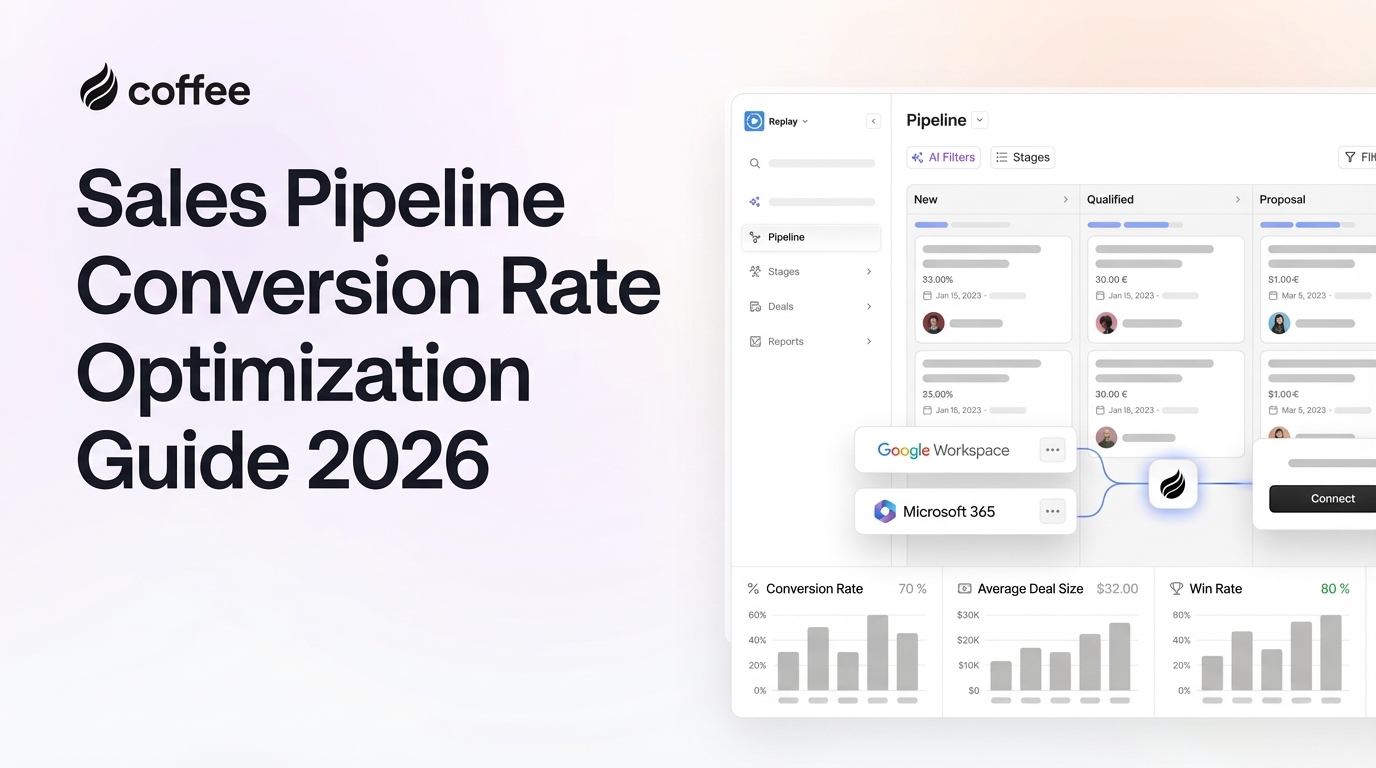
Week 1: Audit your pipeline data. Run a deduplication pass, identify records with missing required fields, and pull a random sample of 50 records to assess overall data health. Coffee handles this automatically after connection to Google Workspace or Microsoft 365, scanning emails and calendars to populate and enrich records from day one.
Week 2: Set up lead scoring in Salesforce or HubSpot using firmographic fit and behavioral engagement criteria. Automate follow-up sequences for new inbound leads with a sub-5-minute response SLA enforced by workflow automation.
Week 3: Build the stage-by-stage diagnostic table using your CRM’s funnel reports. Identify the single biggest drop-off point and diagnose its root cause by reviewing 20–30 individual records from that stage.
Week 4: Launch stalled-deal automation workflows for deals inactive beyond your defined threshold. Review leading indicators such as email engagement rates, average time in stage, and follow-up completion rates, then adjust. Coffee’s Pipeline Compare feature makes this review automatic.
Strategic Considerations For Manual And AI-Powered Pipeline Management
Manual CRM management creates a structural ceiling on performance. Salesforce’s 2026 State of Sales report found that reps spend 60% of their time on non-selling tasks, and reps who feel overwhelmed by their tech stack are 45% less likely to attain quota. Workflow tweaks and cleanup drives help only temporarily because the manual entry requirement remains.
Building custom automation inside Salesforce or HubSpot is possible but time-consuming and requires ongoing maintenance. These automations still depend on humans to capture the raw data that feeds them. Gartner research from May 2026 found that AI saves sellers 4.8 hours per week on average, but 72% of sales organizations fail to reinvest that time into high-value selling activities. Organizations that do reinvest are 3.1x more likely to exceed lead-to-opportunity conversion goals.
Coffee is built for this inflection point. As a Companion App for Salesforce and HubSpot, it deploys as an intelligent layer that handles data capture, enrichment, meeting summaries, and pipeline tracking, without replacing the system of record teams already rely on. For teams not yet committed to a legacy CRM, Coffee’s Standalone AI-First CRM provides the same agent-led approach from the ground up. In both cases, reps spend more time selling instead of serving the software.
Let Coffee handle the busywork for your team so they can focus on selling.
Frequently Asked Questions
How Do I Calculate Sales Pipeline Conversion Rate?
Divide the number of deals closed-won by the total number of leads or opportunities that entered the pipeline in a given period, then multiply by 100. For example, if 80 opportunities entered the pipeline last quarter and 12 closed as won, the conversion rate is 15%. This formula applies to the full funnel, from lead to close, or to any individual stage transition such as MQL to SQL or SQL to demo. Tracking both views gives a complete picture of where the pipeline is healthy and where it leaks.
What Is A Good Pipeline Conversion Rate?
Benchmarks vary significantly by industry, sales model, and lead source. For B2B companies, a healthy lead-to-close rate typically falls between 5% and 15%. Referral leads close at much higher rates than cold outbound leads. Focus on stage-by-stage trends over time instead of a single aggregate number. A consistent improvement in MQL-to-SQL conversion, for example, is more actionable than chasing an industry average that may not reflect your specific market, deal size, or sales cycle length.
How Can I Reduce Pipeline Drop-Off In CRM?
Start with a stage-by-stage diagnostic to identify the single biggest leak point, meaning the stage where the gap between entries and exits is largest relative to expectations. Once you identify that stage, diagnose the root cause before making changes. Common root causes include poor data quality that blocks accurate scoring and routing, slow lead response times, misaligned MQL definitions between marketing and sales, and missing follow-up automation for stalled deals. Fix the highest-revenue-impact bottleneck first, measure the result, then move to the next.
Does CRM Automation Really Improve Conversion Rates?
Yes, when automation runs on clean data. Automation enforces speed-to-lead SLAs, ensures no lead is missed when reps are unavailable, re-engages stalled deals systematically, and keeps scoring models current based on real behavior. As noted earlier, responding within 5 minutes dramatically increases conversion odds, and only automation can close that gap reliably at scale. As mentioned, automation on dirty data only spreads errors, so accurate and complete records form the prerequisite for effective CRM automation.
How Does Coffee Improve Pipeline Conversion?
Coffee is an AI CRM Agent that addresses the root cause of low conversion rates: poor data quality from manual entry. After connecting to Google Workspace or Microsoft 365, Coffee automatically creates and enriches contacts, logs activities, captures call transcripts, and writes structured summaries back to the CRM, saving reps 8–12 hours per week. Because the data entering the system is accurate and complete, every downstream function improves. Lead scoring works on real signals, follow-up automation runs on current records, and pipeline forecasts reflect actual deal state. Coffee works as a Standalone CRM for SMBs or as a Companion App layered on top of existing Salesforce or HubSpot instances.
Conclusion: Turn Your CRM Into A Conversion Engine
The pipeline conversion problem starts as a data problem. Manual entry creates incomplete, duplicated, and outdated records. Those records weaken lead scoring, delay follow-ups, and produce forecasts that no one trusts. Workflow tweaks and cleanup drives treat symptoms without addressing the structural cause.
The practical path forward follows a diagnostic-to-execution framework. Calculate your baseline conversion rates, identify the stage-by-stage leaks, fix the data quality root cause with an AI agent, then layer on lead scoring, speed-to-lead automation, and stalled-deal workflows. Every tactic in this guide performs better when the underlying data is clean, and clean data requires removing the manual entry dependency entirely.
Ready to boost your pipeline conversion rates? Try Coffee’s AI agent for your pipeline and let it handle data entry so your team can focus on closing deals.