Written by: Doug Camplejohn, CEO & Co-Founder, Coffee | Last updated: July 2, 2026
Key Takeaways
- Sales intelligence tools in 2026 differ sharply in data accuracy, CRM integration friction, and automation depth, which shapes long-term CRM data quality.
- Most platforms still rely on humans for enrichment, deduplication, and activity logging, so they shift data-entry work instead of removing it.
- Autonomous AI agents outperform static databases by monitoring communications, creating records, and logging activity without any rep action.
- Company stage and CRM stack drive the right approach, with early-stage teams favoring standalone agent CRMs and larger teams needing companion layers.
- Teams ready to eliminate manual data entry can explore Coffee’s agent solutions at Coffee.
Sales Intelligence Tools in 2026: What They Actually Do
A sales intelligence tool is a software platform that gives B2B sales teams verified contact data, firmographic and technographic details, buyer intent signals, and prospecting workflows. These capabilities help teams identify and engage potential customers more efficiently. Core features usually include contact and company search, email and phone verification, CRM enrichment, and, in newer platforms, behavioral intent data from third-party web activity.
Even the strongest tools in this category still require human intervention somewhere in the workflow. Reps or RevOps teams review enriched records, resolve duplicate contacts, or manually log activity back into the CRM. That dependency creates the main evaluation risk for any team that cares about long-term CRM data quality.
Eight Criteria That Predict CRM Impact
Clear criteria keep vendor comparisons grounded. The following eight dimensions determine whether a tool improves or harms CRM health over time.
1. Data accuracy and verification: What percentage of contacts have verified emails and direct dials, and how often is the database refreshed?
2. Enrichment depth: Does the tool provide firmographics, technographics, funding data, and org-chart relationships, or only basic contact fields?
3. CRM integration friction: Does the tool write data directly to Salesforce or HubSpot, or does it rely on CSV exports, manual copy-paste, or middleware?
4. Automation of data entry and logging: Does the platform automatically log calls, emails, and meetings, or must the rep initiate every sync?
5. Buyer intent signals: Are intent signals first-party, third-party, or both, and how are they surfaced and turned into actions?
6. Pricing transparency: Is pricing seat-based, usage-based, or credit-based, and are enrichment credits metered separately?
7. Compliance: Does the vendor hold SOC 2 Type 2, GDPR, and CCPA certifications that match your data handling obligations?
8. Long-term data quality outcomes: Does the tool create duplicate records, overwrite existing fields, or introduce stale data into the CRM over time?
Sales Intelligence Tools Comparison 2026: Data, Friction, and Automation
The table below compares ten platforms on the three criteria that most directly predict long-term CRM health. Data accuracy determines what enters your system. Integration friction determines how much manual cleanup your team performs. Automation depth determines whether data quality improves or degrades as your team scales. Integration friction and automation ratings reflect documented product behavior and widely reported user experience patterns.
| Tool | Data Accuracy & Verification | CRM Integration Friction | Automation of Data Entry |
|---|---|---|---|
| ZoomInfo | Large verified database, refresh cadence varies by tier | Native Salesforce/HubSpot connectors, field mapping requires admin setup | Enrichment triggers available, activity logging requires rep action |
| Apollo.io | Broad contact coverage, accuracy inconsistent on direct dials | Native connectors, duplicate management is a reported pain point | Sequences automate outreach, CRM sync is partially manual |
| Cognism | GDPR-verified mobile numbers, strong EMEA coverage | Native Salesforce/HubSpot, setup requires RevOps configuration | Enrichment on push, no autonomous activity logging |
| 6sense | Intent-focused, contact data supplemented by third-party sources | Deep Salesforce integration, implementation is enterprise-grade and lengthy | Account scoring automated, contact-level logging requires human action |
| LinkedIn Sales Navigator | Self-reported profile data, high coverage, variable accuracy | CRM sync available, bi-directional write-back requires configuration | No autonomous logging, all activity manual |
| Clearbit (now HubSpot Enrichment) | Firmographic enrichment strong, contact-level accuracy moderate | Native HubSpot, Salesforce via API with developer effort | Form enrichment automated, outbound prospecting manual |
| Lusha | Contact-focused, direct dial accuracy competitive for SMB | Chrome extension primary, CRM push available but not bidirectional | Minimal automation, rep-initiated enrichment |
| Seamless.AI | Real-time search model, accuracy claims disputed in user reviews | Native connectors, duplicate creation is a documented issue | List building automated, CRM hygiene requires manual review |
| RB2B | Website visitor identification, person-level data for U.S. traffic | Slack/webhook delivery, no native CRM write, manual routing required | Identification automated, all downstream action is manual |
| Warmly | Visitor identification with intent overlay, company-level strong | Salesforce/HubSpot connectors available, contact matching requires review | Alerts automated, rep must action each identified visitor |
Data Capture and Enrichment Realities in Everyday Use
Static database tools like ZoomInfo and Apollo.io excel at top-of-funnel prospecting but create a recurring cleanup burden. When enriched records flow into Salesforce or HubSpot, field conflicts, duplicate contacts, and overwritten ownership data appear frequently. Intent platforms like 6sense deliver account-level signals effectively but usually need a dedicated RevOps resource to configure scoring models and maintain the integration.
Visitor identification tools such as RB2B and Warmly automate the identification step but deliver leads into Slack or a dashboard. Reps then manually create the CRM record, enrich it, and log the first touch. Every category, without exception, hands some portion of the data entry burden back to a human.
Salesforce and HubSpot Integration Pain Points in Practice
The most common complaint from RevOps teams running these integrations is not connection failure. The real issue is that the connection creates new maintenance work. Native connectors for ZoomInfo, Apollo, and Cognism require field mapping decisions that age poorly as CRM schemas evolve.
Duplicate detection logic in Salesforce does not automatically reconcile records pushed from an external enrichment tool, so teams run deduplication scripts quarterly. HubSpot’s property structure means enrichment tools frequently create new properties instead of populating existing ones, which fragments the contact record. The net result is that teams spend time cleaning data that the intelligence tool was supposed to improve.
2026 AI-Agent Capabilities vs. Static Databases
Traditional sales intelligence tools function as retrieval systems. A rep queries a database, selects records, and pushes them into another system. The human remains the orchestration layer. Autonomous agents operate differently and remove that orchestration burden.
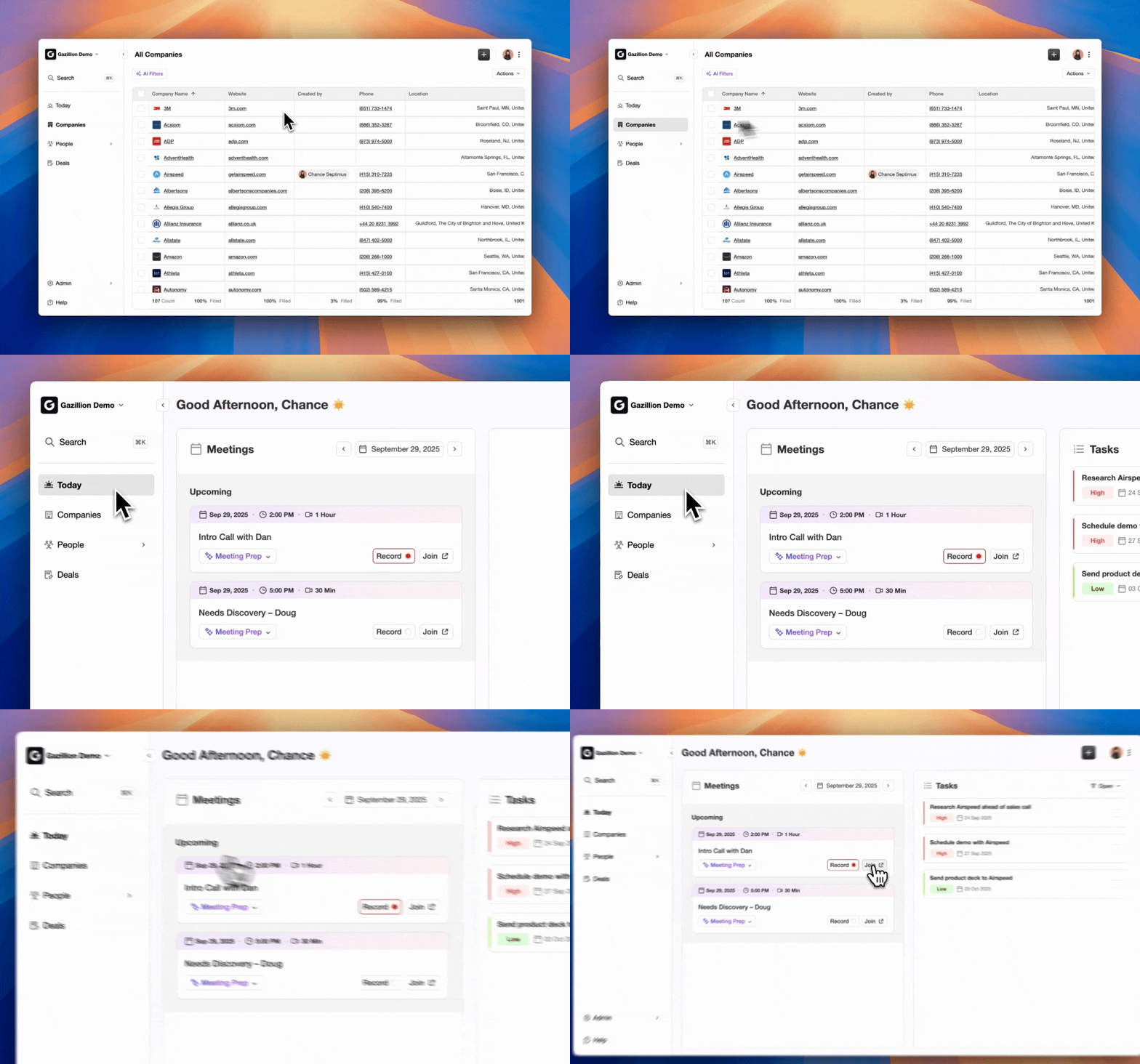
Coffee’s agent connects to Google Workspace or Microsoft 365, scans emails and calendar events, auto-creates contacts and companies, logs activity, enriches records via licensed data partners, and generates post-meeting summaries and follow-up drafts. The agent also joins calls via Zoom, Teams, or Meet, transcribes them, and structures notes according to BANT, MEDDIC, or SPICED. This structure ensures qualification data enters the CRM consistently. This autonomous operation, described earlier, means Coffee’s agent handles all these steps without rep involvement.
Data Entry Reality Check for Modern Sales Teams
Seventy-one percent of sales reps report spending too much time on data entry, which leaves only 35% of their time for actual selling. When reps must log calls, update deal stages, and manually enrich contacts, CRM quality degrades in direct proportion to pipeline volume. High-activity periods such as end of quarter or post-event are exactly when data entry falls furthest behind.
Those same periods are when forecast accuracy matters most. This pattern creates a “good data in, bad data out” cycle. The CRM becomes unreliable at the moment leadership needs it most, and the intelligence tools layered on top inherit the same inaccuracy.
Best-Fit Use Cases by Company Stage and CRM Stack
Early-stage teams (1–20 employees): A standalone AI-first CRM with built-in enrichment removes the need to stitch together a separate intelligence tool, a CRM, and a meeting recorder. Coffee’s Standalone CRM is purpose-built for this profile.

Growing sales organizations (20–200 employees) on HubSpot or Salesforce: The existing CRM investment is too large to replace, while data quality is already slipping. Coffee’s Companion App deploys the agent on top of the existing instance, handling enrichment and activity logging without migrating records.

Mid-market teams with intent requirements: 6sense or Warmly can provide account-level intent signals, but the downstream data entry problem persists unless an agent layer manages CRM write-back.
Operational Considerations and Scaling Data Quality
Tools that rely on rep-initiated actions perform worse as headcount grows. As the team expands, variance in data entry discipline increases, and CRM quality drifts toward the habits of the least diligent rep. Agent-based systems scale in the opposite direction.
The agent’s output remains consistent regardless of team size. The data warehouse underlying Coffee’s architecture also preserves historical context even when fields are updated. Standard relational CRM databases rarely handle that requirement cleanly.
Risks, Limitations, and Common Misconceptions
The most common misconception is that purchasing a sales intelligence tool solves the CRM data problem. It does not. It shifts the problem from initial capture to ongoing maintenance, as described earlier. Enrichment tools improve the quality of net-new records at the moment of import, yet they do not maintain that quality over time and do not log the activity that shows whether a deal is progressing.
A second misconception treats verified contact accuracy as binary. All major vendors report verification rates that reflect a point-in-time snapshot. Contact data decays at roughly 30% annually, which means a database verified six months ago has already degraded meaningfully for a portion of records.
Decision Framework and Practical Checklist
Use the following criteria to match a tool to your situation and constraints.
Company size 1–20, no existing CRM: Prioritize a platform where the agent is the system of record, because at this stage you are building your data foundation from scratch rather than fixing an existing one. This means you should avoid tools that require a separate CRM plus an intelligence layer plus a meeting recorder, since the integration overhead will exceed the value before you have the RevOps capacity to manage it.
Company size 20–200, committed to Salesforce or HubSpot: Prioritize CRM integration depth and autonomous activity logging. Evaluate whether the tool writes back to existing fields or creates new ones. Require a demo of the deduplication behavior so you see how it handles overlapping records.
Budget under $500/month per seat: Credit-based pricing models such as Apollo or Lusha can appear cheaper while metering enrichment separately. Calculate total cost including expected enrichment volume, not just license price.
Low tolerance for manual work: Require the vendor to demonstrate autonomous logging. A sync button or Chrome extension push still relies on reps. If the vendor cannot show logging that happens without rep action, the manual work remains.
Compliance requirements: Confirm SOC 2 Type 2, GDPR, and CCPA certifications before procurement. For EMEA-touching data, Cognism’s verified mobile data approach is particularly relevant.
Frequently Asked Questions
How long does implementation typically take?
Implementation timelines vary significantly by tool category. Static database tools like Apollo or Lusha can be operational within a day via Chrome extension, while full CRM integration with field mapping and deduplication rules usually takes one to three weeks of RevOps configuration. Enterprise intent platforms like 6sense often require a formal implementation engagement of four to twelve weeks.
Coffee’s Standalone CRM activates within minutes of connecting Google Workspace or Microsoft 365, and the agent begins scanning emails and calendars immediately. The Companion App for Salesforce or HubSpot requires a simple authentication step and field-mapping review, which standard configurations complete in under an hour.
What is the migration effort from existing tools?
Migration effort depends on how much historical data you must preserve and how clean the existing records are. Moving from one static database tool to another is generally low-effort, since contact lists export as CSV and re-import easily. Moving CRM data is more complex because custom fields, deal history, and activity logs require mapping and validation.
Coffee’s Companion App avoids this problem entirely for Salesforce and HubSpot users because it does not replace the CRM. It adds the agent layer on top of the existing instance. For teams adopting Coffee’s Standalone CRM, the migration path from spreadsheets or lightweight CRMs is straightforward, and the agent begins enriching and organizing records immediately after import.
How should teams measure ongoing data quality?
Three metrics provide a reliable ongoing signal. Contact record completeness tracks the percentage of contacts with verified email, phone, title, and company. Activity log coverage tracks the percentage of meetings and calls with a corresponding CRM activity record. Forecast accuracy measures variance between committed pipeline and closed revenue.
The first two metrics act as leading indicators of the third. Teams using agent-based systems should see contact completeness and activity coverage approach 100%, because the agent handles both without rep action. Teams using rep-dependent tools should audit these metrics quarterly and expect degradation during high-activity periods.
Which security certifications matter most in 2026?
SOC 2 Type 2 remains the baseline requirement for any tool that processes customer or prospect data. GDPR compliance is mandatory for any team with European prospects or customers. CCPA compliance is relevant for California-based data subjects. Teams in regulated industries may also require certifications such as ISO 27001.
Coffee holds SOC 2 Type 2 and GDPR certifications, and data processed by the Coffee Agent is not used to train public models. That policy matters for teams handling sensitive deal information or proprietary customer data.
How do I evaluate fit for my specific stack?
Start with the CRM write-back question and confirm whether the tool writes to your existing fields or creates new ones. Then test the deduplication behavior by importing a set of records that already exist in your CRM and observing the outcome. For activity logging, run a pilot week with the tool live and compare the number of meetings held against the number of activity records created in the CRM. The gap reveals your manual work estimate.
For Coffee specifically, the Companion App can be evaluated against your live Salesforce or HubSpot instance. The agent’s behavior on real data provides the most reliable signal of fit.
Conclusion: Protect CRM Data Quality When Choosing Sales Intelligence
The evaluation criteria that matter most in 2026 focus on downstream effects on CRM data quality, not just contact database size or intent signal breadth. Any tool in this category that relies on human action to complete the data entry loop will produce inconsistent results as team size and pipeline volume grow. An autonomous agent that handles enrichment, activity logging, and record creation without waiting for a rep provides the only structural fix.
Coffee’s agent operates as that layer. It can serve as the system of record for teams that have outgrown spreadsheets or as the intelligence and automation layer on top of existing Salesforce and HubSpot instances. Both approaches deliver the same outcome: reliable data in and reliable data out, without the manual work that makes legacy approaches unsustainable.