Written by: Doug Camplejohn, CEO & Co-Founder, Coffee | Last updated: August 17, 2026
Key Takeaways
- Modern sales enablement tools in 2026 combine content, training, coaching, and AI agents to automate CRM tasks and tie content usage to pipeline results.
- Five core pillars, including strategy, content, learning, technology, and measurement, form the foundation of any effective sales enablement program.
- Legacy platforms rely on manual data entry, while AI-agent solutions like Coffee autonomously log activities and enrich CRM records.
- Team size and existing CRM shape the right deployment: Coffee Standalone for smaller teams or Coffee Companion for those already using Salesforce or HubSpot.
- Teams ready to automate sales enablement can see Coffee in action and evaluate how an agent layer delivers clean data and measurable ROI.
The Five Pillars of Sales Enablement Programs
A complete sales enablement program rests on five pillars, and each one addresses a specific failure point that hurts quota attainment and forecast accuracy for mid-market teams.
-
Strategy and Planning for Consistent Execution
Strategy sets the methodology, KPIs, and cross-functional ownership before any tool is purchased. Without that foundation, even strong technology automates the wrong processes, so teams that select a structured methodology such as MEDDIC or BANT and secure buy-in from sales, marketing, and RevOps create a base every other pillar depends on.
A 20-person SaaS team that aligns on MEDDIC entry criteria before deploying a CRM agent ensures the agent captures the right qualification fields automatically on every call, because the strategy defines what “right” means. Organizations with formal sales enablement programs often report higher win rates than peers without them.
Sales Content and Buyer-Facing Assets That Match Each Stage
Content enablement maps playbooks, battlecards, case studies, and ROI calculators to specific buyer stages and personas. Surveys from 2014–2025 report that 44–77% of organizations have a documented content strategy or take a strategic approach to content, which leaves many reps improvising at critical deal moments.
A rep entering a competitive displacement call with a pre-built battlecard closes faster than one searching a shared drive. Reps gain selling time when they stop searching for content and guessing next steps, and organizations running a formal content strategy often see improvements in win rates.
Learning and Development That Reinforces Skills
Structured onboarding with milestone-based progression and continuous skills training accelerates time to quota. Reps forget 87% of training within 30 days without reinforcement, so ongoing coaching becomes a non-negotiable investment.
A new enterprise rep who completes certification checkpoints and call-shadowing plans reaches competency faster than one who receives a one-week onboarding and then self-directs. New reps with structured ramp programs reach quota 35% faster.
Technology and Tools That Reduce Non-Selling Work
The technology pillar operationalizes every other pillar by integrating CRM, conversation intelligence, and pipeline analytics into a single workflow. Reps spend 60% of their time on non-selling tasks when technology is fragmented across disconnected point solutions, a problem that compounds when many reps report spending too much time specifically on data entry.
In 2026, this pillar increasingly includes AI agents that auto-log CRM activity, generate post-meeting summaries, and surface visitor identification data, capabilities that legacy platforms cannot deliver without manual input. Combining AI with sales automation accelerates follow-ups, scores accounts, and updates CRM records without manual data entry.

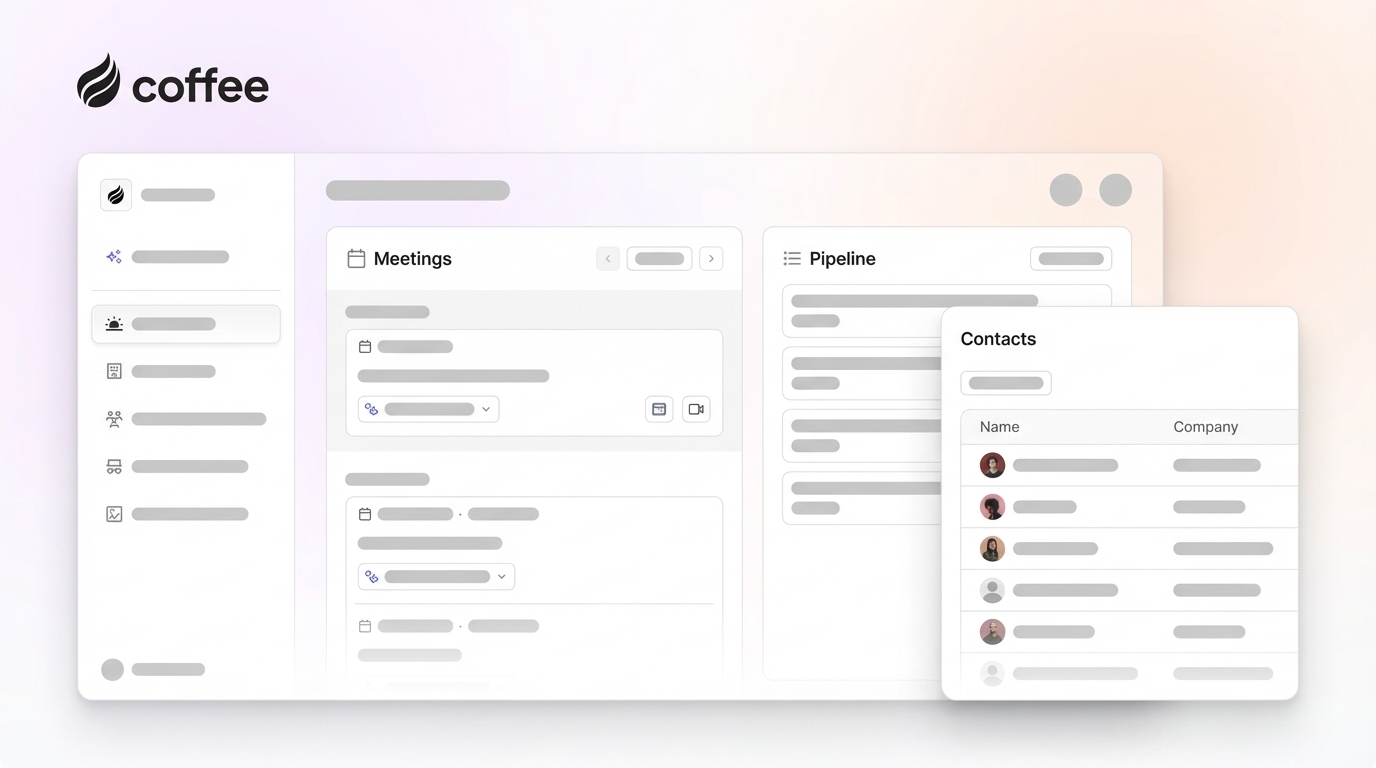
Automated meeting prep with Coffee AI CRM Agent Measurement and Optimization for Continuous Improvement
Measurement closes the loop by tracking leading indicators such as content usage, training completion, and ramp time alongside lagging indicators such as win rates, quota attainment, and deal velocity. Many sales teams still do not fully track their content’s effectiveness.
Pipeline-compare analytics, a 2026 capability built into agents like Coffee, replace manual CSV exports with automated week-over-week deal movement views. Stronger enablement programs correlate with revenue growth when teams use these insights to refine their approach.
The five pillars above define what sales enablement must accomplish, and the next step is choosing a technology architecture that can support all five without forcing reps to feed the system manually.
Legacy Platforms Compared to AI-Agent Solutions
The table below shows why legacy platforms often fail to deliver ROI for mid-market teams, because every dimension traces back to manual data entry. Compare how each platform handles the four operational bottlenecks that determine forecast accuracy, then note how agent automation removes the root cause in each case.
Dimension Legacy Platforms (e.g., Highspot, Seismic, Salesforce) AI-Agent Solutions (e.g., Coffee) Why It Matters Data Entry Effort Relies on manual rep input, structured fields only Agent auto-logs calls, emails, and calendar events, so reps save hours per week As noted earlier, the majority of reps lose selling time to data entry, leaving only 35% of their time for actual selling CRM Integration Depth Tracks completion rates, cannot operate across fragmented stacks Authenticates to Salesforce or HubSpot and reads and writes enriched data automatically Failed CRM integrations rank among the top reasons for implementation failure Coaching Automation Delivers diagnostic advice, managers manually review a limited number of calls per week Analyzes 100% of conversations and surfaces skill gaps plus personalized coaching automatically Dedicated sales coaches achieve 32% higher win rates and 28% higher quota attainment compared to player-coach models. Pricing Model Implementation involves significant costs plus per-seat license fees and add-on modules Simple seat-based pricing, and agent labor is included with no metering on usage or processes Mid-market teams need predictable costs, because hidden add-on fees erode 90-day ROI AI agents coordinate multi-step workflows, including meeting preparation, content recommendation, follow-up drafting, and coaching, while operating within defined guardrails, a capability static platforms cannot replicate.

Create instant meeting follow-up emails with the Coffee AI CRM agent Buyer-Size Decision Matrix for Coffee Deployments
The matrix below shows that one variable, existing Salesforce or HubSpot usage, shapes the deployment path more than team size alone. SMB and mid-market teams follow the same logic, where an existing CRM points to Coffee Companion and no CRM points to Coffee Standalone, while enterprise requirements shift the decision toward governance and compliance needs.
Segment Team Size Primary Pain Recommended Solution SMB 1–20 employees Outgrown spreadsheets, manual CRMs feel like expensive chores Coffee Standalone CRM, where the agent manages the full system of record with automatic contact creation and pipeline compare Mid-Market 21–50 employees Low CRM adoption, poor data quality, fragmented point solutions Coffee Companion App, an agent layer on top of existing Salesforce or HubSpot that enriches and writes data back automatically Enterprise 50+ employees Complex custom workflows, governance requirements, multi-region compliance Full enterprise content management platforms such as Seismic or Highspot with dedicated enablement operations, because Coffee does not fit large enterprise deployments For Heads of Sales and RevOps leaders at 10–50 person B2B companies, the decision centers on whether the team already has Salesforce or HubSpot. If the answer is yes, Coffee Companion deploys as an agent layer without a rip-and-replace migration. If the answer is no, Coffee Standalone replaces the spreadsheet or legacy CRM with an agent-first system of record from day one.
Get your 90-day ROI projection based on your team size and CRM setup.
How to Integrate Enablement with Your Existing CRM
Integrating a sales enablement agent with an existing CRM follows three concrete steps, and skipping the first step often causes enablement investments to miss the mark on clean data output.
- Audit CRM data integrity first. Mid-market teams must enforce clean contact and company data plus clearly defined deal stages before automation or AI agents can effectively reduce administrative burden. Map which fields are empty, stale, or inconsistently populated. Coffee’s agent begins enriching records immediately after connecting to Google Workspace or Microsoft 365, and a pre-audit ensures the agent writes to the right fields from day one.
- Authenticate the agent connection. Coffee’s Companion App connects to Salesforce or HubSpot through a simple authentication flow. The agent then reads emails, calendar events, and call transcripts to auto-create contacts, log activities, and enrich records with job titles, funding data, and LinkedIn profiles, all without rep involvement. Coffee is SOC 2 Type 2 and GDPR compliant, and data is never used to train public models.
- Activate conversation intelligence and pipeline compare. Once the agent logs clean data, enable the AI meeting bot to join calls on Zoom, Teams, or Meet. Post-call, the agent generates summaries, identifies next steps, and drafts follow-up emails, tasks that previously required 30–45 minutes of manual work per meeting. Pipeline Compare then visualizes week-over-week deal movement automatically, replacing the manual CSV exports that consumed another 2–3 hours each week. Together, these automations reclaim 8–12 hours per week that reps previously spent on data entry and meeting administration.
Integrations that connect tools to streamline workflows, when coupled with AI, eliminate manual data entry while providing immediate insights into go-to-market strategy performance. The three steps above compress what legacy platforms take 8–12 weeks to achieve into a deployment measured in days for mid-market teams.

Join a meeting from the Coffee AI platform Frequently Asked Questions
What are the five pillars of sales enablement?
The five pillars of sales enablement are strategy and planning, sales content and buyer-facing assets, learning and development, technology and tools, and measurement and optimization. Strategy sets the methodology and KPIs that guide every other pillar. Content maps playbooks, battlecards, and case studies to specific buyer stages. Learning and development builds rep capability through structured onboarding and continuous coaching. Technology operationalizes the program by integrating CRM, conversation intelligence, and pipeline analytics. Measurement closes the loop by tracking content usage, win rates, ramp time, and quota attainment to identify what works and what needs adjustment.
What is the best sales enablement tool?
The best sales enablement tool depends on team size, existing CRM investment, and the primary bottleneck. For 1–20 person teams that have outgrown spreadsheets, Coffee’s Standalone CRM delivers an agent-first system of record that handles data entry, meeting management, and pipeline intelligence without manual input. For 21–50 person teams already on Salesforce or HubSpot, Coffee’s Companion App is a strong option because it deploys as an agent layer that enriches and writes clean data back to the existing CRM without a migration.
For larger enterprise teams with complex governance requirements, platforms such as Seismic or Highspot provide the content management depth and role-based permissions those organizations require. Across all segments, CRM data quality remains the non-negotiable criterion, because a sales enablement tool that ignores data hygiene produces inaccurate forecasts and failed coaching ROI regardless of its feature set.
How do AI sales enablement tools differ from traditional platforms?
Traditional sales enablement platforms function as systems of record that store data, automate known process steps, and surface information for humans to act on. They rely on reps to enter data manually, track completion rates rather than deal outcomes, and cannot process unstructured inputs such as call transcripts or email threads.
AI sales enablement tools, specifically agent-based solutions like Coffee, observe signals from calls, CRM records, and buyer engagement, then autonomously execute workflows such as logging activities, drafting CRM updates, generating post-meeting summaries, and surfacing pipeline changes, all without rep involvement. The practical difference is that traditional platforms require humans to serve the software, while AI agents serve the humans. For mid-market teams facing the data-entry burden described earlier, the agent model reclaims selling time and produces the clean CRM data that makes forecasting and coaching accurate.
Conclusion: Turning Data Quality into Enablement ROI
Sales enablement in 2026 does not present a content library problem or a training problem in isolation, because it primarily presents a data quality problem. The five pillars, including strategy, content, learning, technology, and measurement, all depend on accurate CRM data to produce reliable forecasts and effective coaching, yet legacy platforms ignore this dependency by assuming reps will enter data consistently, which they rarely do.
Coffee’s agent layer addresses the foundational problem by automating data entry, enriching records from emails and call transcripts, and writing clean insights back to Salesforce or HubSpot without human effort. The result is a CRM that reps trust, forecasts that reflect reality, and enablement investments that produce measurable ROI within 90 days.
For Heads of Sales and RevOps leaders at 10–50 person B2B companies, the decision framework stays straightforward. Audit your CRM data quality, match your team size to the right Coffee deployment model, and activate conversation intelligence plus pipeline compare to close the data loop.