Written by: Doug Camplejohn, CEO & Co-Founder, Coffee | Last updated: June 17, 2026
Key Takeaways
- Manual CRM activity logging wastes significant selling time, with reps spending over an hour daily on data entry instead of closing deals.
- Native email and calendar sync in tools like Salesforce and HubSpot automatically captures communications, which reduces manual entry and improves data accuracy.
- AI meeting bots like the Coffee Agent transcribe calls and log structured notes directly into CRM records for consistent, high-quality data.
- Workflow automation and integrated dialers convert logged activities into follow-up tasks and stage updates without any rep intervention.
- Get started with Coffee to eliminate all forms of manual CRM logging and reclaim hours of selling time each week.
6-Step Overview: Automate CRM Activity Logging in Minutes
The following six steps give you a complete roadmap to remove manual CRM logging across every channel. Each step builds on the previous one so you end up with a fully automated activity capture system.
- Activate native email and calendar sync, and connect mailboxes to Salesforce Einstein Activity Capture or HubSpot calendar sync so every email and meeting logs automatically.
- Add an AI meeting bot and notetaker, and deploy the Coffee Agent (or an equivalent) to join calls, transcribe conversations, and write structured activity records back to CRM objects.
- Configure an integrated dialer for automatic call logging, and map call dispositions to CRM actions so logging drops from minutes of manual entry to seconds of background processing.
- Build workflow rules that create follow-ups automatically, and use Salesforce Flow or HubSpot Workflows to trigger tasks and stage updates from logged activity.
- Use Zapier or Make.com as fallback automation, and bridge any remaining gaps where native connectors fall short.
- Validate data quality and measure time savings, and confirm every activity logs correctly while you quantify reclaimed selling time.
See how Coffee automates all 6 steps in a single deployment, with no heavy manual configuration.
Step 1: Turn On Native Email and Calendar Sync
Einstein Activity Capture setup requires enabling the feature in Setup, connecting Microsoft 365 or Google Workspace, assigning users, choosing which Salesforce objects receive activity, and reviewing sharing and retention settings. One critical limitation appears in how data is stored. Einstein Activity Capture historically stored captured emails externally on AWS rather than natively in Salesforce, with a default retention limit of 6 months (though the Summer ’25 release introduced an option to sync them as native records).
Salesforce automatically logs emails only when the sender or recipient address exactly matches an existing lead or contact record and the mailbox is connected via EAC or a supported integration. For HubSpot, install the Gmail or Outlook extension, enable automatic logging in settings, and define association rules that link emails to contacts, companies, and deals at the same time.
Minimum fields to capture at this stage: email subject, timestamp, direction (inbound or outbound), associated contact, associated opportunity or deal, and rep owner. These fields create the baseline for accurate activity attribution and pipeline reporting. RevOps should own this configuration and validate by sending test emails, checking EmailMessage records, and monitoring logs for several days to catch delays or mismatches.
Common mapping mistake: an activity not linked to the relevant contact, lead, and opportunity records simultaneously is invisible in account history and opportunity timelines. Always configure multi-object association from day one so every activity appears wherever a manager or rep expects to see it.
Step 2: Add AI Meeting Bots and Notetakers for Call and Meeting Logging
With email and calendar sync handling written communication and meeting logistics, the next gap involves conversation content. Native calendar sync captures meeting metadata such as title, attendees, and time, but not what people actually discussed.
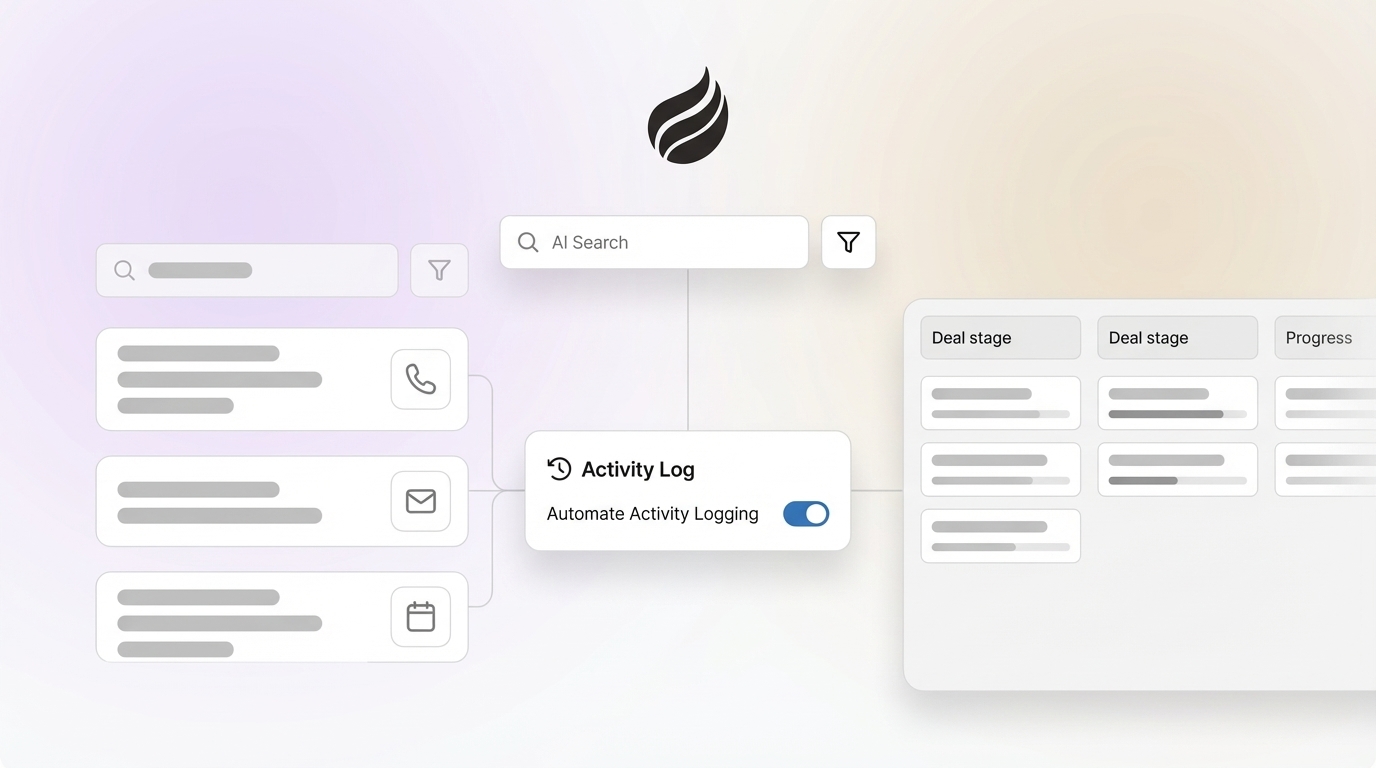
An AI meeting bot fills that gap by joining Zoom, Teams, or Google Meet calls to record, transcribe, and structure the discussion into CRM-ready data. The Coffee Agent operates as this layer. It joins calls automatically, generates summaries and next steps after the meeting, and writes structured activity records back to Salesforce or HubSpot, or to Coffee’s own standalone CRM.

Notes can follow BANT, MEDDIC, or SPICED so qualification data stays consistent from call to call. In Salesforce, meeting transcripts write back as Task or Event records linked to the Contact, Lead, and Opportunity. In HubSpot, they populate the Activity feed on the Contact and Deal records. The Coffee Companion App handles this object mapping automatically and removes that configuration work from RevOps.
Step 3: Configure Integrated Dialers for Automatic Call Logging
Automated call logging with an integrated dialer significantly reduces the time spent per call on manual data entry. Implementation begins by mapping the 5 to 7 most critical call dispositions to automated CRM actions such as creating a completed call activity, generating a follow-up task, updating lifecycle stage, or creating a calendar event.
Key fields to capture on every logged call include date and time, duration, direction, disposition, rep owner, associated contact, associated opportunity, and an AI-generated call summary. Capturing these fields in isolation does not provide full value. The real benefit comes when qualitative data such as objections, competitor mentions, and next steps follow a consistent structure.
AI-powered structured call-note templates ensure every logged call captures key objections, competitor mentions, and explicit next steps in a consistent format that improves data quality for coaching and forecasting. Managers can then compare call outcomes across reps and time periods without digging through unstructured notes. Note that HubSpot’s native connectors for Microsoft Teams calls can take time to sync activity data into the CRM, while a native integrated dialer logs calls in real time, which matters for live pipeline reviews.
Step 4: Build Workflow Rules That Create Follow-Ups Automatically
Steps 1 through 3 ensure every email, meeting, and call is captured automatically. Once activity data flows into your CRM without manual entry, you can convert that stream into consistent follow-up motion.
Logging an activity is only half the equation. Workflow automation converts logged activities into forward motion. In Salesforce, use Flow Builder to trigger a follow-up Task when a call disposition is set to “Interested” or when a meeting is logged against an opportunity in a specific stage. In HubSpot, Workflows can auto-create tasks, send internal notifications, or advance deal stages when an activity type is recorded.

Example triggers keep things concrete. A logged demo meeting on a deal in “Discovery” advances the stage to “Demo Scheduled” and creates a follow-up task due in 24 hours. A call logged with disposition “Left Voicemail” enrolls the contact in a follow-up sequence. These rules remove the manual step of reps creating their own next actions after every interaction.
Step 5: Use Zapier or Make.com as Fallback Automation
When a tool in your stack lacks a native CRM connector, Zapier or Make.com can bridge the gap. Common use cases include logging LinkedIn messages as CRM activities, syncing webinar attendance to contact records, or pushing form submissions into deal pipelines. Build Zaps or Scenarios that trigger on new activity in the source tool and create a corresponding Task or Note in Salesforce or HubSpot.
Data-privacy note: third-party middleware routes data through external servers. Confirm that any Zapier or Make.com workflow involving customer communication data complies with your organization’s data-handling policies and applicable regulations before you enable it in production.
Step 6: Validate Data Quality and Measure Time Savings
Automated activity capture removes the most common source of CRM data gaps that come from manual logging under time pressure. As noted in Step 1, multi-object association ensures activity data appears in every relevant record. After enabling each step above, run a two-week validation sprint so you confirm the system behaves as expected.
During that sprint, audit a sample of 20 deals for activity completeness. Verify that every email, call, and meeting appears on the correct contact and opportunity records. Check that follow-up tasks were auto-created and assigned correctly. This process catches mapping gaps before they affect pipeline reviews.
Measure time savings by comparing pre- and post-automation rep survey data on daily admin time. Workflow automation and integrated CRM tools can reclaim 5 to 10 hours per rep per week, and Coffee customers specifically recover 8 to 12 hours per week. In later sections, you can treat this as the baseline time savings. Adoption signals to monitor include CRM login frequency, activity log volume per rep, and pipeline coverage ratio. Real-time activity capture gives managers an up-to-the-minute view of the pipeline and makes forecasts more reliable than day-old data from manual entry.
Scaling Coffee for Small Teams and Mid-Market Orgs
For small teams with 1 to 20 reps and no existing CRM, Coffee’s Standalone AI-First CRM deploys the agent as the system of record from day one. You avoid legacy configuration entirely. The agent auto-creates contacts and companies from Google Workspace or Microsoft 365 connections, logs all activity autonomously, and surfaces pipeline intelligence through the Pipeline Compare feature.
For mid-market teams committed to Salesforce or HubSpot, Coffee’s Companion App deploys the agent as an intelligent layer on top of the existing instance. A simple authentication allows Coffee to sync, enrich, and write structured data back to the primary CRM without disrupting existing workflows, quotas, or forecasting configurations. Unlike newer CRM alternatives, Coffee has deep knowledge of Salesforce and HubSpot object models, validation rules, and required field logic, which helps the agent write data correctly the first time.
Connect the Companion App to your CRM and see how Coffee layers on top of Salesforce or HubSpot without disrupting current workflows.
Frequently Asked Questions
How long does it take to set up automated CRM activity logging?
Native email and calendar sync in Salesforce or HubSpot can be configured in under an hour for a RevOps admin with the correct permissions. Dialer integration and workflow rule configuration typically add another two to four hours. The Coffee Companion App connects to Salesforce or HubSpot through a single authentication step and begins logging activity immediately, so most teams see full automation running within one business day. The Standalone CRM becomes operational as soon as Google Workspace or Microsoft 365 is connected.
Is automated activity logging secure and compliant?
Coffee is SOC 2 Type 2 and GDPR compliant. Customer data is not used to train public AI models. For Zapier or Make.com fallback workflows, data routes through third-party servers, so teams in regulated industries should review those data-handling agreements separately. Einstein Activity Capture stores email data on AWS external to Salesforce, which matters for organizations with strict data-residency requirements.
How do you overcome rep resistance to CRM automation?
The most effective approach starts with one high-friction pain point, typically email or calendar logging. Prove time savings quickly on that narrow use case, and keep reps in the loop rather than removing their visibility entirely. Framing automation as a tool that handles busywork so reps can focus on selling, rather than a surveillance mechanism, accelerates adoption.
Coffee supports this approach by acting as a co-pilot reps rely on. It handles data entry, prepares meeting briefings, and drafts follow-up emails. The agent becomes something reps want to use instead of a system they resent.

What happens to data quality if a sync fails or a tool goes offline?
Native integrations like Einstein Activity Capture can experience delays of up to 24 hours during initial setup or high-volume periods. Revenue.io-style tools capture validation rule conflicts in an admin log rather than failing silently, which allows RevOps to resolve mismatches quickly. Coffee’s agent writes directly to CRM records without middleware sync delays, which reduces the failure surface. For Zapier fallback workflows, build error notifications into each Zap so sync failures surface immediately instead of creating silent data gaps.
Does Coffee replace Salesforce or HubSpot, or work alongside them?
Coffee operates in both modes. The Standalone CRM replaces legacy systems entirely for small to mid-sized teams that want an agent-native system of record. The Companion App works alongside existing Salesforce or HubSpot instances and adds the agent layer that handles data entry, enrichment, and activity logging without requiring teams to migrate or rebuild their existing pipelines, forecasting models, or integrations.
Conclusion: Put CRM Data Entry on Autopilot
Manual CRM activity logging reflects an architecture problem rather than a discipline problem. Legacy CRMs assumed humans would reliably enter data. In reality, reps do not have time, which leads to incomplete pipeline records, unreliable forecasts, and sellers spending a large share of their week as data-entry clerks.
The six steps above create a complete automation stack that removes manual logging from your reps’ daily workflow. Start with native email and calendar sync to capture high-volume written communication. Layer in AI meeting bots and integrated dialers to handle conversations, then use workflow automation and middleware to convert logged activities into consistent follow-up.
For teams ready to eliminate manual data entry across this entire stack, Coffee’s agent handles every step of the process autonomously. It captures activity, writes structured CRM records, and generates follow-up tasks so managers can trust the data and reps can focus on selling.
Reclaim 8–12 hours per rep per week by deploying Coffee’s agent and removing manual CRM logging from your sales process today.