Written by: Doug Camplejohn, CEO & Co-Founder, Coffee
Key Takeaways for Sales and RevOps Leaders
- Both Gong and HubSpot still rely on heavy manual data entry from reps, which drives labor costs and hurts data quality.
- Gong excels at conversation intelligence but depends on reps to turn insights into CRM updates, while HubSpot’s native tools do not deeply automate unstructured data.
- Coffee’s autonomous agent captures multi-channel data and writes structured outputs back to the CRM without rep involvement.
- Teams running Gong plus HubSpot pay twice in licenses and hours; Coffee consolidates CRM, enrichment, recording, and forecasting into one seat-based product.
- Coffee’s autonomous agent eliminates the manual data-entry burden entirely — see pricing and deployment options.
Evaluation Criteria for Comparing Gong, HubSpot, and Coffee
Most comparisons treat Gong and HubSpot as complementary tools. That framing hides the real issue: how much human labor each platform needs to produce reliable pipeline data. For a 20–100 person sales team in 2026, the criteria that matter are clear.
- How much data is captured automatically versus entered manually by reps
- How deeply conversation intelligence writes back to CRM fields
- The true integration and maintenance burden
- Pipeline forecasting accuracy when data quality is imperfect
- Total cost per seat, including extra tools needed to fill gaps
Evaluate on these axes and the picture changes significantly. The table below compares how Gong, HubSpot, and Coffee perform across these criteria and shows how legacy platforms still depend on manual rep labor while Coffee automates capture and write-back.
Side-by-Side Comparison: Gong vs HubSpot vs Coffee
| Criteria | Gong | HubSpot Sales Hub | Coffee |
|---|---|---|---|
| Automatic data capture | Calls and transcripts, CRM write-back configurable but not complete | Native activity logging, email and calendar sync available but rep-dependent for accuracy | Autonomous capture from email, calendar, and call transcripts, no rep action required |
| Manual labor tax | High, reps must act on Gong insights to update CRM fields | High, fields critical to forecasting still require manual entry | Near-zero, agent writes contacts, activities, and deal updates autonomously |
| Integration complexity | Extra integration layer between Gong, CRM, and video conferencing | Native stack, no extra integration for HubSpot-native features | Simple auth connects Coffee to HubSpot or Google/Microsoft 365, no middleware required |
| Conversation intelligence depth | Deep, objection categorization, deal risk flags, coaching workflows | Shallow, best for conversation logging tied to native CRM | Full transcription, BANT/MEDDIC/SPICED structuring, automated summaries and follow-ups |
| Pipeline visibility | Deal intelligence signals, forecasting dependent on CRM data quality | Native pipeline views, accuracy depends on rep data entry | Automated Pipeline Compare, week-over-week changes tracked without manual CSV exports |
| User adoption friction | Moderate, reps must review and act on Gong recommendations | High, reps resent manual logging, shadow CRMs emerge | Low, agent handles the busywork, reps interact with outputs, not inputs |
| Total cost of ownership | High, Gong license plus HubSpot license plus enrichment tools | Moderate to high, Sales Hub plus Gong or equivalent plus ZoomInfo | Seat-based pricing, agent labor included, replaces multiple point solutions |
Setup and Onboarding Effort Across Platforms
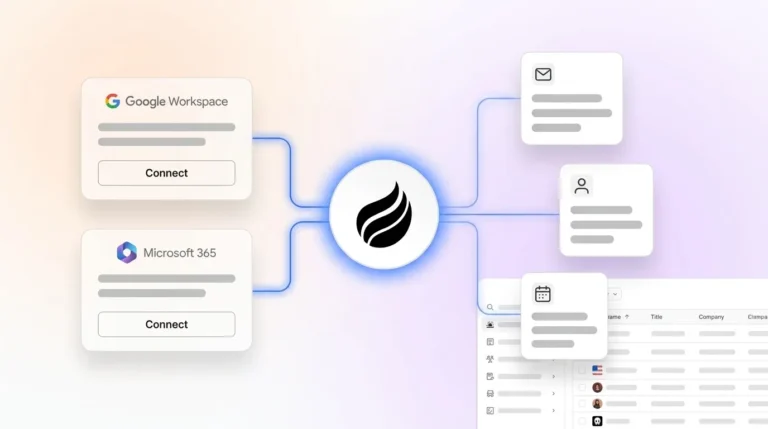
Gong requires connections to your CRM, video conferencing platform, and email provider. This extra integration layer affects data flow into the CRM. Teams must configure and maintain field mapping between Gong’s AI-extracted data and custom CRM fields. HubSpot’s native setup moves faster for teams already on HubSpot, yet conversation intelligence features still need configuration and rep training. Coffee connects through a single authentication to Google Workspace or Microsoft 365 and starts populating records right away.
Automatic Data Capture from Calls and Digital Channels

Advanced conversation intelligence platforms automatically update CRM fields after calls, while basic tools require manual export of data. Gong sits in the advanced category for call data but stops short of the full automation described earlier. It surfaces insights but does not write them back to forecast-critical fields. A tool that writes call summaries to Activity Notes but cannot push MEDDIC fields to custom Opportunity fields remains a 70% solution. HubSpot’s native capture covers email and calendar activity but does not autonomously enrich contact records or structure call data into deal fields. Coffee’s multi-channel capture, outlined in the comparison above, writes structured outputs such as BANT, MEDDIC, or SPICED qualification fields back to the record without rep effort.
Meeting Briefing and Follow-Up Automation in Practice
Once data capture is handled, the next question is how each platform helps reps prepare for meetings and follow up afterward. Gong surfaces pre-meeting context through its deal intelligence layer, but reps must navigate to that view. HubSpot has no native pre-meeting briefing feature. Coffee’s agent generates a “Today” page briefing before each call, joins the meeting as a bot, and after the call drafts a summary, next steps, and a follow-up email in Gmail for one-click review.

AI agents automatically prepare summaries with key takeaways after each customer interaction and update records to keep sales systems accurate and up to date. The practical difference lies in defaults. Coffee treats this automation as the standard workflow, while legacy tools treat it as an optional layer that still depends on rep action.

See how Coffee automates your entire meeting workflow, from briefing through follow-up, without rep involvement.
Reporting, Pipeline Compare, and Forecasting Accuracy
Inaccurate close dates, outdated stages, and inflated deal sizes distort forecasts and delay critical decisions across revenue teams. Gong and HubSpot both generate forecasting outputs, yet both sit downstream from data quality. When reps skip stage updates or activity logging, the forecast misses reality. Coffee’s Pipeline Compare feature tracks week-over-week deal changes automatically, including progressed deals, stalled opportunities, and new additions, because the agent already wrote the underlying data. Pipeline reviews shift from interrogation about updates to strategic discussions about risk and next steps.
Handling Unstructured Data and Preserving Context
Gong excels at processing unstructured call data. It automatically captures, transcribes, and analyzes sales conversations using AI and NLP to identify keywords, topics, buyer intent, deal risks, competitor mentions, and coaching opportunities. HubSpot’s handling of unstructured data stays closer to basic summarization. Neither platform stores unstructured data in a way that preserves full historical context for long-term analysis.
Coffee uses a data warehouse architecture that retains both structured and unstructured data, including emails, transcripts, and enrichment records. Historical context remains intact when fields change, which supports accurate longitudinal reporting and forecasting.
What Real Users Complain About in Gong and HubSpot
Users often complain that Gong feels expensive, requires a separate CRM, and leaves a gap between surfaced insights and what actually reaches deal records. HubSpot complaints focus on the volume of manual steps needed to keep records current, low rep adoption, and the rise of shadow CRMs such as spreadsheets and Notion docs. Latency in bidirectional syncs between a sales CRM and other tools creates data problems that block clean pipeline data. The pattern remains consistent. Both tools generate insights, yet neither closes the loop by writing clean data back autonomously.
Best-Fit Use Cases by Team Type
Early-stage teams (1–20 reps): Gong’s price point feels prohibitive, while HubSpot’s manual burden strains small teams. Coffee’s Standalone CRM offers a practical path, with automation from day one and minimal configuration overhead.
HubSpot-committed orgs (20–100 reps): A CRM switch is off the table. Coffee’s Companion App deploys the agent on top of HubSpot, handling data entry and enrichment while HubSpot remains the system of record. This setup removes the need to add Gong as a separate line item.
Stack consolidators: Teams running HubSpot plus Gong plus ZoomInfo plus a recording tool pay for four overlapping systems. Coffee consolidates CRM, enrichment, recording, and forecasting into one seat-based price.
Operational and Long-Term Stack Considerations
Complex CRM integrations that lack real-time sync with messaging, voice, or ERP systems limit context for automation and increase workflow friction. Every point solution added to the stack becomes a maintenance risk. Data teams report spending 60% of their time fighting fragmented data sources and fragile integrations. The Gong-plus-HubSpot stack compounds this problem with two vendors, two contracts, two renewal cycles, and custom field mapping that can break when either platform ships a major update.
Risks, Limitations, and Common Misconceptions
Many teams assume that adding Gong to HubSpot solves data quality issues. It does not. Teams often integrate conversation intelligence tools with CRM systems by linking interfaces rather than data, which leaves AI without the historical context and relationships needed for accurate insights. Gong improves call analysis but does not make HubSpot self-updating.
A second misconception is that HubSpot’s native AI features match dedicated conversation intelligence depth. HubSpot Sales Hub focuses on conversation logging tied to native CRM, while dedicated tools like Gong focus on revenue intelligence with deal-pattern coaching. That difference creates a meaningful capability gap.
Decision Framework for Choosing Gong, HubSpot, or Coffee
- If you are not yet on HubSpot and have fewer than 20 reps: Choose Coffee Standalone CRM and skip the legacy setup.
- If you are on HubSpot and want to remove manual data entry without migrating: Use Coffee Companion App. The agent writes to HubSpot while your workflows stay intact.
- If you are evaluating Gong to add to HubSpot: Model the true cost, including Gong licenses, integration maintenance, and rep hours still required to act on Gong’s outputs, before signing.
- If forecasting accuracy is the main pain: Treat data quality as the root cause, not reporting tooling. Fix data input first, which Coffee’s agent handles by default.
Explore Coffee’s pricing to see which deployment model fits your constraints.
Coffee: The Proactive Agent for Revenue Teams
Coffee comes in two models. The Standalone CRM replaces HubSpot or Pipedrive and lets the agent manage the system of record from first contact through close. The Companion App deploys the agent on top of an existing HubSpot instance, handling data capture, enrichment, and write-back so HubSpot stays accurate without rep effort.
Both models use seat-based pricing, with the agent’s labor included and no metering on AI usage or processes. Coffee is SOC 2 Type 2 and GDPR compliant, and it does not use your data to train public models. A built-in data warehouse stores structured and unstructured data with full historical context, which powers Pipeline Compare and accurate forecasting that legacy CRM architectures struggle to match.
Seventy-six percent of respondents say conversation intelligence now appears in more than half of their customer interactions. In 2026 the key question is whether your AI behaves as a passive helper or as an autonomous agent. BCG notes that AI agents handle repetitive tasks with accuracy and speed, reduce human error, and free employees for higher-value work. Coffee delivers that shift for revenue teams.
Get started with Coffee and replace your data-entry burden with an autonomous agent.
Frequently Asked Questions
Does HubSpot use Gong?
HubSpot and Gong are separate products from separate companies. Many sales teams run both at once, with HubSpot as the CRM system of record and Gong as the conversation intelligence layer. HubSpot offers native conversation intelligence features, yet these are generally considered less mature than Gong’s coaching workflows, objection categorization, and deal intelligence capabilities. Running both tools together requires a separate integration, custom field mapping, and two vendor relationships, which adds cost and complexity while leaving the manual data-entry burden in place.
What is the best Gong alternative for HubSpot users?
The right alternative depends on the problem you want to solve. Teams that only need better call analysis can choose from several conversation intelligence tools that compete with Gong at lower price points. Teams that want to eliminate manual data entry and improve pipeline data quality across the entire sales workflow need a different approach. Coffee’s Companion App offers that approach by deploying an autonomous agent on top of your existing HubSpot instance. The agent, which captures email, calendar, and call data automatically, enriches contact and company records and writes structured outputs back to HubSpot without rep involvement. This setup addresses the CRM’s dependence on humans to keep it accurate.
How much time do reps spend on data entry in HubSpot or Gong?
The data-entry burden is substantial. As the 71% figure cited earlier indicates, most reps feel they spend too much time updating systems, which leaves only about a third of their time for actual selling. Adding Gong to HubSpot does not change that dynamic. Gong surfaces call insights, while reps still update deal stages, close dates, and qualification fields manually in HubSpot. The manual labor tax appears at both ends, from logging activities in HubSpot to translating call intelligence into CRM field updates. Coffee’s agent handles both ends automatically, and customers report savings of 8–12 hours per rep per week.
Can you get accurate pipeline insights without manual updates?
Accurate pipeline insights become possible when the tool capturing data operates autonomously rather than waiting on rep action. Gong and HubSpot both produce pipeline reports, yet the accuracy of those reports depends on how consistently reps update records. When adoption drops, forecasts reflect what reps remembered to log instead of what actually happened in the sales cycle. Coffee’s agent, which captures activity data automatically and writes structured deal data back to the CRM in real time, changes that equation. Because the input is automated, the output, including Pipeline Compare, forecasting signals, and deal risk flags, reflects ground-truth activity instead of self-reported data.