Key Takeaways
- Firmographic data such as industry, company size, revenue, location, tech stack, and growth stage creates a clear foundation for ICPs and outbound lead prioritization.
- Teams using firmographic targeting see 2-3x higher reply and win rates compared to generic spray-and-pray outreach, which cuts wasted SDR time on low-fit accounts.
- AI agents like Coffee automate firmographic enrichment from emails, calendars, and website visitors, saving 8-12 hours per rep each week on manual data entry and hygiene.
- Proven workflows rely on ICP-based prioritization, contextual personalization, and continuous data maintenance to protect outbound ROI in 2026.
- Transform your outbound sales with Coffee’s autonomous agent, and see pricing and start your free trial for precision targeting and 2x reply rates.
Firmographic Data Basics for Modern Outbound Teams
Firmographic data covers six core business attributes that describe a company in practical, sales-ready terms.
- Industry classification (SaaS, healthcare, manufacturing, financial services)
- Company size by employee count (10-50, 200-2,000, 5,000+ employees)
- Annual revenue indicating budget capacity ($1M-$10M, $50M-$500M ARR)
- Geographic location including headquarters and operational regions
- Technology stack (Salesforce, HubSpot, Microsoft 365, AWS infrastructure)
- Growth stage and funding (seed startup, Series B, publicly traded)
The following table shows how these six attributes translate into a concrete ICP profile for a typical B2B SaaS sales team.
| Attribute | Example |
|---|---|
| Industry | B2B SaaS, Healthcare Technology |
| Company Size | 200-2,000 employees |
| Annual Revenue | $20M-$500M ARR |
| Location | North America headquarters |
| Tech Stack | Salesforce CRM, Outreach.io |
| Growth Stage | Series B funding, 40% YoY growth |
These attributes filter noise and surface high-fit leads. Companies with defined ICPs incorporating firmographics achieve 68% higher win rates by focusing outbound efforts on accounts that match proven success patterns.
How Firmographic Data Drives Outbound Sales Results
Firmographic data shifts outbound from volume-based spraying to precise targeting. Teams that combine firmographic ICP criteria with behavioral signals achieve significantly higher reply rates versus 3.43% for generic outreach. This precision delivers several clear advantages.
- ICP building and validation grounded in historical win and loss patterns
- Lead prioritization through the 3-3-3 rule: 3 personas, 3 key metrics, 3 buying stages
- Territory planning based on geographic and vertical concentration
- Message personalization aligned to industry pain points and tech environments
The productivity impact is significant. Teams using firmographic plus signal-based targeting book more meetings per SDR monthly, compared to the 12-15 industry benchmark, which creates a clear productivity lift. Coffee’s Agent saves 8-12 hours weekly by automating enrichment and hygiene, so reps spend more time selling and less time on data entry.
This productivity advantage highlights a broader market shift. The gap between manual and automated approaches keeps widening, as 71% of sales reps waste time on manual data entry while AI agents handle enrichment automatically. Coffee’s strength comes from proactive data management, because the Agent ensures good data enters your system and supports reliable insights.
Building Your ICP with Firmographic Data
Effective ICP creation follows a clear sequence that uses firmographic data as the starting point.
Step 1: Audit Historical Performance
Review closed-won deals from the past 12-24 months to establish your baseline for success. This historical analysis reveals common firmographic patterns among your best customers, such as industry verticals, company sizes, revenue ranges, and geographic concentrations. Businesses with documented ICPs consistently achieve higher customer conversion rates.
Step 2: Define 4-6 Core Traits
Select the firmographic attributes that most reliably predict success. For a sales enablement platform, that might include VP of Sales title, $10M+ annual funding, North America location, and Salesforce CRM usage. Essential firmographic elements include company size, industry classification, geographic location, business model, and growth stage.

Step 3: Implement Scoring and Prioritization
Create tiered scoring so accounts that match all criteria receive immediate outreach priority. Organizations that run mature Account-Based Marketing programs on strict ICPs often generate larger average deal sizes and more predictable pipeline.
Coffee’s List Builder automates this entire process. You can simply ask, “Find VPs of Sales in North America at $10M+ funded companies using Salesforce.” The Agent then generates enriched, ICP-matched lists instantly, removes manual research, and keeps data accurate.

Where Outbound Teams Get Firmographic Data
The 2026 market gives outbound teams several options for firmographic data, ranging from manual tools to fully autonomous AI agents.
| Provider | Enrichment Method | Automation Level | SMB Fit |
|---|---|---|---|
| Apollo.io | Manual lookup + API | Semi-automated | Medium |
| ZoomInfo | Database queries | Manual export | Low (Enterprise focus) |
| Clearbit | Real-time API | Developer-required | Medium |
| Coffee Agent | Autonomous enrichment | Fully automated | High |
Traditional providers require ongoing manual effort, such as pulling lists, exporting CSVs, and managing Zapier integrations. Apollo.io offers 224 million verified contacts with 96% email accuracy, yet still depends on human work for list building and CRM sync.
Coffee reflects the 2026 evolution toward automation. An autonomous Agent enriches firmographic data from emails, calendars, and website visitors without manual input. The Agent slashes 8-12 hours weekly by handling enrichment, deduplication, and hygiene automatically, so teams avoid complex Zapier setups.
Step-by-Step Firmographic Workflows for Outbound Sales
Successful firmographic integration follows a straightforward four-step workflow that fits into daily outbound operations.
1. Automated Enrichment
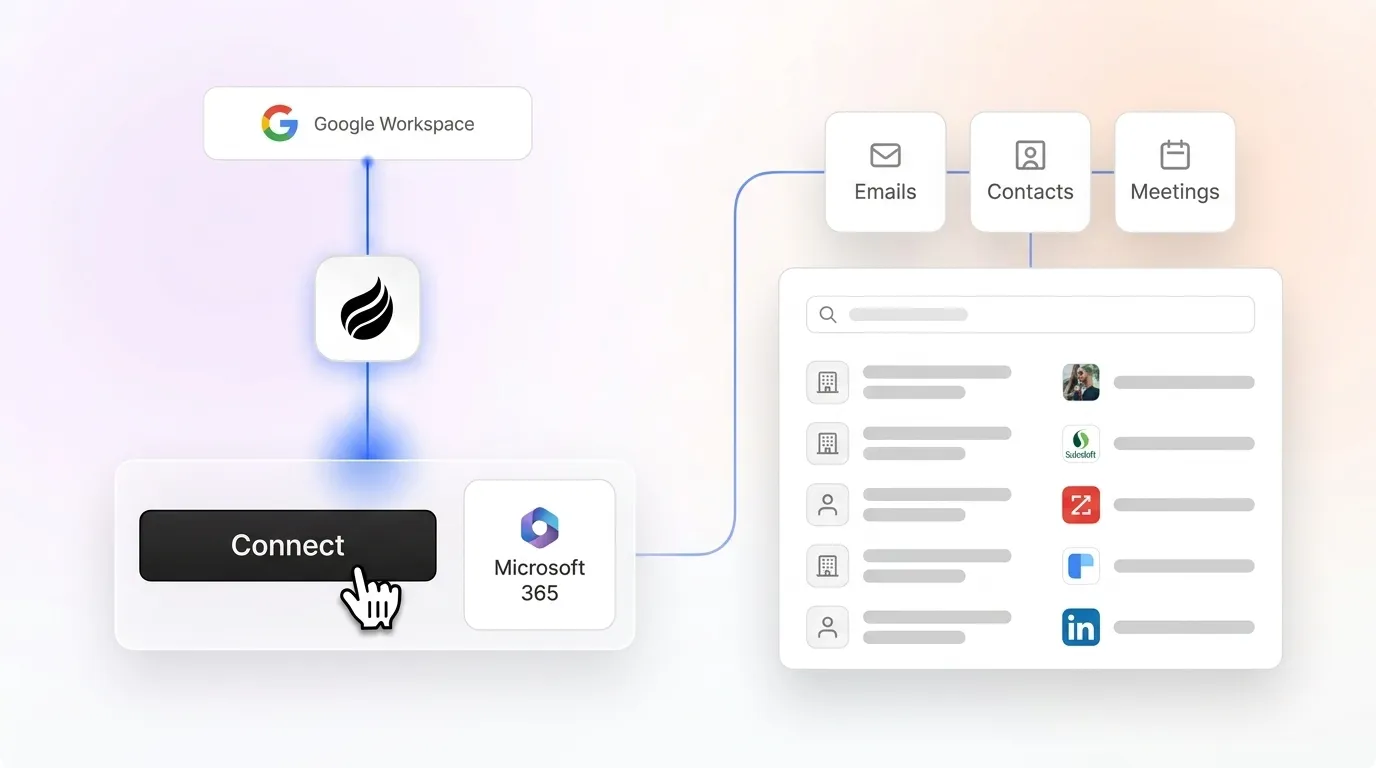
Connect your data sources such as Google Workspace, Salesforce, and your website pixel to enable continuous firmographic enrichment. Coffee’s Agent automatically captures company attributes from email signatures, calendar invites, and visitor identification, which removes the need for manual entry.

2. ICP-Based Prioritization
Apply the 3-3-3 rule with 3 key personas (VP Sales, Head of RevOps, CEO), 3 critical metrics (company size, revenue, growth rate), and 3 buying stages (awareness, consideration, decision). Score accounts on firmographic fit and behavioral signals so reps know exactly where to focus.
3. Contextual Personalization
Use firmographic data to tailor every message. Reference specific technology stacks (“Since you are using Salesforce…”), industry challenges (“Healthcare compliance requirements…”), or company milestones (“Congratulations on your Series B…”).

4. Performance Tracking and Hygiene
Track reply rates by firmographic segment to see which slices of your ICP respond best. Signal-based outbound generates 2-3x more pipeline per rep than volume-based teams. Coffee’s Pipeline Compare feature visualizes week-over-week changes automatically and keeps performance trends visible.
Visitor Identification Workflow
Coffee’s pixel identifies anonymous website visitors, enriches them with firmographic data, and surfaces high-fit prospects for immediate outreach. The Agent provides Suggested Leads matching your buyer persona, which closes the loop from website visit to LinkedIn connection.

Try Coffee’s automated workflows to run these processes with full automation, without manual list building or data entry.
Data Hygiene Challenges and How AI Agents Fix Them
Firmographic data decays quickly and often suffers from quality issues that quietly erode outbound performance.
Common Pitfalls:
- Manual entry errors: The data entry burden mentioned earlier compounds with human error, which creates duplicate records and inconsistent formatting.
- Natural decay: B2B data decays at roughly 22.5% per year
- Inconsistent formatting: Multiple revenue formats ($10M vs $10,000,000 vs 10MM)
- Duplicate records: Same company with different names or spellings
- Missing enrichment: Incomplete industry classifications or outdated employee counts
These issues stack up quickly and hurt every stage of the funnel. Gartner estimates poor data quality costs organizations at least $12.9 million a year on average.
Coffee’s Agent Solution
The Coffee Agent protects “good data in” through autonomous hygiene management. It auto-logs interactions, enriches unstructured data from emails and transcripts, and maintains data quality without human intervention. Unlike Salesforce or HubSpot, which rely on manual updates, Coffee’s Agent proactively identifies and fixes data issues in real time.
Top Firmographic Data Providers for Outbound Sales in 2026
Coffee leads the 2026 firmographic data landscape by pairing autonomous agent technology with practical outbound workflows.
| Provider | Auto-Enrichment | Time Saved Weekly | ICP Match | Price Fit |
|---|---|---|---|---|
| Coffee Agent | Fully autonomous | 8-12 hours | AI-powered | SMB/Mid-market |
| Apollo.io | Semi-automated | 2-4 hours | Manual filters | Medium |
| ZoomInfo | Manual export | 1-2 hours | Static lists | Enterprise |
Coffee’s key differentiators include several outbound-friendly capabilities.
- Autonomous enrichment: No manual list building or CSV exports
- Visitor identification: Website pixel that maps visitors to named prospects with suggested outreach
- CRM-native operation: Works as a standalone system or as a Salesforce and HubSpot companion
- Agent-powered hygiene: Continuous data quality without human intervention
Leading providers combine AI-driven attribute prediction with automated verification, yet Coffee uniquely operates as a proactive agent instead of a passive database.
FAQ
How does Coffee compare to ZoomInfo for firmographic data?
Coffee operates as an autonomous agent that automatically enriches and maintains firmographic data, while ZoomInfo requires manual database queries and exports. Coffee maintains high data validity through continuous agent-powered hygiene, whereas ZoomInfo provides static snapshots that need manual updates. Coffee also integrates directly with your workflow across emails, calendars, and CRM, so you avoid extra logins and list management.
What is the setup time for Coffee’s firmographic enrichment?
Coffee setup only requires instant authentication with Google Workspace or Salesforce. The Agent immediately begins enriching existing contacts and companies and captures new firmographic data from emails and calendar interactions. No CSV imports, field mapping, or integration configuration is required, because the Agent handles everything autonomously.
Is Coffee’s firmographic data secure and compliant?
Coffee maintains SOC 2 Type 2 certification and GDPR compliance, which protects sensitive customer data. All firmographic data is encrypted in transit and at rest. The Agent processes data locally within your authenticated environment and does not use customer data to train public AI models, so Coffee supports regulated industries.
Does Coffee work with existing Salesforce implementations?
Coffee offers a Companion App that acts as an intelligent agent on top of Salesforce and enriches firmographic data automatically. The Agent maintains hygiene without disrupting existing workflows. It syncs enriched data back to Salesforce and provides additional intelligence through Coffee’s interface, so teams gain value without a migration.
What ROI can teams expect from Coffee’s firmographic automation?
Coffee users typically see 2x reply rates through better targeting and personalization, along with 30-50% productivity gains from automated data management. The Agent saves 8-12 hours weekly per rep by removing manual enrichment, list building, and hygiene tasks. Teams also report faster pipeline generation and higher conversion rates because of stronger data quality and sharper ICP targeting.
Conclusion: Firmographic Data with an Autonomous Agent Edge
Firmographic data turns outbound sales from spray-and-pray into precise targeting when automation and hygiene stay in place. Manual approaches drain SDR time and create data quality problems that weaken ROI. Coffee’s autonomous Agent represents the 2026 upgrade, with proactive firmographic enrichment, ICP-based targeting, and continuous hygiene that runs without human effort.
Start your Coffee trial to launch agent-powered firmographic workflows that deliver 2x reply rates and 35% more selling time for your outbound team.