Written by: Doug Camplejohn, CEO & Co-Founder, Coffee
Key Takeaways for 2026 RevOps Teams
- Fireflies extracts action items from every sales call transcript, and automation turns those items into CRM tasks with owners and due dates without manual copying.
- Manual CRM data entry consumes 11.5 hours per rep weekly and cuts selling time to 40% of the workweek, so automation protects pipeline visibility and forecast accuracy.
- Native integrations cover HubSpot, Salesforce, Attio, and Dynamics 365, while Zapier works as a flexible fallback for cross-system logic or unsupported CRMs.
- Coffee’s AI agent removes the Fireflies-to-CRM handoff by joining calls, extracting action items, and writing structured tasks directly into HubSpot or Salesforce without extra tools or maintenance.
- Teams ready to reduce tool sprawl and eliminate manual handoffs can explore Coffee’s pricing and start a trial to automate every action item from every call.
Why Manual Handoffs Fail and Automation Protects Your Forecast
B2B sales reps spend an average of 11.5 hours per week on CRM input, which consumes a large share of a full working week. Salesforce’s 2026 State of Sales report shows that reps spend only 40% of the workweek selling and 60% on non-selling work, including manual CRM updates. Many sales managers see several hours per rep per week disappear into manual CRM updates.
The downstream consequences are measurable. Teams with automated activity logging report higher CRM data accuracy, and accurate CRM data improves forecast accuracy by 15–25%. When reps spend less time on manual data entry, they can validate deal details and update pipeline stages in real time, which reduces the data gaps that cause missed forecasts.
Automating the push from Fireflies action items to CRM tasks is not a convenience feature. It functions as a pipeline visibility requirement.
Access and Accounts You Need Before Setup
Confirm each of the following before configuring any integration:
- An active Fireflies.ai account with call recording enabled and at least one completed, transcribed meeting.
- CRM admin access in HubSpot, Salesforce, Attio, or Dynamics 365 with permission to create task objects and install connected apps.
- Google Workspace or Microsoft 365 connected to Fireflies so calendar invites include participant email addresses, which are required for contact matching.
- For Zapier: a paid Professional or higher Zapier plan, because the Webhooks by Zapier trigger is unavailable on the free tier.
- For Salesforce: awareness that Salesforce enforces API rate limits, which can cause sync failures under high call volume.
Set Up Fireflies to HubSpot Tasks in Four Steps
- Connect HubSpot. In Fireflies, open Integrations, search for HubSpot, and click Connect. Complete the OAuth authorization flow, including OTP verification if prompted, then click Connect app on the HubSpot authorization screen.
- Select the correct sync direction. In the HubSpot integration configuration, select Send meeting data to HubSpot, not Pull recordings. This selection enables logging of notes, summaries, and tasks.
- Enable task creation. Toggle on Create tasks from meeting action items and click Save.
- Set meeting filters (Business plan and above). Under Integration Rules, configure title filters using Contains, Starts With, Equals, or Does not Contain conditions to control which meetings trigger task creation.
Common failure points:
- If deal pipelines are missing from the Fireflies dropdown, create them in HubSpot first and refresh the Fireflies integration page.
- Calendar invites that contain only participant names instead of email addresses prevent automatic contact matching.
- Expect a 5–10 minute processing delay after the meeting ends, which reflects normal processing rather than a sync failure.
- Integration features and field mapping options can vary depending on your HubSpot plan.
Configure Fireflies to Salesforce Tasks
- Connect Salesforce. In Fireflies Integrations, locate Salesforce and initiate the OAuth connection using a Salesforce admin account.
- Configure sync direction. Select Send meeting data to Salesforce to enable activity logging, summary push, and task creation.
- Enable action item tasks. Toggle on task creation from action items and map the task owner field to the Salesforce user who attended the meeting.
- Validate field permissions. Confirm the connected Salesforce user profile has Create and Edit permissions on the Task object. Missing object-level permissions silently block task creation.
Common failure points:
- Picklist value mismatches, such as Fireflies sending a status value the Salesforce Task picklist does not recognize, often cause integration errors. Audit Task Status and Priority picklists before go-live.
- For expired authentication tokens, go to Configuration > Connections, refresh credentials, re-authenticate, and test the connection.
- Fireflies supports native Salesforce integration that automatically logs calls and pushes summaries plus action items without manual entry.
Configure Fireflies to Attio Tasks
- Connect Attio. In Fireflies Integrations, locate Attio and authorize the connection using an Attio workspace admin account.
- Configure Participant Management. Set participant mapping to allow new people creation, not Map Notes Only to Existing People, which blocks syncing for any participants not already in Attio.
- Enable task creation. In the Task Creation configuration tab, toggle on Create Tasks from Action Items. Confirm Only push my tasks is disabled unless intentional, as this setting restricts task creation to action items assigned only to the current user.
- Verify permissions. If meeting data does not appear in Attio, disconnect and reconnect the integration to re-authorize read and write permissions.
Common failure points:
- Integration status showing Disabled or Disconnected on the Integrations page prevents all data from syncing.
- Meetings not recorded and processed by Fireflies produce no data to sync regardless of integration configuration.
Configure Fireflies to Dynamics 365 Tasks
- Connect via Microsoft 365. Ensure Fireflies connects to the same Microsoft 365 tenant as Dynamics 365. Authorize the integration using a Dynamics admin account with the System Administrator or System Customizer role.
- Enable activity logging. In the Fireflies Dynamics integration settings, select Send meeting data and confirm the Task entity is included in the sync scope.
- Map action item fields. Map Fireflies action item text to the Dynamics Task Subject field, and map the assigned participant to the Task Owner (systemuser) lookup. Convert date formats to ISO 8601 in Data Mapping > Field Definitions to prevent format mismatch errors.
- Test and validate. Run a test meeting and confirm the Task appears in Dynamics within 10 minutes. Check the Fireflies integration log for error codes if tasks are absent.
Common failure points:
- If workflows are not triggering, check trigger conditions for overly restrictive settings and review execution logs for trigger attempts.
- Webhook URLs must be public HTTPS endpoints, and internal IPs or non-HTTPS endpoints cause silent failures.
Automate Fireflies Action Items to Any CRM with Zapier
If your CRM is not HubSpot, Salesforce, Attio, or Dynamics 365, or if you need to route action items across multiple systems, Zapier provides a flexible alternative to native integrations.
Use this 2026 recipe when native integrations are unavailable or when cross-system logic is required.
- Trigger: Fireflies — New Meeting. Obtain your Fireflies API key from the Integrations page and paste it into the Zapier trigger configuration. Select transcription format, speaker-name inclusion, and notes-list format.
- Filter. Add a Filter step to restrict the Zap to relevant calls, such as meeting duration over 30 minutes, specific title keywords, or minimum participant count. Fireflies does not limit the number of Zaps; limits are determined by your Zapier plan.
- Fetch transcript. Use the meetingId from the webhook payload to query the Fireflies GraphQL API and retrieve the summary.action_items field.
- Loop. Add Looping by Zapier — Create Loop from Line Items, mapping each action item as a separate line item so each one becomes a discrete CRM task.
- Action: Create CRM Task. For HubSpot, use HubSpot — Create Engagement with Type set to Task. For Salesforce, use Salesforce — Create Record with Object set to Task. Map action item text to Subject, participant email to Owner, and meeting date plus agreed timeframe to Due Date.
Known Zapier limitations:
- Without explicit looping, action items may be added as a single item rather than as individual CRM tasks.
- Lead matching depends on the configured search criteria such as participant email. When one contact links to multiple records, additional logic may be needed to avoid attaching to the wrong record or creating duplicates.
- Duplicate triggers from webhooks can cause duplicate tasks. Add deduplication logic using unique identifiers such as a meeting ID.
Compare Native Fireflies, Zapier, and Coffee’s Agent
The table below compares setup time, ongoing maintenance, data quality, and monthly cost across native integrations, Zapier, and Coffee’s agent so you can choose the right approach for your team.
| Dimension | Native Fireflies Integration | Zapier Recipe | Coffee Agent |
|---|---|---|---|
| Setup Time | OAuth flow plus toggle configuration (time varies) | Configuration time for a working Zap (varies by complexity, templates can be ready in minutes) | Single authentication to connect Google Workspace or Microsoft 365, and the agent begins logging immediately |
| Ongoing Maintenance | Every external platform added creates a new data sync surface, authentication dependency, and failure point to monitor | Ad hoc Zaps become technical debt without clear ownership and change management | Agent-managed, with no Zap maintenance or OAuth token renewal required |
| Data Quality | Participant matching fails when calendar invites contain only names, not emails, and duplicates occur on repeated webhooks | Topics, sentiment, duration, and participants are lost or dumped into unstructured note text without explicit field mapping | Summaries and action items are written directly back to HubSpot or Salesforce using customizable templates, with permission-aware record association |
| Monthly Cost | Included in Fireflies plan, with advanced filters requiring the Business tier | Zapier subscription costs plus Fireflies subscription | Seat-based pricing with agent labor included, and no separate Zapier or Fireflies subscription required |
Troubleshoot Missing, Duplicate, or Stalled Tasks
- Tasks not appearing in HubSpot: Verify that Create tasks from meeting action items is enabled and that the assigned HubSpot user has permission to access the related contact or deal.
- Tasks not appearing in Attio: Check integration status for Disabled or Disconnected, confirm the meeting was recorded and processed, and verify Participant Management is not set to Map Notes Only to Existing People.
- Duplicate tasks: Webhooks delivered more than once can cause duplicate tasks. Add a Filter step that checks for existing tasks with the same meeting ID before the Create Task action.
- Stalled pushes (Salesforce): Salesforce API rate limits can cause sync failures under high volume. Implement exponential backoff with jitter and request throttling.
- Expired OAuth tokens: Go to Configuration > Connections, refresh credentials, re-authenticate, test the connection, and resume sync.
- Filter excluding test meetings: The most common cause for sync rules failing is a filter that excludes the test meeting, such as a rule set to external only when testing with a teammate.
- Silent failures: Monitor API metrics with tools such as Datadog or New Relic and set alerts for failure rates above 5%.
Coffee’s Agent: Direct CRM Tasks from Calls Without Fireflies
Coffee removes the Fireflies-to-CRM handoff entirely. The Coffee Agent joins calls on Zoom, Teams, and Google Meet, records and transcribes the conversation, extracts action items with owners and due dates, and writes structured tasks directly into HubSpot, Salesforce, or Coffee’s own Standalone CRM without a separate transcription tool, Zapier recipe, or manual review step.
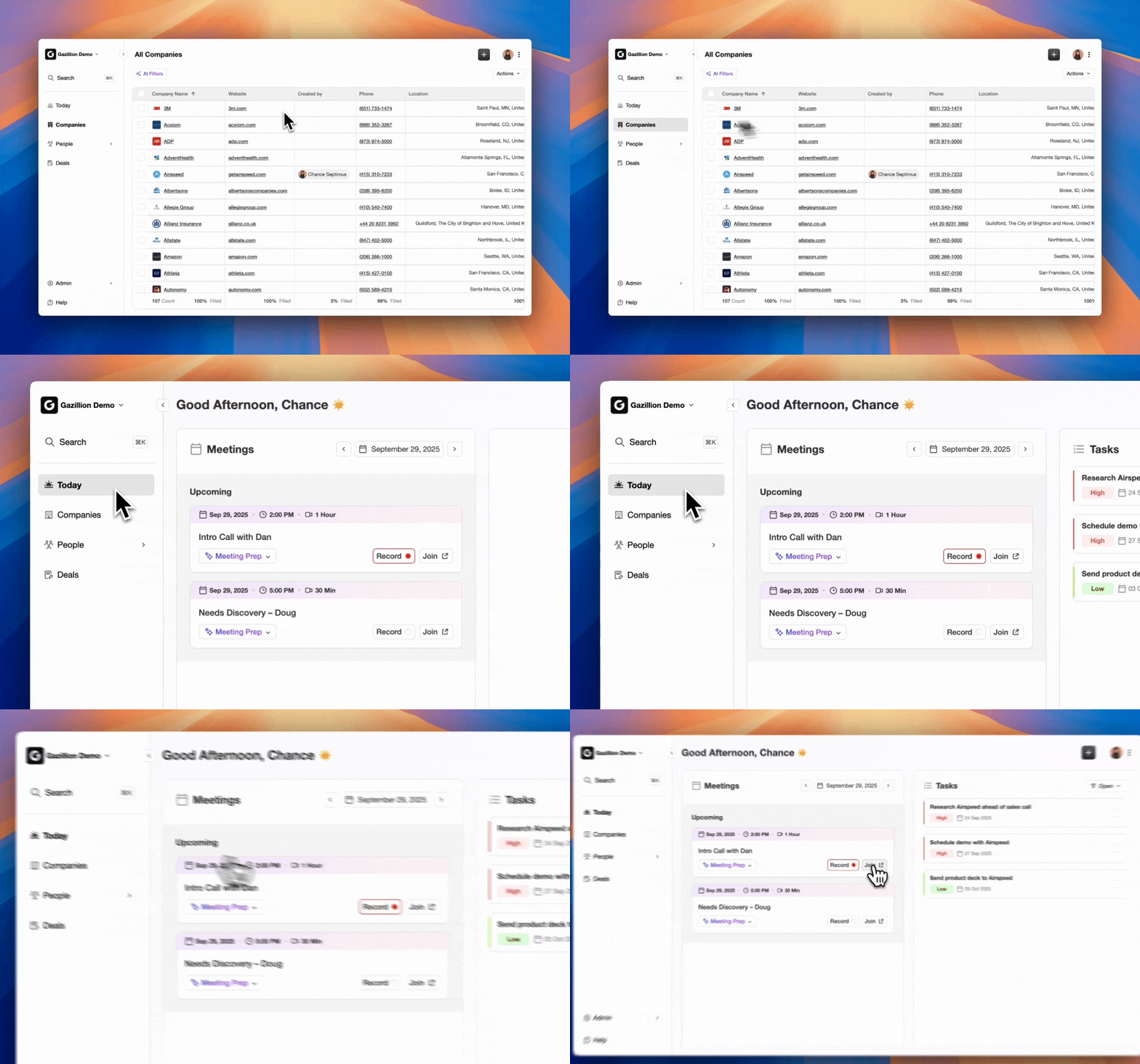
Coffee released customizable summary templates in November 2025 that are writable back to Coffee, HubSpot, or Salesforce, and expanded call recording options in January 2026 via Zapier integration with tools like Fathom, Gong, and Fireflies for teams mid-migration. Coffee is available in two models:
- Standalone CRM: The Coffee Agent acts as the system of record, which suits teams replacing HubSpot or Salesforce with an agent-first platform.
- Companion App: The Coffee Agent layers on top of an existing Salesforce or HubSpot instance, handling data entry and task creation while the existing CRM remains the system of record.
Coffee is SOC 2 Type 2 and GDPR compliant, and call data is not used to train public models.
See Coffee’s pricing and deployment options to remove the transcription-to-CRM integration layer from your RevOps stack.
When to Use Native Fireflies, Zapier, or Coffee’s Agent
RevOps teams should start with the CRM-native option before evaluating iPaaS tools and should exhaust native capabilities before adding external platforms that create new failure points.
- Choose native Fireflies integration when workflows involve only one CRM, complexity stays under 10 steps, the team has strong CRM admin skills, and the total number of active workflows is under 50. This path works best for teams already paying for Fireflies Business or higher.
- Choose Zapier when the target CRM lacks a native Fireflies integration, when cross-system routing is required, such as routing engineering action items to Jira while routing sales tasks to Salesforce, or when native integrations fall short for unique processes or edge cases like routing high-priority overdue action items with multi-step notifications.
- Choose Coffee’s Agent when you want to consolidate your stack by removing the transcription-to-CRM integration layer and write accurate, permission-aware tasks directly into HubSpot or Salesforce without a Zapier layer. This option fits mid-market RevOps teams that are consolidating their stack or experiencing recurring sync failures.
Validate Your Setup and Measure Time Saved
After configuring any integration, run a structured validation before rolling out to the full team.
- Conduct a real test call with at least two participants whose email addresses exist in the CRM.
- Wait 10 minutes, then check the CRM for a new Task record associated with the correct contact or deal.
- Confirm the task Subject matches the action item text, the Owner is the correct rep, and the Due Date is populated.
- Check the Fireflies integration log, or Zapier task history, for any error codes or skipped steps.
- Measure time saved by tracking how long reps spent on post-call CRM updates before automation, then compare that to the time spent reviewing auto-generated tasks after automation. Most teams see a reduction of 3–5 minutes per call once the automation is stable, which helps reclaim a portion of the 11.5 hours per week currently lost to manual CRM input.
Scale Automation from SMB to Mid-Market Teams
More than 90% of RevOps teams use automation as of 2026, and governance becomes the primary constraint as team size grows.
- Assign a named owner for each integration. Treat integration and automation as a managed service with clear ownership, documentation, and change management rather than ad hoc quick Zaps that become technical debt.
- Use meeting title filters and participant domain rules to prevent internal meetings from generating CRM tasks. Implement a hard gate classifier that never routes a meeting as customer-facing without an external attendee.
- Audit task assignee accuracy quarterly, because action item attribution can be incorrect even in mature automated pipelines.
- For Salesforce teams at scale, exhaust Flow and Apex trigger capabilities before adding external iPaaS tools.
Frequently Asked Questions About Ownership, Latency, Security, and API Risk
Who owns the integration setup between Fireflies and the CRM?
Ownership typically falls to the RevOps lead or CRM administrator. The person configuring the integration needs admin access in both Fireflies and the target CRM. For Salesforce, a System Administrator or System Customizer role is required to grant object-level permissions on the Task entity. For HubSpot, a Super Admin account is needed to authorize the OAuth connection. Once configured, day-to-day monitoring, including checks for expired tokens, failed syncs, and duplicate tasks, should be assigned to a named owner with a documented runbook rather than handled ad hoc.
How quickly do native Fireflies integrations create tasks after a meeting?
Native Fireflies integrations push meeting data after transcription completes, which typically occurs within 5–10 minutes of the meeting ending. This behavior creates a short processing window rather than real-time updates. Zapier-based recipes using the webhook trigger fire as soon as Fireflies sends the transcription-completed event, and the downstream Zapier steps add additional latency. Teams that need near-real-time task creation should validate their specific setup with a timed test call and set rep expectations accordingly. Coffee’s Agent writes tasks post-call within a similar processing window, without a separate webhook configuration.
Is call data secure when using Fireflies or Coffee?
Fireflies encrypts recordings and transcripts in transit and at rest, and its data handling practices follow its published privacy policy and applicable data processing agreements. Coffee is SOC 2 Type 2 certified and GDPR compliant, and call data processed by Coffee is not used to train public AI models. For both tools, teams in regulated industries should review the vendor’s data residency options and execute a Data Processing Agreement before connecting call recordings to CRM systems. Teams with strict data residency requirements may decide that native CRM AI, such as Salesforce Einstein or Microsoft Copilot for Dynamics 365, is the appropriate choice because those tools keep data within the existing enterprise agreement boundary.
What happens if Fireflies or the CRM changes its API?
Native integrations maintained by Fireflies are updated by Fireflies when either party changes an API, although a lag can occur between an API change and an integration update. Zapier recipes are more fragile. If Fireflies changes the structure of the action_items field in the GraphQL response, or if the CRM changes a required field on the Task object, the Zap fails silently until a human investigates. The recommended mitigation is to monitor Zapier task history daily, set up failure alert emails, and document the field mapping so any team member can diagnose a break. Coffee’s Agent abstracts this risk because Coffee owns the full pipeline from call recording to CRM write-back, and API changes on either side are handled at the platform level without requiring RevOps to rebuild a Zap.
Conclusion: Stop Moving Action Items Manually
The fastest path from a Fireflies action item to an assigned CRM task is a native integration for teams already on Fireflies Business or higher. Zapier serves as the fallback for CRMs without native support or for cross-system routing logic. For mid-market RevOps teams ready to consolidate their stack and stop managing sync failures, Coffee’s Agent joins calls, extracts action items, and writes accurate tasks directly into HubSpot, Salesforce, or Coffee’s own CRM with no additional tools required.
Reps with fully automated activity logging reclaim a portion of the 11.5 hours per week currently lost to manual CRM input, and that time converts directly to additional selling capacity. The operational case for eliminating manual handoffs is settled, and the remaining decision is which path fits your current stack.
Start your Coffee trial today and let the agent handle every action item from every call, automatically.