Written by: Doug Camplejohn, CEO & Co-Founder, Coffee | Last updated: July 3, 2026
Key Takeaways for Security and RevOps Teams
- Automated meeting platforms must protect data across pre-meeting briefings, live recordings, and post-meeting CRM updates, aligned with SOC 2 Type II, ISO 27001, and GDPR.
- Enterprise buyers should confirm TLS 1.3 encryption, zero-trust access, clear consent with one-click opt-out, and explicit no-training policies at every workflow stage.
- Least-privilege OAuth scopes, per-tenant data residency, and automated retention rules shrink the attack surface and support GDPR data minimization.
- Immutable audit logs and 24-hour incident response SLAs give procurement teams concrete evidence during security reviews and continuous audits.
- Start a free trial of Coffee today to deploy a compliant agent architecture with SOC 2 Type II certification already in place.
SOC 2 Type II and ISO 27001 for Meeting Workflows
The AICPA SOC 2 Trust Services Criteria require vendors to prove ongoing effectiveness across security, availability, processing integrity, confidentiality, and privacy. ISO/IEC 27001:2022 adds a structured risk-treatment framework that ties controls to an information security management system. For RevOps and security leaders, the audit scope must explicitly cover pre-meeting briefings, live recording pipelines, and post-meeting CRM write-backs, not only core infrastructure.
Compliance checklist items for this control category:
- Confirm the vendor’s SOC 2 Type II audit scope includes meeting recording, transcription pipelines, and CRM write-back processes, not just hosting infrastructure. Scope gaps leave entire workflow stages unaudited.
- After confirming scope, request evidence artifacts that prove controls operate in practice. Ask for penetration test reports, vulnerability scan logs, and access review records dated within the current audit period.
- Verify continuous monitoring tools run between annual audits. Point-in-time assessments alone create long blind spots where control drift can go unnoticed.
- Confirm ISO/IEC 27001:2022 alignment for risk treatment plans that cover AI model inference pipelines, which SOC 2 may not address in enough detail.
Coffee is conducting SOC 2 Type II audit planning and provides a security summary on request. This gives enterprise procurement teams ready-made evidence without extra vendor questionnaire cycles.
Enter procurement reviews with Coffee and present a current SOC 2 Type II certificate alongside a focused security summary.
TLS 1.3, AES-256, and Zero-Trust Access Across the Workflow
NIST SP 800-52 Rev. 2 sets TLS 1.3 as the baseline for data in transit. NIST SP 800-53 Rev. 5 control SC-28 calls for AES-256 encryption at rest for sensitive data stores. In a meeting automation platform, these protections must apply to calendar and contact data during pre-meeting briefings, audio streams and transcript payloads during live calls, and summary text written back to Salesforce or HubSpot after the meeting.
Zero-trust access extends encryption with strict identity and access controls. Role-based access control and multi-factor authentication protect user access. Every service-to-service call within the agent architecture should authenticate with short-lived tokens, not static credentials. Least-privilege rules then limit which internal services can read raw audio and which can only access processed summaries.
Consent, Disclosure, and Opt-Out for Meeting Recording
GDPR Article 6 requires a lawful basis for processing personal data, and recording a sales call without disclosure removes consent as a valid basis. U.S. state wiretapping laws create similar expectations. A practical consent framework for meeting bots includes:
- Clear visual and audio disclosure at call join that identifies the recording bot by name.
- One-click opt-out that immediately stops recording and purges the in-progress transcript buffer.
- Immutable audit log entries for every consent grant, opt-out event, and disclosure timestamp.
- Consent records retained for the full duration of any applicable statute of limitations.
Meeting bots can announce their presence when joining Zoom, Teams, or Google Meet sessions, which satisfies disclosure requirements across major conferencing platforms. Beyond disclosure, organizations now focus on how that recorded data is used after collection, especially in relation to AI model training.
Customer Data and AI: Enforcing a No-Training Policy
Enterprise procurement teams now expect contractual and technical guarantees that call recordings, transcripts, and CRM data will not train or fine-tune AI foundation models. GDPR Article 32 requires technical measures that keep data tied to its stated purpose, which excludes undisclosed model training.
A robust no-training policy rests on three connected elements. Contract language must explicitly prohibit use of customer data for model training or fine-tuning. Technical controls must isolate data pipelines so inference logs and workflow data never feed training datasets. Independent third parties should verify these isolation controls at least annually to confirm they continue to work as designed.
Coffee’s agent architecture processes customer data only for contracted workflows such as summarization and CRM sync. Customer data does not train public or shared models, and isolation controls keep inference activity separate from any training environment.
Configurable Data Residency for Each Tenant
Data residency controls define where personal data is processed and stored at each stage of the meeting workflow. For U.S.-only processing, all compute, storage, and logging infrastructure must stay within U.S. regions to satisfy federal contractor requirements and state privacy laws. For EU-only processing, GDPR Chapter V restricts transfers outside the European Economic Area unless an adequacy decision or Standard Contractual Clauses apply.
Residency choices affect pre-meeting contact data from CRM, live transcript payloads, and post-meeting summaries stored in the system of record. Vendors should offer per-tenant residency configuration so each customer can align processing locations with its own regulatory obligations.
Least-Privilege CRM and Calendar Integrations
OAuth 2.0 scopes for CRM and calendar integrations should follow least-privilege principles. An agent that requests full read and write access to a Salesforce org when it only needs to write activity records and read contact fields creates unnecessary risk. Compliant integration design defines the minimum OAuth scopes for each workflow action and documents those scopes in security materials that procurement teams can review.
CRM companion apps for Salesforce and HubSpot can rely on scoped authentication that limits access to specific objects and fields. This approach reduces the blast radius of any credential compromise and simplifies periodic access reviews.
Deploy Coffee’s scoped CRM integration and satisfy enterprise security reviews with least-privilege OAuth from day one.
Data Minimization and Automated Retention Rules
GDPR Article 5(1)(e) states that personal data should be kept only as long as necessary for its processing purpose. For meeting automation platforms, this requirement translates into stage-specific retention rules. Pre-meeting briefing data should not persist beyond the scheduled meeting window. Raw audio recordings should be deleted after transcript generation is confirmed. Post-meeting summaries should follow the organization’s CRM data retention schedule.
A default purge policy for raw recordings and transcripts, combined with anonymization of any retained analytics data, can satisfy minimization requirements for many mid-market SaaS deployments. Automated retention policies also remove manual deletion tasks, which often introduce compliance gaps in fragmented tool stacks.
Audit Logging and Fast Incident Response
Immutable audit logs support SOC 2 Trust Services Criteria CC7.2 and NIST SP 800-53 AU-9. For meeting automation platforms, logs should capture consent events, data access by internal services, CRM write operations, retention policy executions, and anomalous access patterns. These logs need write-once properties and tamper-evident storage.
Incident response SLAs for AI meeting platforms should include a 24-hour initial notification window for data breaches involving personal data. This window gives teams time to investigate while still meeting GDPR Article 33’s 72-hour supervisory authority notification requirement. Real-time alerts for anomalous access events help security teams start triage before regulatory deadlines approach.
How Controls Map to Each Meeting Stage
The following table links each compliance control to the workflow stage where it applies. This view shows how a single control, such as TLS 1.3 encryption, must operate during calendar data pulls, live audio streaming, and CRM write-backs to maintain continuous protection.
| Control | Pre-Meeting | During Meeting | Post-Meeting |
|---|---|---|---|
| SOC 2 Type II / ISO 27001 | CRM data access within audit scope | Recording pipeline within audit scope | CRM write-back within audit scope |
| TLS 1.3 / AES-256 | Encrypted calendar and contact data pull | Encrypted audio stream and transcript payload | Encrypted summary sync to CRM |
| Consent and Opt-Out | Consent status checked before bot joins | Audio and visual disclosure, one-click opt-out active | Consent log retained with summary record |
| No-Training Policy | Briefing data isolated from training pipelines | Transcript data isolated from training pipelines | Summary data isolated from training pipelines |
| Data Residency | Contact data processed in selected region | Audio and transcript processed in selected region | Summary stored in selected region |
| Least-Privilege OAuth | Scoped read access to CRM contacts and calendar | No additional CRM access required | Scoped write access to activity and note objects |
| Automated Retention | Briefing cache purged post-meeting | Raw audio purged after transcript confirmed | Transcript purged per 90-day default policy |
| Audit Logging | Data access events logged immutably | Consent events and bot actions logged immutably | CRM write operations logged immutably |
8-Step Implementation Checklist for Your Team
- Confirm vendor SOC 2 Type II certificate currency. Request the most recent audit report and verify that the scope covers all three meeting workflow stages. A current SOC 2 Type II report completes this step.
- Verify TLS 1.3 and AES-256 enforcement. Request the vendor’s encryption specification and confirm that in-transit and at-rest standards apply across every data store.
- Audit OAuth scopes for each CRM and calendar integration. Map every scope to a specific agent action and remove any scope that does not support the contracted workflow.
- Enable consent disclosure and opt-out for all meeting bot deployments. Test the opt-out flow and confirm that the transcript buffer purge completes within the documented SLA.
- Obtain written no-training policy confirmation. Require contract language and request a technical architecture summary that shows data pipeline isolation.
- Select and configure the data residency region. Record the selection in your vendor risk register and confirm that it applies to pre-meeting, in-meeting, and post-meeting processing.
- Set automated retention policies. Configure default purge rules for raw recordings and transcripts, then align post-meeting summary retention with your CRM data governance policy.
- Connect audit logs to your SIEM. Verify immutable log delivery, configure 24-hour alerting for anomalous access events, and review the compliance dashboard for real-time SOC 2, consent, and residency status.
What a Unified Compliance Dashboard Looks Like
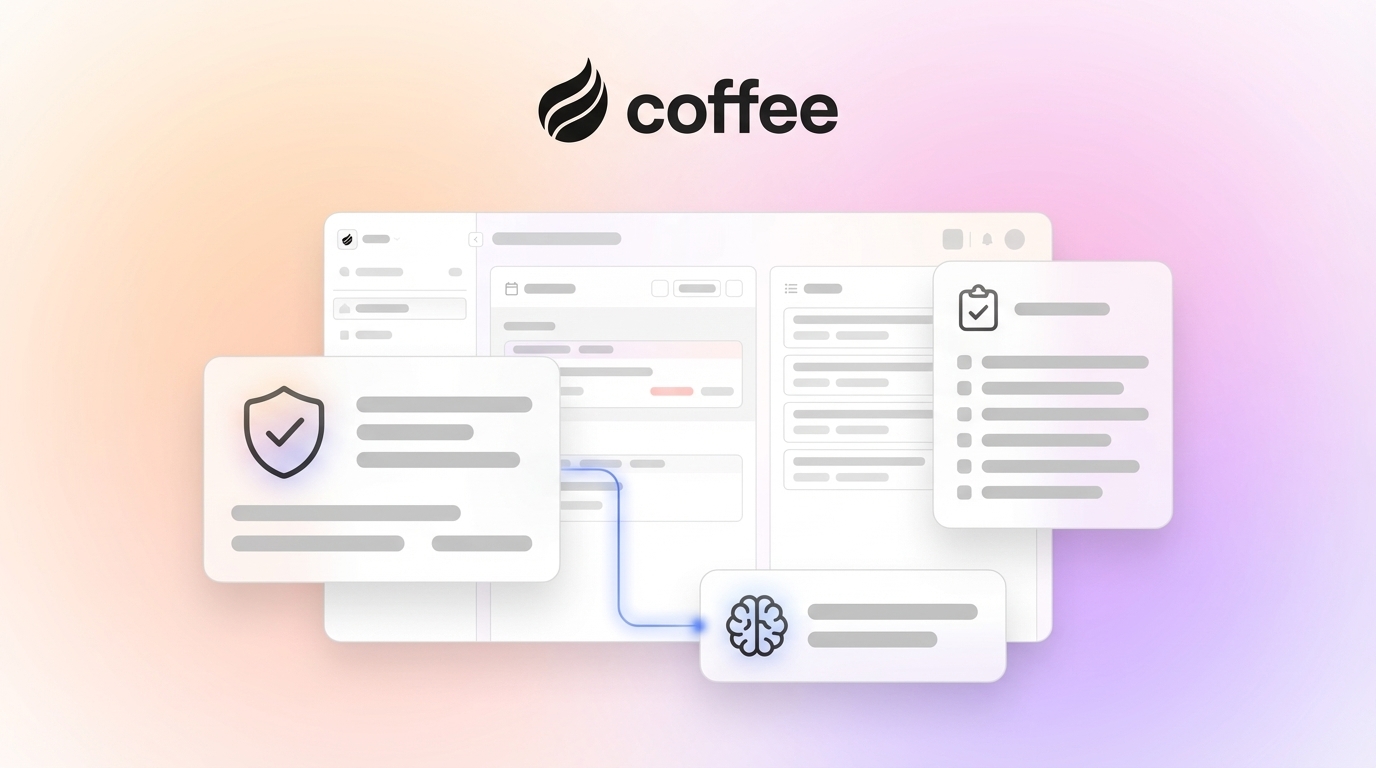
A purpose-built compliance dashboard for an AI meeting platform can bring four key status panels into a single view. The first panel shows SOC 2 Type II certification status with the certificate expiry date and a link to the current audit report. The second panel tracks consent coverage, including the percentage of meetings with logged disclosure and a drill-down to sessions where participants opted out.
The third panel confirms data residency configuration for each tenant, displaying the active region and the last verification date. The fourth panel summarizes retention policy execution, including the count of recordings and transcripts purged in the last 30 days and the next scheduled purge run. Security leaders can export this view as a PDF evidence artifact for enterprise procurement questionnaires.
Frequently Asked Questions
Does Coffee integrate with Salesforce and HubSpot without broad CRM permissions?
Yes. Companion apps for Salesforce and HubSpot use scoped OAuth authentication that requests only the permissions required for each workflow action. Broad administrative scopes are not requested. This least-privilege design appears in Coffee’s security architecture summary, which enterprise procurement teams can request.
How does Coffee handle Data Subject Access Requests (DSARs) for meeting recordings and transcripts?
When a data subject submits a DSAR, data export and deletion tools allow administrators to locate all records tied to that individual and export or permanently delete them. Deletion operations are logged immutably in the audit trail, which supports GDPR Article 17 compliance. Automatic purging of raw audio recordings after transcript generation further reduces the volume of personal data that falls within DSAR scope.
What evidence artifacts does Coffee provide for enterprise security reviews?
As noted in the certification section above, Coffee provides a security summary on request via security@coffeebreakai.dev. Additional evidence artifacts can include an encryption specification confirming TLS 1.3 in transit and AES-256 at rest, a no-training policy addendum for the master services agreement, OAuth scope documentation for Salesforce and HubSpot integrations, and a data residency configuration guide. The compliance dashboard export offers a point-in-time summary suitable for vendor risk register updates.
Can Coffee’s retention policies be customized beyond the 90-day default?
Yes. Administrators can configure retention windows for raw recordings and transcripts to match internal data governance policies. Post-meeting summaries written to Salesforce or HubSpot follow the retention rules of the destination CRM. Custom retention configurations are logged in the audit trail, which proves that the policy was set intentionally and is enforced automatically.
Conclusion: Centralize Meeting Compliance with Coffee
Manual compliance processes for pre- and post-sales meeting platforms create two compounding risks. Teams face gaps in control coverage across the three workflow stages and carry the operational burden of maintaining evidence for continuous audits. Fragmented tool stacks with separate recording tools, CRM instances, and enrichment providers multiply vendor risk assessments, OAuth scope reviews, and retention configurations.
Coffee’s autonomous agent architecture brings these workflows into a single auditable system. SOC 2 Type II compliance, the no-training policy framework, least-privilege CRM integrations, and automated retention policies all come built into the agent design. This consolidation shortens vendor questionnaire cycles and supports a compliance posture that withstands enterprise procurement scrutiny.
Deploy Coffee’s agent architecture and replace fragmented compliance overhead with continuous, auditable data security for every sales meeting.