Written by: Doug Camplejohn, CEO & Co-Founder, Coffee | Last updated: July 17, 2026
Key Takeaways for Small Teams
- Most CRM rollouts fail because they rely on manual data entry that reps avoid, which creates incomplete records and shadow systems.
- Spreadsheets, HubSpot, Zoho, and Pipedrive behave like passive databases that wait for human input, which drives 70%+ failure rates and only 26% high adoption.
- AI-agent CRMs remove the data-entry burden by automatically capturing, enriching, and structuring information from email, calendar, and calls.
- Teams of 1–20 people see the biggest gains once they outgrow spreadsheets, especially when multiple people touch deals or forecasting becomes manual and error-prone.
- Replace manual CRM work with Coffee’s autonomous agent and keep your pipeline accurate from day one.
The Core Problem: Manual Entry and Broken Trust
Manual data entry creates the main friction point in legacy CRM adoption. The average seller spends only 35% of their time actually selling, with the rest lost to admin work, CRM updates, and internal meetings. 71% of sales reps say they spend too much time on data entry, and a 10-rep sales team loses 2,800 hours per year to manual data entry alone, which equals roughly $140,000 in wasted productivity at a $50/hour loaded cost.
The downstream consequences compound quickly. Approximately 90% of CRM contact data is incomplete, ~25% duplicated, and 70–74% becomes outdated each year. This data decay creates a vicious cycle and drives annual revenue losses of 5–20%. As data quality drops, reps lose trust in the system and move to shadow CRMs such as personal spreadsheets, Notion pages, and Slack threads. Only 26% of sales reps report high CRM adoption according to a 2024 Salesforce survey, so nearly three-quarters of users ignore the system as designed.
Eliminate manual CRM entry with Coffee’s AI agent starting today.
Why Spreadsheets and Legacy CRMs Break for Small Teams
Spreadsheets and traditional CRMs share a structural flaw: they behave as passive databases that wait for humans to fill them. The table below contrasts passive database CRMs with active AI-agent CRMs across four dimensions.
| Dimension | Spreadsheets (Excel / Google Sheets) | Legacy CRMs (HubSpot, Zoho, Pipedrive) | AI-Agent CRM (Coffee) |
|---|---|---|---|
| Data Entry Model | 100% manual, no automation or validation | Primarily manual, 32% of reps spend 1+ hour/day on entry | Agent auto-creates contacts, logs activities, and enriches records from email and calendar |
| Data Accuracy | Over 90% of spreadsheets contain significant human error | Manual entry introduces a 1–4% error rate that compounds through forecasting | AI automation improves accuracy from 60–70% to 95%+ |
| Pipeline Visibility | Real-time pipeline visualization requires days of manual labor | Dashboards exist but depend on rep compliance for accuracy | Agent tracks all pipeline changes automatically, with week-over-week compare built in |
| Adoption Rate | High initial use that breaks down past 50–200 contacts or 2+ users | Only 26% of sales reps report high CRM adoption according to a 2024 Salesforce survey | Agent handles the busywork reps resent, which removes the primary adoption barrier |
Analyst reports from Butler Group and Selling Power/CSO Forum found that nearly 70% of CRM implementations fail to meet their intended goals, mainly because users never adopt the system. HubSpot, Zoho, and Pipedrive provide capable features, yet their architecture assumes reps will reliably log every call, email, and meeting. Reps rarely do this, and the system degrades over time.
When a Small Business Actually Needs a CRM
Solo founders with fewer than 20 active contacts and no team handoffs can often rely on a shared inbox and a simple spreadsheet. A spreadsheet works well for contact tracking up to roughly 100–200 contacts with a single owner but breaks down once contacts need activity logs, multiple touchpoints, or handoffs between people.
The inflection point arrives when any of the following conditions appear:
- More than one person touches the same deal or contact
- Follow-ups are being forgotten and deals go cold
- Forecasting requires hours of manual spreadsheet assembly
- A rep leaving the company takes their pipeline knowledge with them
At that point, the hidden cost of not having a CRM grows quickly. 54% of sales reps report losing deals due to poor follow-up and lead visibility in spreadsheet systems, which often exceeds the cost of any subscription.
CRM vs Excel: Where Spreadsheets Start Failing
Excel and Google Sheets function as analysis tools that many teams repurpose as databases. This mismatch creates predictable failures at scale. A spreadsheet is a flat grid of cells, while a CRM is a relational database that links one contact to many deals, emails, tasks, and companies without duplication or copy-pasting between tabs.
Spreadsheet errors such as formula mistakes, copy-paste slips, and version control failures cause lost follow-ups and inaccurate pipeline forecasts. For a five-person team with a $60,000 average loaded salary, time spent on manual spreadsheet entry costs about $37,700 per year in lost selling time.
The ROI case for switching is clear. Nucleus Research found that businesses using a CRM earn an average ROI of $8.71 for every $1 spent, and a 2025 study found small businesses using a CRM see 29% higher sales and 42% better forecast accuracy compared to those using spreadsheets.
Free CRM Plans and Their Hidden Limits
Several CRM tiers start at $0–$20 per user per month in 2026. HubSpot’s free tier, Zoho’s entry plan, and Pipedrive’s Essentials tier all provide basic pipeline management. Price rarely causes the main problem. Architecture does. Free tiers of legacy tools still rely on manual data entry, so adoption problems persist regardless of cost.
The more relevant question for a 1–20 person team focuses on usage. A small team should ask which CRM people will actually use. Human-centered CRM design that reduces manual data entry can increase adoption rates from 40–50% up to 85–95%. A free tool with 26% adoption delivers less value than a paid tool with 90% adoption.
AI-Agent CRM: A Different Category of Tool
An AI-agent CRM replaces the human data-entry requirement with an autonomous software agent that captures, enriches, and structures data from existing communication channels such as email, calendar, and call transcripts. The agent writes to the system of record continuously, so the CRM reflects reality instead of whatever a rep remembered to log at the end of the day.
This category differs from AI features bolted onto legacy CRMs. Legacy platforms with AI add-ons still require clean input data, which still depends on human entry. An agent-native CRM treats data capture as the agent’s job, not the rep’s responsibility.
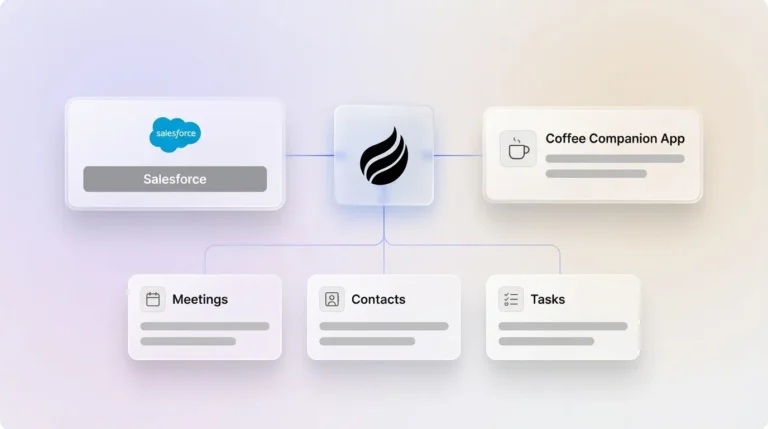
Coffee operates in this category with a dual deployment model. The Standalone CRM serves teams building from scratch. The Companion App layers the Coffee Agent on top of existing Salesforce or HubSpot instances, with summary templates writable back to Coffee, HubSpot, or Salesforce, so teams avoid forced migrations while still gaining agent automation.
Key Benefits Small Teams See With AI Agents
Agent-driven CRM automation delivers measurable benefits in four main areas.
- Time reclaimed: Usage studies of AI-native CRMs show a 60–80% reduction in data entry time within the first 90 days after deployment.
- Data quality: CRM record completeness jumps from the typical 30–50% range to 85–95% when AI meeting extraction captures every detail from conversations.
- Pipeline visibility: Forrester Research’s 2026 evaluation of AI pipeline management across more than 250 B2B companies found a 28% increase in qualification rate, an 18% increase in closing rate, and a 12% reduction in sales cycle length.
- Adoption: When reps no longer serve the software, they use it. The agent handles the chores, and reps receive the intelligence.
How Coffee’s AI Agent Works Day to Day
After a team connects Google Workspace or Microsoft 365, the Coffee Agent scans emails and calendars to auto-create contacts and companies, then associates every interaction with the correct record. It enriches those records with job titles, funding data, and LinkedIn profiles through licensed data partners, which removes the need for separate enrichment tools like Apollo or ZoomInfo.

Before meetings, the agent prepares briefings on attendees, roles, and past context. During calls, an AI meeting bot joins Zoom, Teams, or Google Meet to record and transcribe. After the call, the agent generates summaries structured to BANT, MEDDIC, or SPICED frameworks, identifies next steps, and drafts follow-up emails for rep review. Custom Meeting Briefings and Summaries launched in February 2026 allow users to define exact formats, from high-level executive summaries to granular technical breakdowns.

Pipeline intelligence builds on this data foundation. AI search on deals, released in January 2026, answers natural-language questions such as “Which deals are stuck in negotiation?” or “What is closing this month?” The Pipeline Compare feature shows week-over-week changes, highlights progressed deals, flags stalled opportunities, and surfaces new additions. Pipeline reviews shift from interrogation sessions to focused strategic discussions.

See how Coffee’s agent handles your pipeline automatically with a free trial.
2026 Market Trends and Rep Time Waste
The shift toward agent-native CRM is accelerating across the market. The AI in CRM market is projected to grow from $11.04 billion in 2025 to $15.06 billion in 2026, reaching $51.67 billion by 2030. Gartner predicts 40% of enterprise applications will integrate task-specific AI agents by the end of 2026, up from less than 5% in 2025.
Rep productivity data tells a consistent story. This 35% selling-time figure cited earlier translates into measurable team-level losses. A 5-person sales team without an AI CRM loses an average of 35–45 hours per week on manual entry and administrative tasks. A 12-rep SaaS sales team cut daily CRM admin time from 2.5 hours to 24 minutes per rep after deploying an AI automation layer, recovering 2.1 hours per rep per day. High-performing sellers also prioritize data hygiene more than underperformers, which suggests that CRM discipline correlates with sales success when the system supports rather than burdens the rep.
Neutral CRM Evaluation Checklist for 1–20 Person Teams
The following table gives small teams a framework to evaluate any CRM against real-world failure modes from legacy deployments.
| Criterion | Why It Matters | Legacy CRM Typical Answer | Coffee Answer |
|---|---|---|---|
| Automated data capture | Manual entry is the top adoption killer, cited ahead of price or features | Manual entry required, some email sync available | Agent auto-captures from email, calendar, and call transcripts |
| Deployment flexibility | Teams with existing Salesforce or HubSpot investments cannot afford a full migration | Standalone only, no companion layer | Standalone CRM or Companion App on Salesforce or HubSpot |
| Security & compliance | 49% of employees use AI tools their employer has not sanctioned, often free versions with minimal security | SOC 2 Type 2 varies by tier | SOC 2 Type 2 and GDPR compliant, with data not used to train public models |
| Implementation effort | Overcomplicated configuration is a primary driver of CRM project failure | Weeks to months of setup, admin required | Connect Google Workspace or Microsoft 365 and the agent starts immediately |
| Pricing transparency | Hidden per-feature costs inflate total cost of ownership for small teams | Per-seat plus add-ons for AI, enrichment, and forecasting | Seat-based pricing with agent labor such as enrichment, capture, and intelligence included |
| Integrations | 51% of sales leaders say disconnected systems are slowing down their AI initiatives | Native integrations with Zapier for others | Zapier available now, QuickBooks and Stripe integrations launched in 2026, with deeper roadmap integrations in progress |
Frequently Asked Questions
What is the best CRM for a small business in 2026?
The best CRM for a small business in 2026 is the one your team uses consistently. Research consistently identifies manual data entry as the primary reason CRM adoption fails, not software price or feature gaps. For teams of 1–20 people that have outgrown spreadsheets, an AI-agent CRM that automates data capture from email, calendar, and call transcripts removes the adoption barrier at the source. Coffee is built for this profile, with a Standalone CRM for teams starting fresh and a Companion App for teams already on Salesforce or HubSpot that want agent automation without migrating their system of record.
Can an AI CRM work alongside my existing Salesforce or HubSpot?
Coffee’s Companion App deploys the Coffee Agent as an intelligent layer on top of an existing Salesforce or HubSpot installation. The agent handles data capture, enrichment, and meeting summarization, then writes the results back to the primary CRM. Teams keep their current workflows, quotas, forecasting configurations, and required fields while removing the manual entry burden that causes low adoption. A simple authentication connects the agent to the existing system, and no migration is required.
Is an AI CRM secure, and will my data be used to train AI models?
Coffee is SOC 2 Type 2 and GDPR compliant, and customer data is not used to train public AI models. For small businesses evaluating AI tools, this distinction matters. Many free or low-cost AI tools lack enterprise-grade security controls, and employees often adopt unsanctioned tools that expose company data. Coffee’s compliance posture supports teams that want AI automation benefits without security tradeoffs.
How does Coffee’s AI agent capture data without manual input?
After connecting Google Workspace or Microsoft 365, the Coffee Agent scans emails and calendar events to automatically create and enrich contact and company records. It logs last activity and next activity autonomously, joins calls through an AI meeting bot, and generates post-call summaries with action items and follow-up drafts. The agent also integrates with tools like QuickBooks and Stripe to sync invoices, payment statuses, and customer records directly into the CRM. The result is a system of record that reflects actual deal activity rather than whatever a rep remembered to log.
When should a small business switch from spreadsheets to a CRM?
The practical threshold arrives when any of the following conditions apply. More than one person needs live access to the same contact or deal data. Follow-ups are being missed because no automated reminder system exists. Pipeline forecasting requires more than 30 minutes of manual spreadsheet work per week. A team member departure would remove critical account context. Most practitioners place this threshold at 50–200 active contacts. Beyond that point, the hidden costs of spreadsheet management, including duplicate records, missed follow-ups, inaccurate forecasts, and version conflicts, consistently exceed the cost of a CRM subscription.
Conclusion: Pick the CRM Your Team Will Actually Use
The CRM market in 2026 offers more options than ever, yet the core evaluation question stays the same. Will your team actually use the tool? Legacy platforms from HubSpot, Zoho, and Pipedrive provide strong feature sets, but their passive database architecture places the data-entry burden on reps who lack both time and incentive to maintain it. Spreadsheets work until they fail, and the failure mode looks familiar every time: missed follow-ups, dirty data, and a pipeline that no longer reflects reality.
AI-agent CRMs address the root cause instead of treating symptoms. By automating data capture, enrichment, and pipeline intelligence, they remove the manual burden that kills adoption and erodes data quality. For a 1–20 person team evaluating options in 2026, the most important criterion is not the length of the feature checklist. The crucial question is whether the system does the work or expects humans to do it.
Deploy an AI agent on your pipeline and reclaim hours every week.