Written by: Doug Camplejohn, CEO & Co-Founder, Coffee | Last updated: June 22, 2026
Key Takeaways
- Run a controlled accuracy test before enriched data enters your CRM. Ninety-one percent of CRM data decays every year, so unchecked imports create risk.
- A repeatable six-step workflow helps Heads of RevOps compare any enrichment provider against four clear metrics and a shared scorecard.
- Focus on usable record rate, email verification rate (85–95% benchmark), job title freshness, and firmographic completeness to keep data reliable.
- Manual waterfall testing captures a single moment in time, while agent-native enrichment keeps data current and reduces quarterly manual audits.
- Replace repetitive manual testing cycles with Coffee’s autonomous CRM agent to maintain accuracy and reclaim dozens of hours each year, and explore Coffee’s pricing.
Step 1: Complete the Readiness Checklist for Testing
Confirm three inputs before you send a single record to any provider. First, secure CRM access in a sandbox environment in Salesforce or HubSpot with write permissions and field-level history enabled. Testing enrichment mappings in a Salesforce sandbox before production is the recommended approach, using a sample of 100 to 500 records reviewed field by field to catch unexpected overwrites, formatting mismatches, and duplicate creation while protecting production data.
Second, prepare a 500-record test dataset drawn from active pipeline records, not archived contacts, so results reflect the reality of your current motion. This dataset will be the common sample you submit to each provider for scoring. Third, align stakeholders so everyone agrees on what “good” looks like before you review results. The RevOps lead, a sales manager who will validate job-title accuracy, and a marketing ops contact responsible for email deliverability should define pass and fail thresholds together.
Step 2: Build and Label the 500-Record Test Dataset
Step 2. Export 500 records from the CRM that meet all of the following criteria. Each record was created within the last 18 months, has at least one logged activity, and belongs to one of at least three industry verticals. This mix keeps the sample recent and representative.
Label each record with a unique test ID, the date of last manual verification, and the original data source such as inbound form, outbound list, or event scan. Avoid seeding the dataset with records from an outdated purchased list. Job changes among B2B contacts occur at annual rates of 15–30%, reaching 30% or more in high-turnover sectors like sales and tech, so a list older than 12 months often reflects pre-existing decay rather than provider errors. Strip existing enriched fields before submission so every provider starts from the same baseline of name, company domain, and LinkedIn URL only.
Step 3: Define the Four Accuracy Metrics You Will Score
Before you run any provider, lock in how you will measure success. You will score usable record rate, email verification rate, job title freshness, and firmographic completeness using consistent rules across every vendor. This shared framework keeps comparisons fair and makes the final scorecard easy to explain to stakeholders.
Usable Record Rate: What Counts as a Complete Return
Usable record rate is the percentage of submitted records that return a complete, actionable result across four required fields. These fields are email, job title, company size, and industry. Usable record rate differs from match rate, which only measures whether any data was returned.
A match that returns only company name but nothing else is not useful, and counting it as a success inflates vendor-reported figures. Treat a provider as passing usable record rate when a high percentage of records include all four fields. If the rate falls short, consider adding a secondary waterfall source to fill gaps before records enter the CRM.
Email Verification Rate Benchmark for 2026
Email verification rate measures the percentage of returned email addresses that pass a three-point validity check. Each address must have valid syntax, resolve an MX record, and complete an SMTP handshake without a hard bounce. Track this metric by sending a deliverability probe to all returned addresses within 48 hours of enrichment, then logging hard bounces separately from soft bounces.
The 2026 benchmark range for a production-grade enrichment provider is 85% to 95% verified deliverable. ZoomInfo reports high data accuracy through a verification pipeline combining machine learning, partner data, a contributory network, and in-house human researchers. Exclude any provider that returns below 80% verified email on the 500-record test dataset, because the resulting bounce rate will damage sender reputation and trigger spam-filter penalties on outbound domains.
Job Title Freshness: Confirm Current Roles
Job title freshness measures the percentage of returned titles that match the contact’s current role as verified against LinkedIn at the time of testing. Normalize all titles before scoring. Remove seniority prefixes such as “Sr.” or “VP of” and map each title to a standard taxonomy like “Account Executive” or “Director of Marketing” so formatting differences do not count as inaccuracies.
Mark a title as stale if the contact’s LinkedIn profile shows a different employer or a role change dated within the prior 90 days. Re-checking records 90 days after enrichment to measure what percentage of contacts have changed jobs directly informs re-enrichment cadence, so quarterly refreshes work well for active pipeline records given the decay rates described earlier. Set a high passing threshold for job title freshness on the initial test.
Firmographic Completeness Scorecard
Firmographic completeness scores each matched record on five fields. These fields are industry vertical, employee count range, annual revenue range, headquarters country, and technology stack with at least one confirmed tool. Each populated field earns one point, and each missing field scores zero.
Consider a record complete when it scores 4 or 5 out of 5. Treat a record scoring 2 or below as incomplete. Calculate the percentage of matched records that score 4 or 5 to produce the provider’s firmographic completeness rate. Keep the passing threshold high so downstream routing and segmentation stay accurate. A baseline audit of current CRM data should document fill rates for critical fields including direct phone, job title, company size, industry, and email before enrichment begins, which gives you a clear before metric for comparison.
Step 4: Run the Waterfall Test Across Clay, ZoomInfo, Apollo, Databar, and SyncGTM
With all four metrics defined, you are ready to execute the test across providers. Step 4. Submit the labeled 500-record dataset to each provider in sequence using identical field-mapping rules. Best practice for field mapping requires defining explicit rules for every mapped field that specify the source field, target CRM field, any transformation, and overwrite behavior, for example allowing job title overwrites while preserving existing company name conventions.
Run each provider in isolation and keep outputs separate. Do not allow one provider’s output to serve as input for the next during the initial scoring round. Record raw output in a separate staging sheet before any field is written to the CRM. After all five providers have returned results, run Coffee’s agent across the same dataset as the sixth pass to establish the agent-native baseline.
Step 5: Score Results in the Accuracy Scorecard
Step 5. Score each provider across the four metrics using the thresholds defined above. Use the table below as a scorecard template and replace the example figures with your own measured outputs from the 500-record test.
| Provider | Usable Record Rate | Email Validity | Job-Title Freshness | Firmographic Completeness |
|---|---|---|---|---|
| Clay | Varies (waterfall-dependent) | Varies | Varies | Varies |
| ZoomInfo | Varies | up to 95% | Varies | Varies |
| Apollo | Varies | Varies | ~77.7% freshness (6-mo study) | Varies |
| Databar | Varies | Varies | Varies | Varies |
| SyncGTM | 92% email coverage and 87% phone coverage | Varies | Varies | Varies |
| Coffee | High (agent-continuous) | Varies | Varies | Varies |
Teams should run their own tests to determine specific performance for each provider against their dataset. Coffee’s agent offers continuous enrichment by combining licensed data partners with ongoing re-verification.
Step 6: Monitor 90-Day Data Decay and Rep Feedback
Step 6. Schedule a 90-day re-check for every record enriched in the initial test so you can see how quickly data decays. Pull the same 500 records, re-run the email verification probe, and re-verify a random sample of 50 job titles against LinkedIn. This follow-up shows which providers hold up over time rather than only on day one.
When sales reps flag bad data returned by an enrichment provider, those flags should be reviewed monthly to identify recurring provider-specific or geography-specific accuracy problems. Build a rep feedback form directly into the CRM record view so flagging takes one click. Aggregate flags by provider, field, and geography each month. Deprioritize any provider field that accumulates more than a 20% error flag rate within 90 days in your waterfall sequence.
Move from Manual Waterfall Testing to Agent-Native Enrichment
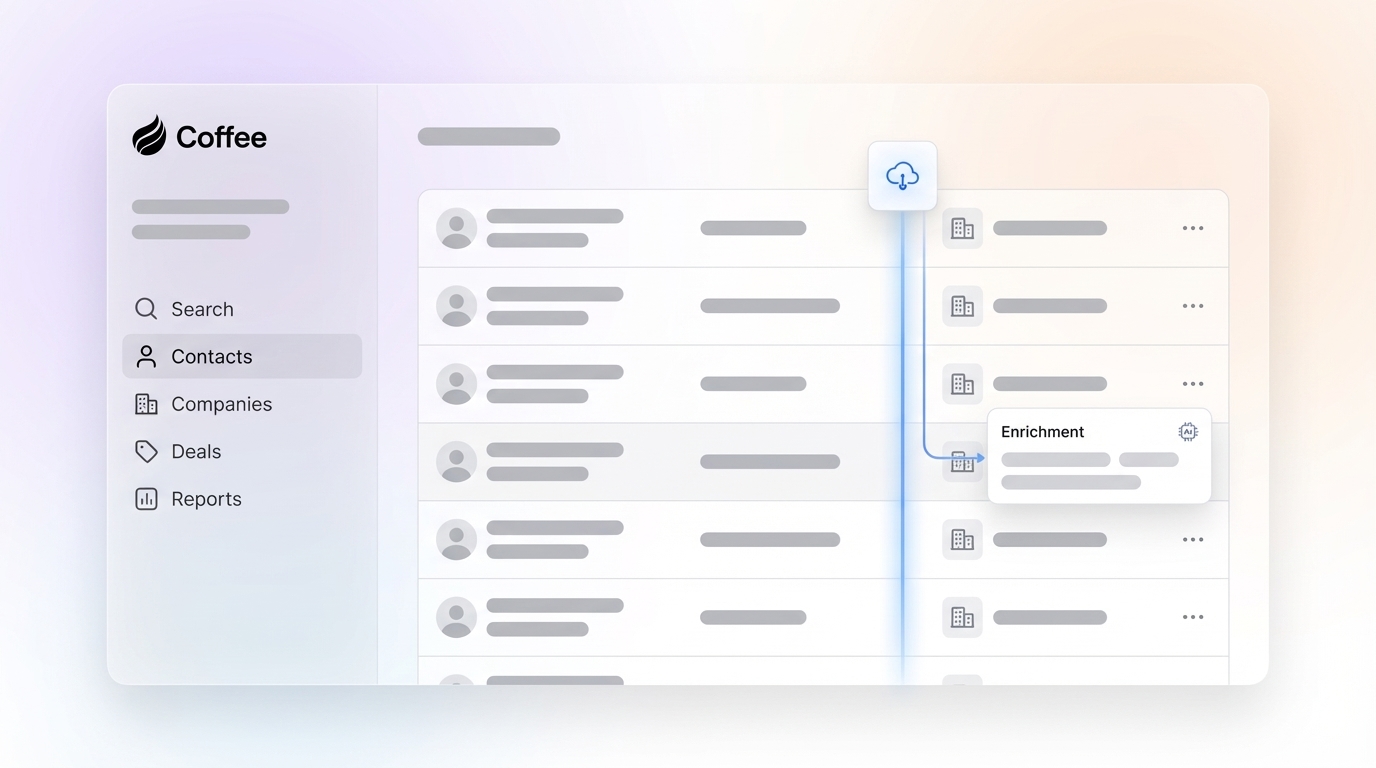
Manual waterfall testing gives you a snapshot, while agent-native enrichment gives you a live feed. Sixty-two percent of enterprises are at least experimenting with AI agents, and many now replace periodic batch tests with continuous enrichment. Coffee’s agent operates as a persistent enrichment layer on top of existing Salesforce or HubSpot instances and keeps your scorecard metrics stable over time.
The agent ingests emails, calendar events, and call transcripts to keep contact and firmographic fields current without a human scheduling a re-test. It flags records with low confidence scores for human review instead of silently writing questionable data, which protects the accuracy floor you established in the initial scorecard. See how Coffee’s agent works to replace manual waterfall testing with continuous enrichment.
Validate Statistical Soundness and Quantify Time Savings
A 500-record sample is sufficient for statistical reliability at a 95% confidence level with a ±5% margin of error for a CRM population under 20,000 records. For populations above 20,000, increase the sample to 1,000 records to maintain the same confidence interval. This approach keeps your comparisons defensible when you present results to leadership.
To quantify time savings, look at current manual effort. A RevOps team of three spending four hours per quarter on manual enrichment audits, rep-feedback review, and re-enrichment scheduling recovers about 48 hours per year by switching to agent-continuous enrichment. For a team of eight, that figure scales to roughly 128 hours annually, which can shift toward pipeline analysis and forecasting accuracy instead of data hygiene. Manual enrichment does not scale for modern revenue teams; successful 2026 strategies rely on intelligent automation that operates continuously in the background.
Frequently Asked Questions
What is the minimum dataset size for reliable enrichment accuracy results?
Five hundred records are the practical minimum for a statistically reliable test at a 95% confidence level with a ±5% margin of error when your CRM population is under 20,000 records. Smaller samples of 100 to 200 records help with initial sandbox validation of field mapping and overwrite behavior, but they are not enough for a final provider decision. For CRM populations above 20,000 records, increase the test dataset to 1,000 records to keep the same confidence interval. Always draw the sample randomly across industry verticals and record ages to avoid selection bias that could distort any provider’s scores.
How often should enrichment accuracy be retested?
Run a full four-metric scorecard test quarterly for any provider that writes data to a production CRM. Between full tests, a lightweight 50-record spot check run monthly against LinkedIn and company websites is enough to catch accuracy regressions before they spread across the pipeline. Rep feedback flags reviewed monthly act as an early-warning system between formal test cycles.
Teams using an agent-continuous enrichment model, such as Coffee’s Companion App for Salesforce or HubSpot, can reduce formal test frequency to twice per year. The agent monitors and updates records on an ongoing basis instead of in periodic batches, which keeps accuracy high with less manual oversight.
What security and compliance considerations apply when sending CRM records to enrichment providers for testing?
Before you submit any records to a third-party enrichment provider, confirm that the provider holds current SOC 2 Type 2 certification and is contractually bound by a Data Processing Agreement that covers GDPR and CCPA obligations. Remove any fields that are not required for the test, such as payment data, support ticket history, and internal notes, before export. Use the CRM sandbox environment instead of production for all test submissions to limit exposure.
Verify that the provider’s contract explicitly prohibits using submitted records to train shared models or populate their own database. Coffee is SOC 2 Type 2 and GDPR compliant, and customer data is not used to train public models.
How much integration effort is required to connect Coffee to an existing Salesforce or HubSpot instance?
Coffee’s Companion App connects to Salesforce or HubSpot through a standard OAuth authentication flow. After authentication, the Coffee agent begins syncing existing records, enriching contact and company fields via licensed data partners, and logging activity data from connected Google Workspace or Microsoft 365 accounts. No middleware or custom API development is required for the initial connection.
Teams with custom field schemas, required fields, or complex forecast categories should plan a brief configuration session to map Coffee’s enrichment output to their specific field structure. The agent respects existing overwrite rules and does not flatten historical field values.
Conclusion: Turn Your Last Manual Test into a Continuous System
The six-step workflow above, from readiness checklist through scorecarding and 90-day decay monitoring, gives any Head of RevOps a repeatable framework for selecting and maintaining enrichment quality in Salesforce or HubSpot. The manual version of this process is necessary once to establish baseline scores and provider comparisons. Repeating the full workflow every quarter consumes RevOps capacity that an autonomous agent can reclaim.
Coffee’s agent handles continuous enrichment, confidence-scored validation, and field-level updates so your scorecard stays current without another scheduled test cycle. Start your free trial and run your last manual enrichment test.