Written by: Doug Camplejohn, CEO & Co-Founder, Coffee | Last updated: June 26, 2026
Key Takeaways for Sales and RevOps Teams
- A CRM agent automatically captures every email, call, meeting, and chat in real time and writes structured records back to the CRM without any manual entry by sales reps.
- The six-step workflow connects email and calendar, deploys a meeting bot, updates activity fields, writes data back to Salesforce or HubSpot, visualizes pipeline changes, and converts anonymous visitors into logged prospects.
- Teams recover 8–12 hours per week previously lost to manual data entry, which frees reps to focus on selling instead of administrative tasks.
- Coffee operates as a standalone CRM for small teams or as an intelligent companion layer on top of existing Salesforce or HubSpot instances, preserving current infrastructure while eliminating manual logging.
- Eliminate manual data entry and let Coffee handle every customer interaction log, then start your free trial of Coffee today.
Why Automatic Interaction Logging Matters for Growing Sales Teams
Sales reps at small-to-mid companies spend between 8 and 12 hours per week on manual CRM data entry, time that does not generate pipeline, close deals, or build relationships. This burden is so severe that Coffee's market data indicates 71% of sales reps report spending too much time on data entry, which compresses actual selling time to just 35% of their working hours. The time pressure creates a "bad data in, bad data out" cycle, because reps skip or delay logging to focus on revenue activities, so records become stale, forecasts become unreliable, and managers lose visibility into deal health. Legacy CRMs like Salesforce and HubSpot were architected before AI agents existed, so they depend on human compliance to stay accurate, and human compliance is inconsistent by nature.
Before deploying an autonomous logging agent, two readiness requirements apply. The team must use Google Workspace or Microsoft 365 as the email and calendar provider, since those are the primary data streams the agent reads. Any team using Coffee as a companion app must also have administrator-level access to their Salesforce or HubSpot instance to authorize the write-back integration. Once these prerequisites are met, the six-step workflow begins with connecting your email and calendar.
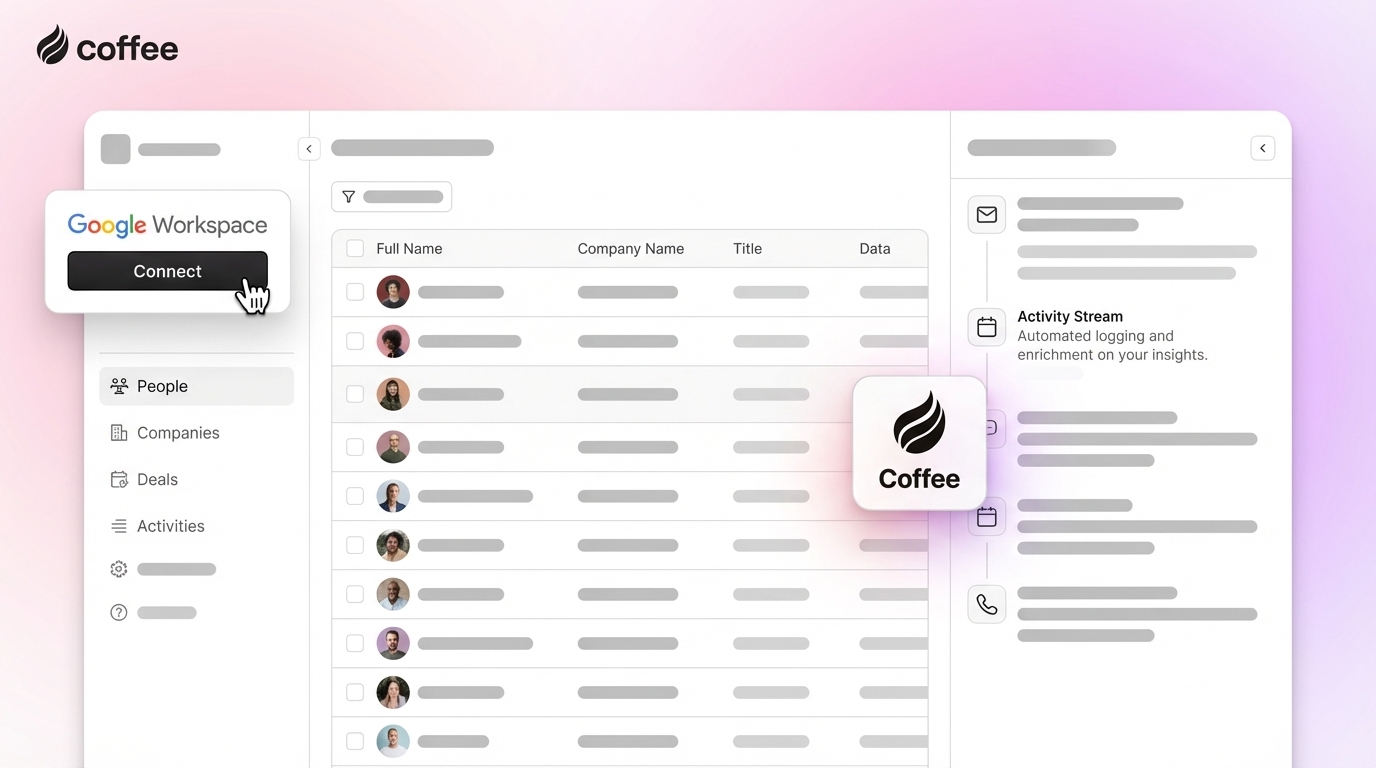
Step 1: Connect Email and Calendar to Auto-Create Contacts and Companies
The workflow begins with a single OAuth authentication to Google Workspace or Microsoft 365. After connection, the Coffee Agent scans inbound and outbound email headers, including sender name, email address, domain, and timestamp, along with calendar event metadata such as attendee lists and meeting titles. From these inputs, the agent decides whether a contact record already exists for each person. If no record exists, it creates one automatically and associates it with the correct company record, inferred from the email domain.
The agent then enriches each new record with job title, LinkedIn profile, company funding stage, and headcount data sourced from licensed enrichment partners, which removes the need for a separate tool like Apollo or ZoomInfo. Every note and interaction logged from this point forward attaches to the correct contact and company record without any rep involvement.

Step 2: Deploy the Meeting Bot to Join, Transcribe, and Summarize Calls
The Coffee meeting bot joins calls automatically when a calendar event includes a Zoom, Microsoft Teams, or Google Meet link. It records and transcribes the conversation in real time, then generates a structured summary that includes key discussion points, identified next steps, and a drafted follow-up email queued in Gmail for the rep to review and send.

Calendar permissions often create issues at this stage. If the Google Workspace or Microsoft 365 account does not grant the agent access to calendar events created by other team members, the bot will not receive invitations to externally organized calls. Administrators should verify that calendar sharing permissions extend to the Coffee integration during initial setup to avoid gaps in meeting coverage.
Step 3: Update Activity Logging and Next-Step Fields Autonomously
The Coffee Agent updates core activity fields after each interaction, whether an email thread, a logged call, or a completed meeting. It writes the "last activity" and "next activity" fields on the contact and deal record without prompting. Deal stage updates rely on signals extracted from the interaction content, such as a prospect confirming a follow-up demo or requesting a proposal.
Teams using Coffee as a companion app on Salesforce or HubSpot should audit their custom field mappings before enabling autonomous writes. If a required field in Salesforce has no corresponding data point in the Coffee schema, the agent will flag the record instead of writing incomplete data. This behavior preserves data integrity but requires a one-time mapping configuration by a RevOps administrator.
Step 4: Sync Clean Data Back to Salesforce or HubSpot
Teams that must keep Salesforce or HubSpot as the system of record can run Coffee as a companion app. A simple authentication grants the Coffee Agent permission to read from and write to the existing CRM. The agent handles the "data in" process, including contact creation, activity logging, meeting summaries, and enrichment, and then syncs all of it back to Salesforce or HubSpot in structured fields.
The system of record stays accurate, and the rep never opens the CRM to type a note. This architecture addresses the core failure mode of legacy CRMs. They store data well but cannot collect it autonomously.
Step 5: Use the Built-in Data Warehouse for Pipeline Compare Views
The Coffee Agent writes every interaction to a built-in data warehouse rather than a flat relational database, so it retains historical context that legacy CRMs discard when fields are overwritten. This design enables the Pipeline Compare feature, which visualizes week-over-week changes across the entire pipeline. Progressed deals, stalled opportunities, newly added accounts, and dropped prospects appear automatically in a single view.
Sales leaders can run pipeline reviews without exporting CSVs or maintaining a parallel spreadsheet, because the agent has already completed the comparison work.
Step 6: Turn Anonymous Website Visitors into Logged Prospects
A single tracking pixel, installed by dropping a custom-generated script into the <head> tag of the company website, enables the Coffee Agent to identify anonymous visitors. The agent infers the visitor's name, title, email address, LinkedIn profile, company, pages visited, time on site, and whether the visit is a first or return session. Real-time Slack notifications alert the sales team when a high-fit visitor lands on the site.
With one click, the prospect is added to Coffee with all enrichment pre-filled and is ready for a LinkedIn connection request, a direct outbound email, or automatic enrollment in a drip campaign. Coffee's Suggested Leads feature differentiates this capability from standalone visitor identification tools. Where competitors surface only the visiting company or an undifferentiated list of employees, Coffee uses the team's defined buyer persona to recommend the two or three specific individuals inside that company most likely to be the right contact, with LinkedIn profiles surfaced for immediate outbound action.

Try Coffee's visitor identification feature and convert anonymous website traffic into named, logged prospects automatically.
Validate Data Quality and Measure Time Savings
Three validation checks confirm that the agent operates correctly once the six-step workflow is live. First, spot-check ten contact records created in the first week to confirm enrichment fields such as title, LinkedIn, and company size are populated without manual input. Second, verify that meeting summaries appear on deal records within fifteen minutes of call completion. Third, confirm that "last activity" dates on open opportunities update after every email exchange.
The primary productivity metric is hours recovered per rep per week. Teams consistently report recovering the time savings mentioned earlier, which translates directly to additional selling capacity. Adoption signals to monitor include the percentage of deals with a logged activity in the past seven days and the percentage of meetings with an attached AI summary. Both figures should approach 100% within the first thirty days because the agent, not the rep, is responsible for logging.
Scaling considerations differ by team size. For teams of one to five reps, the standalone CRM model is typically sufficient, and the agent manages the entire system of record with no legacy CRM dependency. For teams of ten to twenty reps that must retain Salesforce or HubSpot for quota management, forecasting hierarchies, or required fields, the companion app model preserves those configurations while eliminating manual entry. RevOps administrators at this scale should schedule a field-mapping audit during onboarding to ensure all required Salesforce or HubSpot fields have a corresponding Coffee data source before enabling full autonomous writes.
Frequently Asked Questions About Coffee
How does Coffee ensure SOC 2 Type 2 and GDPR compliance?
Coffee is SOC 2 Type 2 and GDPR compliant. Customer data processed by the Coffee Agent is not used to train public AI models. The platform is designed for teams that handle sensitive commercial conversations and require documented security controls. Organizations in heavily regulated industries such as healthcare or finance that require multi-year security review cycles fall outside Coffee's current target profile, but most commercial sales teams will find the existing compliance posture sufficient for their procurement requirements.
What is the pricing model and does it include unlimited agent usage?
Coffee uses seat-based pricing. A team pays for the number of human users on the account, and the agent's labor, including logging, enrichment, transcription, summarization, pipeline tracking, and visitor identification, is included without additional metering on AI usage or process volume. There are no charges per API call, per transcript, or per enrichment lookup. This model keeps cost predictable as interaction volume grows.
How does the agent integrate with existing tools today?
Coffee connects natively to Google Workspace and Microsoft 365 for email and calendar data, and to Zoom, Microsoft Teams, and Google Meet for meeting recording and transcription. For Salesforce and HubSpot, the companion app integration uses a direct authentication that allows the agent to read and write CRM records. Connections to other tools in the sales stack are currently available through Zapier, with deeper native integrations on the product roadmap.
Can the agent structure notes using BANT or MEDDIC methodologies?
Yes. The Coffee Agent can structure its post-meeting summaries and qualification notes according to BANT, MEDDIC, or SPICED frameworks. This approach ensures that every discovery call and demo produces a consistently formatted qualification record in the CRM, which improves forecast accuracy and makes pipeline reviews more predictable. The methodology is configured at the account level so all reps on the team produce notes in the same format without individual setup.
Conclusion: Put an Autonomous Logging Agent in Front of Your CRM
This six-step system represents a complete workflow for autonomous interaction logging, with each step handled by the Coffee Agent rather than a sales rep. The result is a CRM that stays accurate in real time, a sales team that recovers 8–12 hours per week, and a pipeline that reflects ground-truth data instead of whatever a rep remembered to type at the end of the day. This dual-deployment model, referenced earlier, makes Coffee the only CRM agent that meets teams where they are without requiring them to abandon their existing infrastructure.
Deploy your autonomous logging agent with Coffee and let the platform handle every customer interaction log from this point forward.