Written by: Doug Camplejohn, CEO & Co-Founder, Coffee | Last updated: June 22, 2026
Key Takeaways for RevOps and Sales Leaders
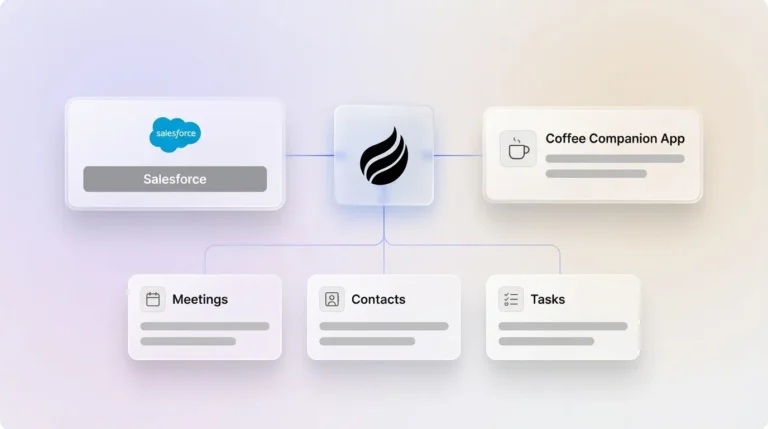
- Coffee and Clarify CRM both remove manual data entry from legacy CRMs. Coffee offers a Companion App on Salesforce or HubSpot plus a Standalone AI-first CRM. Clarify provides only a standalone AI-native CRM.
- Teams invested in Salesforce or HubSpot keep existing configurations, quota structures, and forecasting hierarchies with Coffee Companion App. Setup finishes the same day with no data migration.
- Coffee’s autonomous agent captures email, calendar, and call transcript data in real time, structures it with BANT and MEDDIC, and writes records into existing CRMs or Coffee’s native system.
- Seat-based pricing keeps Coffee costs predictable for any team size. Clarify’s credit-based model can create unpredictable monthly spend for high-activity reps.
- Explore flexible AI agent deployment options for your Salesforce or HubSpot stack with Coffee and remove manual data entry from your team’s workflow.
Coffee and Clarify Deployment Models at a Glance
| Category | Coffee Companion App | Coffee Standalone | Clarify CRM |
|---|---|---|---|
| Deployment model | Agent layer on Salesforce or HubSpot | Replaces system of record | Standalone AI-native CRM |
| Data entry method | Autonomous agent captures email, calendar, call transcripts, writes back to existing CRM | Autonomous agent populates native CRM records | Ambient AI captures interactions, credit-based AI actions for enrichment and transcription |
| Ideal team size | 10–50 reps committed to Salesforce or HubSpot | 1–20 reps outgrowing spreadsheets | Teams willing to adopt an entirely new system of record regardless of size |
| Salesforce / HubSpot integration | Deep: bidirectional sync, quota fields, required fields, forecasting hierarchies | Not applicable (native CRM) | Lighter integration depth, less suited to complex Salesforce configurations with custom objects and forecasting |
The table highlights a structural difference that matters at the 2026 agent inflection point. Twenty-three percent of organizations are scaling agentic AI, and many early adopters are mid-market RevOps leaders evaluating these platforms now. A misaligned deployment model today creates migration debt later.
Setup and Onboarding Effort for Each Platform
Coffee Companion App onboarding starts with a single authentication that connects the agent to Google Workspace or Microsoft 365, plus an OAuth handshake with Salesforce or HubSpot. The existing system of record stays in place, so there is no data migration, no retraining on a new UI, and no disruption to quota structures, required fields, or forecasting hierarchies. The agent begins capturing and writing data immediately.
Coffee Standalone uses a similar authentication-first setup but becomes the new system of record. Teams migrating from spreadsheets or Notion face minimal migration work. Teams moving from a mature Salesforce or HubSpot instance complete the standard data export and field mapping that any CRM switch requires.
Clarify requires adoption of a new system of record regardless of the current tool. Implementation time for AI sales tools can range from one week to more than six months depending on vendor, and that variance comes largely from how much existing CRM configuration must be rebuilt. Teams with mature Salesforce instances that use custom objects, territory hierarchies, or CPQ integrations must rebuild that logic inside Clarify instead of augmenting it.
Choose Coffee Companion App if: your team has more than six months of Salesforce or HubSpot configuration it cannot afford to abandon.
Choose Clarify if: your team is greenfield or ready to treat migration as a deliberate reset.
Automatic Data Capture from Email, Calendar, and Calls
Coffee’s agent connects to Google Workspace or Microsoft 365 and auto-creates contacts and companies by scanning emails and calendars. It logs last activity and next activity on its own, joins calls through an AI meeting bot on Zoom, Teams, or Meet, and structures transcript data using BANT, MEDDIC, or SPICED. For the Companion App, the agent writes all of this into Salesforce or HubSpot records in real time. Agent decision quality is directly proportional to the quality of context delivered upstream, and Coffee’s architecture keeps that context current.

Clarify uses ambient AI to capture interactions and applies credit-based pricing to AI actions such as recording, transcription, enrichment, and email generation. AI actions on platforms like Clarify consume credits at variable rates, so usage-based models can produce unpredictable monthly spend when rep activity or call volume increases.
Sales reps reclaim several hours each week through AI automation. Coffee’s internal estimates put agent-driven data capture savings at 8–12 hours per week per rep by removing manual contact creation, activity logging, and post-call note-taking.
Meeting Management and Follow-Up Automation Workflows
Coffee’s agent acts as a pre- and post-meeting executive assistant. Before a call, it generates a briefing on the “Today” page that covers attendees, roles, and prior interaction history. After the call, it produces a structured summary, identifies next steps, and drafts a follow-up email in Gmail for the rep to review and send. Sales methodology templates such as BANT, MEDDIC, and SPICED keep qualification data consistent across every rep.


Clarify’s ambient intelligence captures meeting context and surfaces it inside its native interface. The workflow functions smoothly within Clarify’s system but does not write structured post-call data into Salesforce or HubSpot with the field-level precision RevOps teams expect for pipeline reporting and forecasting.
Gartner expects that by 2028, 60% of B2B seller work will run through conversational interfaces powered by generative AI sales technologies. Meeting management automation provides a direct path toward that future for teams that cannot wait four years.
Pipeline Intelligence and Week-over-Week Visibility
Coffee’s agent captures every interaction into a built-in data warehouse, so historical context never disappears. The Pipeline Compare feature visualizes week-over-week changes such as progressed deals, stalled opportunities, and new additions without manual CSV exports or spreadsheet reconciliation. Pipeline reviews shift from interrogation to strategic discussion.
Most decision errors in agentic AI trace back to data problems rather than reasoning problems, which is why agentic AI applications require purpose-built data infrastructure with five distinct layers, including data capture, stream processing, context store, agent runtime, and governance, instead of repurposed analytics pipelines. Coffee’s data warehouse architecture satisfies this requirement natively. Clarify’s ambient intelligence delivers contextual summaries but does not expose the same structured, time-stamped pipeline delta that RevOps teams rely on for forecast calls.
Choose Coffee if: your weekly pipeline review depends on a manually maintained spreadsheet or a Salesforce report that reps do not trust.
Pricing Models and Total Cost of Ownership
Coffee uses seat-based pricing. The agent’s work across data capture, enrichment, meeting management, and pipeline tracking is included without additional metered cost. A 25-person sales team pays for 25 seats. There are no credit pools to manage, no platform fees outside user count, and no per-action charges that spike when call volume rises.
Clarify uses credit-based pricing. Clarify offers a free plan with unlimited seats plus a Starter plan at $20 per month that adds AI capabilities and credits. All plans use credit-based pricing with no per-seat charges, so total cost depends on AI actions. For a 25-person team with high call volume, the unpredictable spend noted earlier becomes a material budget risk.
A consolidated AI-native platform can reduce hidden costs by replacing multiple point tools, eliminating roughly 10–15 hours per month of integration upkeep and cutting multi-tool stack costs from about $3,000–$6,000 per month to $1,500–$3,000 per month. Coffee’s Companion App consolidates CRM enrichment, call recording and transcription, and pipeline reporting into a single seat-based line item.
Best-Fit Use Cases and Long-Term Scalability
Coffee Companion App works best for teams of 10–50 reps that rely on Salesforce or HubSpot and cannot absorb a system-of-record migration. The agent adds autonomous data capture and pipeline intelligence while leaving existing configurations intact.
Coffee Standalone fits early-stage teams of 1–20 reps that have outgrown spreadsheets and want an AI-first CRM without legacy overhead. It scales cleanly as the team grows and can be extended with API access for custom workflows, as shown by Coffee’s case study customer that generates tens of millions in revenue and uses Coffee’s API to script bespoke briefings on top of the agent’s data.
Clarify suits teams that are ready to adopt a new system of record and whose Salesforce or HubSpot configuration is shallow enough that rebuilding it does not create major cost. It is less suited to teams beyond 50 reps with complex forecasting hierarchies, territory rules, or CPQ dependencies.
For growing SaaS organizations, the strongest fit for AI replacement of manual processes appears in high-volume, repeatable sales motions with clear qualification rules, while complex enterprise selling remains a strong augmentation use case that layers AI on top of existing systems.
Limitations and Operational Considerations
Coffee’s third-party integrations beyond Salesforce and HubSpot currently run through Zapier, with deeper native integrations on the roadmap. Teams with complex multi-tool stacks should confirm connector availability before committing. Coffee is SOC 2 Type 2 and GDPR compliant, and customer data does not train public models.
Clarify’s integration depth with Salesforce and HubSpot is lighter than Coffee’s. Teams that rely on required fields, custom objects, quota structures, or forecasting roll-ups in Salesforce will find that Clarify cannot mirror that configuration without significant rebuild work. Clarify’s credit-based model also introduces budget unpredictability for high-activity teams, as noted above.
Both platforms require some change management. Training and migration are direct cost drivers for AI sales tools, especially when switching from another vendor or when the platform requires dedicated admin support instead of self-service rep adoption. Coffee’s Companion App reduces this burden by keeping reps inside the Salesforce or HubSpot UI they already know.
Decision Matrix for Coffee vs Clarify
Start by assessing your current CRM investment. If you have 10–50 reps on Salesforce or HubSpot with custom fields, forecasting, or territory rules, Coffee Companion App preserves that configuration. If you have 1–20 reps on spreadsheets or Notion and want an AI-first CRM from day one, Coffee Standalone provides a clean foundation. Teams with shallow or no existing CRM configuration that are willing to adopt a new system of record should consider Clarify CRM.
Next, identify your primary pain point. If low CRM adoption and missing data from calls and emails cause the most friction, and the platform itself works, Coffee Companion App addresses that without migration. If the CRM platform itself creates the pain and you want to replace it entirely, Coffee Standalone or Clarify both remain viable paths.
Then evaluate pricing and reporting needs. Teams that need predictable, seat-based pricing without credit pools align with Coffee in either deployment model. Teams that need week-over-week pipeline delta reporting without spreadsheets also align with Coffee in either model.
Frequently Asked Questions
How long does implementation typically take?
Coffee Companion App implementation starts by authenticating the agent to Google Workspace or Microsoft 365 and connecting it to Salesforce or HubSpot through OAuth. For most teams, the agent captures and writes data within the same day. There is no data migration because the existing system of record remains in place. Coffee Standalone has a similarly fast setup for teams starting fresh. Teams migrating from an existing CRM should budget time for data export and field mapping, which depends on the complexity of the source system. Clarify implementation timelines depend on how much existing CRM logic a team must rebuild in a new system of record. Teams with minimal prior CRM configuration can move quickly, while teams with mature Salesforce instances should expect a longer transition.
What migration effort is required when moving from Salesforce or HubSpot?
Coffee Companion App requires zero migration from Salesforce or HubSpot because it operates as an agent layer on top of the existing instance. The system of record does not change. Coffee Standalone requires a standard CRM migration that includes exporting contacts, companies, deals, and activity history from the source system and mapping fields to Coffee’s schema. The effort scales with data volume and customization depth. Clarify requires a full system-of-record migration from Salesforce or HubSpot, including rebuilding any custom objects, required fields, forecasting hierarchies, and integrations from the prior platform. For teams with complex configurations, this step often becomes the largest hidden cost in a Clarify evaluation.
Which security certifications do Coffee and Clarify hold?
Coffee is SOC 2 Type 2 certified and GDPR compliant. Customer data does not train public AI models. Clarify’s publicly stated security posture should be confirmed directly with its sales team during evaluation, because certification status can change. Teams in regulated industries or with enterprise procurement requirements usually treat SOC 2 Type 2 as the minimum threshold for vendor approval.
How do the pricing models differ for a 25-person sales team?
Coffee charges per human seat. For a 25-person team, the cost equals 25 seats multiplied by the applicable tier rate. The agent’s work across data capture, enrichment, meeting management, and pipeline tracking is included with no additional metered charges. There are no credit pools, no platform fees outside user count, and no per-action costs that rise with call volume. Clarify’s credit-based model means a 25-person team’s monthly cost depends on how many AI actions the team consumes, including recordings, transcriptions, enrichments, and email generations. At low activity levels, Clarify’s entry pricing is lower. At high activity levels, credit consumption can make total monthly spend unpredictable and potentially higher than a flat seat-based model.
How does each platform handle unstructured data from calls and emails?
Coffee’s agent joins calls through a meeting bot on Zoom, Teams, or Google Meet, records and transcribes the conversation, and structures the output using BANT, MEDDIC, and SPICED. It also scans email and calendar data to auto-create contacts, log activities, and surface context on the “Today” briefing page. For Companion App users, all structured outputs write into Salesforce or HubSpot field-level records. Clarify uses ambient AI to capture interactions and surfaces them inside its native interface. It handles unstructured data within its own system but does not write structured, field-level data into Salesforce or HubSpot with the precision required for forecasting and pipeline reporting in mature CRM configurations.
Conclusion: Choosing Your AI Agent Path
At the 2026 agent inflection point, the decision centers on which deployment model fits your stack, migration tolerance, and team size. Eighty-one percent of sales teams have already implemented or are experimenting with AI, and sellers who partner effectively with AI tools are 3.7 times more likely to meet quota than those who do not.
Clarify offers a coherent product for teams starting from a blank slate. Most mid-market RevOps leaders, however, manage an existing Salesforce or HubSpot instance and cannot realistically rip out the system of record. Coffee is the only solution in this comparison that offers both options. You can keep your current CRM and add an autonomous agent, or you can replace the system of record with an AI-first CRM. In both cases, the agent handles the data in so the intelligence out stays accurate.