Written by: Doug Camplejohn, CEO & Co-Founder, Coffee | Last updated: June 24, 2026
Key Takeaways for Sales Leaders
- Coffee runs as an autonomous CRM agent that auto-captures emails, calls, and calendar events, removing manual data entry.
- Attio operates as a passive database that still depends on human reps to maintain record accuracy and hygiene.
- Coffee replaces separate tools for enrichment, call recording, forecasting, and visitor identification, which lowers total cost of ownership.
- Built-in Pipeline Compare and data warehouse features let Coffee track week-over-week changes automatically without CSV exports or extra tools.
- Ready to replace manual CRM maintenance with an always-on agent? Deploy your autonomous agent today.
Why Sales Teams Are Replacing Legacy CRMs
Sales leaders at 10–50 person tech companies are reaching the same inflection point: the spreadsheet era is over, and legacy CRMs have become expensive chores. Skip the manual maintenance cycle by deploying an agent that handles data entry from day one. The decision now focuses on which architecture actually solves the data quality problem instead of repackaging it.
Attio has earned genuine praise for its clean UI and flexible data model, and that polish makes it tempting to overlook a fundamental limitation. Even the most beautiful interface cannot eliminate manual data entry when the underlying database is passive. In 2026, that tradeoff no longer works for teams that have access to an agent-led alternative.
Scope of This Coffee vs Attio Comparison
To evaluate whether Coffee’s agent architecture delivers better outcomes than Attio’s database model, this analysis examines five practical dimensions. This comparison focuses on automation depth, data quality and pipeline accuracy, stack consolidation, pricing and total cost of ownership (TCO), and visitor identification. It is scoped to companies with 10–50 employees that are evaluating a primary CRM or a companion layer on top of Salesforce or HubSpot.
How This Evaluation Measures Each Platform
- Automation Depth: How much data entry the platform removes without human input.
- Pipeline Accuracy: Whether the system maintains historical context and surfaces week-over-week changes automatically.
- Stack Consolidation: How many point solutions the platform can replace in a typical sales stack.
- Total Cost of Ownership: The all-in cost including add-ons, enrichment tools, and maintenance labor.
- Migration Effort: How quickly a team can move from spreadsheets, Salesforce, or HubSpot.
Side-by-Side Platform Comparison
| Dimension | Coffee | Attio |
|---|---|---|
| Automation Depth | Fully autonomous agent, auto-creates contacts, logs activities, enriches records | Passive database, automations require manual configuration and human data input |
| Time Saved per Rep | 8–12 hours/week (data entry eliminated by agent) | Not quantified, manual entry still required for core record hygiene |
| Pipeline Accuracy | Built-in data warehouse preserves historical context, Pipeline Compare tracks week-over-week changes automatically | No native data warehouse, historical context lost when fields are updated |
| Total Cost of Ownership | Seat-based pricing, enrichment, recording, and forecasting included in agent | Platform fee plus separate enrichment, recording, and forecasting tools required |
| Migration Effort | Connect Google Workspace or Microsoft 365, agent populates CRM immediately | Manual import and field mapping required, ongoing hygiene remains a human task |
The table above summarizes the key differences at a glance. The following sections unpack each dimension in more detail, starting with the automation gap that defines the core architectural difference between the two platforms.
Category-by-Category Analysis
Data Entry Automation and Rep Time Saved
Coffee’s agent connects to Google Workspace or Microsoft 365 and immediately scans emails and calendars to auto-create contacts, companies, and activity logs. See your CRM populate automatically within hours of authentication. According to Coffee’s market data, 71% of sales reps report spending too much time on data entry, which leaves only 35% of their time for actual selling. The Coffee Agent reclaims that lost time by auto-capturing every email, call, and calendar event, which removes the manual logging that consumes those hours.

Attio offers workflow automations and API access, but the underlying model stays passive. Records do not self-populate from communication streams without deliberate configuration. Ongoing accuracy depends on rep discipline, which mirrors the same failure mode that affects every legacy CRM.
Pipeline Intelligence and Historical Context
Coffee’s Pipeline Compare feature visualizes week-over-week deal movement, including progressed opportunities, stalled deals, and new additions, without any CSV exports. This works because Coffee stores data in a built-in data warehouse that preserves historical context. When a field changes, the prior state remains available instead of being overwritten.
Attio uses a relational data model that, similar to Salesforce and HubSpot, loses historical context when records are updated. Pipeline reviews in Attio still require manual preparation or third-party reporting tools.
Stack Consolidation and Tool Replacement
A typical Attio stack for a 20-person sales team includes Attio itself, a data enrichment tool such as Apollo or ZoomInfo, a call recording tool such as Fathom or Gong, and a separate forecasting layer. Coffee’s agent replaces that entire stack by performing enrichment, meeting recording, automated follow-up drafting, and pipeline forecasting natively. This consolidation reduces both monthly spend and the cognitive overhead of toggling between tools.

Visitor Identification and Outbound Triggers
Coffee includes a visitor identification feature that converts anonymous website traffic into named prospects with job titles, emails, and LinkedIn profiles. A single tracking pixel powers real-time Slack alerts and auto-enrolls high-fit visitors into outbound workflows. Attio has no equivalent native capability. Teams using Attio must purchase a standalone tool such as RB2B or Warmly and then manually sync identified visitors into their CRM records.
Integrations and Companion Deployments
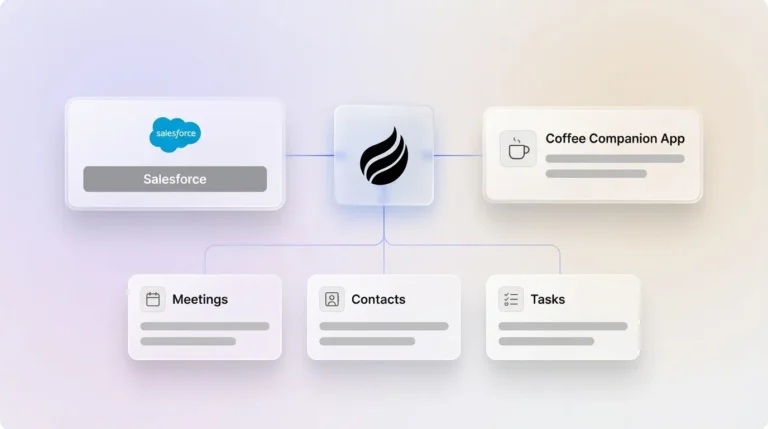
Coffee integrates natively with Google Workspace, Microsoft 365, Zoom, Teams, and Google Meet, with broader integrations available through Zapier. Its Companion App model lets teams already committed to Salesforce or HubSpot deploy the Coffee Agent as an intelligent data layer without migrating their system of record. Attio offers a REST API and Zapier support but does not provide a dedicated companion model for established Salesforce or HubSpot environments.

How Much Manual Data Entry Attio Still Requires
Attio still requires manual data entry in day-to-day use. Its automations can trigger actions based on field changes, but those field values must originate from somewhere, typically a human rep, a form submission, or a manually configured enrichment integration. Attio does not include an agent that reads an email thread and creates a contact record with full activity history. For teams where rep discipline is inconsistent, Attio’s data quality degrades at the same rate as any other passive CRM.
Coffee vs Attio: Cost and Total Ownership
Coffee uses straightforward seat-based pricing, and the agent’s labor for enrichment, recording, pipeline tracking, and visitor identification is included. There are no add-on fees for LLM usage or automated processes. The TCO calculation stays simple: number of seats multiplied by the seat price.
Attio’s platform pricing looks competitive at the base tier, but the true TCO expands quickly. Teams must budget separately for enrichment data, call recording, forecasting, and visitor identification. For a typical sales team, those line items can add substantial costs per month on top of the CRM seat cost, which narrows or removes Attio’s apparent price advantage.
Best-Fit Use Cases for Coffee and Attio
10–50 person tech companies: Coffee’s Standalone CRM is the primary recommendation. The agent handles all data hygiene from day one, and the Pipeline Compare feature replaces manual weekly reviews immediately.
Early-stage teams outgrowing spreadsheets: Coffee’s onboarding requires only a Google Workspace or Microsoft 365 connection. The agent populates the CRM automatically, which removes the configuration burden that causes many early-stage teams to abandon HubSpot or Pipedrive within 90 days.
Mid-market teams committed to Salesforce or HubSpot: Coffee’s Companion App deploys the agent as a data layer on top of the existing system of record. RevOps teams retain their Salesforce configuration, including quotas, forecasting, and required fields, while the agent eliminates the manual entry that degrades data quality.
Operational, Security, and Implementation Details
Coffee is SOC 2 Type 2 and GDPR compliant, and customer data is not used to train public models. Implementation for the Standalone CRM requires a single authentication step. The Companion App requires authentication plus a brief field-mapping review with Coffee’s onboarding team. Most teams are fully operational within one business day. The Companion App model is engineered to respect the complexity of Salesforce and HubSpot environments, including required fields, custom objects, and forecast categories, an area where newer agent CRMs such as Day.ai and Clarify have documented limitations.
Risks, Limits, and Common Misconceptions
Misconception: Coffee’s enrichment data is inferior to ZoomInfo. Coffee’s built-in enrichment is roughly on par with ZoomInfo for most mid-market use cases. Teams with highly specialized data requirements, such as direct-dial phone numbers for enterprise outbound, may still want a supplemental enrichment contract, but the majority of Coffee customers find the native data sufficient.
Misconception: Attio is an AI CRM. Attio has added AI-assisted features, but its core architecture remains a passive relational database. AI features that sit on top of a passive database do not solve the data entry problem. They only process whatever data humans have already entered.
Limitation: Coffee is not designed for large enterprises with complex custom workflows, multi-year security review requirements, or heavily regulated industries such as healthcare and finance.
Decision Framework for Choosing Coffee or Attio
Choose Coffee if any of the following apply:
- Your team spends more than 5 hours per week on CRM data entry or pipeline prep.
- Your pipeline data is unreliable because reps do not log activities consistently.
- You are paying for three or more point solutions that Coffee consolidates natively.
- You are on Salesforce or HubSpot and need better data quality without a migration.
- You want to convert anonymous website traffic into named prospects without a separate tool.
Consider Attio if your team has a dedicated RevOps resource to configure and maintain automations, does not require historical pipeline tracking, and feels comfortable assembling a multi-vendor stack for enrichment and recording.
Frequently Asked Questions
How long does Coffee take to implement?
As noted in the use cases section, authentication takes a single step. The agent begins populating contacts and activity logs immediately, with most teams fully operational within one business day. The Companion App for Salesforce or HubSpot adds a field-mapping step that Coffee’s onboarding team guides, typically completed within the same day.
Is Coffee secure enough for a mid-market sales team?
Yes. As mentioned in the operational section, Coffee meets SOC 2 Type 2 and GDPR standards, which satisfy the security requirements of most 10–50 person tech companies.
How does Coffee’s data quality compare to dedicated enrichment tools?
Coffee’s built-in enrichment covers job titles, company funding data, and LinkedIn profiles through licensed data partners. For most mid-market outbound workflows, this coverage is sufficient and removes the need for a separate Apollo or ZoomInfo subscription. Teams running high-volume enterprise outbound with a need for direct-dial phone numbers may want to evaluate whether supplemental enrichment is necessary for their specific use case.
Can Coffee work alongside an existing Salesforce or HubSpot instance?
Yes. The Coffee Companion App is designed for this scenario. It authenticates with the existing CRM, respects all custom fields, required fields, and forecast configurations, and writes enriched data and activity logs back to the system of record. The sales team continues working in Salesforce or HubSpot, while the Coffee Agent handles all data entry in the background.
What happens to historical data when migrating to Coffee?
Coffee’s onboarding process helps teams migrate their historical data. Once the data is imported, the agent begins enriching and maintaining records going forward. Historical records remain preserved in Coffee’s data warehouse, which enables the Pipeline Compare feature to track changes from the point of migration onward.
Conclusion: Why Coffee Wins for Most 10–50 Person Teams
The Coffee vs Attio decision centers on a single architectural choice: a passive database that stores what humans enter, or an active agent that captures data automatically and improves the accuracy of everything downstream. Attio is a well-built product for teams with the RevOps bandwidth to maintain it. For most 10–50 person tech companies in 2026, that bandwidth does not exist, and the cost of bad pipeline data is too high to accept.
Coffee removes the data entry burden, consolidates the point-solution stack, preserves historical context in a built-in data warehouse, and deploys as either a standalone system or a companion layer on top of Salesforce or HubSpot. Put an agent to work on your pipeline and see the impact on data quality and rep productivity.