Written by: Doug Camplejohn, CEO & Co-Founder, Coffee
Key Takeaways for Building a Lead Scoring Model
- Lead scoring assigns numerical values based on firmographic fit and behavioral engagement to lift MQL-to-SQL conversion rates beyond the typical 13–15% range.
- Separate fit scoring (static attributes like industry and company size) from behavior scoring (dynamic signals like page visits and demo requests) so you can pinpoint and fix model issues.
- Use positive, negative, and decay point rules to keep scores current and prevent old activity from inflating MQL thresholds.
- Automate data capture through CRM integrations so scoring attributes stay complete without manual rep effort, which supports reliable threshold-based routing.
- Build a scoring model that stays accurate without turning your reps into data entry clerks, and explore Coffee’s automated scoring features.
Step 1: Define Your ICP from Won and Lost Deal Analysis
Pull closed-won accounts from the CRM and segment them by revenue, retention, and sales cycle length to surface the accounts that delivered the most value with the least friction. Look for repeating firmographic patterns such as industry, company size, and geography, then layer in technographic data like the prospect’s existing tech stack.

Examine negative patterns from customers who churned, had difficult implementations, or generated low revenue to define what your ICP is not. This negative filtering is critical because companies with well-defined ICPs achieve 68% higher account win rates by concentrating resources on high-probability leads. To maintain this focus, limit the model to 5–8 core criteria that genuinely predict fit instead of cataloguing every possible attribute.
Step 2: Separate Fit and Behavior Scoring Categories
Fit scoring captures static, firmographic, and demographic attributes such as industry vertical, employee count, annual revenue, geography, and job title of the contact. These attributes describe whether a prospect should buy. Behavior scoring captures dynamic engagement signals such as pages visited, emails opened, demo requests, content downloads, and webinar attendance. These signals indicate whether a prospect wants to buy.

Keeping the two categories separate allows RevOps to diagnose model failures precisely. A high-fit, low-behavior lead needs nurture. A low-fit, high-behavior lead wastes sales time. Assign a maximum point ceiling to each category, for example 50 points for fit and 50 points for behavior, so neither dimension alone can push a lead to the MQL threshold.
Let Coffee’s agent handle the data capture automatically and populate both fit and behavior attributes from emails, calendars, and call transcripts, with no manual entry required.
Step 3: Assign Point Values with Positive, Negative, and Decay Rules
Once you have separated fit and behavior categories, assign specific point values to each attribute. The table below provides a ready-to-use point-assignment template based on common B2B SaaS patterns. Use these values as a starting point, then adjust thresholds to match your ICP before deploying.
| Attribute / Behavior | Positive Score | Negative Score | Decay Rule |
|---|---|---|---|
| Target industry match | +15 | — | None |
| Employee count in ICP range | +10 | — | None |
| Decision-maker job title | +10 | — | None |
| Outside target industry | — | −15 | None |
| Student or personal email domain | — | −20 | None |
| Competitor employee | — | −25 | None |
| Pricing page visit | +15 | — | −15 if no return visit in 30 days |
| Demo request submitted | +20 | — | −10 if no sales contact in 7 days |
| Email opened (last 30 days) | +10 | — | −10 if no open in rolling 30-day window |
| Unsubscribed from email | — | −30 | None |
| No CRM activity in 60 days | — | — | −5 per additional 30 days of inactivity |
Decay rules are the most commonly omitted element in lead scoring models. Without them, a prospect who engaged six months ago keeps a high score despite going cold. A declining lead-to-customer conversion rate is a direct signal that stale scoring data requires adjustment.
Step 4: Set MQL and SQL Thresholds with Clear Routing Logic
An MQL threshold is the minimum score at which marketing considers a lead ready for sales review. An SQL threshold is the point at which sales accepts the lead and opens an opportunity. A common starting configuration for a 100-point model sets MQL at 50 and SQL at 70. Top-performing B2B SaaS companies achieve 30–40% MQL-to-SQL conversion rates through tight ICP definitions and robust scoring models.
Routing logic should be automatic. When a lead crosses the MQL threshold, the CRM assigns it to the appropriate sales rep based on territory or account ownership and triggers a notification. This automation is essential because responding to leads within 5 minutes increases conversion rates by 8x, a window that manual routing cannot consistently hit. Every minute spent identifying the right rep or waiting for manual assignment pushes the lead further past that critical 5-minute threshold.
Step 5: Configure CRM Automation So Data Flows Without Rep Effort
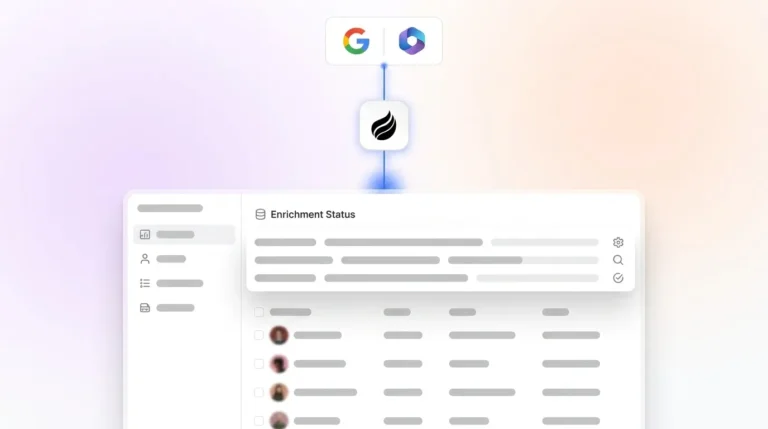
A scoring model stays accurate only when the data feeding it stays accurate. A flawed customer profile can tremendously impact the overall lead scoring method, and flawed profiles usually come from incomplete CRM records. The Coffee Agent addresses this at the source by ingesting emails, calendar events, call transcripts, and website visitor data to populate and update every scoring attribute automatically.

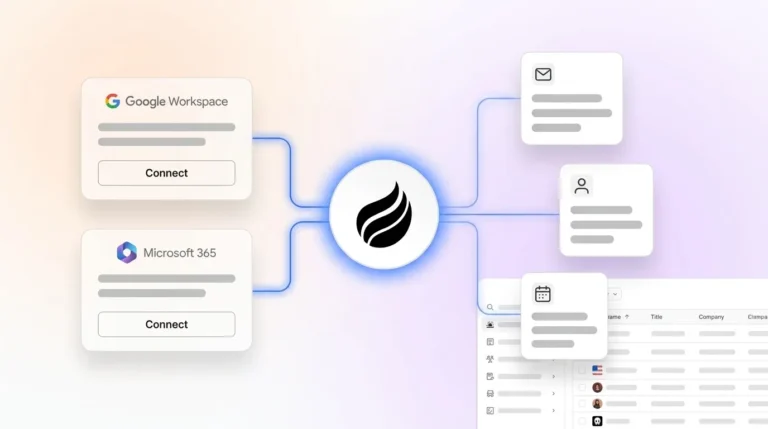
Standalone CRM users: Connect Google Workspace or Microsoft 365. The Coffee Agent scans incoming and outgoing communications to auto-create contacts, log activities, and update engagement signals in real time. The scoring model receives a continuous stream of clean behavioral data without a single manual entry from a rep.
Salesforce or HubSpot companion users: Authenticate Coffee as a companion layer. The agent writes enriched contact data, activity logs, and call transcript summaries back to the existing system of record. Scoring fields stay current because the agent handles the “data in” process that reps routinely skip. Coffee’s agent provides this continuous data stream regardless of which CRM sits underneath, and the scoring model stays relevant as your pipeline evolves.
See how Coffee eliminates manual data entry that would otherwise degrade your scoring model over time.
Step 6: Run a Quarterly Review Cadence with Sales
Schedule a 60-minute joint session between RevOps and sales leadership every quarter. The agenda covers four metrics: score-to-close correlation, MQL-to-SQL conversion rate trend, rep rejection rate and rejection reasons, and win rate by ICP segment. Review the same closed-won versus closed-lost analysis from Step 1, then compare current quarter results against the baseline to detect ICP drift and scoring model degradation.
Sales feedback is the most underused input in scoring model maintenance. Reps know which attributes correlate with fast closes and which lead types waste their time. Formalize that feedback into point-value adjustments each quarter so the model stays aligned with current market reality instead of last year’s assumptions.
Step 7: Troubleshoot the Most Common Scoring Failures
Stale data: Scoring attributes that have not been updated in 60 or more days produce phantom MQLs, which look qualified but have gone cold. Decay rules from Step 3 reduce this risk, but the root cause is missing activity logging. The Coffee Agent’s autonomous activity capture eliminates stale records by logging every interaction as it happens.
Over-reliance on form fills: Gating content and awarding points for every download inflates scores for researchers and competitors who will never buy. Weight intent-rich behaviors such as pricing page visits, demo requests, and repeat product page views more heavily than top-of-funnel content consumption.
Missing sales feedback: When sales rejects MQLs without logging a reason, RevOps has no signal to recalibrate thresholds. Require a rejection reason code in the CRM on every passed lead. Coffee’s Pipeline Compare feature surfaces stalled and rejected opportunities automatically and turns that data into a visible feedback loop without requiring reps to file manual reports.
Validation: Metrics That Confirm Your Model Works
Three metrics confirm that the model is working. First, data completeness percentage measures the share of scored leads with all required fields populated, and you should target 90% or higher. Second, score-to-close correlation confirms that leads above the SQL threshold close at a materially higher rate than leads below it, especially when you apply BANT criteria and negative scoring. Third, rep adoption rate shows whether reps trust the model, because bypassing the scored queue and working their own lists signals a trust problem that requires recalibration with sales input.
Variations: Adapting Scoring for Small Teams and Mid-Market Orgs
Small teams with 1–20 reps should start with a simplified model that uses 3–5 fit attributes, 3–4 behavior signals, a single MQL threshold, and manual SQL review. The Coffee Standalone CRM handles the full data pipeline at this scale and removes the need for a dedicated RevOps function.
Mid-market teams with 20–200 reps benefit from separate scoring tracks by product line or segment, territory-based routing rules, and machine-learning-assisted threshold calibration informed by historical close data. Coffee’s Companion App integrates with existing Salesforce or HubSpot instances, enriches records, and logs interactions so the scoring model scales without proportional increases in administrative overhead.
Frequently Asked Questions About Lead Scoring Models
How long does it take to build a lead scoring model from scratch?
A functional first version usually takes two to four weeks. The first week covers ICP analysis using closed-won and closed-lost data. The second week covers point-value assignment and threshold setting. Weeks three and four cover CRM configuration, automation setup, and initial validation against known high-value and low-value contacts. The model improves significantly after the first quarterly review, when real conversion data becomes available to recalibrate thresholds.
Who should own the lead scoring model?
RevOps should own model architecture, threshold management, and quarterly review facilitation. Marketing owns the behavioral scoring inputs and ensures campaign engagement data flows into the CRM. Sales leadership provides the qualitative feedback that validates or challenges the model’s outputs. Without explicit ownership across all three functions, the model drifts toward serving one team’s priorities at the expense of the others.
How often should the model be recalibrated beyond the quarterly review?
Trigger an off-cycle recalibration when the MQL-to-SQL conversion rate drops more than five percentage points in a single month. You should also recalibrate when a major ICP shift occurs, such as a new product launch or new market entry, or when sales rejection rates spike above 40%. Predictive models update automatically as new data arrives, but threshold logic and point-value weights still require human review when market conditions change in a meaningful way.
How does lead scoring change as the sales motion evolves?
Early-stage companies typically score on fit alone because behavioral data is sparse. As the pipeline matures and historical close data accumulates, behavioral signals become more predictive and should receive higher relative weight. When a company moves upmarket, ICP firmographics shift, including company size bands, revenue thresholds, and decision-maker titles, which requires a full point-value rebuild instead of small adjustments. The quarterly review cadence provides the mechanism for catching these shifts before they degrade conversion rates.
What is negative lead scoring and why does it matter?
Negative lead scoring subtracts points for attributes or behaviors that indicate poor fit or disengagement, such as competitor employees, personal email domains, unsubscribes, or prolonged inactivity. Without negative scoring, a prospect can accumulate enough behavioral points from casual content consumption to cross the MQL threshold despite being a fundamentally poor fit. Negative scoring acts as a filter that keeps the scored queue clean and prevents sales from wasting time on leads that marketing volume inflated into false positives.
Conclusion: Keep Your Scoring Model Accurate Without Extra Admin Work
A lead scoring model produces reliable MQL-to-SQL handoffs only when the CRM data feeding it stays complete, current, and accurate. The seven steps above provide the architecture. The persistent challenge is maintenance, because scoring attributes decay, reps skip data entry, and models built on stale records route the wrong leads to sales.
Coffee’s autonomous agent solves that problem at the source by ingesting emails, calendars, transcripts, and website visitor data to keep every scoring attribute updated without human effort, whether it runs as a standalone CRM or as a companion layer on Salesforce or HubSpot. Get started with Coffee and build a scoring model that stays accurate without turning your reps into data entry clerks.