Written by: Doug Camplejohn, CEO & Co-Founder, Coffee
Key Takeaways
- Legacy CRMs force reps to spend 5+ hours weekly on manual data entry, which creates poor pipeline visibility and shadow systems.
- Agent-first platforms like Coffee automate capture, enrichment, meeting logging, and pipeline updates without human input.
- Coffee removes the need for separate enrichment tools by automatically adding job titles, funding data, and LinkedIn profiles.
- Teams using Coffee gain week-over-week pipeline intelligence and pre-meeting briefings that legacy systems cannot match without spreadsheets.
- Eliminate manual CRM work and see pricing options for Coffee at Coffee.
How We Evaluate Lead Management Systems
Automation depth sits at the foundation. It measures whether the system captures, enriches, and logs leads without human input.
Once automation exists, data quality without human entry shows whether the platform still produces accurate records when reps do nothing.
With clean data in place, integration with Salesforce or HubSpot determines whether that quality reaches your system of record or stays trapped in a silo.
Clean, integrated data unlocks pipeline visibility, so week-over-week changes surface automatically instead of through manual CSV exports.
Finally, buyer-size fit and total cost of ownership decide whether the platform’s capabilities match your team’s scale and budget, including seat fees, add-ons, and implementation work.
AI agent capability now appears on most shortlists. Many mid-market teams are actively evaluating migrations and cite AI agents as a primary reason to switch platforms.
2026 Lead Management Systems Comparison Table
| Tool | Capture & Enrichment Automation | Meeting & Pipeline Intelligence | Best Fit |
|---|---|---|---|
| Salesforce | Manual entry required, enrichment via paid add-ons (ZoomInfo, Einstein) | Forecasting available, pipeline updates require human logging; sales reps spend about 14% of their time (5.5 hours per week) on CRM administration according to Salesforce State of Sales data. | Mid-market to Enterprise |
| HubSpot | Form and email capture built-in, contact enrichment limited without paid tiers | Deal pipeline visual, meeting logging semi-automated via Meetings tool | SMB to Mid-market |
| Apollo.io | Strong prospecting database, integration reduces manual entry time but CRM sync requires configuration | Sequences and analytics, limited post-meeting automation | SMB to Mid-market |
| Pipedrive | Activity-based capture, enrichment requires third-party tools | Visual pipeline, no native meeting intelligence or auto-logging | Small teams (1–20) |
| monday CRM | Form capture and basic automation, AI-powered scoring suggests rules from historical data | Dashboard reporting, pipeline updates remain largely manual | SMB to Mid-market |
| Clarify | AI-assisted data capture, limited Salesforce/HubSpot integration depth for complex instances | Modern UI with AI summaries, integration gaps for mid-market stacks | Small teams (1–20) |
| Day.ai | Unstructured data focus (email, calendar), enrichment coverage limited | Meeting summaries strong, pipeline intelligence narrow | Small teams (1–20) |
| Coffee | Agent auto-creates contacts from Google Workspace/M365, enriches with job titles, funding, LinkedIn; pixel-based visitor ID with Suggested Leads | Pre-meeting briefings, AI bot transcription, automated summaries and follow-ups, Pipeline Compare (week-over-week changes, no spreadsheets); Standalone CRM or Companion App for Salesforce/HubSpot | Small to Mid-market (1–50); Companion App for existing Salesforce/HubSpot users |
Lead Capture Automation Across Platforms
Legacy platforms still capture most leads through web forms and manual imports. Salesforce and HubSpot often require reps to log email interactions manually or pay for inbox-sync tools.
Apollo.io excels at outbound prospecting from its database, yet inbound signals do not become CRM records without configuration. Pipedrive and monday CRM depend on form submissions and manual entry for most capture workflows.
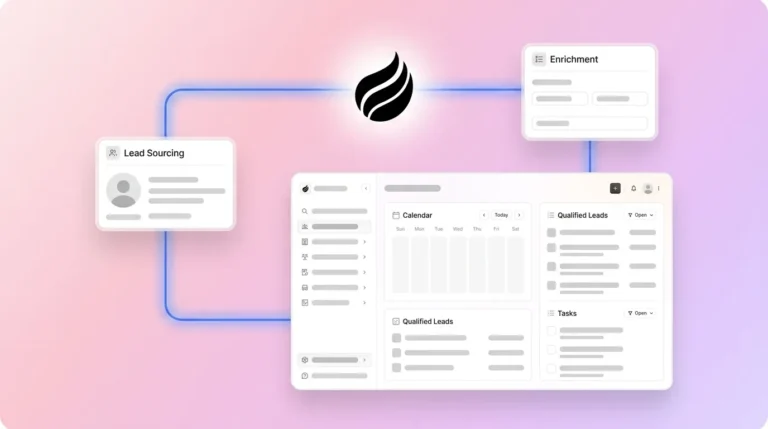
Coffee takes a different approach. A tracking pixel identifies anonymous website visitors by name, title, email, and LinkedIn profile, then surfaces two or three people inside the visiting company who match your buyer persona through Suggested Leads.
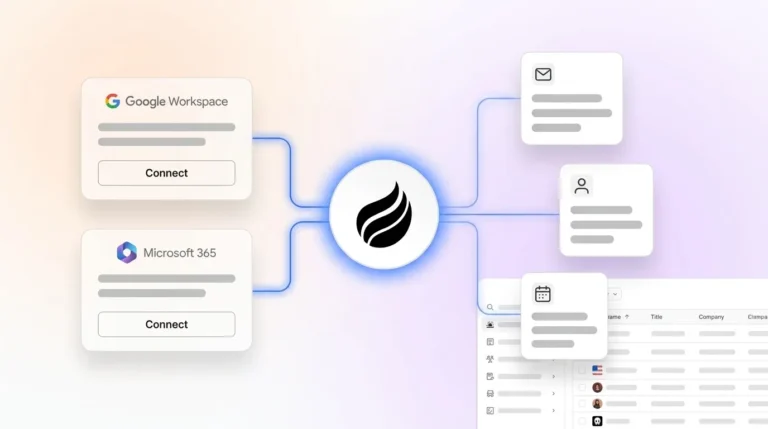
Competitors such as RB2B and Warmly surface company-level data or long people lists. Coffee instead closes the loop from pixel hit to LinkedIn outreach or drip enrollment inside the agent. After you connect Google Workspace or Microsoft 365, the Coffee Agent scans emails and calendars to auto-create contacts and companies so every interaction logs to the correct record without human input.

Intelligent Scoring and Routing That Stay Accurate
Effective AI scoring improves conversion rates and shortens the time from capture to first touch when routing runs automatically.
Salesforce Einstein and HubSpot predictive scoring provide AI-assisted routing, yet both depend on clean historical data that human entry rarely delivers. Demandbase’s AI scoring process includes a dedicated data-cleaning phase that removes inconsistencies and duplicates across CRMs, marketing automation tools, and social media. Legacy CRMs usually skip that step.
monday CRM’s AI scoring analyzes historical conversion data to suggest rules and applies time-based score decay so pipelines stay current. Coffee’s agent-first architecture keeps data clean before scoring runs, which removes the garbage-in problem that undermines many legacy scoring models.
Enrichment Without Extra Tools or Hidden Seats
Clean scoring depends on complete records, so enrichment becomes a core requirement rather than a nice-to-have.
Most platforms in this comparison require a separate enrichment subscription such as ZoomInfo, Clearbit, or Apollo to populate job titles, funding rounds, and technographic data. Companies that connect AI enrichment to their CRM report fewer manual tasks and better lead conversion rates. Research shows reps spend roughly 27% of their time dealing with inaccurate CRM data, roughly 546 hours per year per rep.
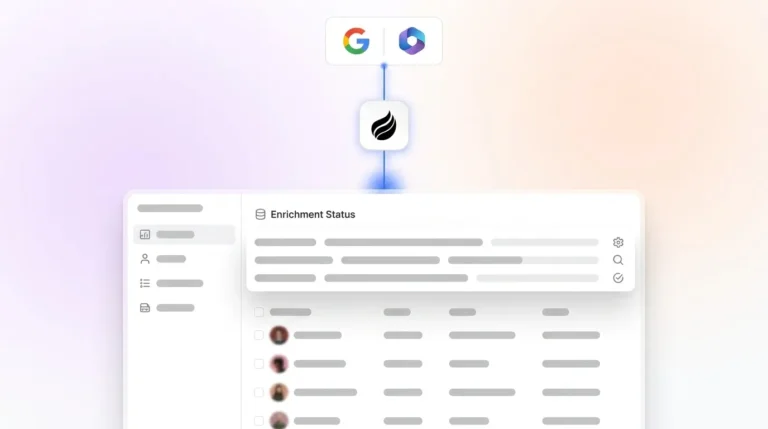
Coffee’s agent augments records with job titles, funding data, and LinkedIn profiles via licensed data partners at no additional seat cost. This setup removes the need for a standalone enrichment tool.
For teams already paying for ZoomInfo or Apollo enrichment on top of a legacy CRM, Coffee’s consolidated model cuts both cost and the manual work of reconciling data across platforms.
See how much you will save by consolidating enrichment into Coffee.
Meeting-to-CRM Workflows Without Manual Logging
Sales reps spend an average of 5.5 hours per week on manual CRM data entry, and Kondo reports from early 2026 note that sales reps spend 28-30% of time selling and over 5 hours per week on LinkedIn-to-CRM data entry, but cite no Salesforce data for a 19% CRM entry figure. The 5.5 hours per week cited earlier is driven primarily by post-meeting logging.
Salesforce and HubSpot often require reps to write call notes manually or rely on a separate tool like Gong or Fathom, then copy outputs back into the CRM. Coffee’s agent joins Zoom, Teams, and Google Meet calls to record and transcribe, then generates summaries, identifies next steps, and drafts follow-up emails in Gmail for rep review.

A “Today” page prepares briefings before each meeting and surfaces attendee roles and prior context. The agent structures notes according to BANT, MEDDIC, or SPICED so consistent qualification data enters the system without rep effort. B2B sales organizations using generative AI can cut time spent on prospecting and client meeting preparation.

Pipeline Reporting Without Spreadsheets or Guesswork
Pipeline reviews only work when the underlying data reflects reality. Legacy CRM pipeline reviews depend on whatever reps entered, which turns weekly meetings into interrogations of incomplete records instead of strategic conversations.
Coffee’s Pipeline Compare feature visualizes week-over-week changes automatically and highlights progressed deals, stalled opportunities, and new additions from a built-in data warehouse that preserves historical context.
Because the agent captures every interaction, the pipeline reflects what actually happened rather than what reps remember. Traditional CRMs create persistent data-quality problems including leads stuck in undefined stages for 90+ days and closed deals lacking campaign source attribution, which blocks accurate pipeline velocity measurement.
Integration Depth with Salesforce or HubSpot
Strong pipeline reporting still fails if the agent cannot sync deeply with your primary CRM. Clarify and Day.ai offer modern interfaces but lack the integration depth required for Salesforce instances with custom objects, required fields, forecasting categories, and quota management.
Coffee offers two deployment models. The Standalone CRM serves teams without an existing system of record. The Companion App authenticates against an existing Salesforce or HubSpot instance, syncs data bidirectionally, enriches records, and writes meeting intelligence back to the primary CRM.
The Companion App fits teams that invested in Salesforce or HubSpot and want the agent to handle data quality without a migration. CRM integration depth increasingly separates leaders from laggards in agentic AI adoption.
Buyer-Size Guidance and Scenario Examples
1–20 person teams that have outgrown spreadsheets but find HubSpot or Pipedrive too manual should start with Coffee’s Standalone CRM, Clarify, or Day.ai. Coffee fits teams that want automated data entry, built-in enrichment, visitor identification, and meeting intelligence in a single seat-based price.
Clarify and Day.ai suit teams with simpler needs that mainly want AI summaries and a modern interface, especially when Salesforce or HubSpot are not part of the stack.
21–50 person teams already committed to Salesforce or HubSpot should evaluate Coffee’s Companion App. Apollo.io adds prospecting depth but does not solve the post-meeting logging problem.
monday CRM works for teams that want visual pipeline management with AI scoring but have not yet adopted a major CRM. Salesforce and HubSpot remain appropriate for complex enterprise workflows, large admin teams, or regulatory requirements that demand established compliance certifications.
Passive Database vs Agent-Led Architecture
Legacy CRMs operate as passive databases. They store data that humans enter and return queries against that data.
The architecture assumes reliable human input, yet Salesforce research shows sales reps spend only about 28-29% of their time selling, with the remainder on administrative tasks including CRM updates. The time-on-admin problem described earlier stems from this passive database model.
When reps skip data entry because they are selling, traveling, or avoiding the chore, the CRM degrades. Managers lose pipeline visibility and turn to shadow CRMs such as spreadsheets, Notion boards, and Slack threads that become the real source of truth.
Forrester predicts that ungoverned use of generative AI will cost B2B companies more than $10 billion in 2026 through declining stock prices, legal settlements, and fines, which reflects the risks of poor data control.
Agent-led architecture flips this model. The agent handles capture, enrichment, and logging autonomously so “good data in” becomes a system property instead of a human discipline.
The output, including forecasts, pipeline intelligence, and scoring, stays accurate because the input is complete. Shadow CRMs disappear because the official CRM reflects reality without rep effort. Organizations using signal-based selling report 34% more deals closed and 57% more revenue than those using traditional methods.
Risks, Limitations, and When an Agent Is Optional
Agent-first systems require an initial authentication step to connect email and calendar providers. Teams with strict data residency requirements should confirm that any platform is SOC 2 Type 2 certified and GDPR compliant before connecting communication data. Coffee holds SOC 2 Type 2 certification and does not use customer data to train public models.
Integration through Zapier covers most common workflows today. Teams that need deep native integrations with niche tools should confirm compatibility before committing.
For enterprise or strategic accounts with high deal complexity, human review of final qualification judgment remains a best practice even when scoring is automated. Large enterprises with custom Salesforce architectures, heavily regulated industries such as healthcare and finance, and organizations that want a static feature-checklist database rather than an autonomous agent often fit better with established legacy platforms.
Decision Framework: Match Your Constraints to a Platform
Use the following criteria to identify the right category:
- Team size 1–20, no existing CRM: Coffee Standalone CRM or Clarify. Choose Coffee if built-in enrichment, visitor ID, and meeting intelligence matter most.
- Team size 21–50, existing Salesforce or HubSpot: Coffee Companion App. This option keeps your system of record while the agent handles data quality.
- Team size 21–50, no existing CRM, outbound-heavy: Apollo.io for prospecting depth combined with Coffee for post-meeting automation, or Coffee Standalone as a unified alternative.
- Team size 50+, complex enterprise workflows: Salesforce or HubSpot with Coffee Companion App for data quality, or evaluate Demandbase for account-based scoring.
- Zero tolerance for manual data entry: Coffee is the only option in this comparison that covers capture, enrichment, meeting logging, and pipeline intelligence through a single agent without human input at any stage.
Compare Standalone vs Companion App pricing for your team size.
Frequently Asked Questions
How long does it take to implement an agent-first lead management system?
Coffee connects to Google Workspace or Microsoft 365 through a standard OAuth authentication. Once connected, the agent scans emails and calendars and starts populating contacts, companies, and activity logs within the first sync cycle, usually within minutes to a few hours depending on inbox size.
The tracking pixel for visitor identification requires a single script tag in the site’s head element. Most teams become fully operational within one business day, without a professional services engagement for standard deployments.
How much migration effort is required when moving from a legacy CRM?
Teams adopting Coffee’s Standalone CRM export existing contact and deal records from the legacy platform and import them into Coffee. Because the agent handles ongoing data entry from that point forward, migration remains a one-time event instead of an ongoing process.
Teams using Coffee as a Companion App on top of Salesforce or HubSpot avoid migration. The agent authenticates against the existing instance and begins enriching and logging data into the current system of record.
How does Coffee integrate with an existing Salesforce or HubSpot instance?
The Companion App model uses a simple authentication flow to connect Coffee to an existing Salesforce or HubSpot installation. After connection, the Coffee Agent syncs contact, company, and activity data bidirectionally, enriches records with job titles, funding, and LinkedIn profiles, and writes meeting summaries, action items, and pipeline changes back to the primary CRM.
Coffee is built with an understanding of Salesforce complexity, including custom objects, required fields, forecasting categories, and quota management. That depth distinguishes it from newer alternatives that lack robust integration.
How does Coffee’s built-in enrichment compare to standalone tools like ZoomInfo?
Coffee’s agent augments records with job titles, funding data, and LinkedIn profiles via licensed data partners. For most 5–50 person B2B SaaS teams, this coverage removes the need for a separate ZoomInfo or Apollo enrichment subscription.
Teams with highly specialized data requirements, such as direct-dial phone numbers at scale or deep technographic signals for enterprise accounts, may still benefit from a dedicated enrichment platform. For most use cases, Coffee’s built-in enrichment removes both the cost and the manual reconciliation work of maintaining a separate data tool alongside the CRM.
Can Coffee scale as a team grows from 5 to 50 people?
Coffee uses seat-based pricing without complex metering on AI usage or automated processes. As headcount grows, teams add seats and the agent’s capacity scales with the subscription.
The Standalone CRM supports teams from early-stage through mid-market. Teams that reach a scale requiring Salesforce or HubSpot for enterprise workflow management can move to the Companion App model and keep the agent’s data-quality benefits while preserving their system of record investment.
Conclusion: Why Agent-First Systems Win on Data Quality
The core cause of poor pipeline visibility in B2B sales teams is not missing CRM features. It is a data-quality problem created by architectures that depend on human entry.
Reps spend nearly two full days per week on administrative tasks, shadow CRMs spread, and forecasts reflect what reps remembered to log instead of what actually happened.
Agent-first lead management systems solve this at the architecture level by making the agent responsible for capture, enrichment, and logging. Good data flows in, so accurate insights, scoring, and pipeline intelligence come out.
For 5–50 person B2B SaaS teams, Coffee stands out as the strongest agent-first option in 2026. It is the only platform in this comparison that covers the full data lifecycle, including visitor identification, contact enrichment, meeting intelligence, and pipeline reporting, through a single agent available as a Standalone CRM or as a Companion App for existing Salesforce and HubSpot users.
Review Coffee pricing and let the agent take over your CRM data entry.